The Iran crisis still lacks the comprehensive settlement that manufacturers need before they can treat Gulf supply routes as reliable again. A ceasefire or political agreement is not enough on its own: companies also need confidence that shipping through the Strait of Hormuz will remain open and insurable, damaged energy and helium infrastructure will be repaired, and critical materials can move without another sudden interruption. Factories and product launches cannot remain on hold while those questions are resolved. Every additional month of uncertainty therefore makes it easier to justify a second supplier, a redesigned component, a regional factory or a larger strategic inventory. As those investments accumulate, what began as a contingency plan becomes the way the industry operates.
Summary
- The principal risk is becoming structural. A short interruption loses sales; a prolonged one gives customers enough time to qualify alternatives and remove the original supplier from future products.
- Some inputs can be diversified within months. Freight routes, standard gases, older-generation chips and less specialised chemicals usually have several possible sources, even if switching raises cost.
- The hardest bottlenecks combine physics with qualification. Helium, gallium, germanium, ultra-high-purity chemistry, silicon carbide substrates and High Bandwidth Memory—the exceptionally fast memory used beside AI processors—require specialist facilities.
- AI concentrates several dependencies in one product. An AI accelerator needs leading-edge logic, specialised memory and advanced packaging, the process of joining several chips into one working system, while the data centre around it also needs transformers, cooling and power electronics.
- Robotics, energy and defence draw on the same supplier base. Their products may look unrelated, but all depend on sensors, embedded processors and power semiconductors that switch and control electricity.
Six weeks ago I argued that a peace accord would begin a recovery story rather than end a disruption story. The earlier analysis of the lasting Iran war supply chain impact focused on damaged infrastructure, helium and logistics. The preceding article on the Iran war semiconductor and AI supply chain examined how apparently peripheral materials could constrain fabs—the highly controlled factories in which circuits are built layer by layer on silicon wafers—thousands of miles away.
The question now is not simply how long the immediate disruption lasts, but what companies do while they wait. A manufacturer can tolerate a late delivery for a few weeks. It cannot base next year’s products, customer contracts and factory schedules on the hope that a vulnerable supply route will soon become reliable again.
Shortages rarely end by returning an industry neatly to its previous shape. Before Russia’s invasion, Ukraine supplied about 70% of the world’s neon and an even larger share of the highly purified neon used by American chipmakers, according to the Center for Strategic and International Studies. Neon is used in the lasers that project circuit patterns onto wafers. When Ukrainian production stopped, chipmakers did not abandon those lasers; they reduced gas consumption, qualified suppliers elsewhere, improved recycling and carried more inventory. The supply recovered, but the old pattern of dependence did not.
The same mechanism appeared during the pandemic chip shortage. Carmakers that had traditionally left semiconductor purchasing to component suppliers began forming direct relationships with chip manufacturers, simplifying electronic architectures and asking for visibility beyond their immediate suppliers. Battery companies responded to cobalt concentration by accelerating chemistries that use less cobalt or none at all. In each case, the original supply chain could recover physically, but customers had already spent money making sure they would be less exposed the next time.
“The biggest long-term risk is not that a customer cannot buy for three months. It is that three months of uncertainty persuades the customer to spend three years making sure it never has to depend on you again.”
Waiting has an industrial cost
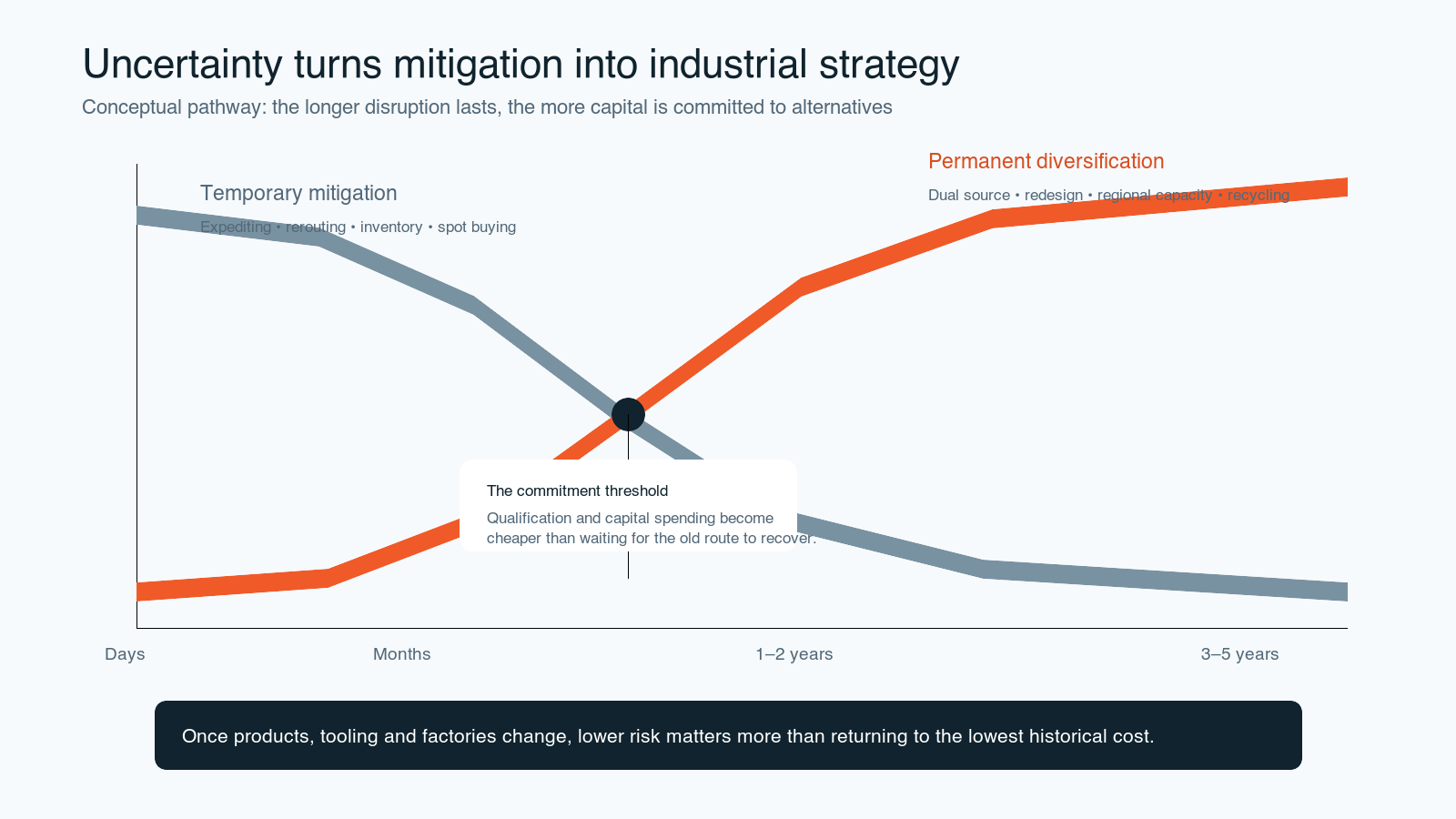
When a component is late, a manufacturer’s first response is usually to keep the existing production line running. Its purchasing staff may pay to have an order shipped sooner, buy a small quantity on the spot market—where materials are available for immediate delivery but often at a much higher price—or switch freight from sea to air. The company may also draw down its safety stock, the reserve of parts it keeps for precisely this kind of interruption. These are expensive ways of buying time, but they do not change the product or replace the original supplier. Once deliveries become reliable again, the company can stop paying for emergency freight and rebuild its reserves.
If the interruption looks likely to continue, buying time is no longer enough and engineers have to find a substitute. A chip from another manufacturer may perform the same broad task without fitting the same place on the circuit board, using the same electrical connections or producing the same amount of heat. The board may therefore have to be redrawn, while the product’s software may need a new driver—the small piece of code that allows it to communicate with the replacement chip. Even a change to the chip package, the casing and connection layout that attaches the chip to the board, can require new tests to make sure the finished product will survive heat, vibration and everyday use.
Making that substitution permanent costs much more than placing an emergency order. The company may have to build prototypes, repeat safety certification, buy new tooling such as assembly equipment and test fixtures, hold parts from two suppliers and prepare a second factory. By the time it has paid those costs and proved that the redesigned product is reliable, sending every future order back to the original supplier would recover little of the investment. It would also restore the single point of failure that the redesign was intended to remove. This is how a temporary shortage gradually produces a permanent change in the supply chain.
Duration therefore matters almost as much as severity. A dramatic two-week interruption can often be covered with inventory and premium freight. Six months of ambiguity crosses budgeting cycles, annual supplier renewals and the dates on which carmakers and electronics companies freeze the design of a new model. If uncertainty lasts for two years, it begins to influence decisions about new production lines and factories whose useful lives are measured in decades.
The OECD’s 2025 mapping of the semiconductor value chain describes an industry that is both highly specialised and internationally interdependent. Design may take place in the United States or Europe, manufacturing in Taiwan or Korea, chemicals in Japan and final assembly elsewhere in Asia. This division of labour lowered costs because each stage could assume that the others would remain available. Once that assumption weakens, the cheapest supplier is no longer necessarily the lowest-cost choice: managers must also price the lost production, delayed product launches and damaged customer relationships that follow when a unique input fails to arrive.
Which semiconductor bottlenecks are genuinely hard to replace?
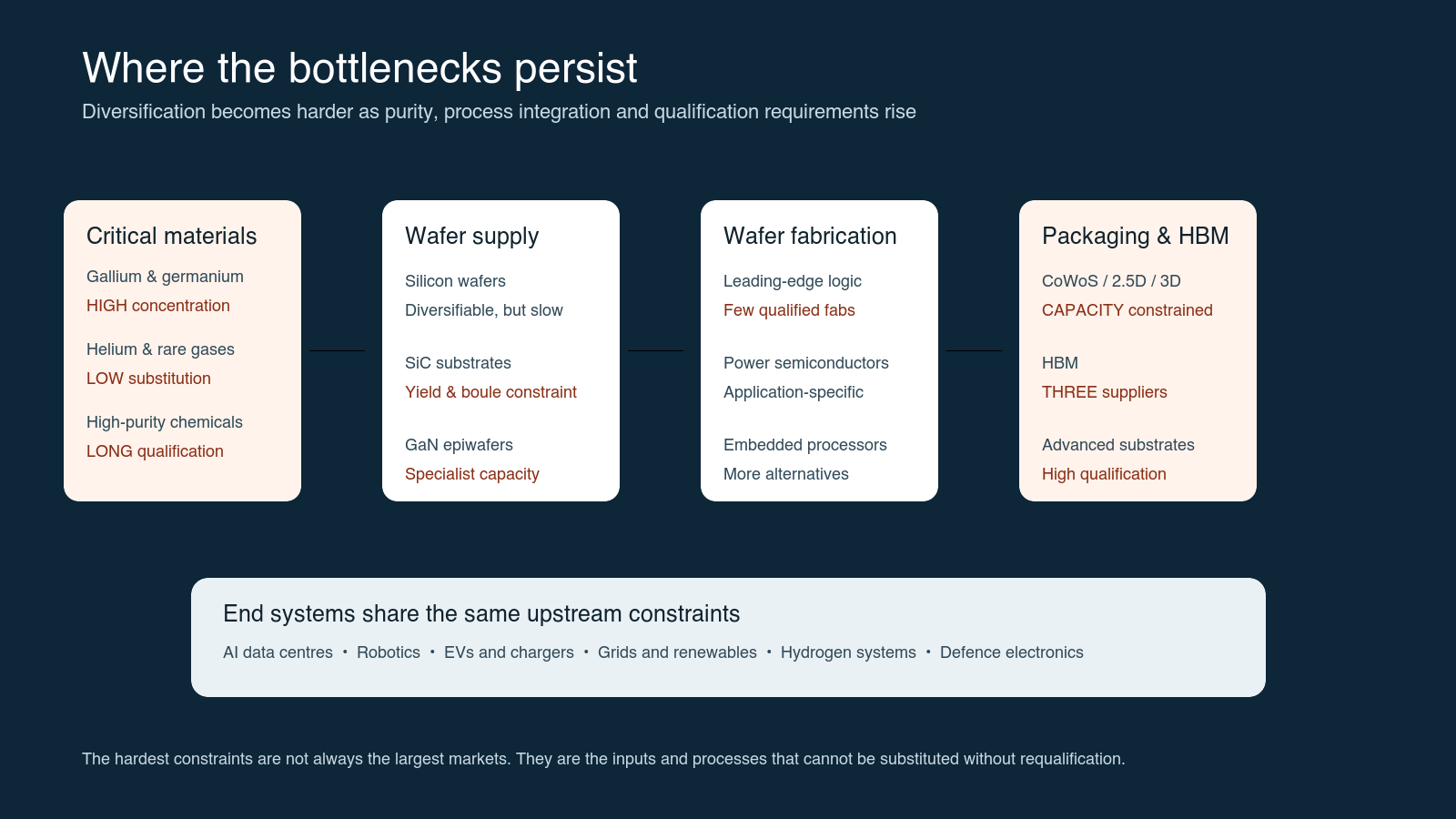
Not every concentrated market becomes a bottleneck. Switching is most difficult when four conditions coincide: production is concentrated in one country or a handful of companies; another material would reduce performance; purity or manufacturing yield depends on the existing supplier; and qualifying an alternative takes longer than the customer’s inventory will last. The table below separates inputs that can usually be rerouted or requalified from those that require new industrial capacity.
| Supply chain stage | Current risk | Ease of diversification | Indicative planning timeline | Strategic importance |
|---|---|---|---|---|
| Gallium and germanium refining | Very high concentration; mainly by-products, so supply responds slowly to price | Low | 2–5 years for meaningful non-incumbent refining; longer for a full ecosystem | RF, photonics, sensors, satellites, power devices and defence |
| Helium and rare process gases | Helium has limited substitution in critical fab uses; neon and other gases need extreme purity | Medium for sourcing; low for physical substitution | 6–18 months to qualify additional routes; 3–7 years for major new production | Lithography, cooling, leak detection and process stability |
| High-purity chemicals | Impurities can destroy yield; formulations are tied to a fab process | Low to medium | 12–36 months for demanding applications | Every advanced-node wafer depends on repeatable chemistry |
| 300 mm silicon wafers | Supplier base is concentrated but globally distributed and expanding | Medium | 12–30 months for qualification and capacity allocation | Foundation of logic, memory and many power devices |
| Leading-edge wafer fabrication | Few fabs can make the most advanced logic at competitive yield | Very low | 3–7 years for a new fab and learning curve | GPUs, AI accelerators and high-end embedded compute |
| High Bandwidth Memory (HBM) | Three credible global suppliers; complex stacking and customer qualification | Low | 12–36 months to expand qualified supply | Memory bandwidth is integral to AI accelerator performance |
| Advanced packaging | CoWoS-class 2.5D/3D capacity, equipment and know-how remain concentrated | Low | 2–4 years for substantial new qualified capacity | Joins logic, HBM and chiplets into an AI system |
| Advanced substrates | High layer counts, warpage control and yield make switching difficult | Low | 18–36 months | Mechanical and electrical foundation of large AI packages |
| Specialised silicon power chips | Many suppliers exist, but automotive and industrial parts are application-qualified | Medium | 9–24 months for redesign and qualification | Motor drives, charging, grids, robots and industrial controls |
| Silicon carbide and gallium nitride | Substrate quality, epitaxy, yield and packaging constrain high-performance supply | Low to medium | 18 months–5 years depending on device and new capacity | Efficient high-voltage and high-frequency power conversion |
These are editorial planning ranges synthesised from current industry expansion schedules and qualification practice, not universal rules published by one source. A-Gas Electronic Materials describes qualification as continuing validation of formulation, handling, storage and batch consistency, while STMicroelectronics notes that even transfers between its own fabs require controlled requalification. A standard industrial component can move faster; a safety-critical automotive, aerospace or defence device can take longer.
Gallium, germanium and the by-product problem
Gallium illustrates why some mineral shortages cannot be solved simply by opening another mine. The metal is relatively abundant in the Earth’s crust, but it occurs in concentrations too low to justify mining it on its own. Producers usually recover it from the liquid left over when bauxite is refined into alumina for aluminium production, with smaller quantities coming from zinc processing. More gallium therefore requires an aluminium or zinc refinery to add recovery equipment, purification expertise and customers prepared to buy the output. Germanium is similarly recovered mainly from zinc-processing residues and some coal deposits. According to the USGS Mineral Commodity Summaries 2026, China accounted for effectively all reported primary gallium output in 2025 and more than half of refinery germanium output.
Engineers can sometimes design around these materials, although each substitution changes the product. Ordinary silicon can replace gallium arsenide in some radio-frequency electronics, but it may use more power or perform less well at very high frequencies. Silicon carbide can compete with gallium nitride in some power applications, but the devices operate differently and need different drive electronics and packaging. Infrared optical systems can sometimes use another material, but may lose sensitivity or work across a narrower range of wavelengths. The substitute is therefore not a like-for-like item on a purchasing list; it is an engineering compromise that must be designed, tested and qualified.
The IEA’s 2026 critical-minerals assessment ranks gallium and germanium among the materials with the highest exposure to concentration, limited substitution and strategic demand. It also makes an important point: diversification needs refining equipment, technical knowledge and customers willing to pay a security premium, not merely another ore deposit.
Gases, chemicals and wafers
The Ukraine experience shows that rare gases can be diversified when customers have several years to respond. Neon, krypton and xenon are chemically unreactive gases separated in small quantities by industrial gas plants. Semiconductor manufacturers need exceptionally pure grades because contamination inside a lithography laser or fabrication process can reduce the number of working chips produced from a wafer. After Ukrainian neon production collapsed, suppliers expanded purification elsewhere and chipmakers reduced consumption and recovered more gas. CSIS estimates that the invasion initially removed 40–50% of world neon supply, yet the industry adapted because alternative raw gas existed and the purification technology could be reproduced.
Helium is harder because it combines irreplaceable physical properties with awkward logistics. It remains a liquid at temperatures where almost every other substance freezes, conducts heat well and does not react with process chemicals. Those properties make it useful for cooling, leak detection and maintaining stable conditions inside semiconductor equipment. Some leak tests can use hydrogen mixed with nitrogen, and recovery systems can capture gas that would otherwise escape, but there is no general substitute across every fab application. The USGS reports that Qatar supplied 28% of US helium imports in 2021–24 and notes that closed-loop recovery is only now becoming more common. Signing a contract with another producer may take months; developing a field, liquefaction plant and fleet of cryogenic containers takes years. For a fab, recovering helium on site is therefore equivalent to creating a small new source of supply inside the factory.
High-purity chemicals attract less attention because many have familiar names. Sulphuric acid, solvents and cleaning agents are made by numerous chemical companies, but semiconductor grades must be free of contaminants measured in parts per billion or even parts per trillion. A small variation can alter a film, leave particles on a wafer or reduce yield—the proportion of chips that work correctly. The OECD notes that some integrated circuits require up to 500 specialty chemicals. A-Gas Electronic Materials explains that even changes in formulation, storage or handling can require continuing validation. Qualifying a second source therefore involves laboratory analysis, test wafers, production lots and reliability monitoring; it is not simply adding another vendor to a purchasing system.
Silicon wafers occupy the middle ground. A wafer is the polished disc on which hundreds or thousands of chips are manufactured. For some devices it receives an additional, precisely controlled crystal layer through a process called epitaxy, which gives engineers the electrical properties they need near the surface. The supplier base is concentrated among a small number of Japanese, Taiwanese, German and Korean companies, but production is geographically broader than the most advanced chipmaking. SEMI expected wafer shipments to rise 5.4% in 2025, supported by leading-edge logic and High Bandwidth Memory. Another wafer supplier can be qualified, but differences in flatness, crystal defects and the epitaxial layer can change fab yield, so polished silicon cannot be treated as an interchangeable commodity.
AI turns three bottlenecks into one
A modern AI accelerator begins with a GPU, or graphics processing unit. GPUs were developed to perform many graphics calculations in parallel, but the same architecture is well suited to the matrix mathematics used to train and run artificial-intelligence models. The processor alone is not enough. It must be placed beside stacks of High Bandwidth Memory (HBM), a specialised form of memory that moves data to and from the processor much faster than conventional server memory. Without that bandwidth, an expensive GPU would spend much of its time waiting for data.
Bringing the processor and memory close enough together requires advanced packaging. Conventional packaging protects one finished chip and connects it to a circuit board. Advanced packaging places several pieces of silicon—often a GPU, memory stacks and smaller supporting chips—on a finely patterned interposer that provides thousands of short electrical connections between them. The assembly sits on an advanced substrate, a multilayer base that keeps a large package flat while carrying power and signals to the server board. Controlling alignment, heat and warping across such a package is difficult, which is why packaging capacity has become as strategically important as manufacturing the individual chips.
TSMC, the world’s largest contract semiconductor manufacturer, sits at the centre of this system. Unlike Intel or Samsung, which also sell many chips under their own names, a contract manufacturer—or foundry—makes designs created by customers such as NVIDIA, AMD and Apple. Almost every leading AI-chip designer therefore depends on TSMC both for advanced logic and for packaging technologies such as CoWoS, which connects large processors to HBM. TSMC’s 2025 annual report places advanced packaging and chip stacking alongside its leading-edge fabrication processes. Producing more GPU wafers does not resolve a CoWoS shortage if the finished processors cannot be joined to memory.
HBM supply is also unusually narrow. Only Samsung, SK hynix and Micron manufacture it at the scale and quality required by the largest AI systems, and each new generation must be tested with the processor it will serve. TrendForce reported in February 2026 that NVIDIA was expected to qualify all three suppliers for its Rubin platform because demand was too large to entrust to one. This is diversification on an industrial scale, but three qualified companies still form a narrow foundation for the fastest-growing part of computing.
The demand side reinforces that concentration. Hyperscalers—the handful of companies operating cloud platforms and data centres at global scale—can reserve enormous quantities of packaging, HBM and power equipment years ahead. The IEA reported that five large technology companies invested more than $400 billion in 2025, with their combined capital expenditure expected to rise by a further 75% in 2026. Electricity use by AI-focused data centres grew 50% in 2025. Suppliers consequently have powerful incentives to allocate their best capacity to a small group of customers able to sign large, long-term contracts.
This magnifies supply risk in two directions. AI pulls the most advanced chips, memory and packages towards a handful of buyers. It also pulls transformers, switchgear, uninterruptible power systems, cooling equipment and power semiconductors towards the same sites. As I explored in the analysis of AI data centres and UK grid capacity, a GPU cluster is only useful if electricity can reach it reliably.
“AI has not created one new semiconductor market. It has coupled leading-edge logic, HBM, packaging, substrates, power electronics and electricity infrastructure into a single delivery problem.”
Robots, energy systems and defence share the same parts bin
Robotics and autonomous systems
Industrial robots do not normally need the most advanced GPU in the market. They do need microcontrollers—small processors dedicated to controlling a machine—along with motor-control chips, position sensors known as encoders, cameras, memory and power modules. Humanoid robots multiply those requirements because each joint needs an actuator and feedback, while cameras and force sensors help the machine understand its surroundings. Drones and autonomous systems add navigation and radio-frequency electronics under severe limits on weight and battery power.
This makes robotics vulnerable in a different way from data centres. A hyperscaler can sometimes accept a later accelerator generation if enough of it is available. A robot manufacturer may have certified a particular motor driver, sensor or processor into a safety architecture and physical enclosure. Replacing a five-dollar chip can require a board redesign, new firmware, electromagnetic testing and months of reliability work.
The more capable the machine, the more semiconductor ecosystems it combines. That is one reason the economics in my humanoid robotics market analysis depend less on a spectacular demonstration than on repeatable manufacturing, uptime and service. Supply-chain resilience becomes part of robot reliability.
The energy transition
EVs, chargers, electrolysers, heat pumps, solar inverters, wind turbines, batteries and grid equipment all need to convert or control electricity. They do this with power semiconductors: electronic switches that turn current on and off thousands or millions of times a second so that voltage and frequency can be changed efficiently. Conventional silicon devices remain widely used, including IGBTs and MOSFETs—two common types of transistor suited to different power levels and switching speeds.
Silicon carbide (SiC) and gallium nitride (GaN) are compound semiconductors made from two elements rather than silicon alone. They tolerate higher electric fields, temperatures and switching frequencies, allowing an EV inverter, fast charger or data-centre power supply to waste less electricity as heat. Silicon carbide is particularly useful at high voltages; gallium nitride excels where rapid switching can shrink transformers and other components. Their advantage comes with a more demanding supply chain: manufacturers must grow high-quality crystals or epitaxial layers, fabricate devices without yield-destroying defects and package them to survive heat and voltage.
The IEA’s Global EV Outlook 2026 expects 23 million electric-car sales this year and notes that new power-electronics materials are enabling higher-voltage, faster-charging vehicles. Infineon is transferring silicon-carbide production to larger 200 mm wafers in Austria and Malaysia, while STMicroelectronics is concentrating 200 mm silicon-carbide investment in Catania and Chongqing. Larger wafers yield more devices per manufacturing run, but moving to them requires new equipment and another learning curve. The same devices are wanted in EVs, renewable-energy systems, trains and AI data centres, so growth in one market affects capacity available to all the others.
Hydrogen systems are sometimes described as an escape from the battery supply chain, although they remain heavily dependent on electronics. An electrolyser uses electricity to split water into hydrogen and oxygen; before it can do so, a rectifier must convert alternating current from the grid into the direct current the electrolyser needs. Compressors and pumps need electronic motor drives, while a fuel cell produces direct current that an inverter must convert into the form required by a vehicle, factory or grid. Hydrogen can reduce dependence on some battery minerals in a particular application, but it increases the need for reliable power conversion and often for platinum-group catalysts. The practical industrial context is set out in the hydrogen infrastructure hub.
Batteries demonstrate both the value and the limitation of material substitution. Lithium iron phosphate, usually shortened to LFP, is a lithium-ion battery chemistry that uses iron and phosphate in the positive electrode instead of nickel and cobalt. It stores less energy for a given weight than the highest-performance nickel-based batteries, but it is cheaper, durable and avoids two minerals with concentrated supply. The IEA reports that LFP rose from less than 10% of the electric-car market in 2020 to almost half by 2025, showing how quickly a redesign can change demand for materials.
That redesign did not make the battery chain geographically diverse. China accounted for more than 80% of battery-cell manufacturing capacity in 2025, and the IEA says the market for LFP cathode material is almost entirely concentrated there. Sodium-ion batteries may eventually reduce lithium exposure in stationary storage and lower-range vehicles, but their hard-carbon anode supply is also immature and concentrated. As the battery analysis and tools on this site show, changing chemistry changes which part of the supply chain carries the risk; it does not remove the supply chain.
Defence demand enters the competition
Defence electronics use relatively modest volumes compared with consumer markets, but specifications are demanding and substitution is slow. Radar, secure communications, electronic warfare, guidance, satellites, drones and autonomous platforms require many of the same RF materials, sensors, FPGAs, embedded processors and power devices used by civilian AI and robotics.
As nations expand defence manufacturing, the competition is therefore not simply for finished chips. It is for gallium, germanium, compound-semiconductor wafers, skilled packaging engineers, test capacity and long-term allocation at trusted fabs. A defence order can be strategically prioritised even when its volume is small, making allocation less predictable for civilian buyers.
| Technology | Dependence on advanced semiconductors | Principal shared dependencies | Vulnerability |
|---|---|---|---|
| AI data centres | Very high | Leading-edge logic, HBM, advanced packaging, networking and power conversion | High |
| Humanoid robotics | High | Edge AI, sensors, motor control, batteries and compact power electronics | High |
| Industrial automation | Medium | Microcontrollers, industrial networking, sensors and power modules | Medium |
| Electric vehicles | High | Power semiconductors, embedded processors, sensors, memory and battery management | Medium |
| Hydrogen systems | Medium | Rectifiers, inverters, sensors, control electronics and grid interfaces | Medium |
| Grid and renewable infrastructure | High | High-voltage power devices, protection, control and communications | High |
| Defence electronics | Very high | RF compounds, trusted logic, sensors, FPGAs, packaging and power devices | Very high |
Companies are spending money to make the alternatives permanent
The shift from temporary mitigation to permanent diversification can now be seen in capital spending, product architecture and supplier qualification. These decisions matter because they survive the crisis that prompted them: a factory will operate for decades, while a newly qualified supplier remains available even if the original trade route reopens.
- TSMC is spreading fabrication across more regions. The company’s 2025 annual report records volume production at its first Arizona fab, construction of a third, a second Japanese fab intended to reach 3 nm technology and a Dresden plant for automotive and industrial chips. It also plans two advanced-packaging facilities in the United States. Taiwan will remain the centre of TSMC’s most advanced manufacturing, but customers will be able to place more production in the region where their products are assembled and sold.
- Advanced packaging is following the fabs. Amkor’s planned Arizona facility is designed to provide 2.5D packaging, in which several chips are mounted side by side on an interposer, for AI and high-performance computing. The U.S. Department of Commerce described the project as the missing step needed to turn American-made wafers into finished AI packages without sending them back to Asia.
- AI-chip designers are qualifying all three HBM manufacturers. NVIDIA’s expected use of Samsung, SK hynix and Micron for Rubin creates extra testing and supplier-management work, but it prevents a problem at one memory company from stopping an entire accelerator generation. TrendForce’s 2026 HBM assessment describes this three-supplier strategy as a response to tight capacity rather than a search for the lowest unit price.
- Power-semiconductor manufacturers are linking regional plants. Infineon is using common processes in Villach and Kulim so that silicon-carbide production can be ramped across two sites. STMicroelectronics is building an integrated silicon-carbide campus in Catania while also operating through a Chinese joint venture. These programmes must coordinate crystal growth, epitaxy, device fabrication, testing and packaging, which explains why regionalisation takes years rather than a procurement cycle.
- Designers are changing products to use materials and factories more selectively. LFP batteries removed nickel and cobalt from a rapidly growing share of EVs. Semiconductor designers are increasingly dividing a large processor into chiplets—smaller functional pieces that are manufactured separately and combined in one package—so that only the parts requiring the newest process consume scarce leading-edge capacity. The design is more complex, but it allows mature and advanced factories to contribute to the same product.
- Recycling is being treated as a source of material. Helium recovery, process-gas reuse and wafer reclaim reduce the amount that must cross an exposed border. For critical minerals, the IEA expects average recycling rates to rise from about 10% today towards 20% by 2040. Recycling cannot fill an immediate gap when too little material has reached end of life, but it reduces the volume that future mines and refineries must supply.
Each route to resilience carries a different cost. A regional factory may need public support because construction, electricity or labour is more expensive than at the established Asian site, and its early production will usually have lower yield while engineers learn to run the process. A second supplier requires duplicate audits, test programmes, contracts and inventory. Substituting a material can increase weight, heat or energy consumption and force changes elsewhere in the product. Recycling requires collection systems, separation equipment and enough used material to keep a plant busy. Companies nevertheless prefer these visible costs to an interruption whose duration and lost revenue cannot be predicted. Once management can compare the annual resilience premium with the value of production at risk, diversification becomes an investment decision rather than a political gesture.
Resilience depends on the invisible middle of the supply chain
Governments usually respond to supply-chain risk by announcing a mine at the beginning of the chain or a fab near the end. Those projects are visible, employ large numbers of people and are easy to describe. They cannot produce a finished semiconductor without the less visible businesses between them.
A resilient semiconductor supply chain also needs purification, specialty chemicals, gas handling, crystal growth, epitaxy, substrates, packaging, testing and metrology—the instruments and methods used to measure features and contamination at microscopic scales. It needs maintenance companies able to keep complex equipment running and process engineers who know how to improve yield. The European Commission’s RESourceEU plan combines stockpiling, joint purchasing, finance and international partnerships because building a mine without processing, or a fab without qualified materials, merely relocates the point of dependence.
Companies should distinguish three categories.
- Inputs to buffer: low-value, non-perishable materials with long transport routes and no easy substitute. Inventory is appropriate.
- Inputs to qualify: components and chemicals with credible alternatives but material switching costs. Engineering capacity should be reserved before a crisis.
- Systems to redesign: products whose architecture creates dependence on a single material, package, country or supplier. This is strategic R&D, not procurement.
Governments face the same economic test as manufacturers. If they subsidise duplicate capacity without securing customers, the alternative plant remains underused and cannot achieve competitive yields or costs. If public procurement always selects the lowest current bid, it sends orders back to the incumbent supplier whose scale made diversification necessary. A workable policy pays an explicit resilience premium where failure would stop essential industries, uses long-term purchase commitments to give alternative producers dependable revenue, shares expensive qualification facilities and treats recycling infrastructure as part of supply security.
Resilience should not be confused with national self-sufficiency, because no country can economically reproduce the entire semiconductor chain. ASML sources about 80% of the materials and components in its lithography machines from suppliers, many of which co-develop parts so specialised that they cannot be replaced through a simple tender. A more resilient network retains international specialisation while adding alternatives, visibility and trusted relationships where a single failure would otherwise stop production.
The old supplier may recover after the customer has moved on
An immediate shortage still matters: a fab without helium cannot maintain production, and a robot factory without motor drivers cannot finish machines. The more lasting change, however, is taking place in engineering meetings, qualification laboratories and capital committees, where companies decide which dependencies will be allowed into the next product generation.
As uncertainty continues, the business case for a second supplier improves. Each qualification lot provides evidence that the alternative can meet specification. A redesigned product becomes less dependent on the incumbent’s material or package. A regional plant trains engineers and attracts local service companies, which makes the next expansion cheaper and faster. These effects compound even if the immediate shortage begins to ease.
Countries and companies that once dominated critical materials or intermediate manufacturing may therefore discover that physical recovery does not restore their previous market share. Customers will still buy from them where their cost and quality remain attractive, but many will preserve the second source, the new chemistry or the regional capacity because the money has already been spent and the insurance value remains.
This is why the duration of the Iran supply chain crisis matters beyond the volume of material delayed this month. The longer uncertainty continues, the more time the industrial world has to design, qualify and finance alternatives. When stability eventually returns, it may find that the old normal has been replaced one engineering decision at a time.
Frequently asked questions
Which semiconductor supply-chain bottleneck is hardest to replace?
There is no single bottleneck, but leading-edge fabrication, HBM, advanced packaging, ultra-high-purity chemicals and some helium applications are among the hardest. They combine concentrated capacity with long qualification cycles and limited substitution.
Can gallium and germanium be sourced outside China?
Yes, but not quickly at equivalent scale and purity. Both are usually by-products of other mineral-processing industries, so higher prices do not automatically produce more supply. New recovery and refining capacity typically requires several years plus customer qualification.
Why does AI make semiconductor shortages worse?
AI accelerators require leading-edge logic, HBM and advanced packaging simultaneously. Hyperscale investment also draws on networking, power-management, cooling and grid equipment, coupling chip constraints to electricity-infrastructure constraints.
How long does semiconductor diversification take?
Logistics and standard components can sometimes diversify in weeks or months. Qualified chemicals, wafers and safety-critical components usually take one to three years. Major new fabs, advanced packaging ecosystems and primary material projects can take three to seven years or more.
Will supply chains return to normal after a settlement?
Physical flows may recover, but many commercial decisions will remain. Once a company has qualified a second supplier, redesigned a product, signed a long-term contract or built regional capacity, there is little incentive to restore the previous single-source model.
References
- USGS, Mineral Commodity Summaries 2026.
- IEA, Global Critical Minerals Outlook 2026.
- IEA, Key Questions on Energy and AI, 2026.
- IEA, Global EV Outlook 2026: Electric Vehicle Batteries.
- IEA, Supply Chains for Emerging Battery Technologies, 2025.
- OECD, Mapping the Semiconductor Value Chain, 2025.
- CSIS, Russia’s Invasion of Ukraine Impacts Gases Critical to Chip Production.
- A-Gas Electronic Materials, Materials Qualification and Semiconductor Supply Risk.
- TSMC, Annual Report 2025.
- ASML, Annual Report 2025: Strategy and Supply Chain.
- SEMI, Global Silicon Wafer Shipment Forecast, 2025–2028.
- TrendForce, HBM Market Bulletin, February 2026.
- U.S. Department of Commerce, Amkor Advanced Packaging Project.
- Infineon, 200 mm Silicon Carbide Manufacturing Roadmap.
- STMicroelectronics, Manufacturing Strategic Programmes.
- European Commission, RESourceEU Action Plan, 2025.