
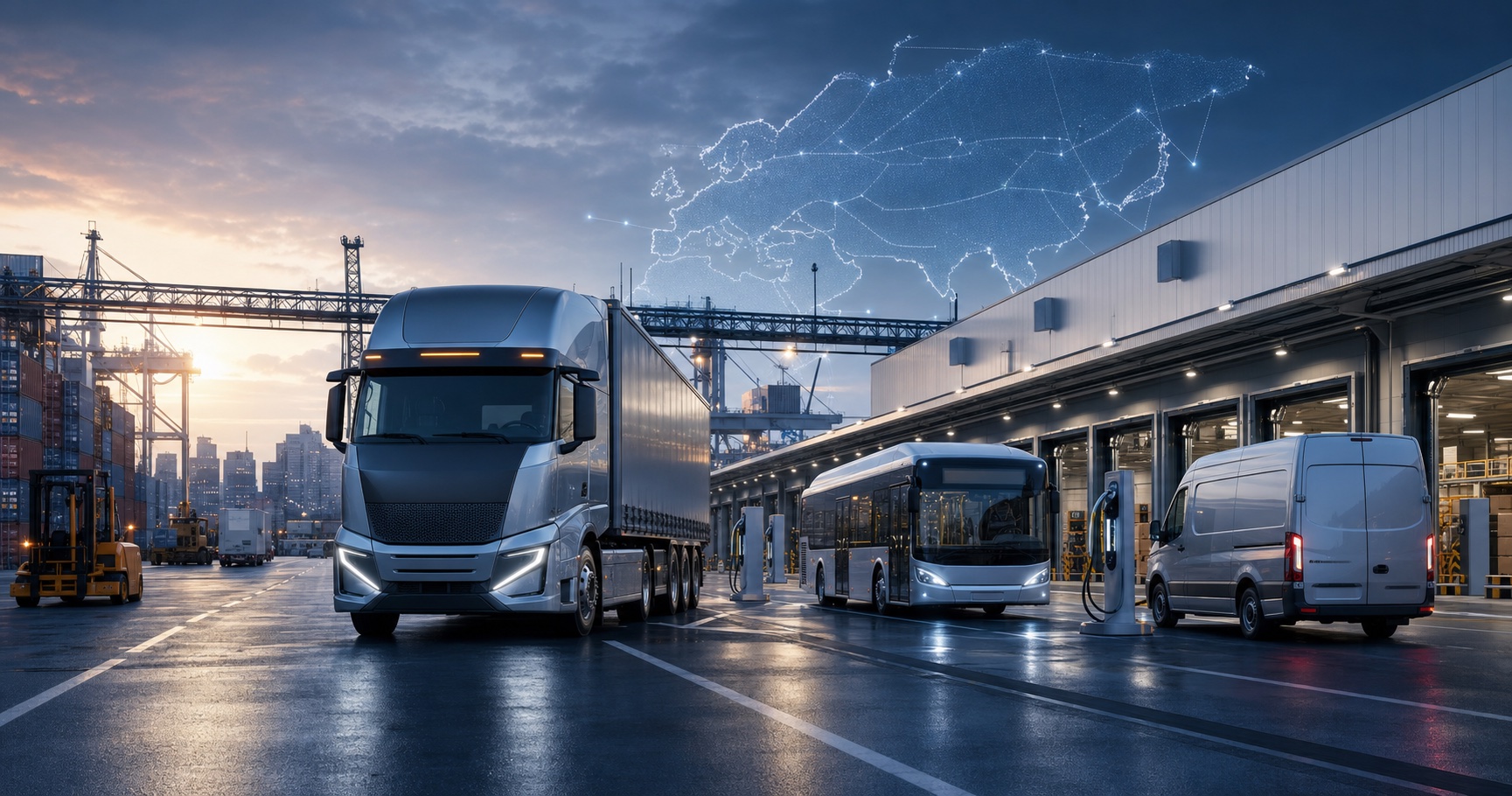
Chinese commercial vehicle manufacturers are still underestimated by many European and North American fleet operators. That is a strategic mistake. China is no longer simply exporting cheap passenger cars or supplying batteries to Western brands. It has built a full commercial vehicle ecosystem across electric buses, electric vans and increasingly heavy trucks, with domestic scale that most Western manufacturers cannot match.
The numbers explain why this matters. China’s zero-emission heavy truck share reached around 29% in 2025. Electric bus deployment has moved from trial projects to mass procurement. Chinese manufacturers are now exporting buses, vans and trucks into Europe, Latin America, the Middle East, Asia and Australia. The commercial vehicle transition is no longer a Western regulatory story. It is becoming a Chinese industrial story.
For fleet operators, logistics companies, infrastructure investors and policymakers, the implication is blunt: the next phase of fleet decarbonisation will not be shaped only by Daimler Truck, Volvo Trucks, Scania, MAN and DAF. It will also be shaped by BYD commercial vehicles, Yutong electric buses, SAIC Maxus electric vans, Farizon electric vans, Foton, SANY, Sinotruk and Dongfeng.
China’s advantage is not just that its vehicles are cheaper. It is that its manufacturers have been forced to industrialise electrification at scale while many Western fleets are still debating pilots.
Key Statistics
- China reached roughly 29% zero-emission heavy truck share in 2025.
- China sold more than 231,000 new-energy heavy-duty trucks in 2025.
- Yutong sold 49,518 vehicles in 2025, including 18,356 new-energy buses.
- BYD exported 4,234 new-energy buses in 2025, giving it a reported 24% share of China’s new-energy bus exports.
- SAIC Maxus reported 222,000 wholesale deliveries and 103,000 overseas sales in 2025.
Why China Has Taken the Lead in Zero-Emission Commercial Vehicles
China’s lead in zero-emission commercial vehicles is not accidental. It is the result of domestic demand, industrial policy, battery scale, urban air-quality pressure and a manufacturing base capable of moving faster than Western incumbents.
The first advantage is volume. Commercial vehicle electrification is difficult because operators care about uptime, payload, range, charging windows, residual values and whole-life cost. A market that can deploy thousands of vehicles quickly learns faster than a market that runs fragmented demonstration schemes. China has provided that learning environment.
The second advantage is battery integration. Chinese electric truck manufacturers and van makers operate close to the world’s most developed battery supply chain. That matters for cost, pack availability, charging rates, battery-swapping options and vehicle iteration. Western truck makers often have strong engineering reputations, but they do not all have the same depth of battery ecosystem around them.
The third advantage is procurement. China electrified buses early because public transport was an obvious target for air-quality policy. Buses operate predictable routes, return to depots and can be bought in large public contracts. That created the first global success story for Chinese electric buses. Vans followed as e-commerce, urban logistics and municipal fleets began to electrify. Heavy trucks are now moving faster because battery costs have fallen, payload penalties have reduced and charging or swapping infrastructure is becoming more mature.
The fourth advantage is export discipline. Chinese commercial vehicle manufacturers are no longer relying only on low headline prices. The more serious players are building dealer networks, service partnerships, local assembly options, finance structures and region-specific homologation. That is why Europe should treat the challenge seriously. Entering Europe is harder than selling into a less regulated market, but it also offers credibility. Once a Chinese electric van or truck proves itself in Europe, it becomes easier to sell elsewhere.
The Biggest Chinese Commercial Vehicle Manufacturers
The Chinese commercial vehicle industry is not one company. It is a layered industrial system, with different manufacturers strongest in different segments. Some are bus specialists. Some are van exporters. Some are heavy truck manufacturers with domestic scale and new European ambitions. For fleet buyers, that means the competitive challenge will arrive through several channels at once.
| Manufacturer | Core products | Main strength | Export relevance |
|---|---|---|---|
| BYD | Electric buses, trucks, vans, batteries | Vertical integration and global EV brand recognition | Strong in buses, expanding commercial EV footprint |
| Yutong | Buses and coaches | Scale in electric buses and public transport contracts | Established across Europe, Latin America, Middle East and Asia |
| SAIC Maxus | Electric vans, pickups, light commercial vehicles | Export-ready van range and broad overseas distribution | One of the most visible Chinese electric van brands in Europe |
| Farizon | Electric vans and trucks | Geely backing and dedicated electric van platforms | European van launch and heavy truck ambition |
| Foton | Trucks, vans, buses | Broad commercial vehicle portfolio | Active in emerging export markets including Latin America |
| SANY | Heavy trucks, construction-linked transport | Industrial vehicle scale and electric truck momentum | One of the Chinese heavy truck Europe contenders |
| Sinotruk | Heavy trucks | Established heavy-duty truck manufacturing base | Potential European challenger in diesel and electric trucks |
| Dongfeng | Trucks, vans, buses | Large legacy commercial vehicle base | Relevant across light, medium and heavy-duty segments |
BYD Commercial Vehicles
BYD is the Chinese name most Western readers already know, but its commercial vehicle importance is still often underplayed. BYD commercial vehicles include electric buses, trucks and vans, backed by the company’s deep position in batteries, power electronics and electric drivetrains.
Its greatest strength is integration. BYD is not assembling electric commercial vehicles from a loose supplier base. It controls much of the technology stack that determines cost, performance and availability. That gives it an advantage when battery supply is tight, when prices move, or when a vehicle needs rapid adaptation for a new market.
BYD’s export strategy has been most visible in buses. It has delivered electric buses into Europe, Latin America and Asia, and it has built a recognisable global brand in zero-emission public transport. Its truck strategy is now becoming more important as European operators start to assess Chinese heavy trucks in Europe more seriously.
For Europe, BYD’s implication is clear. It is not only a passenger-car challenger. It is a battery-backed commercial vehicle manufacturer with the ability to move across vehicle classes. European OEMs can compete with BYD on service, financing and established fleet relationships, but they cannot assume BYD will remain confined to buses.
Yutong Electric Buses
Yutong is the clearest example of China’s strength in electric buses. It is one of the world’s most important bus manufacturers and has turned domestic scale into international credibility. Yutong electric buses are operating in a wide range of markets, including demanding European public transport environments.
The company’s products include city buses, coaches and new-energy buses for public and private operators. Its strength lies in manufacturing scale, proven electric bus deployment and the ability to deliver large public transport orders. Bus operators are conservative for good reason. They need uptime, depot compatibility, parts availability and driver acceptance. Yutong has spent years building that evidence base.
Yutong’s export strategy is practical. It has targeted cities and countries where public transport electrification is politically visible and operationally manageable. Large bus orders in Latin America, the Middle East, Africa and Asia show how Chinese electric buses can move quickly when procurement, financing and route patterns align.
For Europe, Yutong changes the competitive benchmark. European bus makers can still win on local service, specification and trust, but they no longer have an automatic advantage in electric bus maturity. In some markets, Chinese electric buses are already the reference point.
SAIC Maxus Electric Vans
SAIC Maxus is one of the most important Chinese electric van manufacturers for European fleets. Its eDeliver range has given it a visible position in the electric van market, and its broader portfolio includes light commercial vehicles, pickups and people movers.
The company’s strength is export execution. SAIC Maxus electric vans are not theoretical products waiting for a future market. They are already being sold into overseas fleets. The company has built distribution across more than 100 countries and regions, and its light commercial vehicle exports have become an important part of the Chinese commercial vehicle story.
Its export strategy is especially relevant because vans are the easiest entry point into many fleets. Urban delivery operators can charge at depots. Daily mileage is often predictable. Regulation is tightening in cities. Total cost of ownership can work earlier than it does for long-haul trucks. That makes Chinese electric vans a practical threat to European van incumbents.
For Europe, SAIC Maxus matters because it sits exactly where commercial vehicle electrification is already moving fastest: last-mile delivery, trades, municipal fleets and urban logistics. If European brands leave gaps in price, availability or payload, Chinese electric vans will fill them.
Farizon Electric Vans
Farizon, Geely’s commercial vehicle brand, represents the next wave of Chinese commercial vehicle manufacturers. It is not as globally recognised as BYD, but it has serious industrial backing and a clear focus on electric commercial vehicles.
Farizon electric vans are important because they are being designed around electric platforms rather than treated as late conversions from diesel products. That matters for packaging, payload, driver environment and battery integration. The Farizon SV has entered European markets as a direct challenger in the medium and large electric van segments.
Farizon’s export strategy is to use vans as a credible first move while developing a broader commercial vehicle identity. Its truck ambitions, including heavy-duty concepts and future freight platforms, show that Geely is not treating commercial vehicles as a side project.
For Europe, Farizon is a warning that the Chinese challenge will not come only from familiar names. Some of the strongest competition may come from brands that are still relatively unknown to fleet managers today but are backed by major industrial groups with long-term export plans.
Foton
Foton has one of the broadest commercial vehicle portfolios in China, covering trucks, vans and buses. It is not always discussed in the same breath as BYD or Yutong in Western clean transport circles, but that may be a mistake.
Its strength is breadth. Foton can address urban logistics, municipal fleets, regional transport and selected passenger transport applications. That gives it flexibility in export markets where customer needs are fragmented and price sensitivity is high.
Foton’s export strategy appears especially focused on markets where electric commercial vehicles can win through cost, suitability and availability rather than premium branding. Its electric commercial vehicle launches in Brazil show how Chinese manufacturers can build scale outside Europe while European incumbents remain focused on their home markets.
SANY
SANY is best known globally for construction machinery, but it has become increasingly relevant in heavy trucks and electric freight. That industrial background matters. Heavy trucks are not lifestyle products. They are capital equipment, and buyers care about durability, energy cost and uptime.
SANY’s strength is its connection to heavy industrial use cases. Construction, mining, ports and regional freight are early candidates for battery electric trucks because many vehicles run intensive but bounded routes. These are exactly the sectors where diesel fuel costs are high and depot or site charging can be controlled.
Its export strategy is now becoming more visible in Europe. SANY is one of the Chinese electric truck manufacturers expected to push into the European market, with service partnerships likely to be critical. The product is only one part of the offer. Maintenance coverage, parts supply and financing will decide whether European fleets take it seriously.
Sinotruk
Sinotruk is one of China’s major heavy truck manufacturers and has long experience in diesel commercial vehicles. That makes it significant in the transition to zero-emission freight transport because it understands the underlying truck market, not just the electric drivetrain.
Its products include heavy-duty tractors, rigid trucks and specialist vehicles. Its strength lies in truck manufacturing scale, cost competitiveness and experience in demanding commercial duty cycles.
Sinotruk’s export strategy is likely to combine established truck markets with new electric opportunities. It may not need to present itself as a clean-tech disruptor. It can present itself as a truck maker that now offers lower-emission options at competitive prices.
Dongfeng
Dongfeng is one of China’s large legacy automotive groups, with a broad presence across trucks, buses, vans and passenger vehicles. Its zero-emission commercial vehicle relevance comes from that scale and from its ability to participate across several vehicle categories.
Dongfeng’s strengths include manufacturing depth, product breadth and domestic market experience. It may not always be the most visible Chinese brand in European electric vehicle debates, but it is part of the wider competitive field that makes China so formidable.
Its export strategy is likely to be selective by segment and region. Dongfeng can compete in light commercial vehicles, medium-duty trucks and specialist applications where price and availability matter.
Chinese Electric Buses: The First Global Success Story
Chinese electric buses were the first proof that China could lead global commercial vehicle electrification. Buses were the ideal starting point. They run fixed routes. They return to depots. They are often publicly procured. Their emissions are politically visible because they operate in dense urban areas.
Yutong and BYD used this opportunity well. Both companies built experience across battery systems, depot charging, vehicle integration, driver acceptance and route planning. That experience now gives Chinese electric buses a level of operational credibility that newer electric truck products still need to earn.
For cities, the attraction is straightforward. Electric buses reduce tailpipe emissions, improve urban air quality and can lower operating costs when electricity prices and depot charging are managed properly. For manufacturers, bus contracts provide visibility, scale and reference projects. A successful electric bus deployment in one capital city becomes a sales tool for the next.
Europe should not dismiss this as low-cost procurement. The electric bus market has forced Chinese manufacturers to solve real operational problems. Cold weather performance, charging reliability, passenger comfort, maintenance planning and battery warranties all matter. The best Chinese bus makers now have substantial experience in these areas.
The electric bus was China’s commercial vehicle proof point. The heavy truck is the next test.
Chinese Electric Vans and Urban Logistics
Chinese electric vans are now a major competitive threat in European commercial transport. The reason is simple: vans electrify earlier than long-haul trucks.
Urban delivery fleets often run predictable routes. They return to depots. They face clean-air zones and customer pressure to decarbonise. Their operators are highly sensitive to fuel cost, maintenance cost and vehicle availability. That makes commercial vehicle electrification attractive where the vehicle can complete the duty cycle without operational compromise.
SAIC Maxus electric vans have already shown how Chinese manufacturers can enter this market. Farizon electric vans add another layer of competition, especially with dedicated electric platforms. BYD’s European van activity adds further pressure. Foton and Dongfeng can also compete where price-sensitive logistics operators need practical vehicles rather than brand prestige.
The strategic risk for European van manufacturers is not only price. It is product availability. If fleets want electric vans and the established brands cannot supply the right payload, lead time, range or finance package, Chinese electric vans become a rational procurement choice. Fleet managers are not buying national industrial strategy. They are buying vehicles that need to work.
| Use case | Why electric vans work | Chinese OEM advantage |
|---|---|---|
| Parcel delivery | Predictable routes and depot return | Competitive pricing and growing model choice |
| Municipal fleets | Urban air-quality pressure and public procurement | Ability to supply complete electric van ranges |
| Trades and service fleets | Lower daily mileage and overnight charging | Lower upfront cost can accelerate adoption |
| Retail logistics | Brand pressure to decarbonise last-mile delivery | Fast availability and practical payload options |
Chinese Heavy Trucks Are Next
The most important development is the acceleration of Chinese electric trucks. Heavy trucks are harder than buses and vans. They require larger batteries, higher-power charging, tougher duty-cycle analysis and more careful payload economics. But China is now proving that heavy truck electrification can move faster than many Western analysts expected.
Battery electric heavy trucks are strongest in predictable, high-utilisation applications: ports, mines, construction materials, regional distribution, container shuttles and depot-based logistics. In these segments, the economics can be compelling. Diesel consumption is high. Maintenance savings matter. Charging can be planned. Vehicles can run enough kilometres to justify the capital cost.
China has also advanced battery swapping for heavy trucks. Swapping will not suit every market, but it addresses one of the central operational objections to electric freight: downtime. Where a truck can exchange a depleted battery for a charged one quickly, the utilisation case changes.
For Europe, the arrival of Chinese heavy trucks is strategically uncomfortable. Daimler Truck, Volvo Trucks, Scania, MAN and DAF have strong products, service networks and trusted customer relationships. But they also have legacy manufacturing systems, diesel profit pools and higher cost structures. If Chinese electric trucks arrive at lower prices with acceptable service support, some fleets will test them.
Why Heavy Trucks Matter
Heavy trucks are a small share of vehicle numbers but a large share of road freight emissions, diesel demand and infrastructure investment. The manufacturer that wins electric heavy trucks gains influence over charging depots, battery supply, fleet finance and freight decarbonisation strategy.
Europe’s Commercial Vehicle Industry Faces Its Biggest Challenge in Decades
Europe’s commercial vehicle industry has survived regulatory cycles, recessions and technology shifts. But the Chinese challenge is different because it combines cost pressure with the transition away from diesel.
Daimler Truck remains one of the global leaders in heavy-duty vehicles. It has engineering depth, customer trust and a strong service network. Its challenge is speed and cost. If the market moves faster toward battery electric regional trucks, it must scale without allowing Chinese competitors to define the price benchmark.
Volvo Trucks has been one of the more proactive European electric truck manufacturers. It has credible battery electric products and a strong sustainability narrative. Its challenge is defending premium positioning when lower-cost Chinese rivals offer acceptable vehicles for predictable routes.
Scania has a powerful reputation for efficiency, driver appeal and fleet economics. It is also deeply exposed to the long-haul transition question. Scania can compete well where customers value total operating performance, but it must show that its electric trucks justify any premium over new entrants.
MAN is important in trucks, buses and vans through the wider Volkswagen commercial ecosystem. Its challenge is breadth. Chinese manufacturers are attacking all three areas: buses, vans and trucks. MAN therefore faces competition not only in heavy vehicles but also in urban and municipal electrification.
DAF has a strong position in European distribution and long-haul markets. Its risk is that regional distribution, one of the more electrifiable truck segments, becomes more contested as Chinese heavy trucks enter Europe. DAF’s dealer network and fleet relationships are strengths, but pricing pressure will intensify.
| European OEM | Strength | Exposure to Chinese competition |
|---|---|---|
| Daimler Truck | Scale, service, heavy truck reputation | High in heavy-duty electrification and fleet finance |
| Volvo Trucks | Early electric truck credibility | Medium to high where Chinese rivals compete on price |
| Scania | Efficiency, premium fleet relationships | High in long-haul transition and regional freight |
| MAN | Broad commercial vehicle coverage | High across vans, buses and trucks |
| DAF | European distribution strength | High in regional haul and tractor segments |
The uncomfortable conclusion is that Europe may be strongest exactly where the market is changing most slowly: long-haul diesel optimisation, dealer trust and traditional fleet relationships. China is strongest where the market is changing fastest: batteries, electric platforms, urban deployment and cost reduction.
Battery Electric vs Hydrogen Commercial Vehicles
The debate over hydrogen trucks vs battery trucks is often too simplistic. Batteries will dominate many commercial vehicle applications. Hydrogen may still win in some. The real question is not ideology. It is duty cycle, infrastructure cost, energy efficiency and asset utilisation.
Battery electric vehicles dominate where routes are predictable, daily mileage is manageable, vehicles return to base and charging can be scheduled. That includes most city buses, many electric vans, refuse vehicles, depot-based trucks, port vehicles, regional distribution and some construction logistics. In these cases, batteries are more energy efficient and infrastructure can be concentrated at depots.
Hydrogen may still have a role where payload, range, refuelling time and grid constraints create genuine barriers for batteries. Long-haul freight, remote operations, high-utilisation vehicles with limited charging dwell time and some specialist heavy-duty uses may support hydrogen if fuel supply is reliable and affordable.
But hydrogen faces a hard commercial test. Green hydrogen is expensive to produce, transport, store and dispense. Fuel cell vehicles also require a refuelling network that must reach sufficient utilisation. A hydrogen truck only makes sense if the vehicle, fuel, maintenance and infrastructure economics work together. Fleet decarbonisation does not reward elegant technology. It rewards dependable cost per kilometre.
For infrastructure investors, the implication is disciplined segmentation. Depot charging for buses and vans is already investable in many cases. Megawatt charging for trucks will become increasingly important along freight corridors and at logistics hubs. Hydrogen refuelling infrastructure should be targeted at specific corridors, anchor fleets and industrial clusters.
| Application | Battery electric outlook | Hydrogen outlook |
|---|---|---|
| Urban buses | Dominant | Limited niche role |
| Electric vans | Dominant | Unlikely except specialist cases |
| Regional trucks | Strong and improving | Possible where utilisation is extreme |
| Long-haul trucks | Growing, but infrastructure dependent | Possible role if fuel cost falls |
| Ports, mines and depots | Strong where charging can be controlled | Possible in very high utilisation operations |
What Fleet Operators Should Watch Over the Next Five Years
Fleet operators should watch five things carefully.
First, watch total cost of ownership, not list price. Chinese commercial vehicle manufacturers may enter with lower capital costs, but the real comparison must include energy, maintenance, tyres, uptime, warranty and residual value. A cheap truck that cannot be serviced quickly is not cheap. A premium truck with poor charging utilisation is not premium.
Second, watch service networks. Europe’s incumbent OEMs still have a major advantage in aftersales coverage. Chinese brands know this and are building partnerships. The first Chinese manufacturer to combine low vehicle cost with credible service coverage will become a serious fleet contender.
Third, watch battery warranties and degradation data. Commercial vehicles work harder than passenger cars. Fleets need clarity on battery life, usable capacity, replacement cost and second-life value. Manufacturers that can provide transparent battery data will win trust faster.
Fourth, watch charging infrastructure. Commercial vehicle electrification depends on depots, grid connections, energy tariffs and operational planning. The vehicle is only one part of the system. The winners will be fleets that integrate procurement, charging, route planning and energy strategy. Payload-sensitive operators should also test the operational impact using a battery payload calculator, because battery mass only matters commercially when it changes the workload.
Fifth, watch regulation and trade policy. Tariffs, local content rules, subsidies and procurement rules can change the speed of Chinese entry. Europe may defend its industrial base, but fleet operators will still push for vehicles that reduce operating cost and meet emissions rules.
The power system also matters. Depot electrification is a grid connection, tariff, storage and flexibility decision. Where electricity supply, charging windows or renewable curtailment shape the economics, operators and investors should treat energy modelling as part of the fleet transition plan. Tools such as a wind curtailment calculator help connect vehicle demand to wider energy-system economics.
The next five years will separate fleets that treat electrification as a procurement exercise from fleets that treat it as an energy, infrastructure and operations strategy.
FAQ: Chinese Commercial Vehicle Manufacturers
Who are the largest Chinese commercial vehicle manufacturers?
The most important Chinese commercial vehicle manufacturers include BYD, Yutong, SAIC Maxus, Farizon, Foton, SANY, Sinotruk and Dongfeng. Yutong is especially strong in electric buses, SAIC Maxus in electric vans, and SANY, Sinotruk and Dongfeng in heavier truck segments.
Are Chinese electric trucks coming to Europe?
Yes. Several Chinese electric truck manufacturers are preparing to enter or expand in Europe, including BYD, Farizon, SANY and Sinotruk. Their success will depend on pricing, homologation, service networks, financing and fleet confidence.
Is BYD making electric trucks?
Yes. BYD makes commercial vehicles including electric buses and trucks, and its battery integration gives it an important advantage in zero-emission commercial vehicle markets.
Which Chinese company makes electric buses?
Yutong and BYD are two of the best-known Chinese electric bus manufacturers. Yutong is one of the world’s largest bus makers, while BYD has built a strong export position in new-energy buses.
Are Chinese commercial vehicles cheaper than European vehicles?
Chinese commercial vehicles are often priced below European competitors, especially in electric vans and some truck segments. However, fleet buyers should compare total cost of ownership, including service, uptime, warranty, residual value, charging infrastructure and financing.
Conclusion
Chinese commercial vehicle manufacturers are no longer a peripheral issue for European fleet operators. They are becoming central to the future of commercial transport. Chinese zero emission commercial vehicles have already proved themselves in electric buses, are gaining ground in electric vans and are now moving quickly into heavy trucks.
BYD, Yutong, SAIC Maxus, Farizon, Foton, SANY, Sinotruk and Dongfeng do not all have the same strengths. That is precisely the point. China’s advantage is systemic. It has bus specialists, van exporters, heavy truck manufacturers, battery suppliers, charging providers and policymakers moving in broadly the same direction.
Europe still has powerful advantages: engineering quality, safety standards, brand trust, leasing relationships and service networks. But those advantages are no longer enough on their own. If European manufacturers cannot match China on cost, speed and product availability, they will lose share in the segments that electrify first.
For fleet operators, the right response is not panic and not protectionism. It is disciplined comparison. Test the vehicles. Model the duty cycles. Stress-test the warranties. Understand the charging requirement. Compare batteries with hydrogen honestly. Then buy the solution that delivers reliable decarbonisation at the lowest whole-life cost. Organisations needing an independent commercial view should use commercial transport advisory support before procurement assumptions harden into strategy.
The zero-emission transport race is not coming. It has already started. China is not waiting for Europe or North America to decide how quickly commercial vehicle electrification should happen.
Further Reading
Fleet Decarbonisation Economics
A practical framework for comparing vehicle, energy and infrastructure costs.
Hydrogen
Analysis of where hydrogen fits in the energy and transport transition.
Hydrogen Economics
A commercial view of hydrogen production, distribution and end-use costs.
UK Hydrogen Infrastructure
How hydrogen networks, refuelling and industrial clusters may develop in the UK.
About the Author
Tim Harper is a clean transport and hydrogen infrastructure specialist. He is the founder and former CEO of Element 2, where he worked on hydrogen refuelling infrastructure for commercial transport. His work focuses on fleet decarbonisation, commercial vehicle economics, hydrogen infrastructure, industrial strategy and clean transport investment.
Need a Clear Fleet Decarbonisation Strategy?
If you are assessing electric trucks, hydrogen infrastructure, fleet transition costs or commercial vehicle investment opportunities, Tim Harper provides commercially focused advisory support for operators, investors and infrastructure developers.