Ballard Buys GeoPura: Hydrogen Enters the Consolidation Phase
Hydrogen is moving out of the story-telling phase and into the part of the market where assets, customers, logistics and balance sheets start to matter.
Hydrogen has had no shortage of announcements. Most of them disappear into the fog of pilots, partnerships and conference slides.
Ballard’s acquisition of GeoPura feels different. Not because it proves that hydrogen has suddenly won, but because it shows the market moving into a more serious phase: consolidation.
That is usually when the weak stories get exposed and the useful companies get bought.
Market note
The important shift is from technology claims to operating proof. Hydrogen companies are no longer being judged only on stack efficiency, electrolyser curves or a plausible deck about future demand. The harder test is whether they have customers, contracts, logistics, asset finance, government-backed revenue and enough access to capital to keep going.
The M&A phase is good news for the companies still standing. It strips out some of the pilot-project noise and gives serious operators a cleaner market to build in.
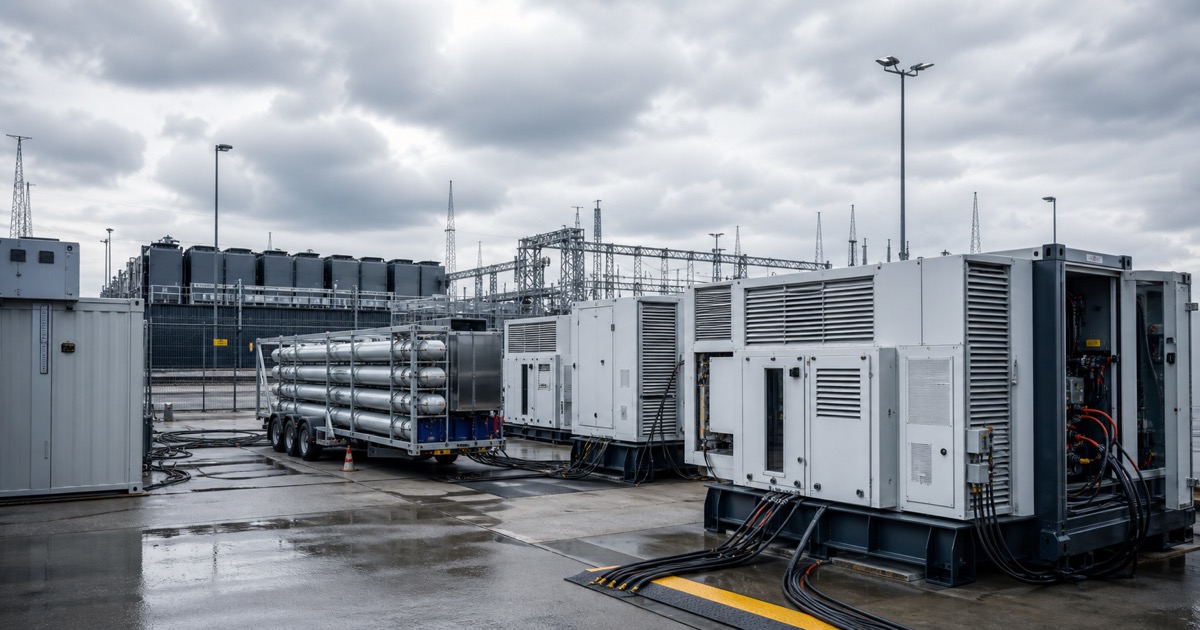
Hydrogen is becoming an infrastructure market
Ballard Power Systems announced a definitive agreement to acquire GeoPura at a total transaction enterprise value of £301.1 million, approximately US$400 million. The upfront consideration is £275 million, funded roughly 30% in cash and 70% in Ballard stock.
GeoPura is expected to bring around £38 million of 2026 revenue. Ballard has identified around US$25 million of annual run-rate EBITDA synergies. GeoPura also brings something much harder to fake than a hydrogen slogan: operating assets, fuel logistics, service revenue, serious customers and a 15-year HAR1 government-backed hydrogen production revenue contract.
Those details matter because they move the discussion away from whether hydrogen is a good idea in the abstract. The question now is more practical. Who can put equipment in the field, fuel it, service it, finance it and keep the customer paying?
It also matters that Ballard is public. Ballard Power Systems trades as BLDP on NASDAQ and the TSX. This is a listed fuel-cell company using cash and shares to move closer to deployment, customers and recurring revenue. That is not a small tactical add-on. For a company financial sites put at roughly US$1.25 billion of market capitalisation in June 2026, a roughly US$400 million enterprise-value acquisition is a material statement about where management thinks the value is moving.
This is what consolidation looks like
Early hydrogen markets were fragmented because nobody yet knew which parts of the value chain would become financeable. Stack manufacturers, electrolyser companies, project developers, logistics operators, generator businesses, station developers and service providers all tried to prove their own piece.
That made sense for a while. The sector was still trying to discover demand, policy support, cost curves and customer behaviour. Everyone wanted a narrow wedge and a clean technology story. The assumption was that the rest of the system would arrive around them.
Customers are less romantic. They do not buy a value-chain diagram. They buy uptime, fuel, compliance, service response and a contract their finance director can understand.
The Ballard-GeoPura deal pulls several loose pieces into one operating structure. Ballard brings fuel-cell technology, manufacturing expertise, public-market currency and a long history in hydrogen power systems. GeoPura brings Hydrogen Power Units, hydrogen supply, logistics infrastructure, customer relationships, service revenue and production-linked policy support. That is consolidation in the useful sense: fewer interfaces, more control, and a better chance of turning hardware into a service business.
| Transaction element | What matters commercially |
|---|---|
| Total enterprise value of £301.1 million, about US$400 million | The market is putting real value on integrated hydrogen deployment, not only component intellectual property. |
| £275 million upfront consideration, funded with £82.5 million cash and about 50.8 million Ballard shares | Ballard is preserving cash while using public-company equity as acquisition currency for infrastructure capability. |
| GeoPura estimated 2026 revenue of around £38 million | This is attached to operating assets and service demand, not just a long-dated hydrogen vision. |
| US$25 million annual run-rate EBITDA synergies identified by Ballard | The integration case is operational: supply chain, deployment, manufacturing, service and overhead leverage. |
| 15-year HAR1 government-backed hydrogen production revenue contract | Long-term policy-backed revenue helps turn hydrogen production from an announcement into a financeable asset. |
Why US investors should care about a UK hydrogen deal
For US investors watching Ballard, the interesting part is not that the company has bought a British hydrogen generator business. The interesting part is that it has bought contracted revenue, logistics, customers and a service model in a market where the UK government has already made parts of the hydrogen value chain financeable.
That is why the NASDAQ and TSX angle matters. Ballard Power Systems is not a private infrastructure fund buying an operating platform with patient capital. It is a public hydrogen company, trading as BLDP, using its own stock as part of the acquisition currency. Around 70% of the upfront consideration is Ballard equity. GeoPura shareholders are being rolled into the combined public company rather than simply exiting for cash.
That does not make the deal automatically good or bad for shareholders. It does make the financial question more interesting. Public-market investors looking at NASDAQ hydrogen stocks and TSX hydrogen stocks have spent years trying to work out whether fuel-cell companies can escape the technology-narrative trap. The problem has rarely been that the engineering is irrelevant. The problem has been that stack sales alone can leave public hydrogen companies exposed to slow customer adoption, uneven order timing, weak utilisation and long waits for infrastructure to arrive.
GeoPura gives Ballard something public hydrogen companies have often lacked: a route to recurring revenue that is closer to infrastructure services than equipment sales.
The UK angle is also easy to miss from North America. US commentators often look at hydrogen through the lens of tax credits, industrial hubs, transport incentives and the stop-start politics of federal support. The UK model is different in places. HAR1-style contracted revenue support gives producers a clearer line of sight on future hydrogen production revenue. That does not remove execution risk, but it can make parts of the revenue stack more bankable than many outside observers assume.
This is why UK hydrogen infrastructure matters beyond the UK. The country has grid constraints, construction demand, temporary power requirements, data-centre pressure, defence use cases and government-backed hydrogen production contracts. That is a plausible testbed for hydrogen Energy-as-a-Service models, where the commercial proposition is not simply “buy our fuel cell”, but “we will provide low-carbon power, fuel, logistics and service under a contract you can budget for”.
For public-market investors, the read-through is not a buy-or-sell conclusion. It is a better analytical frame. Hydrogen M&A and hydrogen consolidation are starting to show which companies can move from technology narrative toward infrastructure finance, recurring revenue and operating accountability.
The market has stopped grading the story
The old hydrogen question was too forgiving: who has the best technology story?
The new question is less comfortable: who has customers, contracts, logistics, asset finance, government-backed revenues and the balance sheet to survive?
That is a healthier question. It is also a brutal one. A clever component can still be valuable, but it is no longer enough to say the market will eventually need it. Eventually is expensive. Eventually kills companies with weak balance sheets.
Financial coverage of Ballard over the past two years gives the deal some context. Ballard has won serious fuel-cell orders, including European bus commitments and stationary-power demand, while still carrying the familiar fuel-cell-sector burden: losses, uneven order timing, customer financing delays and a market that keeps taking longer than technology vendors would like. Buying operating demand, service revenue and hydrogen logistics is a different response from waiting patiently for component volumes to arrive.
The wider market is saying the same thing. The IEA’s 2026 hydrogen review points to high costs, uncertain demand, complex regulation and lack of infrastructure. It also says offtake remains insufficient to unlock large-scale investment. Strip out the institutional language and the message is simple enough: hydrogen optimism does not pay invoices.
Why the survivors should welcome this
Consolidation always sounds unfriendly. Some companies disappear. Some get absorbed. Some keep issuing announcements until the market stops listening.
Good. Hydrogen has had too much noise and not enough operating proof. Investors have had to separate operators from storytellers. Customers have been shown too many suppliers that were “strategically positioned” but not yet capable of taking full responsibility for delivery. Policymakers have too often been invited to confuse announcements with capacity.
The companies still standing should welcome the sorting process. A cleaner market means fewer speculative entrants clouding the view. It means stronger investor attention for businesses with working assets and funded growth plans. It means better access to infrastructure capital for operators that can show contracted or government-backed revenue. It means serious customers can spend less time sorting through slideware.
It also creates a more realistic route to margin. Integrated operators can capture value across equipment, fuel, logistics, service and asset utilisation. Fragmented markets spread responsibility thinly. Consolidated markets make somebody accountable.
The M&A phase is good news for the companies still standing. It means the market is starting to separate real operators from press-release companies.
Ballard is buying proximity to the customer
Ballard is buying proximity to the customer.
That matters because component suppliers in emerging infrastructure markets can get trapped in an awkward place. They take technology risk early, invest heavily in engineering and manufacturing, then wait for other people to create enough deployment volume. If the market grows slowly, the factory waits. If it grows quickly, the customer and the integrator still push the component layer on price.
GeoPura changes Ballard’s position in the stack. It gives Ballard customer relationships across construction, media, data-centre, defence and industrial power use cases. It adds hydrogen logistics, fleet deployment capability and recurring service revenue. It also adds production-linked subsidy visibility through HAR1.
The strategic move is straightforward. Ballard is shifting away from being mainly a fuel-cell component supplier and toward an integrated hydrogen power and Energy-as-a-Service operator. The phrase can sound grandiose. Here, the physical pieces are at least visible: units in the field, fuel supply, tube trailers, service operations, customer contracts and production support.
GeoPura had already done the hard part
GeoPura was not a failed company being rescued. That distinction matters.
The company had raised institutional equity and asset-backed debt. It had infrastructure underway. It had customers in markets where temporary, off-grid or grid-constrained power is not a branding exercise. Construction sites, data centres, defence users, media productions and industrial customers do not care whether a supplier has a beautiful hydrogen narrative. They care whether power turns up and keeps working.
The GeoPura model is commercially more serious than selling a unit and hoping the rest of the market arrives later. It combines Hydrogen Power Units, hydrogen fuel, logistics, service and asset finance. That package is dull in the best possible way. It turns hydrogen from a thing the customer has to understand into power the customer can use.
It also gives investors something better to underwrite. A one-off hardware sale creates revenue once and leaves fuel, utilisation, maintenance and replacement somewhere else. A service model can build recurring revenue, operational data, fleet utilisation, financing relationships and customer stickiness. None of that is magic. It is just a better commercial shape.
The weak stuff gets stripped out
If your hydrogen business still depends on future policy, future infrastructure, future customers and future cost curves, the market is getting less patient.
That does not mean every early-stage hydrogen company is doomed. It means the burden of proof is moving. A clever stack, lower-cost electrolyser pathway or better storage concept may still matter. But the next phase will reward companies that already have an operating wedge into real demand.
This is where the hydrogen argument often gets lazy. It treats the sector as if the main question is whether hydrogen is good or bad. Infrastructure markets do not work like that. Hydrogen is useful where it solves a specific customer problem better than the alternatives, can be supplied reliably and can be financed on terms that survive contact with reality. The rest is theatre.
For related context, the same deployment logic runs through UK hydrogen infrastructure, fleet decarbonisation economics and hydrogen internal combustion engines. The technology only matters when the surrounding operating system can carry it.
The investor read
Investors should pay attention to where value is being pulled. This deal suggests hydrogen value may sit increasingly with integrated operators that control deployment, fuel, service and customer relationships, not only with pure-play technology vendors.
Component technology still matters. Without reliable fuel cells, electrolysers, compression systems, tanks and control electronics, there is no infrastructure market. But durable margin often sits closer to the customer. It sits where the operator controls more of the delivered value and can price for availability, uptime, service and risk transfer.
Hydrogen is not special in this respect. Infrastructure markets often start with technology differentiation and then move toward integration, financeability and operating reliability. The attractive company is not always the one with the most elegant component. It is often the one that can turn components into a bankable service, signed contracts and repeatable deployment.
That is why the stock-and-cash structure is worth reading carefully. Ballard says the share component is based on about 50.8 million new Ballard common shares issued at US$5.02 per share, using Ballard’s 30-day volume-weighted average share price before announcement. GeoPura shareholders are expected to own about 14.4% of Ballard on a pro-forma basis after closing and enter lock-up agreements. They are being rolled into the public-company platform rather than simply cashed out. That does not make the deal low risk. It does make the alignment more serious.
Policy only matters when it makes assets bankable
HAR1 matters because long-term revenue certainty makes infrastructure financeable. Policy is useful when it turns projects into bankable assets, not when it merely produces announcements.
Hydrogen policy has often been judged by headline ambition: targets, strategies, clusters, roadmaps and funding rounds. Some of that is useful. Much of it is decoration unless it reduces risk for real projects.
A 15-year government-backed production revenue contract is different. It gives investors and acquirers something to value. It can support debt, customer confidence and long-term planning. It helps explain why GeoPura looks like an infrastructure business rather than a collection of equipment and claims.
The policy lesson is not that every hydrogen project deserves support. It is that well-designed support should create investable assets and then allow the market to consolidate around the operators capable of delivering them.
Where this leaves the market
Operators now need more than technology performance. They need customers, logistics, financing capacity, service capability and a path to utilisation.
Investors need to ask a less glamorous question: which business model captures value when the technology is actually deployed?
Policymakers should make real projects financeable and then let weak models fail. A healthier market is not one where everyone survives. It is one where useful assets, competent operators and serious customers can find each other.
A cleaner market
The Ballard-GeoPura deal is a marker for the next phase of hydrogen. Less theatre. More balance sheet. Less pilot-project noise. More operating accountability.
The hydrogen market is not dead. The easy-money phase is dead. The press-release phase is dying.
What comes next is more useful: fewer companies, better capital discipline, more vertical integration and a sharper distinction between businesses that built something real and businesses that were mostly waiting for the future to arrive.
For the companies still standing, that is not bad news. It is the beginning of a cleaner market.
Sources and further reading
- PR Newswire: Ballard announces acquisition of UK-based GeoPura
- H2TECH: Ballard Power Systems to acquire GeoPura
- Ballard investor hub and public-market information
- CompaniesMarketCap: Ballard Power Systems market capitalisation
- MarketWatch: Ballard’s Solaris fuel-cell engine order
- WSJ: Ballard revenue, losses and backlog context
- IEA: Global Hydrogen Review 2026 executive summary
- GeoPura company profile and infrastructure overview
- East Midlands Hydrogen: HyMarnham project showcase
- Tim Harper: Hydrogen Hub
- Tim Harper: Hydrogen Economics
- Tim Harper: Technology Commercialisation