
Agricultural technology is moving from novelty to necessity. This is my field-level assessment of what is genuinely scaling in 2026, what remains overhyped, and where the strongest UK and global investment opportunities lie.
What matters in 2026
- Already at commercial scale: robotic milking, guidance and autosteer, precision spraying, poultry and packhouse automation.
- Scaling now: supervised autonomy, laser and mechanical weeding, battery equipment for return-to-base duties, farm-management systems tied to measurable outcomes.
- Still early: general-purpose fruit picking, hydrogen tractors and synthetic fuels for routine farm work.
- Investment opportunity: enabling sensors, retrofit systems, water infrastructure, service networks, resource recovery and outcome-based finance.
Every summer I make the annual pilgrimage to the Great Yorkshire Show, and every summer somebody asks for my expert opinion on cattle.
This is flattering, but unwise. I can usually distinguish a cow from a combine harvester, although I would not advise anyone to make a breeding decision on that basis. My real interest is in what happens behind the livestock rings: the machinery stands, the energy systems, the water equipment and the increasingly crowded agri-innovation village. Agricultural shows are among the best places to observe an emerging technology market because the people buying the technology are standing next to the people selling it, and neither has much time for a PowerPoint presentation.
I have been going to agricultural shows for as long as I can remember. I did not grow up in a farming family, but in a rural village agriculture touches everything: employment, traffic, water, land prices, weather and whether the village shop survives. I have also spent much of the past 30 years trying to commercialise technologies that looked magnificent in a laboratory and rather less magnificent when exposed to customers, infrastructure and cash flow. A wet field is an unusually efficient detector of nonsense.
At the 2026 show, hydrogen was prominent in the innovation area. Toyota’s British-built fuel-cell Hilux was there, alongside a HyKit hydrogen bowser and solar and biogas systems assembled by local specialists Energy Oasis. Toyota had built ten Hilux prototypes for testing; it has since confirmed that a production fuel-cell Hilux is scheduled for 2028.
That commitment now coincides with a material change in hydrogen economics. In Germany, better station utilisation and the reformed THG quota allowed H2 MOBILITY to cut renewable-hydrogen prices by 10% at five high-volume stations in June 2026, with further reductions expected. From January 2026, selected German truck fleets have also been offered renewable hydrogen at about €8/kg net—a level the operators describe as bringing fuel-cell trucks close to diesel parity. My modelling for UK fleets puts effective supported hydrogen at roughly £8–9.50/kg in suitable depot contracts, already within the fuel-cost parity band for some intensive duties such as refuse collection and approaching it for buses. A farm producing its own biomethane or hydrogen, or sharing a highly utilised local hub, can improve the calculation further by removing part of the distribution and retail margin.
The 2028 Hilux has not yet been priced, but it is no longer reasonable to assume that hydrogen must remain more expensive than diesel by the time it arrives. Price formation increasingly includes utilisation, local production, compliance value and avoided downtime—not merely the thermodynamic efficiency of making the molecule.
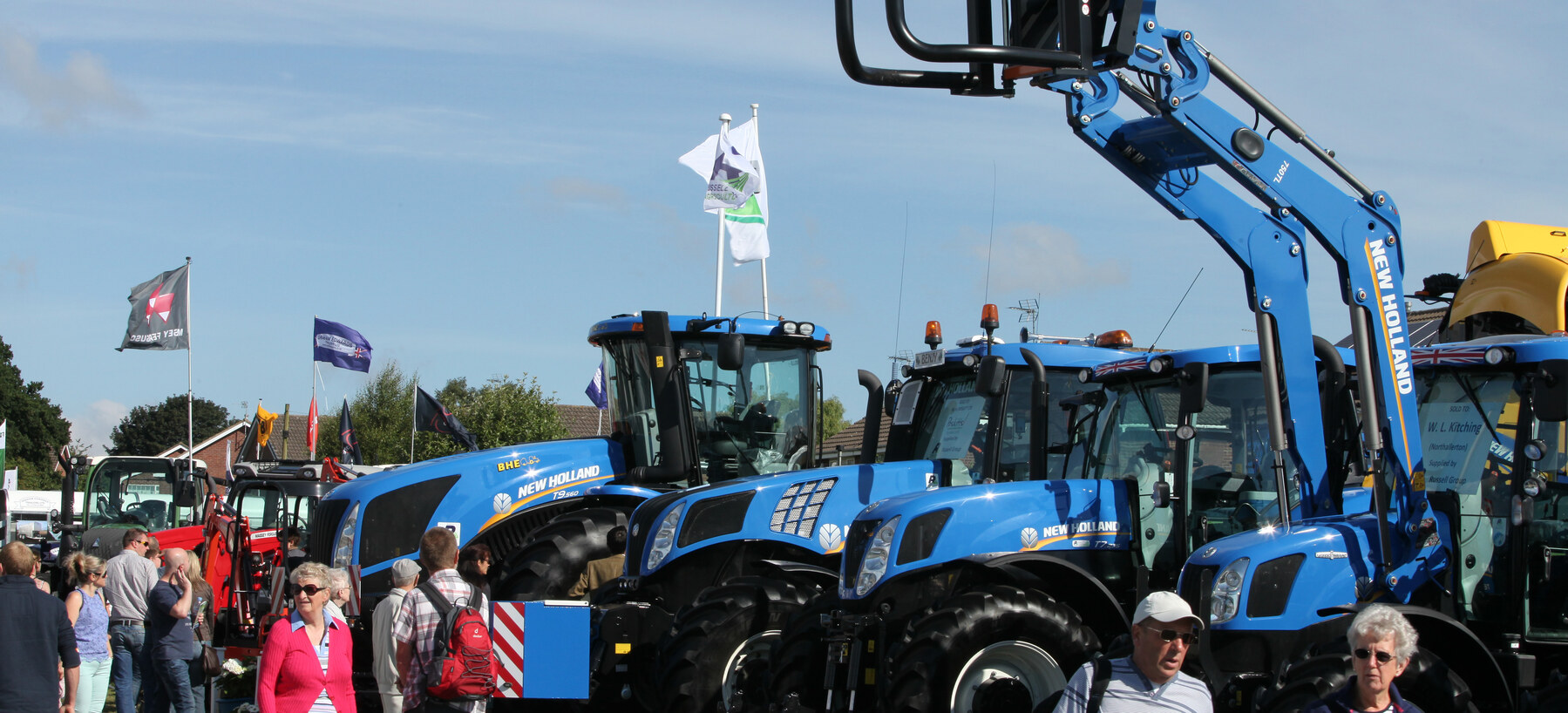
Meanwhile, most of the working machinery at the show remained resolutely diesel-powered. That is not because farmers have failed to receive the memo about climate change. It is because a tractor working a 17-hour day through a narrow harvest window is not an urban delivery van. Energy density, refuelling time, soil compaction, towing load, grid connection and the distance to a competent mechanic all matter.
That contrast—future fuels in the innovation village, diesel doing most of the work—is the story of agricultural technology in 2026. The transition is real. It is also uneven, practical and rather more interesting than the hype.
“A wet field is an unusually efficient detector of nonsense.”
Why agricultural technology has become a defining market
Agriculture is being squeezed from several directions at once. It must remain profitable while adapting to climate volatility, reducing pollution and emissions, using less water and coping with fewer workers. Agriculture, forestry and other land use represented about 22% of global greenhouse-gas emissions in 2019, according to the IPCC. Agriculture also accounts for roughly 72% of global freshwater withdrawals. In England, more than a third of farm holders were over 65 in 2024 and only 5% were under 35.
The farmer’s problem is not “digital transformation”. It is getting a crop established in a wet autumn; finding people to pick soft fruit; reducing fertiliser and chemical bills; keeping animals healthy; securing water; meeting a supermarket specification; repairing a machine during harvest; and making enough margin to try again next year.
That distinction matters commercially. Worldwide agrifood-tech start-ups raised about $16.2 billion in 2025, broadly flat on the previous year and far below the $51 billion peak of 2021. Investors are becoming more selective, which is healthy. In the first half of 2025, farm robotics, mechanisation and equipment attracted about $314 million, down from $398 million a year earlier. Capital has discovered that farms are not software companies with unusually large gardens.
Consultants nevertheless forecast magnificent markets. One estimate puts precision farming at $9.9 billion in 2025 and $20.3 billion by 2030; another puts agricultural robots at $17.7 billion in 2025 and $56.3 billion by 2030. These numbers are useful mainly as evidence that definitions differ: some include drones, dairy systems and conventional guided machinery, while others do not. I would rather know how many machines are completing paid work, for how many hours, at what intervention rate.
Energy: there will be no universal zero-carbon tractor
The decarbonisation debate is often reduced to a prize fight between batteries and hydrogen. Farming makes that framing look particularly silly.
Battery-electric equipment already makes sense for low- and medium-power machines with predictable duty cycles and a home base: compact tractors, loaders, utility vehicles, municipal machines and equipment used around livestock, where low noise and zero exhaust emissions have additional value. AGCO’s 100hp Fendt e107 Vario entered production in 2025, with a quoted working time of roughly four to seven hours depending on the job. Monarch began delivering its 40hp-equivalent MK-V electric tractor in 2022 and reported more than 400 deployed by 2024; its Autodrive function moved into commercial availability for suitable dairy operations in 2025. Yet its Foxconn manufacturing arrangement ended in August 2025 and California WARN filings later covered 97 layoffs. A $133 million funding round and hundreds of machines in the field were not enough to prove a durable manufacturing business.
The limitations appear as power and utilisation rise. Batteries add weight, fast charging requires a substantial grid connection, and the machine may be working far from a socket. A 100hp tractor doing light yard work is not a 600hp crawler pulling cultivation equipment through the night. Battery swapping and hybrids may help, but each adds capital, logistics or complexity. The commercially sensible question is not “Can this tractor be electrified?” It is “Can this farm complete the same workload, in the same weather window, at an acceptable total cost?”
Hydrogen becomes interesting where utilisation is high, refuelling must be fast and a farm, contractor or regional cluster can support captive infrastructure. JCB’s hydrogen-combustion engine received type approval for commercial use across the UK and Europe in 2025. Hydrogen combustion preserves much of the familiar engine and service architecture, although it is less energy-efficient than using renewable electricity directly and can still produce nitrogen oxides that must be controlled. Fuel-cell machinery is more efficient at the vehicle but costlier and less tolerant of dirty operating environments. In both cases, delivered low-carbon hydrogen—not hydrogen at the electrolyser gate—is the economic test, as I explain in more detail in Hydrogen Economics.
Biomethane is further ahead in tractors than hydrogen. New Holland’s 180hp T6.180 Methane Power has been series-produced since 2022, and its 270hp T7.270 CNG model became orderable in late 2025 for spring 2026 delivery. It offers diesel-like refuelling and working time, especially attractively for livestock farms already producing biogas. But methane leakage can destroy the climate benefit, and a digester, gas upgrading and storage system only make sense with sufficient feedstock and utilisation.
Renewable diesel and HVO are the least exciting and most immediately deployable options. They use existing machines and fuel logistics, but supply is constrained and lifecycle emissions depend on feedstock. Synthetic e-fuels may eventually serve legacy fleets and the hardest duties, but making electricity into hydrogen and then into a liquid fuel is an expensive way of returning to where we started. Hybrids, by contrast, can cut fuel consumption and provide electrical power to implements without demanding an all-or-nothing infrastructure transition.
My conclusion is unfashionably plural: batteries for smaller and return-to-base work; biomethane where the farm controls the molecule; hydrogen for selected high-utilisation clusters; renewable liquids for the installed fleet and hardest duties; hybrids across the messy middle. Diesel will decline, but not because a single technology defeats it at a trade show.
“Farmers do not buy an energy carrier. They buy the reliable completion of a job before the weather changes.”
Robotics: automate the task, not the brochure
Agricultural robotics is simultaneously mature, emerging and overhyped. It depends where one looks.
Robotic milking is a mature commercial industry. Lely delivered its 50,000th Astronaut in 2024 and said its systems were milking 2.5 million cows a day in more than 50 countries. DeLaval’s newer batch-milking configuration was already operating on 20 farms in 13 countries by early 2025. Robotic feed pushers, manure scrapers, egg collection, poultry climate control and optical grading also work because the environment and task can be constrained.
Precision spraying has crossed into commercial scale. John Deere’s See & Spray systems covered more than five million US acres in 2025 and, according to the company, cut non-residual herbicide use by nearly 50% on average. The important innovation is not merely computer vision recognising a weed. Deere can factory-fit or retrofit the system, support it through dealers and charge per acre—with a guarantee linked to savings. Blue River Technology, acquired by Deere in 2017, therefore matters as much for its route into the installed base as for its algorithms.
Carbon Robotics takes a more theatrical approach, using lasers to kill weeds. The company raised a $70 million Series D in October 2024. FarmDroid’s lighter solar-powered seed-and-weed robots worked in 26 countries and weeded more than 26,000 hectares during the 2025 season. Australia’s SwarmFarm is stronger evidence still: by May 2026 more than 250 robots had worked over ten million acres, and the Australian Clean Energy Finance Corporation committed A$7 million in 2025 to expand production. These are not science projects.
Autonomous tractors occupy the middle ground. Deere has commercial autonomy for defined tillage and is extending it to larger tractors and orchard spraying. CNH has integrated Raven autonomy; AGCO paid for an 85% stake in the PTx Trimble joint venture, the industry’s largest precision-ag transaction, with mixed-fleet retrofit as a central proposition. Kubota has sold supervised Agri Robo tractors in Japan since 2017 and launched a driverless combine in 2024. The pattern is clear: autonomy advances first in repetitive, geofenced jobs where obstacles are limited and a human can supervise several machines.
Robotic fruit picking remains early. Fruit hides behind leaves, moves in wind, bruises, ripens unevenly and presents a fresh geometry to every gripper. Tevel, Advanced Farm, Fieldwork Robotics and others are running commercial-farm deployments, but most systems remain pilots or limited services rather than mass-market products. A robot that picks 80% of visible fruit in a demonstration may still fail economically if it is slow, misses the valuable grade, needs frequent rescue or cannot move between varieties.
One reason this remains difficult is that vision is only half the problem. A camera can locate an apple or strawberry, but once the gripper makes contact—and often blocks its own view—the robot needs to know whether it has touched the fruit, how firmly it is squeezing and whether the fruit or stem is beginning to slip. Humans make those corrections unconsciously through touch. Most harvesting robots still approximate them through position and motor current.
This is where Kirisense becomes relevant. As chair of the company, I am directly involved in its work on low-cost tactile sensing that can detect contact, force and slip in real time. Kirisense is not building a fruit-picking robot; it is developing an enabling layer that could help a gripper handle delicate, irregular produce with less bruising and fewer failed picks. Independent research published in 2026 has similarly shown that combining vision, tactile and curvature sensing can support adaptive, non-destructive strawberry harvesting. Touch will not solve slow cycle times, occluded fruit or the economics of moving machines between crops, but it can close one of the most important feedback gaps between recognising fruit and picking it reliably.
The casualties are instructive. Britain’s Small Robot Company entered creditors’ voluntary liquidation in 2024. France’s Naïo Technologies went into administration in 2025 before being rescued by investors. Both produced capable machines and valuable learning. Neither could make the capital cycle, service burden and farm economics line up quickly enough.
Harper Adams demonstrated with Hands Free Hectare that existing machinery could autonomously sow, tend and harvest a cereal crop. The UK’s next job is not another demonstration. It is certification, insurance, dealer support, finance, interoperability and repair. The UK Agri-Tech Centre’s ARRNet programme, involving Harper Adams, Lincoln and the Manufacturing Technology Centre, is aimed precisely at the regulatory gap.
AI: valuable when it disappears into the machine
AI is transforming agriculture, but not mainly through a farmer chatting to a digital agronomist over breakfast.
Its strongest applications are embedded: cameras distinguishing crop from weed; combines adjusting themselves as crop density changes; dairy systems flagging mastitis risk; irrigation controllers responding to soil moisture and weather; software spotting an abnormal vibration before a bearing fails; satellite imagery prioritising which fields an agronomist should inspect. These systems compress a decision or remove a pass across the field.
The commercial evidence is substantial. xFarm raised €36 million in 2024 and says its farm-management platform supports 450,000 farms covering seven million hectares. CropX has assembled soil sensing, weather, irrigation and enterprise supply-chain monitoring through seven acquisitions; its 2025 acquisition of Acclym added deployments across millions of hectares and customers including AB InBev, Nestlé and McCain. This also reveals who may pay: not always the farmer, but the processor, insurer, lender or food company that benefits from consistent supply and auditable data.
Satellite and drone data are useful for identifying variability, not for abolishing agronomy. A satellite can show that one part of a field differs from another; it may not tell whether the cause is nitrogen, drainage, disease, compaction or a cloud-shadow artefact. Drones provide finer detail but create another data-processing job and, in Europe, face tighter rules for beyond-visual-line-of-sight operation and aerial spraying.
The overhyped part is the universal AI farm platform. Farms have mixed fleets, patchy connectivity and years of incompatible records. The European Commission’s 2025 work, supported by a Joint Research Centre assessment, found adoption uneven and tools difficult to integrate, with transparency and data governance continuing to limit trust. The opportunity is therefore not another dashboard. It is interoperability, clean data, decision support inside existing workflows and business models that share value with the farmer.
Water: the investment case arrives before the drought
Water is moving from an environmental concern to a balance-sheet constraint. The Environment Agency estimates that England could face a five-billion-litre-a-day public-supply shortfall by 2055, plus another billion litres for the wider economy. In southern Europe, Australia and the western United States, scarcity is already shaping crop choice, land value and insurance.
Precision irrigation is commercially mature: drip systems, soil-moisture probes, variable-rate pivots, pressure monitoring and weather-based scheduling. The failure is usually systemic. A clever sensor cannot compensate for a leaking main, a badly designed irrigation block, no reservoir or an abstraction licence that disappears during drought. Nor will “AI irrigation” help if the farmer receives an alert but has no controllable valve.
The real opportunity is a water stack: measurement, storage, distribution, treatment, control and reuse. That includes shared farm reservoirs, leakage detection, low-energy filtration, desalination for high-value crops, treatment of dairy and food-processing effluent, and recovery of nitrogen and phosphorus. The EU Water Reuse Regulation has applied since June 2023 and sets common quality, monitoring and risk-management requirements for treated urban wastewater used in agricultural irrigation. Europe reuses about one billion cubic metres a year, while the Commission estimates six times as much could be reused.
This is not a licence to spray anything vaguely wet onto a lettuce. Pathogens, salinity, PFAS, pharmaceutical residues and supermarket standards matter. Treatment must be matched to crop, soil and route of exposure. But a regulated supply of recovered water and nutrients can become more dependable than an increasingly contested river abstraction.
Labour: robots will change jobs before they remove them
The UK’s agricultural workforce fell to 446,000 in 2025, down 1.5% in a year. Horticulture remains dependent on migrant labour: the government allocated 43,000 seasonal visas for horticulture and 2,000 for poultry in 2025. The NFU estimated that labour shortages left more than £60 million of fruit and vegetables unpicked in the 2022 season; the government’s subsequent review concluded that automation is essential but not a quick substitute for seasonal workers.
Farmers are not primarily trying to eliminate people. They are trying to fill jobs that are seasonal, repetitive, physically punishing, dangerous or impossible to staff at short notice. Automation often moves labour rather than removes it: one person supervises several tractors, maintains robots, handles exceptions or concentrates on animal health and crop quality.
The economics depend on utilisation. A milking robot works every day. A fruit picker may work for a few weeks on one crop, then sit idle unless it can move to another variety or region. That favours robotics-as-a-service, contractors and machines with several useful implements. It also favours packhouse automation, where the environment is controlled and equipment can process several growers’ output.
Climate resilience: biology and engineering meet in the soil
The difficult truth is that climate resilience cannot be purchased as a single product. It is a property of a farm system.
Better drainage, water storage, drought-tolerant varieties, diverse rotations, cover crops, shelter belts, integrated pest management and more accurate weather information can all reduce risk. Regenerative agriculture can improve infiltration, soil structure, biodiversity and dependence on purchased inputs. But it is not a universal recipe, and “chemical-free” is not automatically lower-carbon if yields fall and more land is required.
Rothamsted’s long experiments are valuable because they puncture slogans. Research across 17 English arable farms found ecological practices improved biodiversity, soil carbon and yields on the cropped area, but the most ambitious system still required additional subsidy to match the profitability of intensive farming. Broadbalk data also showed that long-term nitrogen and phosphorus fertilisation increased soil organic carbon by up to 28% compared with unfertilised plots because more plant growth meant more carbon entering the soil. Nature declines under careless intensification; equally, hungry crops do not build soil carbon by moral virtue.
Carbon farming is promising but overmarketed. Soil carbon changes slowly, varies across metres and can be reversed by drought or management. Measurement, reporting and verification can consume much of the value on smaller farms. The EU’s voluntary Carbon Removals and Carbon Farming framework, adopted in 2024, is an attempt to impose consistent quality and monitoring rules. That is progress, but carbon credits should be the by-product of better land management, not the sole reason for it.
Economics: the technology must survive the farm accounts
British farming illustrates why adoption will be selective. UK Total Income from Farming rose to £8.4 billion in real terms in 2025, but this aggregate conceals enormous differences between livestock, horticulture and arable farms and follows years of weather and commodity volatility. Crop output fell again in real terms, while livestock output rose.
Policy is also being rebuilt. England replaced the Basic Payment Scheme with delinked payments in 2024; in 2026 payments are cut by 98% on the first £30,000 of the reference amount and 100% above it. The Sustainable Farming Incentive closed unexpectedly to most new applications in March 2025, then returned in 2026 with controlled windows and £240 million for new agreements. Farmers making ten-year equipment decisions have therefore been asked to do so against one-year policy visibility—an approach rarely recommended in business school.
At LAMMA, Cereals and the Great Yorkshire Show, the machines attracting attention are not always those that win orders. Farmers buy when a technology protects yield, removes labour, cuts a volatile input, unlocks a payment or keeps working through a critical window. Retrofit is powerful because farms operate mixed fleets and replace machinery slowly. Service is decisive because an autonomous tractor waiting three days for a software engineer is a large, expensive sculpture.
The UK agri-tech position: excellent science, difficult scale-up
The UK has most of the ingredients for an important agri-tech industry. Rothamsted provides long-duration agricultural science that few countries can replicate. Harper Adams combines engineering with working-farm reality. The UK Agri-Tech Centre can connect research, demonstration facilities and industry, while LAMMA, Cereals and the Great Yorkshire Show put new machinery in front of actual buyers rather than innovation panels.
The weakness is not invention. It is scale-up capital, procurement, regulation, service coverage and patient routes to market. British field-robotics companies have repeatedly demonstrated technically competent machines, only to discover that manufacturing inventory, seasonal sales and nationwide support consume cash much faster than a software investor expects. Public money is most useful when it funds shared testing, safety standards, interoperability and first commercial deployments—not another robot designed to look persuasive in a ministerial photograph.
For the UK, the opportunity is to become the place where agricultural technology is proved under demanding commercial conditions: mixed fleets, variable weather, tight regulation and farmers who calculate payback properly. If a system works here, survives a Yorkshire winter and can be repaired through an ordinary dealer network, it has a reasonable chance elsewhere.
I use a simple readiness ladder:
| Stage | Evidence required | 2026 examples |
|---|---|---|
| Research | Repeatable performance in controlled conditions | General-purpose fruit manipulation; synthetic e-fuels for routine farm use |
| Pilot | Work on commercial farms, but with specialist support or limited seasons | Flying pollination robots; many robotic fruit pickers; hydrogen tractors |
| Early commercial | Customers pay; deployments repeat; service model still developing | Autonomous tillage and orchard tractors; laser weeding; battery compact tractors |
| Commercial scale | Thousands of machines or millions of acres; dealer and service ecosystem | Robotic milking; guidance and autosteer; precision spraying; poultry and packhouse automation |
Where I would invest for the next decade
The best opportunities are not necessarily in complete machines.
- First, I would look at precision application: vision, nozzle control, variable-rate fertiliser, non-chemical weeding and retrofit kits. The customer saving is visible in litres, passes and crop damage.
- Second, water infrastructure and resource recovery: reservoirs, sensing, filtration, reuse, nutrient recovery and control systems. Water has regulation, scarcity and an unavoidable customer need behind it.
- Third, enabling components for robust autonomy: sensors, edge computing, safety systems, actuators, machine connectivity and fleet supervision. Selling picks and shovels is not glamorous, but agriculture destroys delicate hardware with admirable efficiency.
- Fourth, automation for livestock, poultry, packhouses and controlled environments, where year-round utilisation and constrained workflows produce better returns than a machine used for a fortnight.
- Fifth, finance and services: robotics-as-a-service, outcome-based pricing, warranties, insurance, maintenance and dealer tools. Deere’s per-acre See & Spray guarantee may prove more important than another percentage point of model accuracy.
- Sixth, climate genetics and biological inputs supported by rigorous field data. Drought, heat, pests and nitrogen efficiency create enormous markets, but biological variation makes proof across seasons and soils essential.
- Finally, distributed farm energy where all the pieces connect: solar and storage for electric equipment; anaerobic digestion with genuine methane control; heat recovery; and hydrogen only where an anchor user and refuelling system make it financeable.
I would be cautious about universal farm-management platforms, general-purpose field robots, undifferentiated drone imagery, soil-carbon schemes dependent on optimistic modelling, vertical farms growing low-value crops with expensive light, and any plan whose economics begin “once every farmer has…”.
“The biggest agricultural technology companies may not sell farmers more technology. They may sell fewer inputs, fewer breakdowns and fewer bad surprises.”
The next industrial revolution will have mud on it
The first agricultural revolution domesticated plants and animals. The second mechanised work. The third used chemistry, genetics and scale to raise yields. The next one will make agriculture more precise, autonomous, biologically informed and resource-constrained.
It will not resemble the smartphone revolution. Farms are capital-intensive biological systems operating outdoors, and their upgrade cycle is measured in seasons, not software releases. But that is precisely why the opportunity is so large. Energy, robotics, AI, water, genetics and finance are converging around an industry that cannot opt out of climate change, labour scarcity or food demand.
Walking out of the Great Yorkshire Show, past the immaculate cattle and the less immaculate visitors, I am struck by how little farming’s central challenge has changed. Produce more value from finite land, water, energy and labour; remain solvent; and hand the farm on in better condition.
The technologies that help do that will scale. The rest will be back in the innovation tent next year, with a new banner and a slightly larger grant.