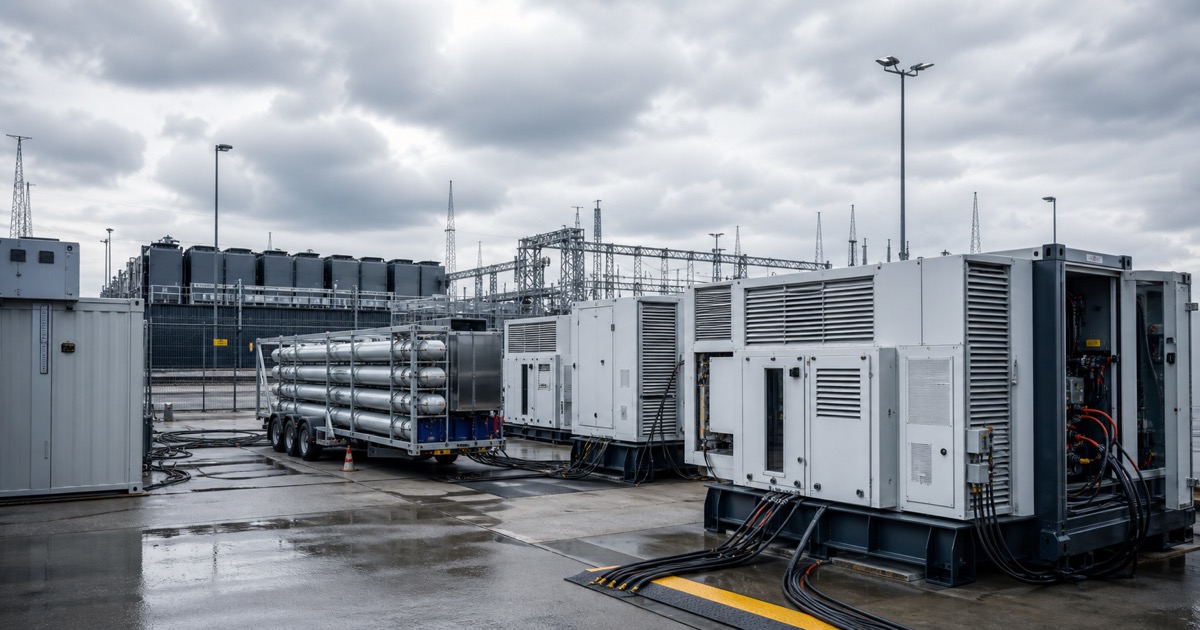
UK hydrogen pricing is usually discussed as though there is one national number. That is the wrong way to understand the market.
A kilogram produced beside a renewable generator, sold under a supported contract and dispensed into a busy captive depot is not economically equivalent to a kilogram transported to a lightly used public station. The physical product may be similar. The price formation is not.
This guide separates four numbers that are too often conflated: ex-plant pricing, delivered pricing, gross dispensed fleet pricing and effective customer pricing after eligible support. It uses the UK Transport Hydrogen Price Forecast model prepared for Tim Harper on 27 May 2026 as its primary analytical framework, strengthened with current GOV.UK policy material. All forecasts, scenarios and probabilities are modelling assumptions rather than official government forecasts.
Executive Summary
The most likely 2026 contracted depot-fleet gross dispensed price is £9.5-10.5/kg. In the model, that falls to £7.0-7.8/kg by 2030 and £5.6-6.3/kg by 2035. Selected captive clusters can do better: £5.5-6.5/kg gross dispensed hydrogen by 2030 is achievable where low-cost supported supply, short logistics, high utilisation and bankable fleet demand coincide.
That does not make £6/kg a likely broad-market UK hydrogen price. Public corridor stations still need redundancy, land, logistics and capital recovery while demand remains uncertain. The model puts their likely 2030 price at £8-10/kg. Remote or low-volume supply can remain above £10/kg.
The second important distinction is between gross price and effective fleet economics. Eligible renewable hydrogen supplied into transport can create RTFC value. If part of that value is contractually shared with the fleet, an £8/kg invoice price can behave economically like £6-7/kg. RTFCs do not reduce the physical cost of production, and they should never be assumed for blue hydrogen, by-product hydrogen or uncertified grid-connected electrolysis.
Core conclusion: £6/kg hydrogen by 2030 is credible in selected clusters. It is not a credible single national price assumption. Station utilisation, contract structure and certificate eligibility matter as much as production technology.
What Is the Current UK Hydrogen Price?
There is no transparent, liquid UK transport-hydrogen benchmark comparable with the weekly petrol and diesel series. Most useful prices are private contract terms, often bundled with delivery, dispensing, minimum volume, certification and support allocation. Public pump prices are poor indicators of depot economics because a public station must recover a much larger utilisation and uptime risk premium.
For 2026, the model’s best estimate for contracted depot fleets is £6.5-7.5/kg ex-plant, £8.0-9.0/kg delivered and £9.5-10.5/kg dispensed. Effective customer economics are estimated at £8.0-9.5/kg where eligible support is shared. These are forecast ranges, not verified nationwide market quotes.
Low-volume supply is more expensive because logistics and fixed station costs are divided by too few kilograms. A 1,000 kg/day station selling only 200 kg/day may carry several pounds per kilogram of fixed-cost recovery before buying the hydrogen itself. This is why discussions of the hydrogen price per kg in the UK must start with volume and location.
Why Hydrogen Pricing Is Not One Market
| Segment | Likely 2030 gross dispensed price | Why |
|---|---|---|
| Best captive clusters | £5.5-6.5/kg | High utilisation, short logistics, anchor demand and support sharing |
| Contracted depot fleets | £7.0-7.8/kg | Reasonable utilisation, but still carrying early infrastructure return |
| Public corridor stations | £8.0-10.0/kg | Demand risk, redundancy, uptime, land and logistics |
| Remote or low-volume supply | £10.0+/kg | Poor utilisation and expensive logistics dominate |
The relevant commercial unit is therefore a local fuel ecosystem, not a national market average. Ports, airports, bus depots, municipal fleets and regional freight clusters can aggregate daily demand and negotiate supply around a known operating schedule. A speculative public network cannot do that until enough vehicles exist.
This segmentation also explains why apparently contradictory market claims can both be true. A producer can credibly discuss supported ex-plant supply near £5.5/kg while a public operator still needs to charge more than £10/kg. The difference is not necessarily excessive margin. It can be the cost of transport, compression, storage, redundancy and underused infrastructure. Buyers should therefore reject quotations that do not state the delivery point, pressure, daily volume, contract term and treatment of environmental certificates.
Understanding Hydrogen Pricing
| Layer | Definition | What changes it | Why it matters |
|---|---|---|---|
| Physical production cost | Full cost before support | Power, CAPEX, utilisation, O&M, water, compression and finance | Shows unsubsidised production economics |
| Supported achieved sale price | Producer sale price after HAR or contract support | Strike price, reference price, LCHA terms and indexation | Can sit below physical cost |
| Gross dispensed fleet price | Invoice price into the vehicle tank | Delivered cost, station CAPEX, utilisation, storage and margin | Primary supplier revenue and fleet invoice |
| Effective customer fuel economics | Net economic price after eligible rebates or certificates | RTFC eligibility, pass-through, grants and customer value | Drives adoption, but is not station profitability |
Two errors follow from collapsing these layers. First, HAR strike prices are not fleet prices. Second, RTFCs are not production-cost reductions. They are conditional certificate value. A fleet may receive attractive net economics while the infrastructure owner still earns an inadequate return.
HAR1, HAR2 and the £5.5/kg Signal
DESNZ reports a HAR1 weighted average strike price of £241/MWh hydrogen HHV. Using 39.4 kWh/kg HHV, that is approximately £9.5/kg. Under the Hydrogen Production Business Model and Low Carbon Hydrogen Agreement, the strike price supports producer revenue against an achieved sale or reference price. It is not a pump price and does not imply that fleets buy hydrogen at £9.5/kg.
The report treats commercial discussion around £5.5/kg ex-plant for 2027 as a significant supported-offtake signal, not verified broad-market data. Such a price can be credible if support bridges part of the producer revenue gap. But logistics, conditioning, storage, dispensing and infrastructure return still sit between that number and a vehicle tank.
| Item | Interpretation |
|---|---|
| HAR1 strike price around £9.5/kg HHV | First-wave supported production economics, not fleet retail |
| £5.5/kg ex-plant 2027 discussion | Potential supported sale price; a report modelling assumption |
| Difference between the two | Potentially covered by support, contract structure, indexation or portfolio economics |
| Fleet-relevant question | How much of the lower ex-plant price survives logistics and dispensing? |
As of June 2026, GOV.UK lists 11 HAR1 projects with agreed contracts and describes HAR2 as a 27-project shortlist. That is evidence of a developing supported production pipeline, not evidence that contracted transport supply is already available everywhere.
RTFC Value and Renewable Hydrogen
The Renewable Transport Fuel Obligation requires obligated suppliers to supply renewable transport fuel or acquire certificates. Qualifying renewable hydrogen used in transport can generate RTFCs, but eligibility depends on the route, renewable electricity evidence, greenhouse-gas methodology, additionality, temporal matching, verification and chain of custody.
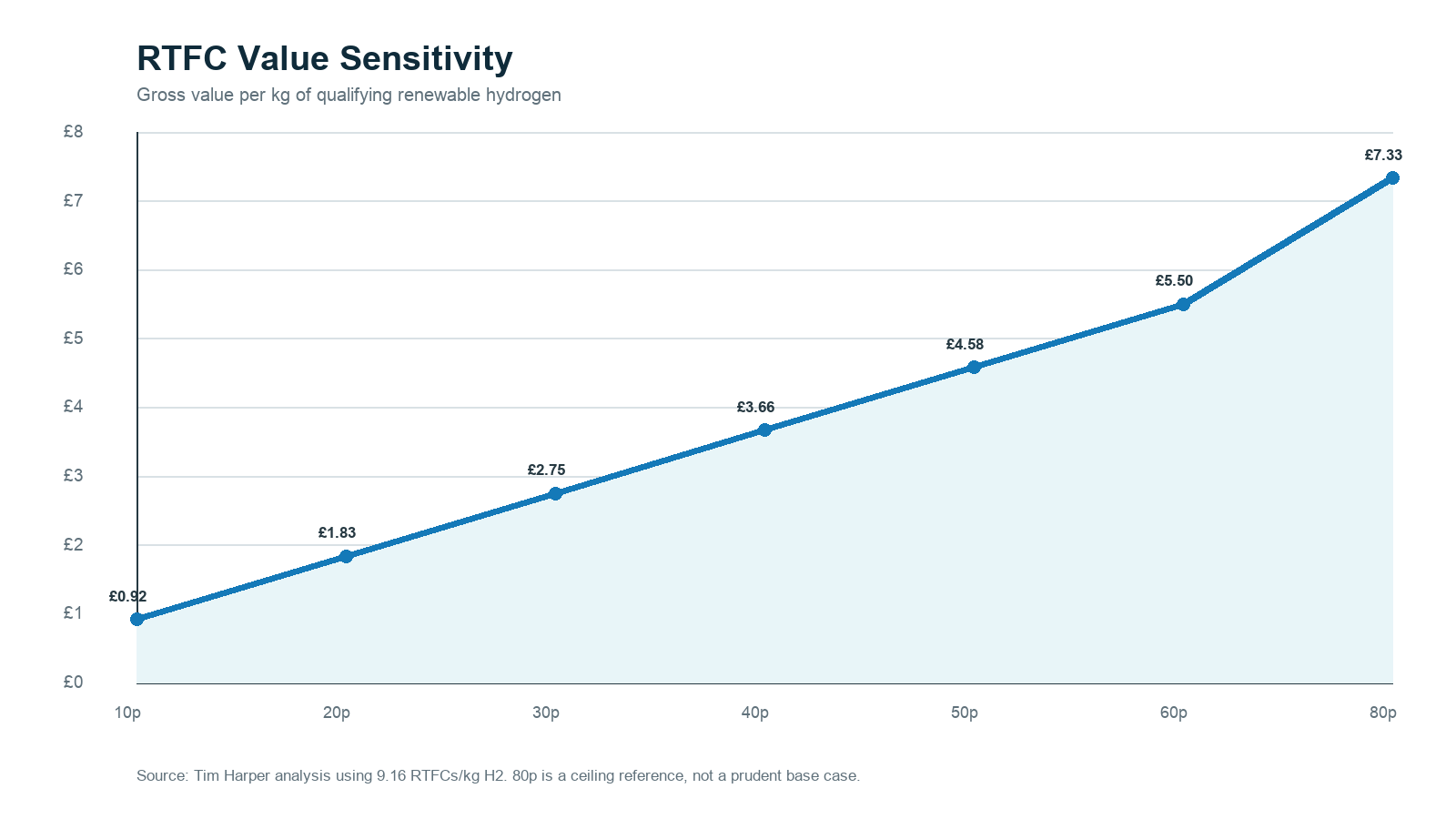
The model uses 9.16 RTFCs per kg of qualifying hydrogen. The development-fuel buy-out price of 80p per certificate creates a theoretical reference of £7.33/kg. That is a ceiling reference, not a prudent market assumption. Certificate prices can be much lower and the claimant may retain much of the value.
| Production route | Likely RTFC position | Principal risk | Modelling treatment |
|---|---|---|---|
| Private-wire renewable electrolysis | High if evidence is robust | Metering, additionality and no double counting | Strongest route for bankable RTFC economics |
| Grid-connected electrolysis | Conditional | Additionality, temporal matching and grid carbon | Haircut or exclude without project evidence |
| Curtailed renewable power | Potentially high | Proof of eligible generation and timing | Include only with clean audit trail |
| Blue hydrogen | Not renewable RTFC-equivalent | Fossil origin, residual emissions and policy treatment | Exclude renewable RTFC value by default |
| By-product hydrogen | Usually low or fact-specific | Origin and sustainability | Do not assume in base case |
| Imported renewable hydrogen | Potentially eligible | Border documentation and chain of custody | Apply verification haircut |
| Hybrid supply portfolio | Eligible share only | Consignment allocation | Use weighted eligibility |
| Certificate value | RTFCs/kg H2 | Gross RTFC value |
|---|---|---|
| 10p | 9.16 | £0.92/kg |
| 20p | 9.16 | £1.83/kg |
| 30p | 9.16 | £2.75/kg |
| 40p | 9.16 | £3.66/kg |
| 50p | 9.16 | £4.58/kg |
| 60p | 9.16 | £5.50/kg |
| 80p buy-out ceiling | 9.16 | £7.33/kg |
The prudent broad-market customer benefit in the primary report is £0.75-1.25/kg where eligibility is established. A strategic anchor fleet may negotiate £1.25-2.00/kg. Full theoretical pass-through is possible in a particular contract, but is not prudent for base valuation because suppliers, aggregators and infrastructure operators may retain value for compliance costs, working capital, risk or margin.
Certificate value also introduces a contract-design question. A fixed-price supply agreement may leave all upside and downside with the supplier. An indexed agreement can share RTFC value transparently, but exposes the fleet to certificate volatility. A floor-and-collar structure can be more bankable: the supplier retains enough value to protect infrastructure returns while the customer receives a defined share above an agreed threshold. Whatever the mechanism, ownership of the environmental attribute must be explicit. It cannot be assumed from the physical delivery of hydrogen.
UK Hydrogen Price Forecast 2026-2035
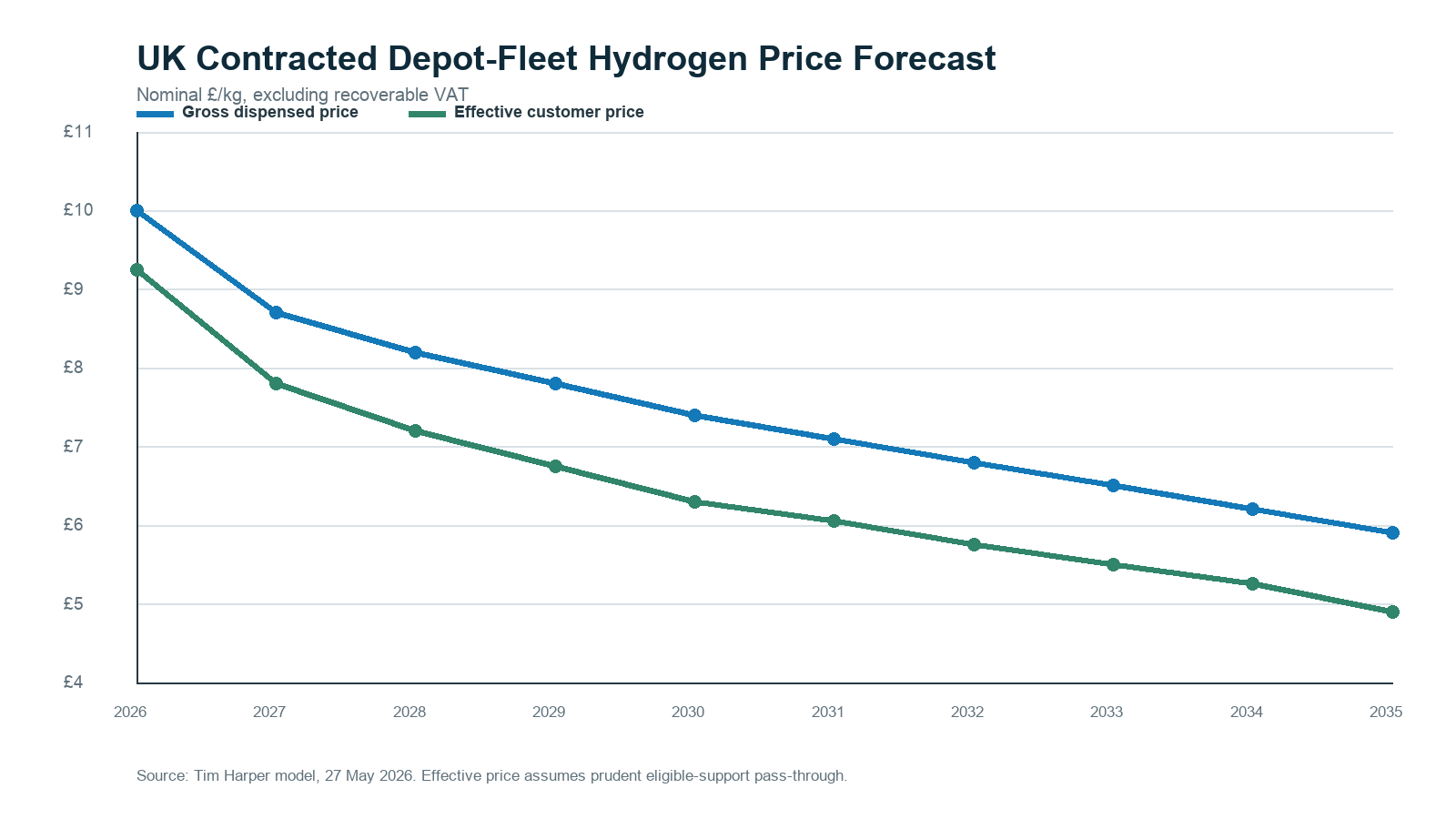
The following is the report’s best-estimate contracted depot-fleet trajectory. It is not a forecast of public retail pricing. Ranges are nominal pounds per kilogram, excluding recoverable VAT.
| Year | Ex-plant | Delivered | Dispensed | Effective customer price | Confidence |
|---|---|---|---|---|---|
| 2026 | £6.5-7.5 | £8.0-9.0 | £9.5-10.5 | £8.0-9.5 | Medium |
| 2027 | £5.3-6.3 | £6.8-7.8 | £8.2-9.3 | £6.8-8.2 | Medium |
| 2028 | £5.0-5.8 | £6.4-7.3 | £7.7-8.7 | £6.3-7.7 | Medium |
| 2029 | £4.7-5.5 | £6.1-7.0 | £7.3-8.3 | £6.0-7.3 | Low-medium |
| 2030 | £4.4-5.2 | £5.8-6.7 | £7.0-7.8 | £5.8-7.0 | Low-medium |
| 2031 | £4.2-5.0 | £5.5-6.4 | £6.7-7.5 | £5.5-6.8 | Low |
| 2032 | £4.0-4.8 | £5.3-6.1 | £6.4-7.2 | £5.3-6.5 | Low |
| 2033 | £3.8-4.6 | £5.0-5.9 | £6.1-6.9 | £5.0-6.2 | Low |
| 2034 | £3.6-4.4 | £4.8-5.6 | £5.9-6.6 | £4.8-6.0 | Low |
| 2035 | £3.4-4.2 | £4.6-5.4 | £5.6-6.3 | £4.6-5.7 | Low |
Scenario Modelling
The base case carries a 50% modelling probability: supported production arrives with some delays, depot clusters form, RTFC value is partly shared and public-network utilisation remains uneven. Best and downside cases each carry 25%. These probabilities express analytical judgement, not statistical certainty.
| Year | Downside | Base | Best |
|---|---|---|---|
| 2026 | £12.5 | £10.0 | £9.0 |
| 2027 | £11.3 | £8.7 | £7.2 |
| 2028 | £10.8 | £8.2 | £6.5 |
| 2029 | £10.3 | £7.8 | £6.0 |
| 2030 | £9.8 | £7.4 | £5.7 |
| 2031 | £9.5 | £7.1 | £5.4 |
| 2032 | £9.2 | £6.8 | £5.2 |
| 2033 | £8.9 | £6.5 | £5.0 |
| 2034 | £8.7 | £6.2 | £4.8 |
| 2035 | £8.5 | £5.9 | £4.6 |
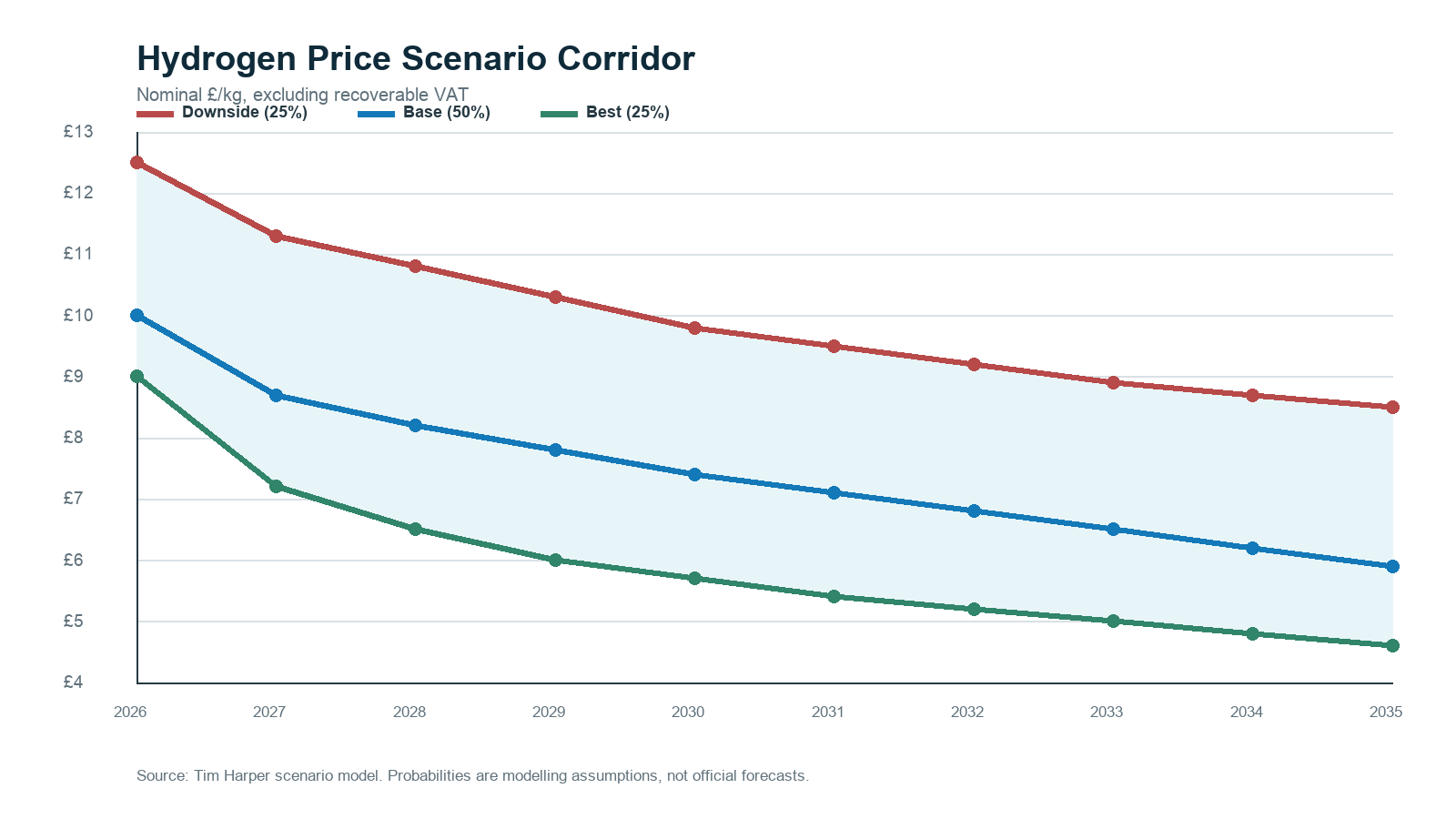
The best case assumes that £5-6/kg ex-plant supply becomes widely contractable, logistics are short and 500-1,000 kg/day clusters become common. The downside assumes slow vehicle demand, low station utilisation, expensive finance and support retained upstream. The spread between scenarios does not disappear quickly because infrastructure utilisation can remain weak even after production costs fall.
The confidence bands widen after 2030 because several uncertainties compound. HAR delivery schedules, future support design, electricity prices, electrolyser utilisation, certificate markets, vehicle availability and financing costs can each move the result. A forecast that shows a smooth national decline without segmenting these risks creates false precision. The useful question is not whether the base-case line is exactly right in 2033. It is which commercial conditions move a specific project from the downside case toward the best case.
The Hidden Variable: Station Utilisation
Station utilisation is one of the most important variables in hydrogen economics. A fleet sees a fuel price. An infrastructure investor sees a fixed-cost asset whose capital recovery and maintenance bill must be divided by kilograms sold.
| Station type | Capacity | CAPEX | Fixed OPEX | 20% utilisation | 50% | 80% |
|---|---|---|---|---|---|---|
| Captive depot | 500 kg/day | £1.5m | £100k/year | £7.26/kg | £2.90/kg | £1.81/kg |
| Cluster station | 1,000 kg/day | £3.0m | £200k/year | £7.26/kg | £2.90/kg | £1.81/kg |
| Public HGV station | 1,000 kg/day | £4.5m | £300k/year | £10.89/kg | £4.35/kg | £2.72/kg |
| Large hub | 2,000 kg/day | £7.0m | £450k/year | £8.34/kg | £3.34/kg | £2.09/kg |
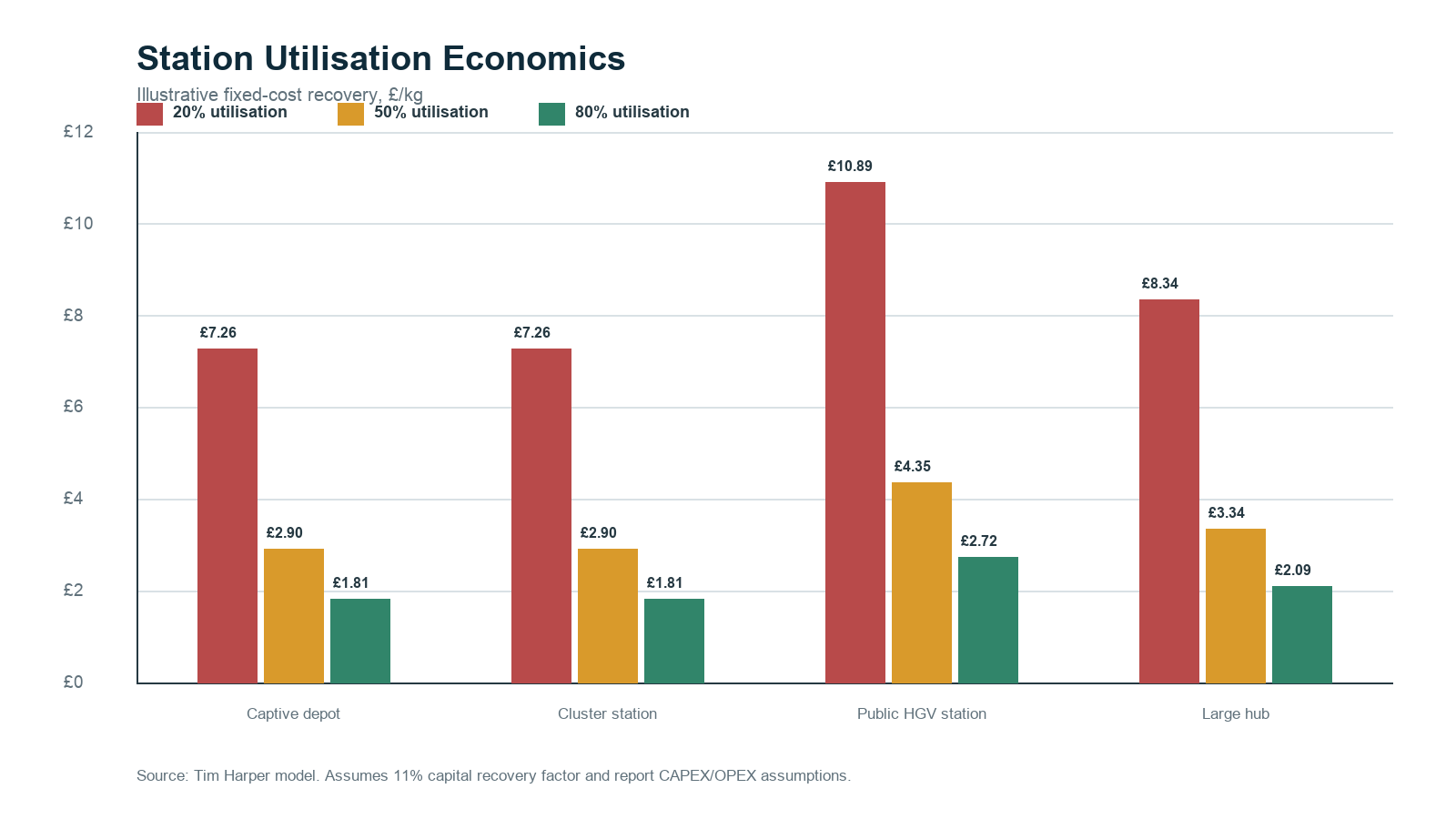
The direction is more important than false precision. Low-utilisation public stations cannot offer £6/kg dispensed hydrogen without subsidy or cross-subsidy. Captive depots can reach competitive economics because contracted vehicles arrive every day. Installed capacity is not demand. Volume sold is what pays for the asset.
How Much Demand Does a Hydrogen Station Need?
| Vehicle type | Hydrogen use | Vehicles for 500 kg/day | Vehicles for 1,000 kg/day |
|---|---|---|---|
| Urban buses | 25-35 kg/day | 15-20 | 30-40 |
| Refuse vehicles | 18-30 kg/day | 17-28 | 34-56 |
| Regional HGVs | 35-55 kg/day | 9-14 | 18-29 |
| Long-haul HGVs | 60-90 kg/day | 6-8 | 12-17 |
| Construction equipment | 100-500 kg/day/site | 1-5 large sites | 2-10 large sites |
This table explains why buses, refuse fleets, ports, airports and construction sites are likely early adopters. A relatively small number of intensively used assets can support meaningful throughput. By contrast, a public station may need a large and geographically dispersed vehicle parc before utilisation becomes bankable.
Supply Route Economics
| Supply route | 2027 supply cost | 2030 supply cost | Strength | Weakness |
|---|---|---|---|---|
| HAR-backed green hydrogen | £5.0-6.5/kg supported sale | £3.8-5.2/kg | Bankable early cluster supply | Support terms and delivery timing |
| Merchant electrolysis | £7.0-10.0/kg | £5.5-8.0/kg | Flexible project structure | Power-price and utilisation exposure |
| Private-wire electrolysis | £5.0-7.0/kg | £3.8-5.8/kg | Strong provenance and potential RTFC case | Generation matching and site constraints |
| By-product hydrogen | £2.0-4.5/kg | £2.0-4.5/kg | Low local cost | Finite, local and certification-constrained |
| Blue hydrogen | £3.5-6.0/kg | £3.0-5.5/kg | Potential cluster scale | Gas, CCS, emissions and procurement risk |
| Imported hydrogen | £6.0-10.0/kg landed | £4.5-8.0/kg | Potential future price cap | Liquefaction, handling, boil-off and certification |
Production route affects both gross cost and support eligibility. Cheap by-product or blue hydrogen may support attractive gross pricing but should not be conflated with renewable hydrogen. Private-wire electrolysis may create the cleanest RTFC case but can suffer low electrolyser utilisation. Imported hydrogen may eventually cap prices, but it is not a near-term answer to every depot.
Diesel Parity and Fleet Economics
Fuel-price parity is not a comparison between £/kg and £/litre. It depends on vehicle efficiency and duty cycle. Using the report’s diesel baseline and vehicle assumptions, refuse vehicles reach direct fuel-cost parity around £10.69/kg, urban buses around £8.30/kg, regional HGVs around £6.69/kg, long-haul HGVs around £6.66/kg and construction equipment around £5.13/kg.
| Use case | Diesel use | Hydrogen use | Fuel-cost parity |
|---|---|---|---|
| Refuse vehicle | 75 l/100 km | 11.0 kg/100 km | £10.69/kg |
| Urban bus | 45 l/100 km | 8.5 kg/100 km | £8.30/kg |
| Regional HGV | 32 l/100 km | 7.5 kg/100 km | £6.69/kg |
| Long-haul HGV | 34 l/100 km | 8.0 kg/100 km | £6.66/kg |
| Construction equipment | 18 l/hour | 5.5 kg/hour | £5.13/kg |
These are fuel-only thresholds. Full TCO must include vehicle premium, financing, maintenance, residual value, infrastructure access and downtime. Fuel-cell drivetrains can use hydrogen more efficiently than combustion. Retrofit dual-fuel systems have a different logic: they avoid full vehicle replacement but do not receive the same efficiency uplift. The report estimates ULEMCo-style dual-fuel energy parity at approximately £5.25/kg before conversion cost.
The diesel baseline uses GOV.UK weekly road-fuel data and includes fuel duty, while excluding recoverable VAT for commercial fleets. Because diesel prices move, parity is a moving target. Current comparisons should always be refreshed with the latest official series and HMRC duty treatment.
Implications for Fleet Operators
Fleet operators should procure a delivered service, not merely a headline kilogram price. The contract needs to define pressure, availability, backup supply, eligible provenance, RTFC ownership, price indexation, minimum volume and what happens when the station is unavailable.
Buses and refuse fleets can aggregate demand at a depot and can reach fuel parity at higher hydrogen prices than HGVs. Ports and airports combine concentrated vehicles with local air-quality value. Construction can use controlled sites and mobile delivery. Regional HGVs become credible where they return to base or operate within a cluster. Long-haul HGVs require corridor reliability as well as competitive fuel.
Operators should connect hydrogen procurement to a full fleet decarbonisation economics model. Battery-electric will remain superior for many workloads. Hydrogen is most defensible where high utilisation, refuelling speed, payload, grid constraints or specialist duty cycles create a genuine operating advantage. The battery payload calculator helps make that comparison explicit. An independent fleet economics review can test that comparison against the operator’s route and infrastructure data.
Implications for Hydrogen Infrastructure Investors
Do not value hydrogen infrastructure by kilograms of installed capacity. Value it by kilograms sold through utilised assets under bankable contracts.
Investors should begin with contracted throughput and downside utilisation, then work backwards to station size. Take-or-pay or minimum-volume commitments can reduce financing risk. Anchor demand should be secured before speculative capacity is installed. Logistics distance, backup arrangements and RTFC monetisation must be explicit rather than buried in a blended margin assumption.
Modular expansion is particularly valuable in an immature market. A smaller first phase may carry a somewhat higher theoretical unit cost at full utilisation, but it reduces the risk of paying for capacity that will sit idle for years. Expansion should be triggered by signed vehicle deployments and demonstrated daily throughput. Investors should also distinguish technical uptime from commercial availability: a station can be mechanically operational yet unable to dispense because hydrogen delivery, certification or storage has failed.
| Investor assumption | Recommended base treatment |
|---|---|
| 2027-2028 cluster dispensed price | £7-8.5/kg gross; £6-7.5/kg effective |
| 2030 broad contracted price | £7-8/kg |
| 2030 best cluster price | £5.5-6.5/kg |
| 2030 public/corridor price | £8-10/kg |
| RTFC customer benefit | £0.75-1.25/kg prudent; £1.25-2.00/kg cluster upside |
| Station deployment | Modular expansion tied to contracted demand |
| Terminal value | Do not assume permanent full RTFC support |
The strongest projects integrate supply, logistics, dispensing and demand without hiding cross-subsidies. RTFC value can be used to win an anchor fleet and improve utilisation, but a station that only works at the theoretical certificate ceiling is not a robust infrastructure asset. See the wider analysis of UK hydrogen infrastructure and the recent discussion of how Germany is sharing compliance value at high-volume stations in the H2 Mobility pricing analysis.
Implications for Policymakers
Policy should concentrate demand as well as support production. A cheap molecule delivered into an underutilised station is still expensive at the vehicle tank. Cluster development, certification clarity, durable RTFC rules and bankable fleet commitments can reduce more risk than indiscriminate station coverage.
Public procurement can help create that concentration. Municipal refuse fleets, buses and public-service vehicles can provide anchor demand where a local supply route is credible. The objective should not be to mandate hydrogen where batteries work better. It should be to aggregate difficult-to-electrify workloads so that production and dispensing assets have a realistic utilisation path. Support should then decline as throughput and private contracting improve, rather than preserving permanently uneconomic stations.
Certification rules need to be demanding enough to protect environmental integrity and clear enough to finance. Policymakers should avoid conflating renewable and low-carbon hydrogen, and should ensure that support mechanisms do not create stranded assets or reward installed capacity without throughput. The relationship between hydrogen and UK wind curtailment is real, but curtailed electricity is not simply free fuel: electrolyser utilisation and network constraints still matter.
Original analysis attribution: This article contains original market analysis and forecasting by Tim Harper based on hydrogen infrastructure economics, fleet adoption modelling, RTFC policy analysis and publicly available government data. Forecasts and scenarios represent the author’s analysis rather than official government forecasts.
Frequently Asked Questions
What is the current UK hydrogen price per kg?
There is no single national market price. The model estimates 2026 contracted depot-fleet hydrogen at £9.5-10.5/kg gross dispensed, with higher prices likely for public or low-volume supply.
Could UK hydrogen reach £6/kg by 2030?
Yes, in selected captive clusters with low-cost supply, short logistics, strong utilisation and support sharing. £6/kg is not the model’s broad-market base case.
What is the difference between ex-plant and dispensed hydrogen pricing?
Ex-plant is the price at the production site. Dispensed pricing includes delivery, conditioning, storage, station capital recovery, operating cost, losses, margin and risk.
Does HAR1 mean fleets can buy hydrogen at £9.5/kg?
No. The approximately £9.5/kg equivalent is a supported producer strike-price reference. It is not a fleet retail price.
How much are RTFCs worth?
Theoretical gross value equals the certificate price multiplied by 9.16 RTFCs/kg for qualifying hydrogen. Actual customer benefit is lower and contract-dependent; the prudent model range is £0.75-1.25/kg.
Does blue hydrogen qualify for RTFCs?
Blue hydrogen may qualify as low carbon under relevant standards, but it should not be assumed to qualify for renewable-hydrogen RTFC treatment.
Why does station utilisation matter?
Station capital and fixed operating costs are spread across kilograms sold. At low utilisation, fixed cost per kilogram can exceed the cost of the hydrogen itself.
Which fleets are likely to adopt hydrogen first?
Depot-based, high-utilisation and operationally difficult-to-electrify fleets: refuse vehicles, some buses, ports, airports, construction equipment, specialist fleets and regional HGV clusters.
Conclusion
The UK hydrogen market will not clear at one national price. It will clear first in local fuel ecosystems where supply, vehicles, refuelling, certification and support are contracted together. The credible route to lower pricing is not simply cheaper electrolysers. It is lower supported supply cost combined with short logistics, high station utilisation and bankable demand.
The decisive question is not when UK hydrogen reaches £6/kg. The decisive question is which fleets can access £6/kg effective hydrogen with reliable uptime, and which infrastructure operators can provide it without destroying their own return on capital.
Need a fleet-level hydrogen economics model?
Need to evaluate depot-scale hydrogen infrastructure? Need independent analysis of hydrogen pricing, RTFCs or infrastructure investment? Contact Tim Harper.
Sources and Model Notes
- Primary analytical source: Tim Harper, UK Transport Hydrogen Price Forecast, 27 May 2026.
- DESNZ: Hydrogen Allocation Rounds.
- DESNZ: HAR2 cost challenge guidance.
- DESNZ: Hydrogen Production Business Model and Low Carbon Hydrogen Agreement.
- DfT: Renewable Transport Fuel Obligation and RTFO guidance.
- DfT: RFNBO guidance.
- DESNZ: UK Low Carbon Hydrogen Standard.
- DESNZ: Weekly road fuel prices and HMRC: fuel duty rates 2026-27.
- IEA: Global Hydrogen Review 2025.
- IRENA: electrolyser costs.
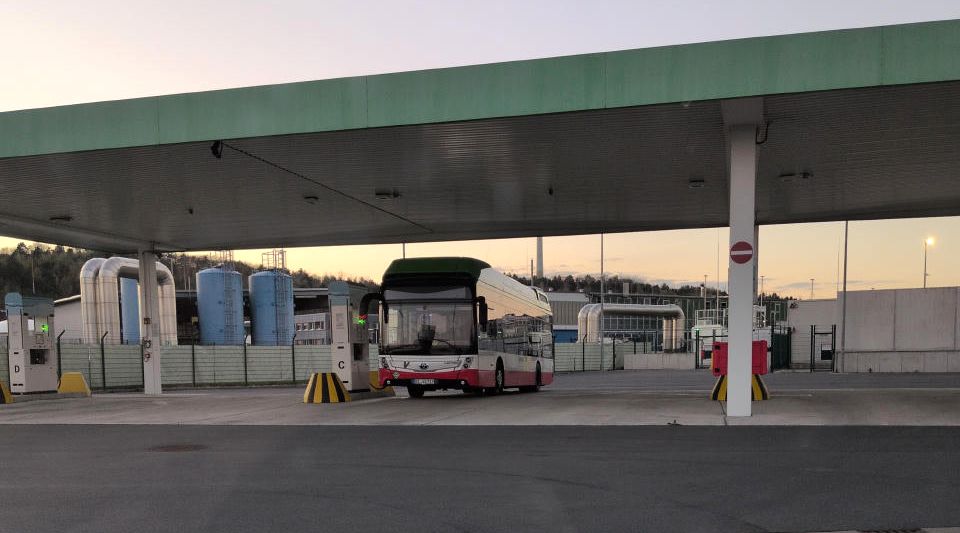
- Featured photograph: fuel-cell bus at a hydrogen refuelling station, Icke68746, CC0.
Last updated: 10 June 2026. All model prices are nominal £/kg excluding recoverable VAT unless stated. Forecasts, probabilities, cost ranges and certificate pass-through assumptions are Tim Harper modelling assumptions. Verified policy facts are linked to official sources.