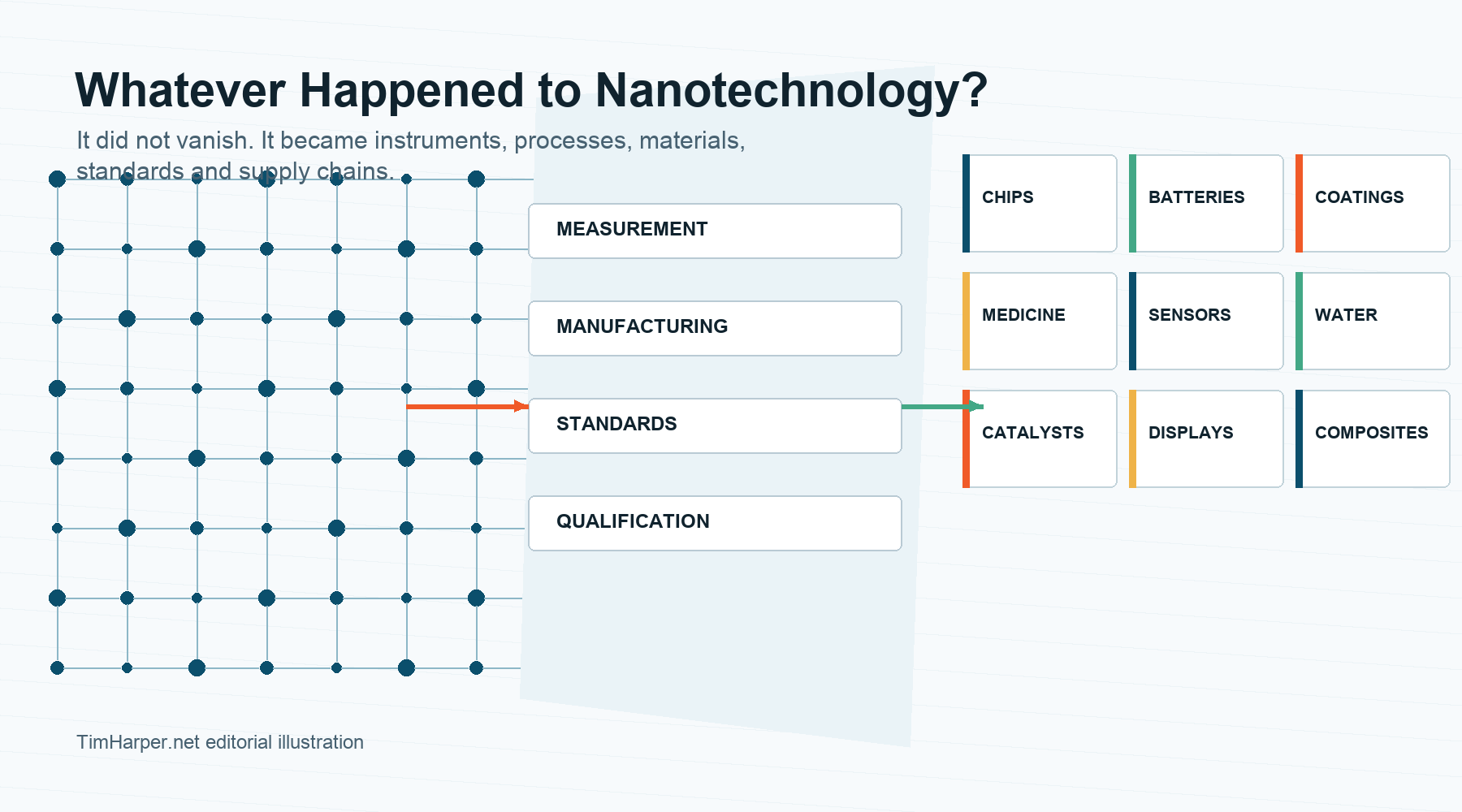
Nanotechnology did not fail. The investment bubble failed. The label faded. The useful parts became tools, materials, processes, standards and supply chains. That was not the story people expected in 2005, but it is the story my archive now tells.
There is a folder in my archive called Old Nanotech Stuff. It is not a subtle name. Inside it are the strata of a particular period in technology history: TNT03, TNT05, WNEC India, NanoForum, Visit Reports, NanoWater, NanoSight, government strategies, roadmaps, market reports, risk reports, conference prospectuses and half-forgotten presentations from cities where everyone was trying to work out whether nanotechnology was about to become the next industrial revolution.
That folder is a better starting point than another general history of nanotechnology. The general history has been told often enough: Feynman, Drexler, the National Nanotechnology Initiative, scanning probe microscopes, fullerenes, carbon nanotubes, quantum dots, graphene, the hype, the backlash, the apparent disappearance. It is useful, but I am not interested in retelling it here.
What interests me now is what the industry looked like from the inside: founding Cientifica, co-founding NanoSight, selling nanotechnology market intelligence to investors and governments, organising business conferences, sitting in standards and policy conversations, watching public markets misunderstand industrial timescales, and later seeing the same commercialisation habits reappear in graphene, hydrogen, robotics and AI.
My archive does not show a field that vanished. It shows a field being absorbed.
The Files Say Something Different
The popular version of the story is simple. Nanotechnology was overhyped in the early 2000s. Investors believed impossible forecasts. The public heard about grey goo and tiny robots. Companies put “nano” in their names. Then the bubble burst, the headlines faded and everyone moved on to the next thing.
That version is not completely wrong. It is just incomplete enough to be misleading.
There was hype. There were inflated numbers. There were companies with more narrative than revenue. There were consultants, analysts, conferences, funds, government programmes and start-ups all trying to find shape in a field that was not really a field at all. There were also real technologies, real customers, real tools, real materials and real industrial constraints. The mistake was treating all of those as one thing.
In the early Cientifica material, the warning signs are already there. The 2003 executive summary of The Nanotechnology Opportunity Report took aim at the idea of a single nanotechnology market. The report’s point was not that nanotechnology was unimportant. It was that the phrase “nanotechnology market” was close to meaningless if it included everything from semiconductor process control to cosmetics, solar cells, drug delivery, coatings, sensors and materials characterisation. A scale of measurement is not a market segment.
That was the first commercial warning. Nanotechnology was not an industry in the way steel, software or automotive manufacturing are industries. It was a set of capabilities that appeared wherever control of matter at small length scales changed performance, cost or functionality. Sometimes that meant a company could sell a product called nanotechnology. More often it meant an established sector quietly improved something it already did.
The archive is full of that tension. On one page there are trillion-dollar forecasts and investor excitement. On another, a far more practical list: particle size, surface area, agglomeration, toxicity, standards, metrology, manufacturing, quality control, customer qualification, regulation. The second list turned out to be the more important one.
That is why “whatever happened to nanotechnology?” is the wrong question if it means “where is the nanotechnology industry?” The better question is: where did nanoscale control become useful enough to stop needing the label?
The Boom Was A Market Trying To Invent Itself
Looking back at the World Nano-Economic Congress material, the strangest thing is how explicit the ambition was. The WNEC prospectuses from Singapore and India were not shy about the purpose of the events. They brought together science, government and business to discuss the full value chain of nanotechnology’s commercial development. The agendas included batteries, water purification, composites, safety and toxicology, venture funding, manufacturing, tools and commercialisation strategies.
That sounds normal now. In 2005 and 2006 it was more experimental than it looks on paper.
The conferences were not just conferences. They were market-making exercises. They put electron microscope companies next to government agencies, venture capitalists next to university researchers, materials start-ups next to corporates trying to understand whether they were missing something. The prospectuses promised sponsors qualified leads and access to decision makers because the industry was still trying to work out who the buyers were.
I was not watching that process from the back row. Through Cientifica I was, for better or worse, one of the people trying to convene it. TNT, WNEC and the NanoWater conferences were part conference, part market experiment and part travelling argument about what nanotechnology was actually for. Ringmaster is not a word I would have put on a business card, but it is not a bad description of the job: keep the scientists, investors, government people, start-ups, instrument companies and industrial customers in the same tent long enough for useful collisions to happen.
There is a line in the WNEC Singapore material about connecting Chinese technologies and manufacturing capabilities with global nanotechnology markets. There is another in the India prospectus about textiles, automotive industries and air and water purification. These were not fantasies about nanobots. They were attempts to connect nanoscale research with sectors that already knew how to buy, manufacture and distribute things.
That is what made those events useful and occasionally absurd. Everyone wanted the revolution, but the serious conversations kept returning to components, instruments, standards, regulations and customers. The conference stage wanted a future. The exhibition floor wanted a purchase order.
The same pattern appears in the visit reports. Tokyo in 2005 was about market need, committees, conference links and the Japanese ecosystem. Singapore was about foresight, water, bio-nano events and the country’s instinct for turning technology into national strategy. Riyadh, in the KACST roadmap work, was about building a nanotechnology centre with scientific and commercial focus, using roadmapping, technology transfer, standards bodies, human resources and international cooperation.
Those files make the period feel less like a bubble and more like a global search process. Governments, companies and investors could see that something was happening. They could not yet agree what the commercial unit was.
The Archive Is A Better Witness Than Memory
Memory makes technology history too neat. It rearranges events into a story that seems obvious because we already know what happened. The archive is less polite. It keeps the contradictions.
The Tim Harper Nanotechnology Archive is not only a set of old articles. It is a record of a period when the industry was still arguing with itself. My local files include market reports written when the forecasts were still moving, conference documents designed to persuade sponsors that the audience existed, risk papers written before regulators had settled language, company plans written before the product had found its market, and visit reports from cities trying to decide whether nanotechnology was a research priority, an industrial policy tool, an investment theme or all three.
That is why I have tried to keep this article close to those files. A clean retrospective would be easier to write. It would say that investors were foolish, governments were overexcited, start-ups were unrealistic and the serious companies carried on. There is some truth in that, but it misses the texture of the time. The people in those meetings were not stupid. They were often asking the right questions with incomplete evidence. Which applications are real? Which countries are serious? Which companies can manufacture? How do you compare materials that nobody can define consistently? How much of the market is new demand and how much is substitution? Who pays for the testing? Who carries the liability if a material migrates, aggregates, degrades or fails?
Those were not abstract questions. They came up in investor meetings, government workshops, conference corridors, laboratory visits and awkward conversations with founders who wanted a market to exist faster than it did. They came up with corporates that wanted to know whether they were falling behind, but also knew that putting an unqualified new material into an existing product could create more risk than advantage. They came up with policymakers who wanted national leadership but had to turn an enabling science into budget lines, centres, training programmes and public explanations.
This is where TimHarper.net has a different job from a general nanotechnology history. I do not want to say “nanotechnology changed the world” or “nanotechnology was hype”. Both statements are too lazy. I want to show how an emerging technology looks before the labels settle, because that is the thing the archive can still do. It shows the optimism and the unease together.
It also shows how much commercialisation depends on people who rarely appear in popular accounts of breakthrough science: application engineers, standards participants, metrology specialists, business development people, policy officials, conference organisers, corporate scouts, insurers, procurement teams, scale-up managers and technical salespeople. Nanotechnology did not move from laboratory to market because a single paper changed everything. It moved through hundreds of negotiations over definition, evidence, cost, risk and use.
That is why this story has to feel lived rather than merely researched. My archive is full of the smell of photocopied prospectuses, conference hotel lobbies, exhibition stands, investor briefings, government workshops and laboratories where the instrument was more convincing than the pitch. It is not nostalgia. It is evidence of how deep technology actually travels.
The Hype Curve Was Useful, But It Was Never The Whole Story
I used versions of the Gartner hype cycle in presentations for years because it gave audiences permission to talk about expectation as a commercial force. It was a simple curve, and like all simple curves it was both useful and dangerous.
Useful, because the nanotechnology boom really did follow the emotional shape: early excitement, inflated expectations, disappointment, quieter learning and eventual productive use. Dangerous, because it made the process look too tidy. Technologies do not move smoothly from one stage to another. Companies run out of cash. Governments change priorities. Standards take longer than expected. Customers get nervous. A good application appears in an unfashionable market. A boring supplier becomes more valuable than the celebrated start-up. A word disappears while the technology underneath it keeps moving.
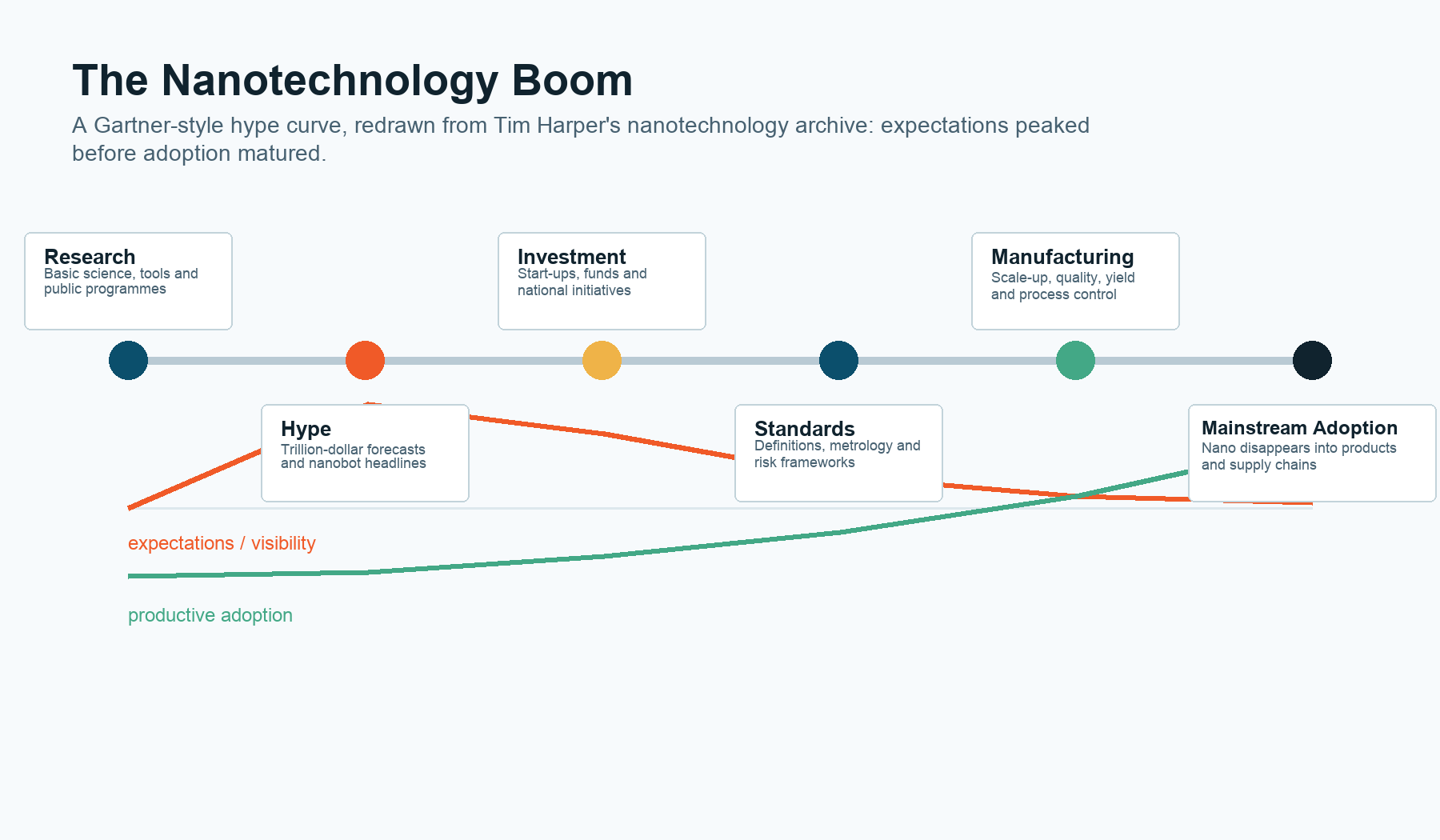
The hype curve also hides a commercial truth that is easier to see in hindsight. The peak of attention is not the peak of value creation. The peak of attention is usually when the story is easiest to tell and hardest to prove. The value often arrives later, after the language has become less exciting.
This is why the nanotechnology boom looks odd from 2026. The public story faded, but the National Nanotechnology Initiative did not vanish. The official NNI 2026 budget supplement says the President’s 2026 Budget requested $1.45 billion for the initiative and that cumulative NNI funding since 2001 totals nearly $47 billion, including the 2026 request. ISO/TC 229, created in 2005, now lists 118 published ISO standards and 36 under development. Those are not the vital signs of a dead field. They are the infrastructure of a field that matured out of public view.
The hype curve was an expectations chart. The real story was an infrastructure chart.
Cientifica Was Selling Translation
I founded Cientifica because the nanotechnology conversation needed translation as much as it needed enthusiasm. The old two-page profile carried the line “where nanotech means business”. It was a neat line, but the business was not selling certainty. The business was translation.
The clients were manufacturers, investors, governments, insurers, law firms and corporates that could see the word nanotechnology everywhere and did not know which parts mattered. The service was not to say “buy nano”. It was to connect technologies with markets, monitor companies, quantify risks, develop strategies and make better decisions in a field characterised by hype and inflated statistics.
That was a good business because the confusion was real. A venture capitalist wanted to know whether a start-up was a platform or a science project. A government wanted to know whether a national programme should fund basic research, manufacturing facilities, standards work or industry clusters. A large company wanted to know whether nanotechnology threatened an existing product line or offered a cheaper route to performance. An insurer wanted to understand whether nanoparticles created new liabilities. A regulator wanted definitions that would not collapse under scientific scrutiny.
The 2005 Cientifica risk report is striking because it feels contemporary. It talks about regulators, insurance premiums, definitions, exposure monitoring, product life cycles, the Royal Society report, European Parliament discussions, British Standards and the difficulty of regulating “nanotechnology” as if the word described a single risk. The report’s centre of gravity is not wonder. It is governance.
This is a side of the nanotechnology story that the failure narrative usually misses. The boom forced institutions to build machinery: standards committees, risk frameworks, measurement protocols, regulatory discussions, public engagement, technology roadmaps. Some of that was premature. Some of it was slow. Some of it was bureaucratic. But it was part of how the field became usable.
The European Commission’s 2005 action plan reads the same way. It recognised nanosciences and nanotechnologies as enabling advances across many sectors, but it also called for infrastructure, industrial innovation, standards, nanometrology, responsible development, risk assessment, public dialogue and international cooperation. The Royal Society and Royal Academy of Engineering report, published in July 2004, did something similar in the UK by putting opportunities and uncertainties in the same frame.
That combination mattered. The public wanted to know whether nanotechnology was dangerous. Investors wanted to know whether it was profitable. Industry wanted to know whether it was reliable. Governments wanted to know whether it was strategic. Cientifica sat in the middle of those questions.
The Forecast Was The Least Interesting Product
The most quotable part of the nanotechnology boom was the trillion-dollar market forecast. It was irresistible because it turned a vague enabling science into a number large enough for ministers, investors and journalists to understand. It was also a trap.
The 2003 Nanotechnology Opportunity Report was more sceptical than many people now remember. It did not deny the scale of the opportunity. It challenged the usefulness of the category. A market forecast that includes a semiconductor device, a sunscreen, a polishing slurry, a drug-delivery system, a catalyst, a research instrument and a textile finish may be numerically impressive, but it is not necessarily commercially useful. It does not tell a founder whom to sell to. It does not tell an investor how long qualification will take. It does not tell a government whether to build a pilot line or fund a toxicology programme.
The better part of the work was not the big number. It was the segmentation behind it.
In practice, Cientifica was most useful when it made the word nanotechnology smaller. That sounds backwards, but it was the only way to make the field actionable. A client did not need a lecture on the transformational nature of nanoscale science. They needed to know whether carbon nanotubes were a materials business, a process-control problem, an intellectual-property thicket, a toxicology concern, a composites opportunity or a distraction. The answer could be different depending on whether the client made aircraft components, electronics, filtration systems, sporting goods, chemicals or analytical instruments.
This is why the consultancy work was often closer to translation than prediction. The task was to move between languages. Scientists talked about mechanisms and properties. Investors talked about addressable markets and exits. Governments talked about national capability and strategic sectors. Corporate managers talked about product roadmaps, risk, margins and supplier reliability. Regulators talked about exposure, definitions and evidence. None of those languages was wrong. None was sufficient on its own.
The forecasts mattered because they opened doors. The maps mattered because they helped people decide what to do after entering the room.
This is also why some of the old reports read better now than more confident predictions from the same period. The useful parts are the cautions: the warning that a nanotechnology market is an artificial construct, the reminder that many commercial effects would be small but significant, the insistence that manufacturing and metrology were already shaping national differences, and the repeated concern that hype and poor definitions would distort decisions. Those observations aged better than the headline numbers.
There is a current parallel here with AI market forecasts. The largest numbers are less interesting than the segmentation. “AI” can mean data-centre chips, model providers, enterprise software, drug discovery tools, call-centre automation, robotics, military systems, design software, compliance tools, synthetic media or workflow integration. A huge total market tells us less than the route by which a particular customer changes behaviour. The same was true of nanotechnology. The category was exciting. The application was the business.
If there is one thing I would rescue from the consultancy era, it is not a forecast. It is the habit of asking what the word hides.
NanoSight Was The More Important Lesson
If I had to choose one company from the archive that explains the commercial history of nanotechnology better than the public-market pure plays, I would choose NanoSight. That is partly because I was a co-founder, but mainly because NanoSight shows the side of nanotechnology that actually became indispensable.
It was not the loudest story. It did not promise to remake civilisation. It did something more useful. It helped people see and measure nanoparticles in liquid in real time.
The early business plan is wonderfully specific. NanoSight wanted first-stage equity funding of GBP350,000 to manufacture and sell the first devices. The initial product range was not a moonshot. It included a microscope attachment, advanced analytical systems and portable or online systems, with early prices in the low thousands to tens of thousands of pounds. Manufacturing was to be handled through a partner, reducing the need for heavy infrastructure at the start. The company was aiming at customers who needed practical nanoparticle analysis, not a philosophical argument about the future.
The 2003 press release with Smiths Detection positioned the technology for biohazard detection, virus detection, quality control in nanomaterials and nanoparticle analysis. It is a reminder that measurement is not a support activity in emerging technology. Measurement is often the market.
That is one of the reasons NanoSight matters in this story. When people ask what happened to nanotechnology, they often look for spectacular end products. But the companies that enable other people to qualify, manufacture and regulate new materials can be more durable than companies trying to own a grand platform. If you cannot measure the particle, you cannot sell the material with confidence. If you cannot prove consistency, you cannot qualify into a product. If you cannot monitor exposure, you cannot manage risk.
NanoSight later became part of the wider particle-characterisation instrumentation landscape through Malvern. That is a quieter ending than a consumer revolution, but commercially it is a very respectable one. The technology found a place in the analytical toolkit. It became useful infrastructure.
I keep coming back to that example because selling the tool that lets a new industry measure itself is often a better business than selling the entire future.
The Science Was Never The Only Hard Part
There is a phrase that appears again and again in the archive, sometimes explicitly and sometimes between the lines: manufacturing.
In 2003, the Cientifica material noted that many US nanotechnology companies existed because high-precision manufacturing and metrology had already developed around the semiconductor industry. Germany’s strength was linked to chemicals and materials producers refining processes that were already producing nanoscale products. That observation matters. The commercial winners were not always the places with the best slogans. They were the places with adjacent industrial capabilities.
This is still poorly understood. A country can fund excellent science and still fail to build an industry if it lacks process engineering, scale-up facilities, quality systems, patient procurement, technical sales channels and manufacturing customers. A start-up can own patents and still fail because the customer cannot integrate the material. A government can create a centre of excellence and still miss the market because it measures publications rather than adoption.
Nanotechnology exposed the gap between research excellence and industrial capability. Graphene exposed it again. Hydrogen is exposing it in infrastructure. Robotics will expose it in reliability and service. Physical AI will expose it in sensors, actuators, safety cases and edge deployment.
The science matters. But after the first proof, the problem changes. It becomes a chain of less glamorous questions.
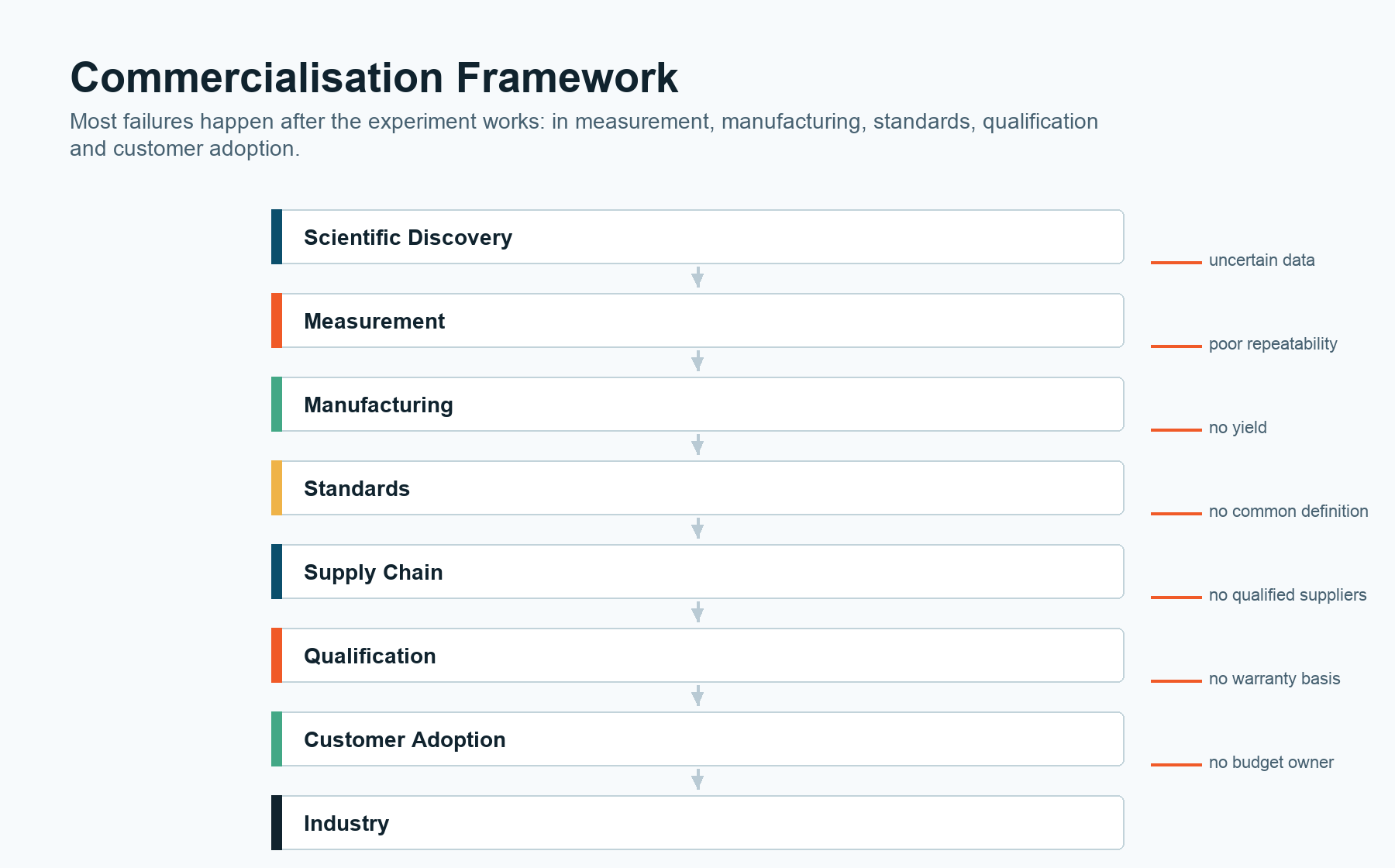
Can the material be made repeatedly? Can the process be scaled without changing the property that made it useful? Can the customer test it without inventing a new laboratory? Can a standards body describe it? Can an insurer price the risk? Can a factory run it on a normal shift? Can a second supplier exist? Can a purchasing manager compare it with the incumbent? Can the value survive when the customer demands margin?
Most technologies fail outside the laboratory rather than inside it.
Standards Created Markets
Standards are boring until you need one. Then they become the difference between a market and a collection of incompatible claims.
Nanotechnology needed standards because the word covered too much. What counted as a nanoparticle? Was a particle defined by one dimension below 100 nanometres, by novel properties, by manufacturing intent, by exposure pathway, by surface chemistry, by aggregation state? How should a company report size distribution? What test methods should regulators recognise? How should a buyer compare two suppliers of what appeared to be the same material?
The ISO/TC 229 scope is revealing. It covers understanding and control of matter and processes at the nanoscale, but its specific tasks include terminology, nomenclature, metrology, instrumentation, reference materials, test methodologies, modelling, simulations and health, safety and environmental practices. In other words, it is not only about naming the science. It is about creating the conditions under which people can trade, regulate and trust it.
This is why I have become impatient with technology commentary that treats standards as a late administrative detail. Standards are part of market formation. They reduce ambiguity. They let customers specify. They let suppliers compete on comparable terms. They let regulators avoid inventing definitions case by case. They let insurers and finance teams move from unease to diligence.
Graphene suffered from the same issue. There was graphene, graphene oxide, reduced graphene oxide, nanoplatelets, few-layer graphene, functionalised graphene and a wide range of materials sold under a word that customers thought they understood until they tried to specify it. Hydrogen has a similar problem with colours, carbon intensity, certification and price layers. AI is now discovering the same issue in safety, provenance, evaluation and auditability. Robotics will face it in safety, uptime, interfaces and performance claims.
Standards are not the enemy of innovation. They are one of the ways innovation becomes purchasable.
The Companies That Quietly Won
The nanotechnology boom produced failures, but it also produced a pattern of quieter success. The winners were not always the companies with the purest nanotechnology identity. In fact, the pure identity could become a liability.
The companies that did best tended to fall into a few categories. Some sold tools and instruments. Some supplied materials into existing industries. Some were acquired by larger manufacturers or equipment companies. Some survived by narrowing their application. Some created value through intellectual property rather than by owning the end product. Some stopped looking like nanotechnology at all.
| Pattern | Examples | What It Shows |
|---|---|---|
| Measurement and tools | NanoSight, FEI, JEOL, Oxford Instruments, Veeco, Cambridge NanoTech | The people selling the ability to see, measure, deposit or control nanoscale structures often had clearer customers than broad materials platforms. |
| Materials absorbed into supply chains | Nanosys, QD Vision, Nanoco, Thomas Swan, Graphenea | Quantum dots, graphene and speciality materials created value when they entered displays, chemicals, coatings or research supply chains, not when they remained abstract platforms. |
| Public-market cautionary tales | NanoInk, some graphene and nanotech investment vehicles, several listed graphene plays | Capital-market narratives moved faster than customer qualification, manufacturing maturity and repeatable revenue. |
| Application-led survival | Oxford Nanopore, Ilika, specialist coatings and sensor firms | When the application became the identity, the word nano became secondary or disappeared altogether. |
I do not read that table as a scoreboard. I read it as a reminder that the word on the business card was rarely the business.
FEI did not need to persuade the world that nanotechnology was a consumer category. It sold electron microscopy and focused ion beam systems into research and industrial markets. Oxford Instruments, JEOL and Veeco operated in similar territory: analytical equipment, process tools and instrumentation. Cambridge NanoTech’s atomic layer deposition story belonged more naturally to semiconductor and process equipment than to popular nanotechnology.
Quantum dots are another useful case. As a public story, they were nanocrystals with remarkable optical properties. As a business, they had to enter display supply chains, licensing arrangements, manufacturing partnerships and television brands. The consumer did not need to know the word nanotechnology. The display had to look better, meet regulations and fit the economics of consumer electronics.
Oxford Nanopore is perhaps the cleanest example of the thesis. It is built around nanoscale sensing, but the company is not understood by customers as a nanotechnology company in the old boom sense. It is a sequencing company. The application swallowed the enabling technology.
That is what successful enabling technologies often do. They disappear into nouns that customers already use.
The Failures Were Also Informative
It would be too easy, and too convenient, to divide nanotechnology companies into sensible winners and foolish failures. The real pattern is more uncomfortable. Some technically impressive companies failed for commercial reasons. Some companies survived but never justified the public story built around them. Some created useful knowledge while destroying investor capital. Some were early rather than wrong. Some were wrong because the market they imagined never appeared.
NanoInk is a useful example because it had serious science and credible backing. Dip-pen nanolithography was elegant, but elegance is not the same as a large urgent market. The company needed customers who cared enough about that capability to buy it at the pace and scale required by the capital structure. When that did not happen, the technical story could not save the business. This is not an argument against difficult tools. It is an argument for matching capital, market size and adoption speed.
The public-market vehicles tell a related story. Harris & Harris, Nanostart and the various listed nanotechnology and graphene plays gave investors thematic exposure to an emerging-technology label. That was attractive during the boom because it turned a fragmented set of scientific and industrial bets into something that looked like an asset class. But the underlying companies did not mature at the same rate, face the same risks or share the same business model. A portfolio label can make a technology wave investable before it makes it understandable.
The same problem later appeared in graphene. Public-market investors wanted a pure play because pure plays are easy to explain. Industrial customers wanted qualified materials that improved a specific product without wrecking a process. Those are different demands. The public market rewards visibility; the industrial market rewards usefulness. For materials companies, the distance between those two can be expensive.
Applied Nanotech, Haydale, Versarien and other public or semi-public stories each have their own details, but the broad pattern is familiar. The pitch moved faster than adoption. The technology could be real while the revenue model remained unresolved. Partnerships generated headlines before they generated repeat orders. Customers tested, delayed, narrowed scope or walked away. Investors discovered that a memorandum of understanding is not a purchase order and a pilot is not a market.
I am wary of failure stories that blame everything on hype, because they avoid the harder diagnosis. Hype was a problem, but the deeper issue was mismatch. Mismatch between capital and qualification time. Mismatch between platform claims and application-specific buying. Mismatch between laboratory performance and production economics. Mismatch between public-company news flow and industrial decision cycles. Mismatch between investors wanting optionality and customers wanting certainty.
The failures also show why “technology readiness” is an incomplete idea. A technology can be scientifically ready and commercially unready. It can be commercially interesting but organisationally impossible for the customer to adopt. It can be attractive at one scale and uneconomic at another. It can solve a technical problem while creating a procurement problem. It can win in a product line too small to sustain the company that developed it.
That is a hard thing for founders to hear because it seems unfair. It is unfair. Commercialisation is often unfair. The best technology does not always win. The first mover does not always capture the value. The company that educates the market may not be the one that benefits when the market finally appears. Nanotechnology produced plenty of that pattern, and today’s deep-tech companies should study it without comforting themselves that better storytelling or better venture terms will make industrial adoption simple.
The failed companies are therefore not footnotes. They are part of the evidence. They show where the market was not yet ready, where the product was too early, where the customer problem was too weak, where the business model was wrong and where investors asked an industrial technology to behave like something else.
Where Nanotechnology Went
The list of places nanotechnology went is long because the label was broad. Semiconductors. Coatings. Catalysts. Batteries. Composites. Sensors. Water treatment. Medicine. Electronics. Energy. Additive manufacturing. Cosmetics. Textiles. Analytical instruments. Membranes.
Some of those areas were overpromised. Some moved slowly. Some created good businesses. Some became part of incremental product improvement. Some are still in the long qualification process. The point is not that every nanotechnology claim succeeded. The point is that success rarely looked like the original story.
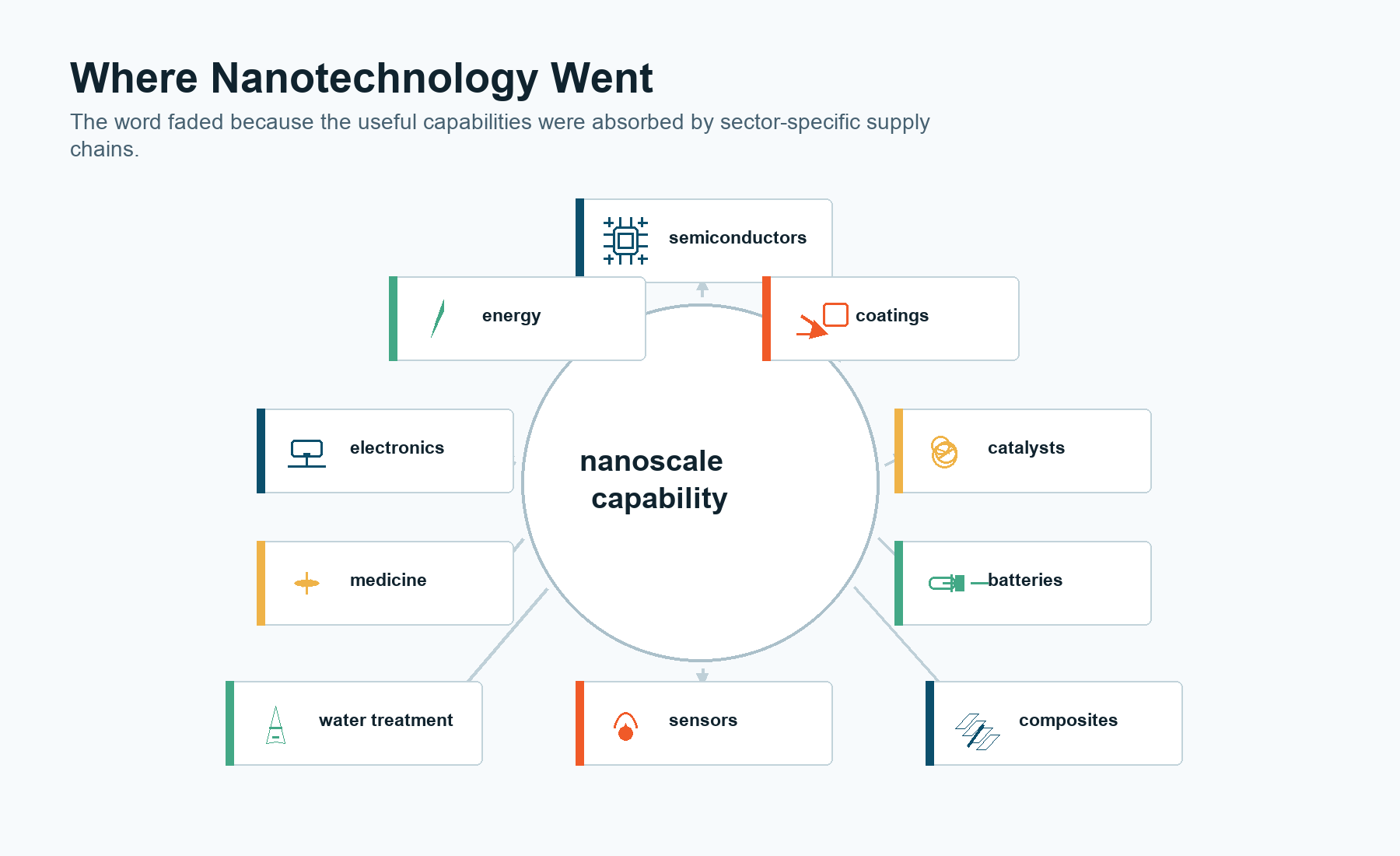
In semiconductors, nanoscale engineering became inseparable from the continuation of the industry. In coatings, nanostructure changed hardness, wetting, optical behaviour, barrier properties and wear. In catalysts, surface area and structure mattered because chemistry cares about interfaces. In batteries, nanoscale structure affected transport, stability and surface reactions. In medicine, nanoparticles, liposomes, delivery systems and diagnostic tools entered a world of regulation and evidence. In water, membranes and nanomaterials met the brutal economics of infrastructure.
Water is especially close to my own history because the NanoWater work sat at the intersection of need, technology and deployment reality. The 2005 white paper was not only about membranes and adsorbents. It was about desalination, contamination, sensors, catalysts, groundwater, industrial processes, development needs and the difficulty of making water technologies cheap, robust and acceptable. Years later, in Nanotech and Water: It Took Ten Years Just To Get To The Starting Line, the title said what the archive had already taught me. In water, even obvious need does not remove the requirement for economics, trust and infrastructure.
That line now applies far beyond water.
Graphene Repeated The Mistake In Better Lighting
Graphene should have made everyone more careful. Instead, it repeated many nanotechnology mistakes with better photography and a Nobel Prize.
The material was extraordinary, and still is. But the commercial conversation moved too quickly from property to destiny. Strength became aircraft. Conductivity became electronics. Impermeability became membranes. Surface area became energy storage. The fact that each of those words contained years of manufacturing, integration, qualification and customer adoption was often treated as a detail.
The graphene articles now republished on TimHarper.net read like a second act of the nanotechnology story. Searching for Commercial Graphene at the Commercial Graphene Show was not scepticism about graphene. It was frustration with the gap between promise and purchasable application. Did Manchester Miss Out By Not Patenting Graphene? was not only about patents. It was about the difference between discovery and value capture. Graphene may well change the world but will it change Manchester? asked whether local industrial benefit follows automatically from local scientific fame.
The answer, usually, is no.
Graphene’s commercialisation problem was never that it had no uses. It was that “graphene” described many materials, customers needed repeatability, and applications required specific compromises. The best graphene for a conductive ink is not necessarily the best graphene for a polymer composite, a membrane, a coating, a sensor or a thermal interface material. Each application has its own cost tolerance, process window, incumbent material and qualification route.
That is why the broad platform pitch so often failed. Customers did not want a platform. They wanted a component that solved a problem without creating five new ones.
Governments Got The Speed Wrong And The Importance Right
Government programmes overestimated how quickly nanotechnology would become visible as a new industrial category. They often underestimated how deeply nanoscale science would seep into existing industries.
The United States National Nanotechnology Initiative is the clearest example. It was launched at a moment when the field was still easy to hype, but its long-term significance is not measured by whether the public now talks about nanotechnology every day. It is measured in research infrastructure, tools, education, standards, user facilities, health and safety work, and the accumulated knowledge that made later products and processes possible.
The European Commission action plan had a similar structure. It wanted Europe to turn research into wealth-generating products, but it also placed standards, nanometrology, responsible development, public dialogue and risk assessment inside the programme. The UK Royal Society and Royal Academy of Engineering report did not treat benefit and risk as separate tribes. It put them in the same room.
That was the right instinct.
The wrong instinct was assuming that new centres, reports and funding lines would automatically create industries. They do not. Industrial capacity is more stubborn. It lives in suppliers, technicians, process engineers, application specialists, customers, production managers, procurement systems, standards committees, finance teams and the tacit knowledge of people who have made something fail often enough to know how to make it work.
That is the policy lesson I would carry into hydrogen, batteries, robotics and AI infrastructure. Public funding can create options. It can reduce risk. It can build shared infrastructure. It can train people. It can support standards. It can help early customers. But it cannot declare a market into existence by naming one.
The phrase “industrial strategy” should mean more than choosing fashionable technologies. It should mean building the conditions under which the useful parts of those technologies can become boringly deployable.
Venture Capital Misread Industrial Time
Venture capital was not wrong to look at nanotechnology. Some companies deserved backing. Some investors understood the problem. But the standard venture mental model struggled with industrial technologies that required long qualification cycles, manufacturing scale-up, uncertain customer adoption and capital-intensive infrastructure.
The 2003 Cientifica report counted 146 venture capital investors in nanotechnology participating in 187 deals. That number captures a moment. Investors wanted exposure to the theme, but the theme did not behave like a software category. A nanomaterial does not scale because a server can copy it. A sensor does not enter a factory because a user clicks download. A coating does not become standard because a founder has a better deck.
Industrial technologies need different patience. They need customers willing to test. They need pilots that teach something real. They need manufacturing partners. They need working capital. They need regulatory and standards awareness. They need people who can sell into conservative supply chains. They need enough capital to survive the period when the science works but the market has not yet reorganised around it.
This is where the nanotechnology boom rhymes with climate tech and robotics. The capital is often available at the moment of maximum narrative excitement, then becomes scarcer when the work becomes more specific and less photogenic. The best companies are not always those that raise the most during the peak. They are the ones whose capital structure matches the adoption path.
That is a hard lesson because it is not emotionally satisfying. It does not say “move fast” or “be patient” as a universal rule. It says: understand what kind of time your technology lives in.
AI And Robotics Should Read The Old Files
AI is not nanotechnology. Robotics is not graphene. Hydrogen is not quantum dots. The comparisons become lazy if pushed too far. But commercialisation patterns do repeat because customers, factories, regulators, capital markets and supply chains have not become infinitely flexible.
The AI industry is now discovering that capability is not the same as deployment. A model can perform astonishingly and still run into data governance, workflow integration, reliability, evaluation, liability, power, chips, cost and organisational resistance. The more AI moves into the physical world, the more it starts to look like an industrial technology. Data centres need power and cooling. Robots need sensors and actuators. Autonomous systems need safety cases. Embodied AI needs maintenance, uptime and service networks.
That is where I find the nanotechnology archive useful again. It shows what happens when a capability is mistaken for a market. It shows the danger of platform language when customers buy applications. It shows why standards and measurement matter. It shows how governments can be both premature and essential. It shows why the most successful companies may become invisible suppliers. It shows why the public story often ends just as the industrial story begins.
The same applies to hydrogen. The question is not whether hydrogen is useful. It is where it is useful enough to justify the infrastructure. It applies to robotics. The question is not whether robots are improving. It is where they can be deployed with sufficient reliability, economics and safety. It applies to advanced manufacturing. The question is not whether a process is impressive. It is whether it can be repeated at a cost and quality that customers will accept.
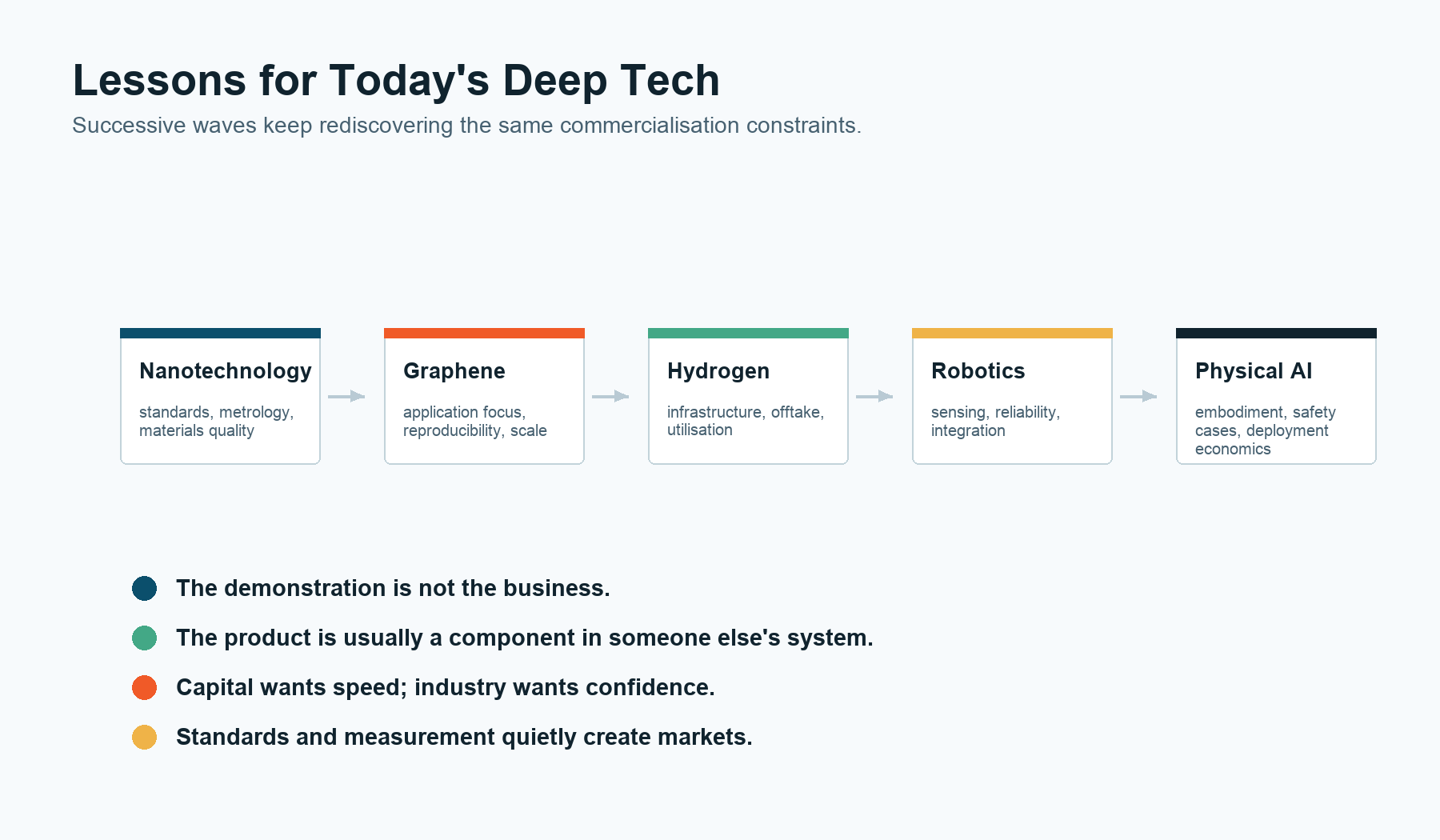
I do not read the old files as an argument for pessimism. I read them as an argument for precision.
Do not say the market is everything that could one day use your technology. Say which customer has a budget, a pain point, a qualification route and a reason to switch. Do not say your material is stronger, lighter or more conductive. Say what that changes in the customer’s product and what it costs them to adopt it. Do not say your robot can do a task. Say how often, under what conditions, with what supervision, at what service cost and with what liability. Do not say your AI will transform an industry. Say which workflow changes, who trusts it, who pays and what happens when it is wrong.
This is not less ambitious. It is more serious.
What Twenty Years Of Watching Nanotechnology Taught Us About Commercialising Breakthrough Science
If I have learnt anything from those twenty years, it is that the world does not owe a breakthrough a market.
That sounds harsh, especially to people who have spent years making something work. It is not harsh. It is useful. A breakthrough is a possibility. A market is a social, technical and financial arrangement in which many other people decide to change what they do. Those people have budgets, incentives, fears, habits, standards, suppliers, existing assets and memories of the last technology that promised too much. They are not obstacles to the real work. They are the real work.
Nanotechnology made that impossible to ignore because the science was so broad and the language so intoxicating. Once you can manipulate matter at small scales, it is easy to imagine consequences everywhere. That was both true and commercially unhelpful. Everywhere is not a go-to-market strategy. The fact that nanoscale structure can improve coatings, sensors, catalysts, membranes, displays, batteries and drug delivery does not mean there is a single buyer, a single channel or a single business model. It means the technology must be translated again and again into the language of each sector.
I think this is why I became suspicious of platform claims. Platforms exist, but they are rarer than pitch decks suggest. A platform is not a collection of possible applications. It is a repeatable mechanism for creating products, revenue and advantage across more than one market. Many nanotechnology companies were not platforms. They were scientific capabilities looking for the first application that could bear the cost of adoption. Graphene repeated this. AI is repeating it in a different form. Robotics will repeat it whenever a general-purpose machine is sold into markets that buy very specific outcomes.
Measurement changes destiny. This is easy to overlook because measurement does not have the glamour of invention. But in every deep technology I have watched, the ability to measure, characterise, test and compare has altered the commercial path. NanoSight mattered because it made particles observable in a way customers could use. Standards mattered because they gave buyers and regulators a shared language. Metrology mattered because it turned claims into evidence. Without measurement, a technology remains partly rhetorical. With measurement, it can begin to enter contracts.
For today’s AI, robotics and advanced-manufacturing companies, I would still put evidence before adjectives. What is the unit of performance? What is the failure mode? What is the baseline? What does the customer measure today? What would make them believe improvement? What does reliability mean in the field rather than in the laboratory? In software, weak evidence can sometimes hide for a while behind growth. In industrial technology, weak evidence usually appears as a failed pilot, a nervous customer or a purchasing delay that never ends.
Manufacturing is not implementation. It is discovery under harsher conditions. Laboratories discover whether something can work. Manufacturing discovers what it really is. Scale reveals impurities, tolerances, supplier dependencies, operator skill, process drift, yield losses and hidden costs. It also reveals whether the original property that made the technology exciting survives contact with reality. Many materials look less magical after scale-up. Some look more useful. You do not know which until the factory starts arguing with the theory.
Policy that stops at research funding is incomplete. Research creates options. Manufacturing decides which options can become industries. If a country wants to capture value from breakthrough science, it needs more than papers, patents and centres. It needs pilot lines, process engineers, technicians, application specialists, procurement pathways, standards participation, finance that understands scale-up and enough domestic customers willing to try early products without pretending they are already mature.
The best companies often become less visible as they become more successful. This was the opposite of the boom narrative. The boom wanted pure plays, labels and obvious revolutions. Industry wanted ingredients, instruments, process improvements and qualified suppliers. The closer nanotechnology came to adoption, the less it looked like a category. It became a better display, a more precise instrument, a coating with improved wear, a membrane, a catalyst, a drug-delivery vehicle, a semiconductor process, a sensor, a battery material. Success removed the label.
That is why the question “whatever happened to nanotechnology?” contains its own misunderstanding. It assumes a successful technology remains visible under its original name. Often it does not. Electricity is not always sold as electromagnetism. Semiconductor devices are not sold as quantum mechanics. Sequencing customers do not buy “nanotechnology”; they buy nanopore sequencing. A fleet operator does not buy electrochemistry; it buys uptime, range, payload and cost. A factory does not buy embodied AI; it buys a system that performs work safely and repeatedly.
Hype was not only bad. It was crude, distortive and often financially dangerous, but it also attracted attention, talent, capital and public policy. The problem was not that hype existed. The problem was when hype was mistaken for adoption. During the nanotechnology years, the peak of attention made it easier to raise money and harder to think clearly. After attention faded, some of the serious work became easier because the tourists left. Standards progressed. Instruments improved. Customers became more specific. The field became less exciting and more useful.
This is one reason I do not enjoy simple backlash stories. They are as lazy as the hype they replace. First everything will change by next year. Then nothing happened and it was all nonsense. The truth is usually slower and more interesting. Some things fail. Some survive in niches. Some are acquired. Some become infrastructure. Some arrive twenty years late wearing a different badge. Some disappoint investors and still benefit industry. Some benefit industry and never reward the original investors. Commercial history is not a morality play.
Government time and market time rarely align, but both matter. Governments like initiatives, centres, roadmaps and announcements. Markets like evidence, price, reliability and risk reduction. The two can irritate each other. Yet nanotechnology also shows that public programmes can create shared assets that markets would underfund: basic research, user facilities, standards work, safety research, education, public engagement and international cooperation. The question is not whether government should be involved. The question is whether it understands which layer of the commercialisation stack it is funding.
The wrong layer produces theatre. The right layer produces options.
Investors need to know the shape of the risk. Scientific risk, manufacturing risk, market risk, regulatory risk, infrastructure risk and adoption risk are different animals. Venture capital is good at some and poor at others. Project finance solves some problems and refuses others. Corporate capital can be patient or suffocating. Public markets can provide visibility and punish delay. The capital stack is part of the technology. If the money expects software speed from a materials company, everyone will be disappointed. If the money is too cautious, the technology may never get the chance to prove itself.
This is where I think today’s AI and robotics investors should pay attention. AI has enjoyed software economics in parts of the stack, but the moment it becomes embodied, powered, regulated, safety-critical or infrastructure-heavy, the old industrial rules return. Robots need hardware margins, service networks and reliability. Data centres need grid connections, cooling, chips and planning permission. AI in factories, hospitals, energy systems and vehicles needs trust, auditability and liability frameworks. The technology may be digital. The deployment is physical.
The mistake would be to read this as a warning against ambition. It is a warning against confusing ambition with impatience. The most serious deep-tech companies I have seen are not the ones that refuse big claims. They are the ones that can move between the big claim and the small proof without losing intellectual honesty. They can explain why the world may eventually change, and they can also explain why this customer, this process, this test method and this first market matter now.
Nanotechnology taught that the route from breakthrough to industry is not a straight line from invention to adoption. It is a series of translations. Science becomes measurement. Measurement becomes specification. Specification becomes manufacturing. Manufacturing becomes qualification. Qualification becomes procurement. Procurement becomes routine use. Routine use becomes infrastructure. By the time that chain is complete, the original language may have vanished. That does not mean the technology failed. It means it has been metabolised.
Customers are not waiting for revolutions. They are trying to get through the week. This is perhaps the most important and least fashionable point. A customer does not wake up wanting nanotechnology, graphene, hydrogen, robotics or AI. They wake up with costs, failures, regulations, competitors, staff shortages, energy bills, warranty claims, downtime, quality problems and customers of their own. A breakthrough becomes valuable when it enters that world without demanding religious conversion.
That is why incremental adoption beat technological revolution so often in nanotechnology. A better coating could enter a product. A measurement tool could enter a lab. A nanoparticle formulation could enter a manufacturing process. A quantum-dot film could improve a display. None of these looked like the promised revolution, but they were real. Revolutions are easier to narrate after many increments have accumulated.
Archives matter because they keep the uncertainty intact. At the time, old presentations, reports and visit notes feel like debris from a busy life. Years later they become a record of what people believed before the outcome was obvious. They show which warnings were ignored, which assumptions survived, which forecasts were silly, which questions kept returning. The TimHarper.net archive is valuable not because every old article was right. It is valuable because it records an industry thinking out loud before the verdict had been written.
That is why I do not want to turn nanotechnology into a failed revolution. It was messier and more useful than that. It was the first modern deep-tech commercialisation wave: global public funding, venture enthusiasm, national strategies, standards battles, public-risk debates, platform start-ups, enabling tools, materials companies, supply-chain absorption and a long gap between promise and deployment. If we understand it properly, we get a better map for the next twenty years.
AI, robotics, hydrogen, batteries and advanced manufacturing are not condemned to repeat nanotechnology’s mistakes. But they are already repeating some of its assumptions. They are assuming that capability creates markets, that demonstrations predict deployment, that capital can compress industrial time, that platforms are easier than applications, that standards can wait, that customers will reorganise themselves around superior technology, and that public attention is the same as adoption.
Nanotechnology says: be careful.
It also says something more optimistic. The end of a boom is not the end of a technology. Sometimes it is the beginning of the useful part.
Archive Basis
This article draws on the public Tim Harper Nanotechnology Archive and my historical archive, including The Nanotechnology Opportunity Report, Cientifica market and risk material, WNEC Singapore and India prospectuses and presentations, NanoWater material, NanoSight company documents and press material, visit reports from Tokyo and Singapore, KACST nanotechnology roadmap material, and historical government strategy documents.
Where I reference historical Tim Harper articles, this version links to the republished TimHarper.net article rather than to third-party snapshots.
Selected Sources
- Tim Harper Nanotechnology Archive
- National Nanotechnology Initiative, 2026 Budget Supplement
- ISO/TC 229 Nanotechnologies
- Royal Society and Royal Academy of Engineering, Nanoscience and nanotechnologies: opportunities and uncertainties
- European Commission, Nanosciences and nanotechnologies: An action plan for Europe 2005-2009
- UK Nanotechnologies Strategy
- Nanotech and Water: It Took Ten Years Just To Get To The Starting Line
- Searching for Commercial Graphene at the Commercial Graphene Show
- Did Manchester Miss Out By Not Patenting Graphene?
- Innovation is not a Magic Sausage Machine