BP Teesside Hydrogen: Why the Project Really Died — and Why AI Replaced It
Executive Summary
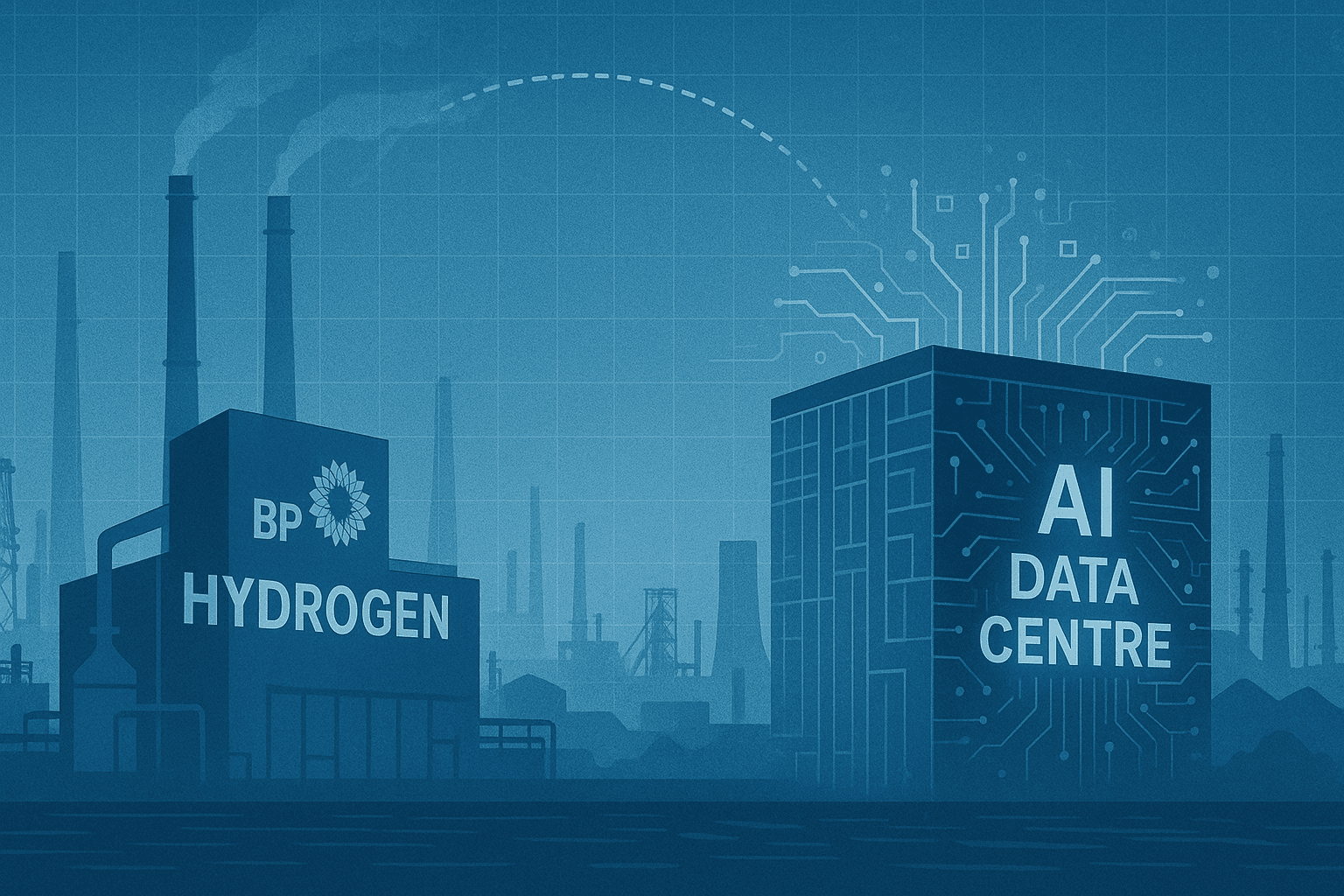
The public announcement framed BP’s withdrawal from its BP Teesside hydrogen project, H2Teesside, as a response to a planned “AI mega-campus” on the same site. But the full story is different: the project was already commercially dead. The proposed AI data centre simply offered a more attractive economic outcome for the site owners and government stakeholders.
This wasn’t just a bp teesside hydrogen withdrawal driven by optics — the underlying economics had already removed the foundation of the project.
Three forces converged:
- Commercial collapse: When Sabic permanently closed its Olefins 6 cracker, the anchor customer for BP’s blue hydrogen supply disappeared.
- Land economics shifted: The site owner, Teesworks Ltd, repositioned the land for a high-value AI data centre — a far more lucrative use than a difficult-to-finance hydrogen plant.
- Government priorities changed: A Cabinet split between Net Zero advocates and tech-growth supporters ended with political backing for the AI infrastructure route.
The result was not a heroic policy turn, but a pragmatic exit: H2Teesside no longer had either a viable market or a secure site. The “AI campus” framing simply became a convenient way to move on.
BP Teesside Hydrogen: The Economic Reality Behind the Withdrawal
The decisive factor wasn’t AI — it was that the demand vanished.
Sabic’s Exit
BP’s H2Teesside project depended on supplying blue hydrogen to regional heavy industry. Its main prospective buyer was Sabic, operator of the refinery-adjacent Olefins 6 cracker at Wilton on Teesside.
In mid-2025, Sabic confirmed the permanent closure of Olefins 6 after 46 years, citing high energy and operating costs. That wiped out the largest credible hydrogen load for H2Teesside — and destroyed the underlying business case.
Sabic’s decision was widely covered in chemicals-industry media such as
ICIS,
which highlighted how high energy costs undermined Teesside’s industrial competitiveness.
Without an anchor customer, and with BP refocusing on high-return oil and gas assets, the appeal of fighting for contested land at Teesworks diminished sharply.
Commercial Implication
Blue-hydrogen plants without long-term offtake contracts are extremely difficult to finance, even with subsidies. With Sabic gone, H2Teesside’s revenue model evaporated. In that context, the bp teesside hydrogen withdrawal becomes less of a choice and more of an inevitability.
For more background on hydrogen-project economics, see my earlier Field Note on shifting hydrogen demand and market dynamics. Read here.
2. Inside Government: Net Zero vs Tech-Growth Politics
According to multiple sources, the decision sat dormant for months — stalled by an internal Cabinet divide over whether to prioritise climate-aligned hydrogen or high-value AI infrastructure.
The Net Zero View (Energy Brief)
As Energy Secretary, Ed Miliband backed H2Teesside and reportedly supported granting a Development Consent Order (DCO), which could have forced land access through compulsory purchase if required.
The Tech-Growth View (AI Infrastructure Brief)
The Department for Science, Innovation & Technology (DSIT), backed by the Prime Minister, proposed a new “AI Growth Zone” policy aligning regional development with digital infrastructure. The use case: Teesside as a UK hub for hyperscale data-centres.
Supporters argued that this route offered larger, faster private investment, sometimes framed as a potential “£100 bn” AI campus investment — far beyond the scale of a subsidised hydrogen plant.
The Turning Point
Once the hydrogen project lost its market base and land access stayed contested, political momentum shifted decisively toward the data-centre alternative. The Cabinet effectively opted for the path offering immediate private investment and lower friction — marking the final turning point for the bp teesside hydrogen withdrawal.
3. The Teesworks Factor: Land Economics Don’t Sleep
The land required for H2Teesside isn’t fully public — it’s controlled by Teesworks Ltd, where private developers hold a 90% stake and the remainder is held via the public-sector South Tees Development Corporation.
Value vs Complexity
A hydrogen plant comes with modest rents, high permitting risk and uncertain long-term demand. By contrast, a hyperscale AI data centre — especially one backed by a global tech firm — promises premium rents, enhanced land value, and long-term strategic relevance.
Leverage Through Planning Objections
Teesworks Ltd and the public development body formally objected to key elements of BP’s planning submission, arguing a hydrogen plant would “sterilise” future development potential on the site. Overriding these objections via a DCO would have required political will — and likely public backlash. With the hydrogen project’s economics in tatters, the government chose not to force the issue.
This combination — collapsing demand and owner leverage — defines why the bp teesside hydrogen withdrawal from Teesside was not ideological, but structural.
4. The Replacement: A Hyperscale AI Data Centre on Teesside
What’s now advancing in place of H2Teesside is reportedly one of Europe’s largest planned data-centre campuses, part of the UK’s new AI Growth Zone strategy.
Planned Scope
- ≈ 500,000 m² of floor space
- Backed by a major global tech firm (not confirmed but widely rumoured to be Google)
- Promoted as national-scale AI infrastructure, aligned with government digital strategy
The Carbon/Irony Twist
A hydrogen plant would have produced low-carbon energy for heavy industry. The replacement — a data centre — is electricity-hungry, increasing demand on the grid and potentially undermining decarbonisation targets. That irony underscores how this isn’t purely a technological shift — it’s a change of priorities.
5. Summary: Why AI Won
Here’s how the competing options stack up:
| Feature | BP H2Teesside (Withdrawn) | AI Data Centre (Advancing) |
|---|---|---|
| Lead Proponent | BP | Teesworks Ltd / global tech firm |
| Anchor Customer | Sabic (Olefins 6, closed) | Hyperscaler tenant |
| Government Backing | Energy / Net-Zero brief | Tech & Growth brief, PM-backed |
| Investment Scale | ~£2bn | Potential ~£100bn |
| Landowner Incentive | Low rent, high regulatory burden | High rent, long-term value |
| Commercial Viability | Collapsed after Sabic exit | Strong, private-investment driven |
Conclusion
BP did not walk away from a thriving hydrogen opportunity on Teesside. It pulled back from a project whose market had vanished and whose land access was contested — at precisely the moment when a far more valuable alternative emerged.
The public-facing narrative of an “AI campus” was not the root cause. It was the exit strategy.
The bp teesside hydrogen story ultimately reflects a shift in market logic rather than a clash between technologies.
Hydrogen didn’t lose to AI.
Hydrogen lost to economics.
AI simply arrived at the right time.