BP Teesside Hydrogen: Why the Project Really Died — and Why AI Replaced It
Executive Summary
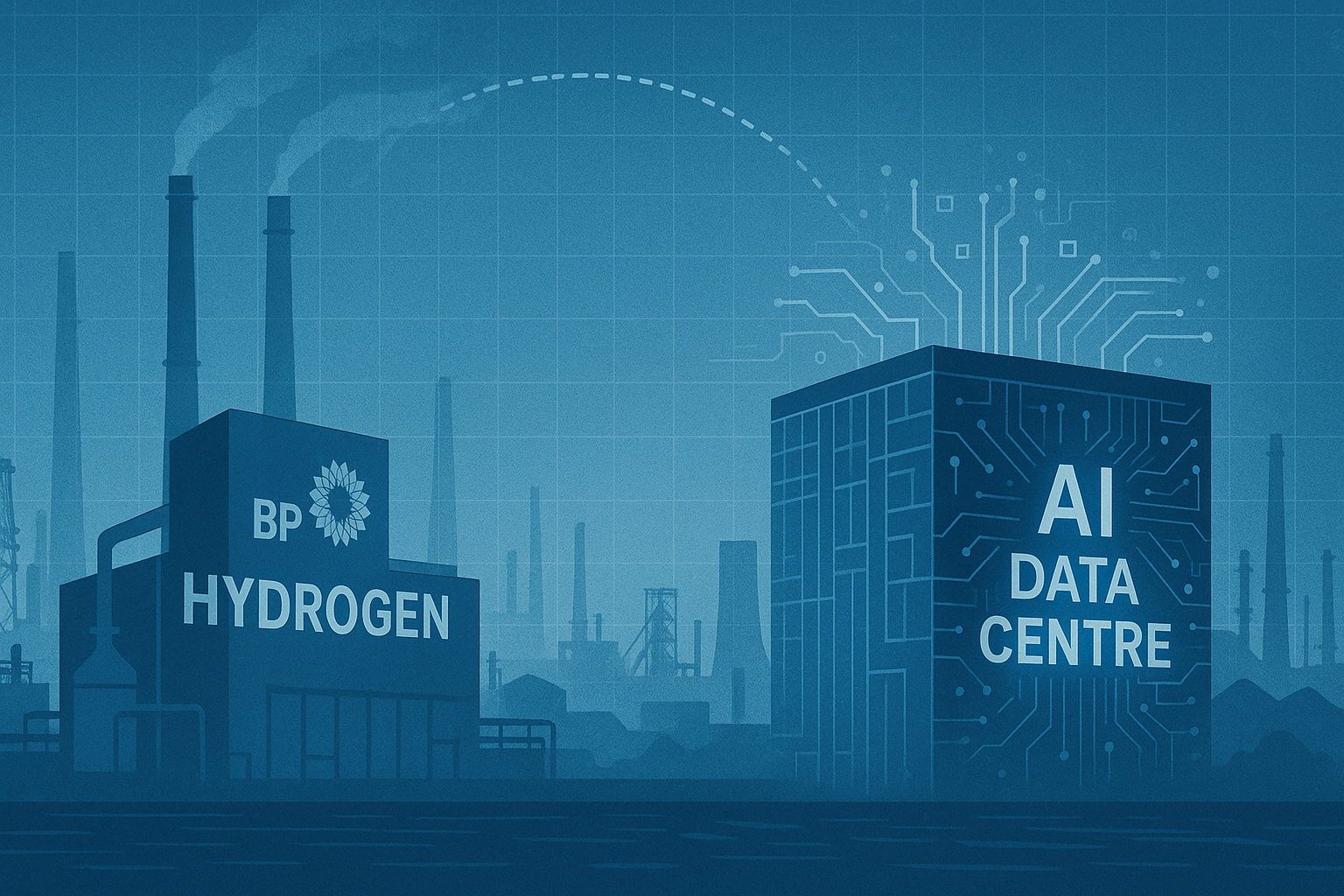
The public announcement framed BP’s withdrawal from its BP Teesside hydrogen project, H2Teesside, as a response to a planned “AI mega-campus” on the same site. But the full story is different: the project was already commercially dead. The proposed AI data centre simply offered a more attractive economic outcome for the site owners and government stakeholders.
This wasn’t just a bp teesside hydrogen withdrawal driven by optics — the underlying economics had already removed the foundation of the project.
Three forces converged:
- Commercial collapse: When Sabic permanently closed its Olefins 6 cracker, the anchor customer for BP’s blue hydrogen supply disappeared.
- Land economics shifted: The site owner, Teesworks Ltd, repositioned the land for a high-value AI data centre — a far more lucrative use than a difficult-to-finance hydrogen plant.
- Government priorities changed: A Cabinet split between Net Zero advocates and tech-growth supporters ended with political backing for the AI infrastructure route.
The result was not a heroic policy turn, but a pragmatic exit: H2Teesside no longer had either a viable market or a secure site. The “AI campus” framing simply became a convenient way to move on.
BP Teesside Hydrogen: The Economic Reality Behind the Withdrawal
The decisive factor wasn’t AI — it was that the demand vanished.
Sabic’s Exit
BP’s H2Teesside project depended on supplying blue hydrogen to regional heavy industry. Its main prospective buyer was Sabic, operator of the refinery-adjacent Olefins 6 cracker at Wilton on Teesside.
In mid-2025, Sabic confirmed the permanent closure of Olefins 6 after 46 years, citing high energy and operating costs. That wiped out the largest credible hydrogen load for H2Teesside — and destroyed the underlying business case.
Sabic’s decision was widely covered in chemicals-industry media such as
ICIS,
which highlighted how high energy costs undermined Teesside’s industrial competitiveness.
Without an anchor customer, and with BP refocusing on high-return oil and gas assets, the appeal of fighting for contested land at Teesworks diminished sharply.
Commercial Implication
Blue-hydrogen plants without long-term offtake contracts are extremely difficult to finance, even with subsidies. With Sabic gone, H2Teesside’s revenue model evaporated. In that context, the bp teesside hydrogen withdrawal becomes less of a choice and more of an inevitability.
For more background on hydrogen-project economics, see my earlier Field Note on shifting hydrogen demand and market dynamics. Read here.
2. Inside Government: Net Zero vs Tech-Growth Politics
According to multiple sources, the decision sat dormant for months — stalled by an internal Cabinet divide over whether to prioritise climate-aligned hydrogen or high-value AI infrastructure.
The Net Zero View (Energy Brief)
As Energy Secretary, Ed Miliband backed H2Teesside and reportedly supported granting a Development Consent Order (DCO), which could have forced land access through compulsory purchase if required.
The Tech-Growth View (AI Infrastructure Brief)
The Department for Science, Innovation & Technology (DSIT), backed by the Prime Minister, proposed a new “AI Growth Zone” policy aligning regional development with digital infrastructure. The use case: Teesside as a UK hub for hyperscale data-centres.
Supporters argued that this route offered larger, faster private investment, sometimes framed as a potential “£100 bn” AI campus investment — far beyond the scale of a subsidised hydrogen plant.
The Turning Point
Once the hydrogen project lost its market base and land access stayed contested, political momentum shifted decisively toward the data-centre alternative. The Cabinet effectively opted for the path offering immediate private investment and lower friction — marking the final turning point for the bp teesside hydrogen withdrawal.
3. The Teesworks Factor: Land Economics Don’t Sleep
The land required for H2Teesside isn’t fully public — it’s controlled by Teesworks Ltd, where private developers hold a 90% stake and the remainder is held via the public-sector South Tees Development Corporation.
Value vs Complexity
A hydrogen plant comes with modest rents, high permitting risk and uncertain long-term demand. By contrast, a hyperscale AI data centre — especially one backed by a global tech firm — promises premium rents, enhanced land value, and long-term strategic relevance.
Leverage Through Planning Objections
Teesworks Ltd and the public development body formally objected to key elements of BP’s planning submission, arguing a hydrogen plant would “sterilise” future development potential on the site. Overriding these objections via a DCO would have required political will — and likely public backlash. With the hydrogen project’s economics in tatters, the government chose not to force the issue.
This combination — collapsing demand and owner leverage — defines why the bp teesside hydrogen withdrawal from Teesside was not ideological, but structural.
4. The Replacement: A Hyperscale AI Data Centre on Teesside
What’s now advancing in place of H2Teesside is reportedly one of Europe’s largest planned data-centre campuses, part of the UK’s new AI Growth Zone strategy.
Planned Scope
- ≈ 500,000 m² of floor space
- Backed by a major global tech firm (not confirmed but widely rumoured to be Google)
- Promoted as national-scale AI infrastructure, aligned with government digital strategy
The Carbon/Irony Twist
A hydrogen plant would have produced low-carbon energy for heavy industry. The replacement — a data centre — is electricity-hungry, increasing demand on the grid and potentially undermining decarbonisation targets. That irony underscores how this isn’t purely a technological shift — it’s a change of priorities.
5. Summary: Why AI Won
Here’s how the competing options stack up:
| Feature | BP H2Teesside (Withdrawn) | AI Data Centre (Advancing) |
|---|---|---|
| Lead Proponent | BP | Teesworks Ltd / global tech firm |
| Anchor Customer | Sabic (Olefins 6, closed) | Hyperscaler tenant |
| Government Backing | Energy / Net-Zero brief | Tech & Growth brief, PM-backed |
| Investment Scale | ~£2bn | Potential ~£100bn |
| Landowner Incentive | Low rent, high regulatory burden | High rent, long-term value |
| Commercial Viability | Collapsed after Sabic exit | Strong, private-investment driven |
Teesside shows how commercialisation risk is shaped by competing uses of the same land, infrastructure and political attention. H2Teesside lost its anchor customer and therefore the demand certainty needed to support capital, while the data-centre proposal arrived with a stronger market signal and higher perceived value. In the Seven Barriers framework, market adoption and capital availability are linked: once credible offtake disappears, even a strategically supported technology can lose access to the resources required for deployment.
Conclusion
BP did not walk away from a thriving hydrogen opportunity on Teesside. It pulled back from a project whose market had vanished and whose land access was contested — at precisely the moment when a far more valuable alternative emerged.
The public-facing narrative of an “AI campus” was not the root cause. It was the exit strategy.
The bp teesside hydrogen story ultimately reflects a shift in market logic rather than a clash between technologies.
Hydrogen didn’t lose to AI.
Hydrogen lost to economics.
AI simply arrived at the right time.