Google says launch below $200 per kilogram could make large space data centres for AI worth considering. Could it? The arithmetic says $200/kg is not the point at which space wins. It is roughly the point at which launch stops settling the argument before power, cooling, radiation and communications are counted.
Summary
- At several thousand dollars per kilogram, launching a 100 MW orbital AI facility costs many billions of dollars. Nothing else in the calculation gets a chance to matter.
- The mass estimate ranges from 21.3 to 77.6 tonnes per MW of useful computing power. The reference design is 41.4 tonnes/MW, or 4,140 tonnes for 100 MW.
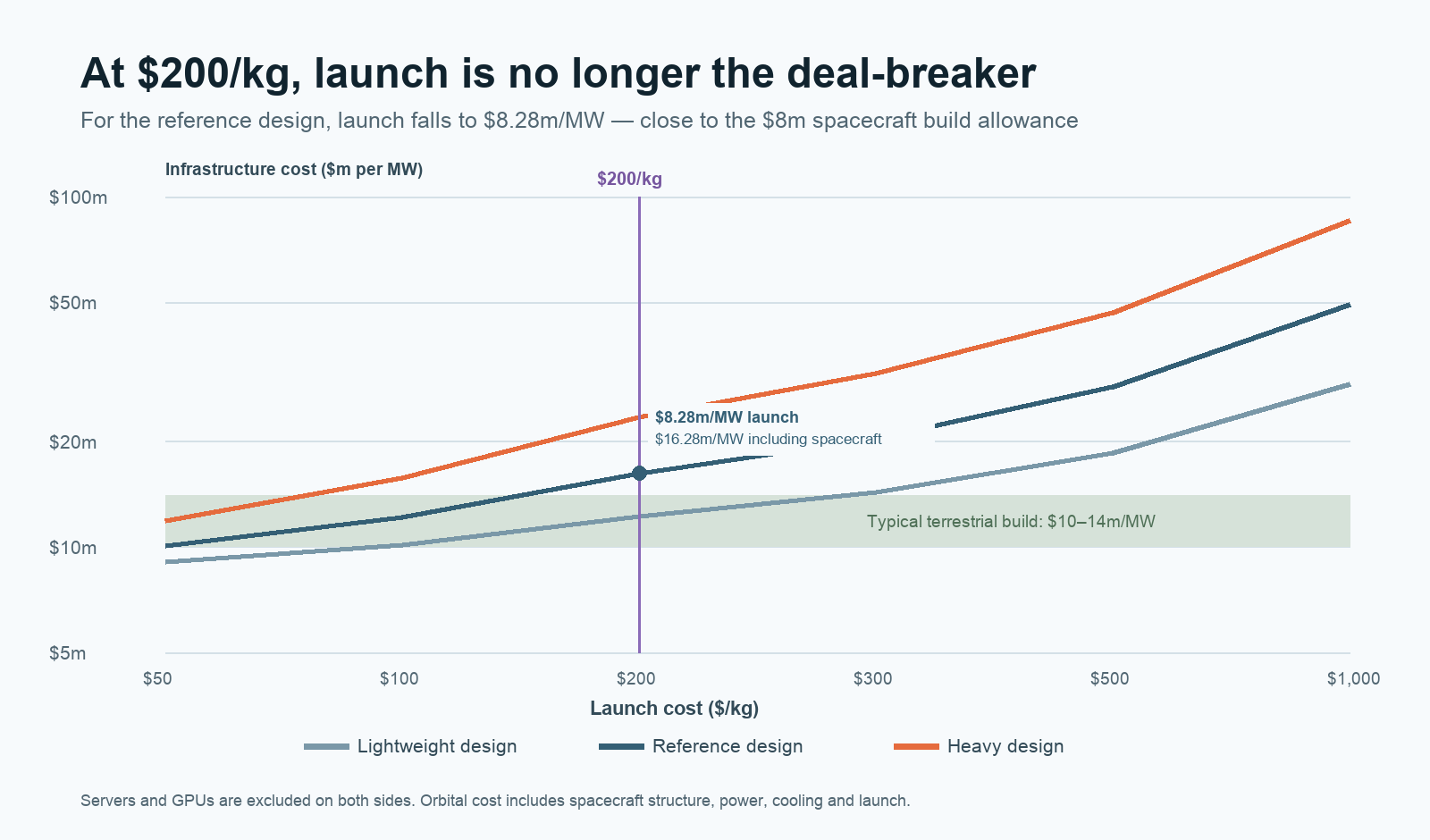
- At $200/kg, launching that reference design costs $8.28 million/MW. The separate allowance for building its spacecraft systems is $8 million/MW. A typical terrestrial shell and core costs about $10–14 million/MW.
- At $200–300/kg, it becomes worth costing specialised orbital computing seriously. Competing more widely with data centres on Earth probably needs roughly $50–150/kg, unless the terrestrial site faces an unusually expensive or slow power connection.
- $200/kg does not make space cheaper. It makes cooling, power, radiation, communications, utilisation and replacement life more important than the rocket bill.
For most of the space age, the idea of putting a significant data centre into orbit failed before anyone needed to worry about graphics processing units, cooling or networking. The transportation bill killed it. At tens of thousands of dollars for every kilogram placed into orbit, a thousand-tonne installation carried a launch cost measured in tens of billions of dollars. A terrestrial facility might struggle to secure power or a grid connection, but it did not first have to accelerate its equipment to roughly 7.5 kilometres per second.
Falcon 9 changed that arithmetic. Falcon Heavy pushed the maximum-payload calculation lower. Starship is intended to move it again, although intended and achieved capability are very different things. Google’s Project Suncatcher preprint, revised to version 2 in June 2026, puts a number on the claim. It suggests that prices could fall below about $200/kg in the mid-2030s if launch costs keep falling as cumulative payload rises.
That number is sometimes repeated as though it proves that a data centre in space would beat one on Earth. Google does not claim that. Its paper compares the annualised cost of launching satellite mass with the electricity bill for a machine-learning facility on Earth. It says plainly that this is not a complete cost comparison. A proper test must also count the computers, solar arrays, batteries, radiators, shielding, structure, communications, propulsion, spare capacity and useful life.
How launch costs actually fell
The familiar story that the Space Shuttle represented the cheapest old way to reach orbit is wrong. A NASA review of launch-cost history puts Saturn V near $5,200/kg in its 2018-dollar compilation and the Shuttle near $61,700/kg. The Shuttle was partly reusable and could carry crew, return cargo and service spacecraft, capabilities that a simple cargo launcher does not provide. Its standing workforce, refurbishment and infrastructure costs nevertheless made it extremely expensive per delivered kilogram.
NASA’s series shows a steep early fall, little progress from the 1970s to about 2000, then another step down with Falcon. A 2026 PNAS Nexus study covering 4,405 launches from 1960 to 2025 estimates that average real cost fell 21.2% each time cumulative payload doubled. That average hides the way the change happened. New rockets, production methods, competition and higher flight rates caused distinct jumps rather than smooth improvement.
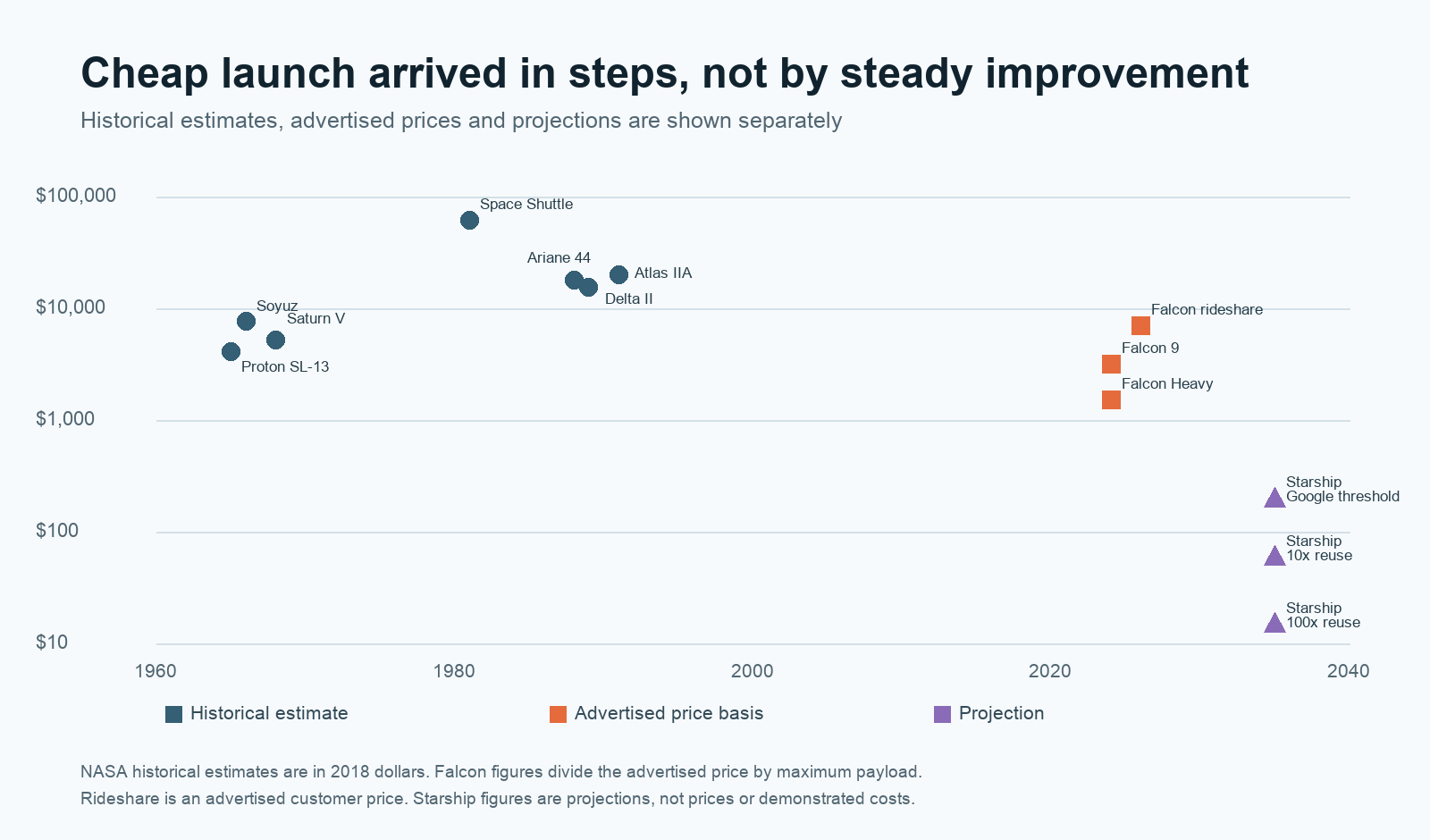
Price and cost must also be kept separate. SpaceX’s most recent public Falcon capability sheet quotes $69.75 million for a standard Falcon 9 mission and 22,000 kg to low Earth orbit (LEO), the region below about 2,000 km where drag remains measurable and communications delay is relatively low. Divide the price by the fully expendable maximum and the answer is about $3,170/kg. That is a useful ratio, but it is not the cost of adding one more kilogram. Many missions run out of volume, need a higher orbit or preserve the booster for recovery before they reach the maximum mass.
Falcon Heavy shows the same distinction. The capability sheet gives a maximum LEO payload of 63,800 kg. At the advertised $97 million price, that works out at about $1,520/kg. SpaceX’s small-satellite rideshare offer, by contrast, starts at $350,000 for 50 kg to a sun-synchronous orbit (SSO), an inclined LEO that keeps a near-constant angle to the Sun. Extra mass costs $7,000/kg. That is a price a customer can buy. It is higher because the customer is paying for a reserved slot, integration and a particular destination, not an abstract share of a full rocket.
The orbit changes the price. LEO is not the same destination as geostationary transfer orbit (GTO), the elliptical route used to reach high altitude, or geostationary Earth orbit (GEO), about 35,786 km above the equator. Rockets carry less as the required energy rises. All transport calculations here use LEO unless stated otherwise.
What Google’s $200/kg scenario actually says
Project Suncatcher proposes groups of solar-powered satellites carrying Google tensor processing units. They would exchange data through optical inter-satellite links: lasers between spacecraft rather than radio links through the ground. The satellites would fly hundreds of metres apart in a dawn–dusk SSO near 650 km. That orbit offers near-continuous sunlight, while the short distance between satellites makes fast laser links easier.
Google derives a roughly 20% learning rate from Falcon pricing and cumulative SpaceX payload. Starting with Falcon Heavy’s low maximum-payload price, the curve reaches below $200/kg around 2035 only after approximately 370,000 additional tonnes have been launched. At a nominal 200 tonnes per Starship, that is about 1,800 launches, or roughly 180 a year over a decade. Google says a cumulative-mass path about 70% smaller could instead reach around $300/kg. Neither result is a scheduled price commitment.
The paper also estimates Starship costs from the bottom up. It gets below $60/kg if major components fly ten times and below $15/kg if they fly one hundred times, before adding a possible customer margin. Google built those estimates from public specifications and propellant prices. They are not SpaceX accounts, a disclosed marginal cost, a fully allocated cost or a customer price.
As of 4 September 2026, Starship has completed 13 integrated flight tests. Flight 13 flew on 24 July; Flight 14 has not flown, although its booster completed a full-duration static fire on 28 August. Flight 12 deployed 20 mass simulators and two modified Starlink spacecraft along the vehicle’s suborbital trajectory, and Flight 13 continued deployment testing. Starship has not demonstrated routine commercial payload delivery, recovery and reuse of both stages. SpaceX’s June 2026 prospectus describes 100 tonnes to orbit in a reusable V3 configuration and potentially 200 tonnes for V4 as design targets. It also says the company believes Starship can eventually reduce launch cost by 99% or more relative to NASA’s $18,500/kg historical average. Those are company expectations, not demonstrated performance.
What $200/kg changes
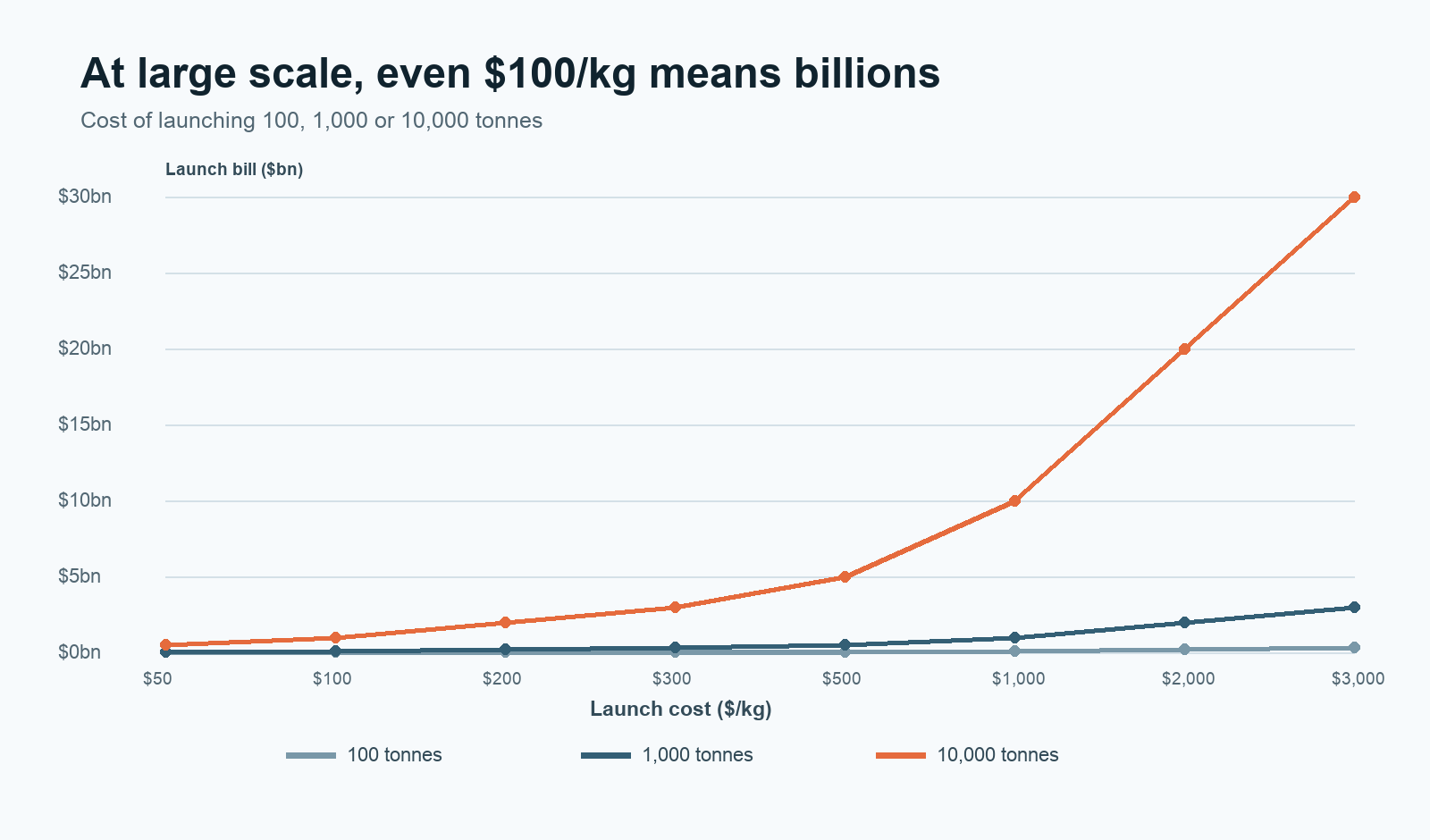
At $3,000/kg, launching 10,000 tonnes costs $30 billion. At $500/kg it costs $5 billion. At $200/kg it costs $2 billion, and at $50/kg it costs $500 million. None of those figures is small. The difference is that at $200/kg the rocket bill can sit beside the cost of the equipment being launched instead of overwhelming it.
What space data centres actually are
Space data centres can take several forms. The smallest is a computer aboard an Earth-observation satellite, processing images before they are sent down. A larger system might serve nearby spacecraft. A distributed cluster would spread one job across many satellites, while a facility assembled from large modules would look more like a data centre in scale. None would simply be a warehouse full of terrestrial racks.
The hardware evidence is real but small. Starcloud-1 launched an NVIDIA H100 in November 2025 and reports running a Google Gemma model and training nanoGPT in orbit in December. Axiom Space says it demonstrated an initial compute unit on the International Space Station in 2025 and launched two dedicated nodes on 11 January 2026. NASA reported in May that a compressed version of its Prithvi geospatial foundation model had run on the Kanyini satellite and an ISS payload for cloud and flood detection. These are demonstrations of onboard processing, not megawatt-scale operating facilities.
Larger projects were announced in 2026. NVIDIA launched its Space Computing range in March, including processors for individual satellites and a Vera Rubin module intended for bigger systems. On 24 August, NVIDIA and SpaceXAI announced a planned Starmind satellite based on an adapted Vera Rubin NVL72. Planned is the important word. The announcement proves nothing yet about power, cooling, network performance or cost in orbit.
Power in orbit: abundant sunlight, demanding hardware
Solar irradiance near Earth is about 1,361 watts per square metre, according to NASA’s measured total solar flux. A well-chosen dawn–dusk orbit keeps an array in sunlight for most of each orbit. Its capacity factor—the energy it actually produces divided by the energy it would produce at full output all the time—can be far higher than solar power on Earth. There are no clouds and little night, although eclipse seasons, pointing losses, hot cells, radiation damage and outages keep the figure below 100%.
The useful number is specific power: how many watts an array produces for each kilogram it weighs. NASA’s current survey finds flown spacecraft clustered near 30 W/kg, with the best near 200 W/kg. NASA-backed roll-out array programmes quote beginning-of-life targets above 225–500 W/kg for the arrays themselves. A complete power system will be heavier. Power management and distribution (PMAD), deployment booms, cables, conversion losses, radiation damage and spare capacity all add mass.
I allow 2.5, 4.0 and 7.0 tonnes/MW for the solar arrays and PMAD. The lightweight design assumes advanced arrays and very tight integration. The heavy design allows for lower output per kilogram, more degradation and more support structure. Batteries add another 0.5–3.0 tonnes/MW. An orbit with long eclipses would need more.
The cooling problem: space is cold but vacuum is insulating
A data centre on Earth moves heat into air or water and then into the atmosphere. Space offers no surrounding fluid to carry it away. Heat must pass from each accelerator into a cold plate, heat pipe or pumped liquid loop, then across a large panel that emits infrared radiation. That final step is radiative cooling.
Q = εσA(T⁴ − Tsink⁴)
Here Q is heat flow in watts, ε is surface emissivity, σ is the Stefan–Boltzmann constant, A is radiating area and T is absolute temperature in kelvin. The fourth power makes operating temperature exceptionally important. With emissivity 0.90 and a 3 K background, an ideal unobstructed surface rejects about 413 W/m² at 300 K, 535 W/m² at 320 K, 766 W/m² at 350 K and 1,306 W/m² at 400 K.
The ideal equation is only a starting point. For the chart, I cut the ideal heat output to 65% to allow for sunlight and heat from Earth, imperfect orientation, temperature loss through the cooling loop and operating margin. Area means one effective emitting surface. A panel that radiates freely from both faces can use less physical area, but both faces need a clear view and the pipes and structure still weigh the same.
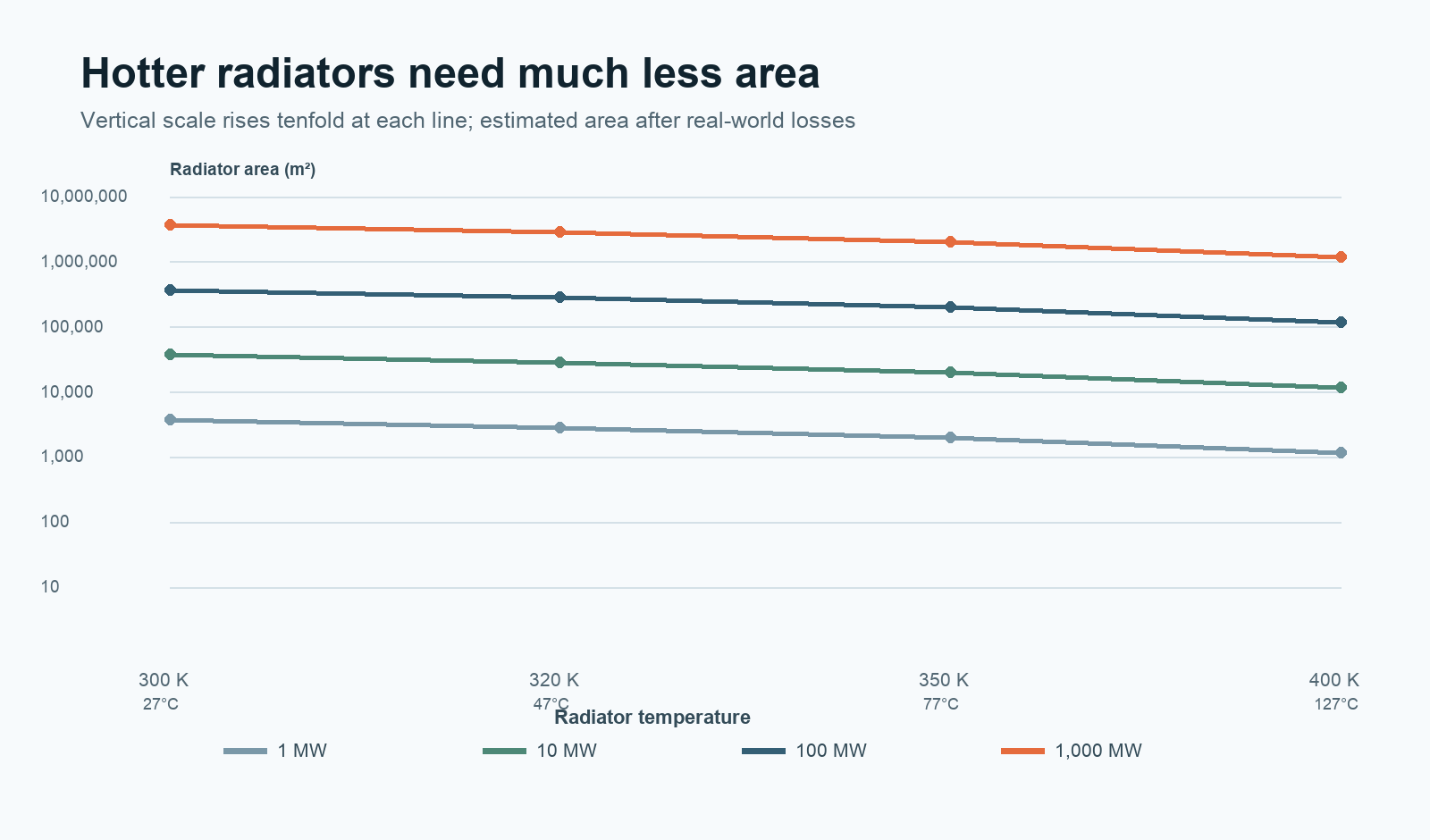
At 300 K, rejecting 1 MW needs about 3,722 m² after that allowance. Raise the radiator to 400 K and the area falls to about 1,178 m². For 100 MW, the range is 372,000–118,000 m²; for 1 GW, it is 3.72–1.18 million m². Hotter coolant saves area and mass, but chips, memory, pumps and pipework limit the temperature.
I tie the radiator mass estimates directly to those areas. The lightweight design uses 400 K and about 3.4 kg/m² for panels, pipework, support and backup capacity. The reference design uses 350 K and 4.0 kg/m², giving about 8.0 tonnes/MW. The heavy design uses 320 K and 5.2 kg/m², giving about 15 tonnes/MW. NASA has studied conventional systems weighing tens of kilograms per kilowatt, advanced liquid systems near 3 kg/kW, and lightweight panels below 3 kg/m² at much higher temperatures. No system has yet combined the temperature, weight, scale and reliability assumed here. These are engineering estimates.
Keeping accelerators alive
Radiation hardening traditionally uses specialised processes, conservative architectures, shielding and qualification to keep electronics operating in space. Commercial AI accelerators are optimised for performance and manufacturing yield, not a decade in orbit. Two radiation mechanisms matter. Total ionising dose (TID) is cumulative charge deposited in insulating materials, gradually degrading a device. A single-event upset is a transient bit error caused by one energetic particle; related single-event effects can also crash or damage a subsystem.
Google’s revised Suncatcher paper reports testing a Trillium v6e TPU and host with a 67 MeV proton beam. For its target SSO, it estimates about 150 rad(Si) a year behind substantial shielding, illustrated by 10 mm aluminium equivalent, or approximately 750 rad across five years. High-bandwidth memory began showing irregularities after about 2 krad, while the tested chip completed compute workloads without a hard TID-attributable failure through 15 krad.
Transient errors remain more difficult. The revised test estimates roughly one silent-data-corruption event per three million inferences under its assumed workload and radiation environment. Error-correcting code (ECC) memory can detect and repair many bit errors; checkpointing, redundant nodes and rerunning suspicious work can contain others. Inference tolerates this approach more readily than a long training run, where an undetected error may corrupt hours of distributed computation.
One practical answer is to replace the computers every three to five years rather than make them survive for fifteen. That matches the refresh cycle of many terrestrial systems and limits the accumulated radiation dose. It also creates a recurring launch bill and a disposal problem. I allow 1–6 tonnes/MW for radiation protection and 2–7 tonnes/MW for backup capacity and spares. That is a mass allowance, not a proposal to wrap the whole system in a uniform aluminium shell.
Moving the data determines which workload works first
An optical inter-satellite link uses a narrowly aimed laser to carry data between spacecraft. Google’s terrestrial machine-learning clusters require hundreds of gigabits per second per accelerator and aggregate links measured in terabits. Commercial long-range optical satellite links are typically 1–100 Gbit/s. Suncatcher closes part of that gap by keeping satellites unusually close: its bench demonstrator reached 800 Gbit/s in each direction over a short free-space path, while the paper models multi-channel links near 10 Tbit/s.
Space-to-ground links face a different limit. Clouds can block an optical ground station, atmospheric turbulence distorts the beam, and a fast-moving satellite is visible for only part of each pass. Multiple geographically separated stations, radio fallback and buffering can improve availability, but Earth-serving compute still has to move input and output through the atmosphere. LEO propagation latency can be low; waiting for a suitable ground pass or retransmission can be much longer.
The order is fairly clear. Process an image beside the camera and far less data has to reach Earth. An autonomous spacecraft also uses data already in orbit. A chatbot must serve users on the ground continuously. Training a frontier model is harder still because thousands of accelerators must exchange data quickly and run without interruption.
The mass of a 100 MW orbital facility
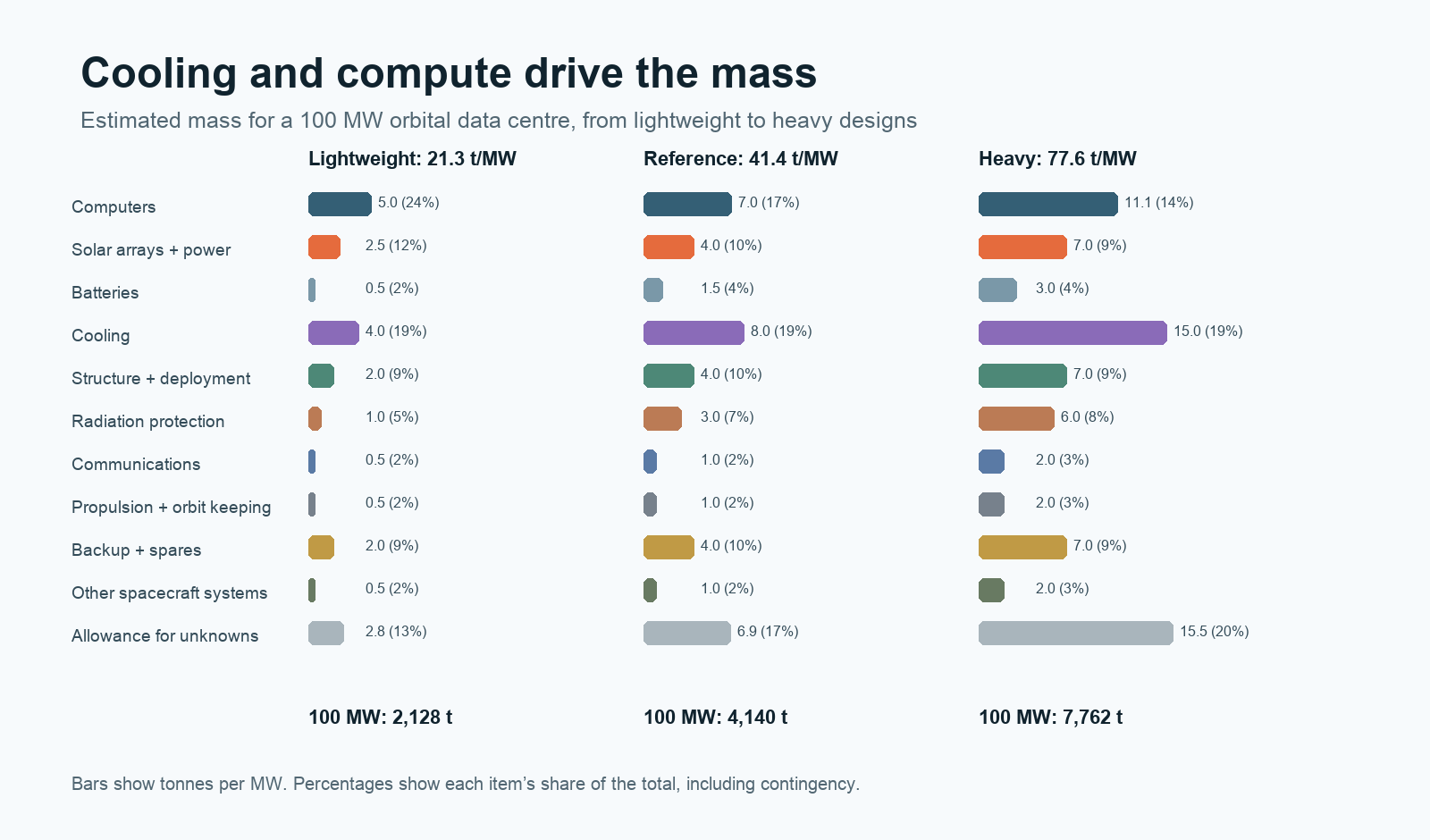
The 100 MW figure refers to useful computing power, not total electricity generated. That is how terrestrial data centres are usually quoted. A populated NVIDIA GB300 NVL72 rack weighs roughly 1,580 kg and draws up to about 142 kW, equal to 11.1 tonnes/MW before adding the rest of the data hall. A purpose-built orbital system would shed the steel cabinets, service aisles and air-handling equipment. I use 5.0 and 7.0 tonnes/MW for the lightweight and reference designs.
| What has to be launched | Lightweight t/MW | Reference t/MW | Heavy t/MW |
|---|---|---|---|
| Computers | 5.0 | 7.0 | 11.1 |
| Solar arrays and power distribution | 2.5 | 4.0 | 7.0 |
| Batteries | 0.5 | 1.5 | 3.0 |
| Cooling | 4.0 | 8.0 | 15.0 |
| Structure and deployment gear | 2.0 | 4.0 | 7.0 |
| Radiation protection | 1.0 | 3.0 | 6.0 |
| Communications | 0.5 | 1.0 | 2.0 |
| Propulsion and orbit keeping | 0.5 | 1.0 | 2.0 |
| Backup capacity and spares | 2.0 | 4.0 | 7.0 |
| Other spacecraft systems | 0.5 | 1.0 | 2.0 |
| Subtotal | 18.5 | 34.5 | 62.1 |
| Allowance for unknowns | 15% | 20% | 25% |
| Total | 21.275 | 41.400 | 77.625 |
| 100 MW total | 2,127.5 t | 4,140.0 t | 7,762.5 t |
No one has built a 100 MW orbital AI facility, so these are estimates rather than a bill of materials. Published hardware data helps set the ranges but cannot prove the finished weights. The retained CSV marks every row as an engineering assumption and adds 15%, 20% or 25% for the things the estimate will have missed.
What the mass costs to launch
The reference design weighs 41,400 kg/MW. Every $100/kg of launch cost adds $4.14 million/MW, or $414 million for the full 100 MW facility. The annual figures below simply spread that first launch bill over three, five or seven years. They do not include financing, resale value or replacement launches.
| Launch cost | Cost per MW | Cost for 100 MW | Per kW/year over 3 years | Per kW/year over 5 years | Per kW/year over 7 years |
|---|---|---|---|---|---|
| $3,000/kg | $124.20m | $12.42bn | $41,400 | $24,840 | $17,743 |
| $2,000/kg | $82.80m | $8.28bn | $27,600 | $16,560 | $11,829 |
| $1,000/kg | $41.40m | $4.14bn | $13,800 | $8,280 | $5,914 |
| $500/kg | $20.70m | $2.07bn | $6,900 | $4,140 | $2,957 |
| $300/kg | $12.42m | $1.242bn | $4,140 | $2,484 | $1,774 |
| $200/kg | $8.28m | $828m | $2,760 | $1,656 | $1,183 |
| $100/kg | $4.14m | $414m | $1,380 | $828 | $591 |
| $50/kg | $2.07m | $207m | $690 | $414 | $296 |
At $200/kg, the lightweight, reference and heavy designs cost $4.26 million, $8.28 million and $15.53 million per MW to launch. Spread over five years, that is about $851, $1,656 and $3,105 per kW-year. The weight of the design changes the answer more than several steps in launch price.
I have not calculated a launch cost per GPU-hour. Dividing by the number of GPUs in a current rack would look precise but tell us little. An orbital design may use different accelerators and packaging, while useful computing time depends on utilisation, radiation resets, network delays and spare capacity. Until those variables are known, the number would be made up.
Data centres on Earth are getting more expensive too
A fair comparison must keep the building separate from the computers. The building cost includes the shell, substations, power distribution, cooling, backup power, grid connection, reinforcement, land and sometimes water infrastructure. The computer fit-out includes accelerator servers, networking and storage. A building cost per megawatt cannot be compared with a spacecraft estimate that already includes GPUs.
JLL’s 2026 Global Data Center Outlook puts the average shell and core of a single-tenant 50 MW air-cooled facility at $11.3 million/MW, up from $10.7 million/MW in 2025. Northern Virginia is $11–12 million/MW and London $12–14 million/MW. Those figures exclude land and active IT equipment. Liquid cooling adds an estimated 10%. JLL says the AI hardware and network fit-out can add as much as $25 million/MW, but that belongs on the computer side of the comparison.
Location and timing can matter more than the average build cost. The IEA’s Electricity 2026 analysis says new grid infrastructure can take 5–15 years to plan, permit and build, while a data centre may take only 1–3 years. Average connection queues in Frankfurt, London, Amsterdam, Paris and Dublin are seven to ten years. A cheap building with no firm power is not a data centre.
Space does not have to beat the cheapest site in Virginia or Sweden to find a market. It may first compete where a site needs expensive grid reinforcement, where land or water is scarce, or where planning and connection delays add years. My analysis of UK AI data-centre power requirements sets out the demand problem, while the article on data-centre microgrids examines one response. The wider grid and infrastructure hub and the analysis of UK electricity constraints and curtailment show why spare energy is not the same as a connection that can deliver it.
Space has its own costs. A dawn–dusk SSO is limited and increasingly crowded. A large constellation brings collision risk, debris, interference with astronomy and a duty to dispose of failed spacecraft. On Earth, operators can repair pumps, swap servers, upgrade networks and reuse buildings. Any honest comparison must count the complete system on both sides.
Where the numbers cross
I assume it costs $8 million/MW to build the spacecraft systems around the computers. That covers power, batteries, cooling, structure, shielding, communications and propulsion. It excludes the accelerators themselves. No industry benchmark exists for a system that has never been built, so the figure is an estimate. Change it and every break-even point changes.
| What are we comparing? | Lightweight design | Reference design | Heavy design |
|---|---|---|---|
| Launch costs the same as the $8m/MW spacecraft systems | $376/kg | $193/kg | $103/kg |
| Launch alone costs the same as a typical $10–14m/MW terrestrial build | $470–658/kg | $242–338/kg | $129–180/kg |
| Spacecraft systems plus launch cost the same as a typical terrestrial build | $94–282/kg | $48–145/kg | $26–77/kg |
| Launch falls below one quarter of spacecraft systems plus launch | below $125/kg | below $64/kg | below $34/kg |
The first row explains the title. For the reference design, launch costs the same as the $8 million/MW spacecraft allowance at $193/kg. Round that to $200/kg and the rocket no longer costs more than all the power, cooling, structure and other spacecraft systems put together. A lighter design moves that point up to $376/kg; a heavy one pulls it down to $103/kg.
That is only the first test. To match a typical terrestrial shell and core, the reference spacecraft systems plus launch need a price of about $48–145/kg. Across all three weight estimates, the range is $26–282/kg. This is why $50–150/kg is a better guide to broad competition than a single $200 figure. Even then, both sides still need computers, operations and finance. Space also needs ground stations and replacement launches; Earth needs electricity, land and a grid connection.
A few choices move the answer by hundreds of dollars per kilogram. Halve the mass per MW and the project can tolerate twice the launch price. Raising radiator temperature from 300 K to 400 K cuts radiator area by more than two-thirds. Spreading the first launch over seven years rather than three more than halves its annual cost. High utilisation gets more work from the same hardware. Heavy shielding, poor solar output, larger batteries, failed deployments and frequent replacement all push the other way.
What is likely to work first
- In-orbit preprocessing. Filtering, compressing or classifying sensor data avoids transmitting raw information that nobody needs.
- Earth-observation processing. Cloud detection, disaster mapping and target selection gain value from acting before the next ground pass.
- Satellite and autonomous-spacecraft inference. Local models can support navigation, maintenance and constellation control with limited Earth dependence.
- Specialised orbital compute. Dedicated nodes serving space customers can tolerate a narrower market and higher unit cost because data is already in orbit.
- Terrestrial inference. Interactive Earth users require dependable high-capacity ground links and compete with rapidly improving terrestrial accelerators.
- Hyperscale frontier-model training. Tight accelerator coupling, sustained utilisation, large datasets and failure-free long jobs make this the most demanding architecture.
The demonstrations now flying follow this order. Starcloud, Axiom, NASA and ESA-linked projects process data or test modest AI workloads in orbit. They show that useful work can be done and that the hardware can survive. They tell us little about cooling 100 MW, linking a moving cluster or launching thousands of tonnes.
Three different verdicts
Can it be built? Yes at demonstration scale, and no physical law rules out a much larger system. Solar arrays, commercial accelerators, laser links and radiators all exist. Making them work together at 100 MW, while keeping temperatures controlled and a moving cluster safe and connected, is far beyond anything flown so far.
Does it deserve serious economic analysis? At several thousand dollars per kilogram, the rocket bill rules out hyperscale orbital computing. At $500/kg, launching the reference design still costs $20.7 million/MW before building the spacecraft or buying processors. At $200–300/kg, that falls to $8.28–12.42 million/MW. Specialised orbital AI is then worth costing properly rather than dismissing on transport alone. Google reached a similar threshold, but these figures come from the independent mass and cost model used here.
Can it beat a data centre on Earth? At $200/kg, the model does not support that as a general claim. Under the reference assumptions, broad competition probably needs roughly $50–150/kg, high utilisation, several reliable years in orbit and lightweight cooling. Space may win sooner against a terrestrial site facing a seven-to-ten-year grid wait, expensive reinforcement, scarce water or no available land. It will struggle against a low-cost, repairable site with firm clean power.
$200/kg is not the price at which space data centres suddenly become cheaper. It is roughly the price at which launch stops being the reason to dismiss them. From there, the answer depends on radiator temperature and weight, power-system mass, radiation damage, network availability, utilisation, replacement frequency and the cost of building the spacecraft. Cheap rockets make the calculation worth doing. They do not decide the result.
Frequently asked questions
Does $200/kg make space data centres cheaper than terrestrial facilities?
No. For the reference design, it makes launch cost about $8.28 million/MW, close to the separate $8 million/MW allowance for spacecraft systems. Computers, operations, ground links, finance and replacement still have to be added. $200/kg is where launch stops killing the idea on its own, not where space becomes cheaper.
Has Starship demonstrated a $200/kg launch service?
No. Starship had completed 13 flight tests by 4 September 2026, but had not demonstrated routine commercial payload delivery with full two-stage reuse. SpaceX’s V3 and V4 payload figures are design targets and no standard Starship customer $/kg price has been published.
Why is cooling difficult when space is cold?
Vacuum contains almost no matter to carry heat away by convection. A spacecraft must conduct heat to radiator surfaces and emit it as infrared radiation. At data-centre power levels this requires very large areas, especially when electronics demand relatively low coolant temperatures.
Which orbital AI workloads are likely to be commercial first?
Processing data already generated in space has the clearest early advantage: Earth-observation filtering, spacecraft autonomy and nearby satellite services. Earth-facing inference and tightly coupled frontier-model training require much more ground and inter-satellite bandwidth.
Principal sources and model
- Google Project Suncatcher preprint v2 — formation, optical links, radiation tests and launch-price scenarios.
- SpaceX June 2026 prospectus — stated Starship payload targets, reuse status and cost ambition.
- NASA launch-cost history and spacecraft power state of the art.
- JLL 2026 Global Data Center Outlook — terrestrial building and AI hardware costs.
- The complete mass, thermal, launch, annualisation and crossover model is retained with this article in machine-readable CSV and JSON form.