
How Microgrids Could Solve the UK’s Data Centre Grid Capacity Crisis
The UK faces a stark choice: wait years—sometimes over a decade—for grid connection capacity to materialise, or fundamentally rethink how data centres are powered. Microgrids, which allow data centres to circumvent the national grid by connecting directly to dedicated renewable generation assets via private wires, are emerging as the most viable short-term solution to the connection queue crisis. Recent modelling shows they can be deployed in roughly half the time of alternative solutions like small modular reactors, at 43% lower cost, while meeting 80% of annual data centre demand from renewables.
The UK grid connection queue has reached crisis proportions. Total demand connection requests doubled from around 40 GW in late 2024 to 125 GW by mid-2025, with data centres accounting for more than half of new requests (link, link). Connection lead times now stretch to 15 years in some locations, and around Greater London alone, outstanding data centre connection requests reportedly total an “almost unbelievable 400 GW” (link). Even accounting for speculative projects, genuine demand of 120–160 GW is competing for capacity in one of the world’s most constrained electricity networks (link).
For data centre operators under intense commercial pressure to deploy AI capacity rapidly, waiting a decade or more for a grid connection is not commercially viable. The result has been a dramatic pivot toward alternative power procurement strategies, with microgrids and private wire networks emerging as the leading solution.
If you want the wider system context, this piece sits alongside my analysis of the UK gas system in The UK Gas Grid’s Prisoner’s Dilemma and the broader hydrogen and energy systems work collected under Hydrogen & Energy Systems.
What is a data centre microgrid?
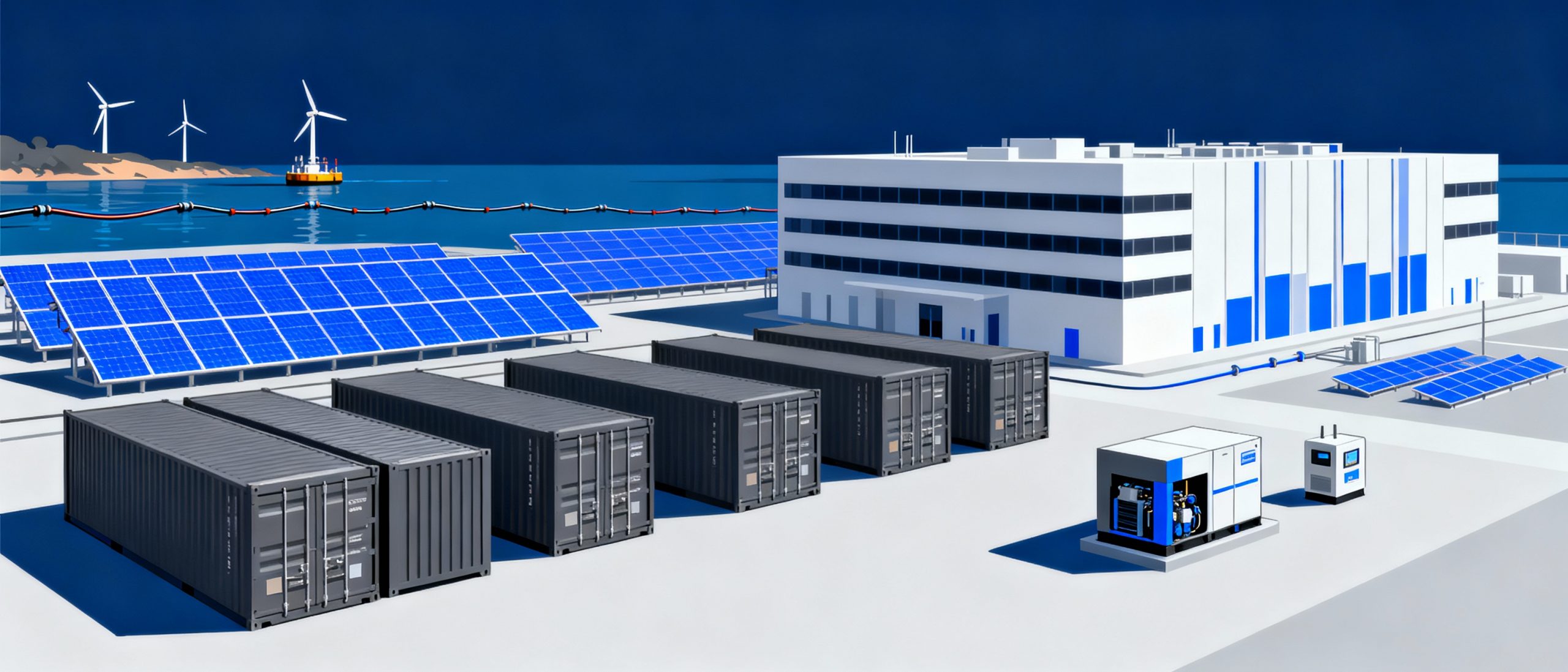
A microgrid is a localised, self-contained power network that can operate independently of the national electricity grid, though it may retain a grid connection for backup or export (link, link, link). For data centres, microgrids typically comprise:
- Distributed energy resources (DERs): on-site or nearby renewable generation (solar PV, onshore wind, offshore wind via private cable), combined with battery energy storage systems (BESS) and, currently, gas-fired generation (gas engines, turbines or fuel cells) for firming (link, link, link).
- Private wire or direct connection: a dedicated electrical connection between the generation assets and the data centre load, bypassing the public transmission and distribution network (link, link, link, link).
- Microgrid controller (MGC): advanced control systems that coordinate dispatch of generation and storage assets, manage islanding (disconnection from the grid), synchronisation, power quality, black start sequences, and optimise real-time operations (link, link, link).
- Optional grid tie: many microgrids retain a low-utilisation or pay-per-use grid connection for emergency backup, surplus export, or participation in flexibility markets, but the microgrid is designed to meet the majority of load independently (link, link, link).
Critically, microgrids allow data centres to be “behind the meter”: generation and consumption occur within a single metered boundary, avoiding transmission and distribution network charges, connection queue delays, and exposure to grid constraints (link, link, link).
The economic case: renewables beat nuclear SMRs by 43%
The most rigorous analysis of data centre microgrid economics in the UK to date comes from the Centre for Net Zero (CNZ), which modelled three scenarios for powering a 120 MW data centre—at the upper end of current UK deployments—and compared capital and operating costs annuitised over asset lifetimes (link, link, link, link, link).
Scenario 1 (Nuclear SMR baseline): Power supplied by a Rolls-Royce SMR, using the £2.5 billion capex estimate for a 470 MW first-of-a-kind unit (2021–22 pricing) and £55/MWh opex (2012 prices, re-confirmed by Rolls-Royce in early 2025), annuitised over a 60-year lifetime (link).
Scenario 2 (Renewable microgrid – full suite): Offshore wind + solar PV + BESS + open-cycle gas turbine (OCGT) backup, optimised using Python for Power System Analysis (PyPSA) to minimise total cost while meeting 100% of data centre load every hour of the year (link, link).
Scenario 3 (Renewable microgrid – land-constrained): Same as Scenario 2 but excluding solar PV, to reflect sites where land is unavailable for ground-mounted solar (link, link).
Key findings:
- Scenario 2 is 43.4% cheaper annually than Scenario 1 when considering combined capex and opex (link, link, link, link).
- Scenario 3 (no solar) is 42.1% cheaper than Scenario 1, with only a marginal cost penalty versus Scenario 2 (link, link).
- A 95% renewable microgrid (restricting gas to under 80 MW capacity and allowing larger BESS and wind/solar capacity to compensate) aligned with the UK’s Clean Power 2030 target was modelled at 31.7% lower cost than the SMR scenario (link).
- Offshore wind meets the majority of load year-round, with solar, batteries and gas providing support. Gas is used on average 20.4% of the time across the entire year in Scenario 2, and 22% in Scenario 3 (link).
- During “dunkelflaute” periods (low wind and low solar, typically in shoulder seasons like August–September), gas and batteries together account for the majority of load, sometimes for multiple days (link).
The cost advantage of renewables is driven by dramatically lower capex and opex compared to nuclear. Between 2010 and 2022, global costs for batteries fell 90%, solar PV 89%, and onshore wind 69%; in the UK, offshore wind and solar costs have fallen approximately 70% and 76% respectively in the last decade (link). Nuclear costs, by contrast, have remained stubbornly high or increased: Sizewell C cost estimates have escalated from £20 billion (2020) to £38 billion in real 2024 prices, with some modelling suggesting true financing costs could reach £100 billion (link).
Operational SMRs in China, Russia and Argentina have all experienced cost overruns of 300–700% versus original estimates (link). Even assuming Rolls-Royce can deliver power at its optimistic £55/MWh target—which many industry analysts doubt—CNZ’s modelling shows the renewable microgrid is substantially cheaper (link).
Speed: 5 years vs 10+ years
Beyond cost, deployment speed is the defining advantage of microgrids over grid-dependent solutions or nuclear.
Renewable microgrid timeline: ~5 years
CNZ estimates that a microgrid powered predominantly by offshore wind could be operational in approximately five years from site selection to commercial operation (link, link, link, link, link).
Part one: Site selection to Final Investment Decision (FID) = ~36–42 months, including 6–18 months for private export cable consent, licence-exemption compliance under the Electricity Act, and onshore planning rights (link). This is grounded in UK offshore wind precedents:
- Galloper (353 MW): consent May 2013, FID November 2015 (~30 months).
- Rampion (400 MW): consent July 2014, FID May 2015 (~10 months).
- Dudgeon (402 MW): consent July 2012, FID July 2014 (~26 months) (link).
Part two: FID to Commercial Operation Date (COD) = ~28–38 months:
- Galloper: FID November 2015, fully operational March 2018 (~28 months).
- Rampion: FID May 2015, fully commissioned March 2018 (~34 months).
- Dudgeon: FID July 2012, fully commissioned October 2017 (~38 months) (link).
For solar PV, consent timelines are typically 18–24 months following a 9–12-month pre-application phase, with construction in 12–24 months (or as little as 10 weeks for some projects like Shotwick, 72 MW) (link). BESS projects can be completed in 6–12 months for construction, though development and planning add another year (link).
The key advantage: generation assets do not require National Energy System Operator (NESO) or offshore transmission operator (OFTO) engagement on grid-level consenting and multi-year network modelling, which currently adds years to conventional grid connections (link).
SMR timeline: 10+ years (and uncertain)
Rolls-Royce’s first SMR is projected to come online in the mid-2030s, roughly a decade from Final Investment Decision (expected end of 2029) (link, link). However, globally, not a single operational SMR has met its construction schedule:
- Russia (KLT-40S floating SMRs): projected 4 years, actual 12+ years.
- China (HTR-PM): projected 5 years, actual 9+ years.
- Argentina (CAREM-25): ongoing delays, significant cost overruns (link).
Even if the UK’s first SMR avoids these pitfalls—a heroic assumption—it will not be available to power data centres in the late 2020s when the bulk of AI-driven demand is expected to materialise. For operators needing capacity now, microgrids are the only credible option (link, link, link, link).
Grid reinforcement: decades
Expanding the national grid to accommodate data centre demand is the “official” pathway, but timelines are prohibitive. The UK needs to build five times more transmission infrastructure in the next five years than was built in the last three decades—the largest grid overhaul in generations (link, link). Even with Ofgem’s connection queue reforms (removing “zombie” projects, prioritising “first ready, first connected”), new transmission capacity in congested areas like Greater London will not meaningfully arrive until the mid-to-late 2030s (link, link, link).
Technical architecture: what does a data centre microgrid look like?
A well-designed data centre microgrid balances reliability, cost, decarbonisation and resilience through a layered architecture.
Generation mix
Offshore wind (via private cable): the backbone of the microgrid. A dedicated subsea export cable runs from an offshore wind array directly to the data centre site, bypassing the transmission network entirely (link, link, link). This avoids transmission charges, queue delays, and locational constraints. CyrusOne’s FRA7 data centre in Frankfurt provides a real-world precedent: multiple 4.5 MW gas engine modules powered initially by natural gas but capable of running on hydrogen blends (link). Similarly, UK operators are exploring private cables from North Sea wind farms to data centre campuses in the North East and Scotland (link, link).
Solar PV (on-site or adjacent): where land is available, ground-mounted or roof/carport-mounted solar provides daytime generation and peak shaving. For a 120 MW data centre, on-site solar will typically cover only a small percentage of annual MWh, but reduces effective peak grid draw and supports resilience (link, link).
Battery energy storage systems (BESS): utility-scale lithium-ion batteries (or emerging alternatives like vanadium redox flow batteries for longer duration) provide:
- Millisecond frequency response to stabilise the microgrid during load steps or generator trips.
- Grid-forming operation with virtual inertia, voltage control and fast fault ride-through.
- Black start capability to restart the microgrid after a complete outage.
- Load smoothing to keep turbines and engines in stable operating regions (link, link, link, link).
Typical BESS sizing is for power (MW) to handle ramp rates, and energy (MWh) to ride through short disturbances or smooth renewable variability. For a 120 MW data centre microgrid, CNZ’s modelling suggests BESS capacity in the range of tens of MW/MWh, optimised alongside wind, solar and gas to minimise total cost (link).
Gas-fired generation (CHP, gas engines, fuel cells, or open-cycle gas turbines): in current UK deployments, gas remains the most cost-effective firming technology to bridge periods of low renewable output, especially during “dunkelflaute” events (link, link). As battery costs fall and carbon prices rise, the role of gas is expected to decline, but today it provides:
- Fast-ramping backup during multi-day low-wind/low-sun periods.
- Guaranteed capacity for N+1 resilience.
- CHP capability, with waste heat recovered for district heating, industrial processes, or absorption cooling, substantially improving overall system efficiency (link, link, link).
Gas engines and turbines can be converted to run on hydrogen blends (20–25% today, with pathways to 100% in future), enabling decarbonisation over time as hydrogen infrastructure scales (link, link, link).
Control and protection systems
Microgrid controller (MGC): the “brain” of the system, coordinating:
- Real-time dispatch optimisation across wind, solar, BESS and gas to minimise cost and emissions.
- Islanding sequences: detecting grid faults and seamlessly transitioning to island mode.
- Synchronisation and reconnection to the grid when required.
- Black start logic: restarting the microgrid from a dead state using BESS or dedicated black start generators.
- Droop control, set-point optimisation and contingency logic for frequency and voltage stability (link, link, link).
Grid-forming inverters: modern battery and solar inverters can operate in grid-forming mode, providing virtual inertia, voltage support and fast fault ride-through—critical for stable island operation without synchronous generation (link, link).
Protection and selectivity: islanded microgrids need carefully graded protection schemes, with intentional fault current sources (synchronous condensers, engines, or grid-forming inverters with fault current capability) and selective relaying to isolate faults without collapsing the entire system (link, link).
Cybersecurity: the MGC and SCADA systems are treated as critical infrastructure, with network segmentation, secure protocols, role-based access and monitored remote connections (link, link).
Grid connection options
Three models are emerging:
- Fully islanded (no grid connection): the microgrid operates entirely independently. Rare in the UK, but feasible for data centres in areas with zero grid capacity or as an interim solution before grid capacity arrives (link, link, link).
- Low/no-utilisation grid tie: the data centre has a grid connection, but it is sized much smaller than the total load (e.g. 10–20 MW for a 120 MW data centre) and used only for emergencies, surplus export, or flexibility services. This model reduces connection costs and queue times while maintaining resilience (link, link, link). CNZ proposes a pay-per-use or penalty-per-overuse structure: the data centre receives a grid connection capable of its full load, but pays penalties if it exceeds a low threshold (e.g. 10 MW), incentivising reliance on the microgrid (link).
- Integrated microgrid (flexible grid connection): the microgrid operates in parallel with the grid, exporting surplus generation, importing during shortfalls, and providing demand-side response and ancillary services (frequency response, reserve, constraint management) to earn revenue (link, link, link).
National Grid and AI data centre operator Emerald AI announced a strategic partnership in September 2025 to demonstrate how AI data centres can dynamically adjust energy consumption in real time using Emerald Conductor, an AI-powered system that mediates between the grid and the data centre (link). This model increases utilisation of existing grid infrastructure and allows NESO to offer accelerated connections to data centres that can guarantee flexibility during peak demand periods (link).
Reliability and resilience: black start and islanding
Data centres demand 99.999% uptime (“five nines”), which translates to less than 5.26 minutes of downtime per year. Microgrids can meet or exceed this through:
Black start capability
Black start is the ability to restore power independently after a complete outage, without external grid support (link, link, link, link). In a data centre microgrid:
- BESS acts as the first-up black start source, energising the local network and providing startup power for other generators (link, link, link).
- Diesel or gas engines (or hydrogen fuel cells in future) provide additional black start capability and can run indefinitely if fuel is available (link, link).
- Microgrid controller executes the black start sequence: energise busbars, synchronise generators, ramp up load in stages, stabilise frequency and voltage (link, link, link).
Recent microgrid solutions for data centres, such as Delta’s Data Center Microgrid Solution unveiled at RE+ 2025, feature virtual synchronous generator (VSG)-based multi-power source synchronisation, real-time control with sub-4-millisecond response, seamless on/off-grid transition, and flexible black start capability, maintaining voltage regulation within ±2% under AI workloads (link).
Islanding (planned and unplanned)
Microgrids must handle four types of transitions (link):
- T1 – Planned islanding: the microgrid disconnects from the grid in advance (e.g. during maintenance or known grid constraints), transitioning smoothly to island mode.
- T2 – Unplanned islanding: the grid fails unexpectedly; the microgrid detects the fault and islands automatically within milliseconds to maintain internal supply.
- T3 – Reconnection: when grid conditions are restored, the microgrid synchronises (matching voltage, frequency and phase) and reconnects.
- T4 – Black start into island: the microgrid restarts from a dead state and establishes a stable island before any grid connection.
IEEE Standard 2030.7 and related standards define requirements for microgrid design, operation and interconnection, reducing complexity and ensuring interoperability (link, link).
Resilience during grid constraints
Microgrids decouple data centre operations from national grid failures, regional blackouts, and local distribution network faults. During the 2022 European energy crisis, France’s nuclear fleet availability dropped to around 40% for extended periods due to maintenance and cooling water constraints (link). A data centre relying solely on grid supply would have faced severe uptime risk; a microgrid with diverse local generation would have continued operating (link, link, link).
Regulatory and licensing challenges
The UK regulatory regime is built around grid export and centralised markets; microgrids operating largely or entirely behind the meter face several regulatory uncertainties:
Licensing under the Electricity Act 1989
Any entity generating or supplying electricity beyond single-premises self-supply must hold a licence from Ofgem, or qualify for an exemption (link, link, link). For data centre microgrids:
- Generation licence: required if the microgrid generates electricity for supply to others. Exemptions exist for small-scale generation, but large offshore wind or gas plants may require full licensing (link, link, link).
- Supply licence: required if the microgrid supplies electricity to multiple customers or tenants (relevant for multi-tenant colocation data centres) (link).
- Private wire exemptions: Ofgem has granted exemptions for private wire networks serving specific developments (e.g. Emergent Energy Systems’ residential microgrids), but each case is assessed individually (link).
Navigating this regulatory maze can add 6–12 months to development timelines and requires bespoke legal and technical advice (link, link).
Distribution Network Operator (DNO) engagement
Even if a microgrid is predominantly off-grid, it may still require DNO engagement for:
- Grid connection (even if minimal): connection agreements, grid studies, reinforcement contributions (link, link, link).
- G98/G99 compliance: UK standards for connecting distributed generation to the grid, covering protection, power quality, fault ride-through, etc. (link, link, link).
- Embedded benefits and charges: embedded generators historically received benefits (avoided transmission charges), but reforms have reduced or removed these for many generators (link).
Ofgem Regulatory Sandbox
Ofgem operates a Regulatory Sandbox to trial innovative business models and grant temporary derogations from licence conditions. Emergent Energy Systems, a microgrid operator for residential housing developments, was granted sandbox approval in 2023 to trial new methodologies for DUoS (Distribution Use of System) charges on microgrids and ensure residents’ right to switch suppliers (link). Similar sandbox applications may be needed for large data centre microgrids to clarify regulatory treatment.
Network charges and subsidies
A contentious issue is whether data centre microgrids should pay for grid infrastructure they do not use, or conversely, whether they should be allowed to “free-ride” on the grid for backup without contributing to system costs (link, link).
CNZ proposes:
- Pay-per-use grid connections: data centres with microgrids pay only for actual kWh drawn from the grid, plus a small standby charge, rather than full capacity-based TNUoS (Transmission Network Use of System) charges (link).
- Penalties for overuse: if a data centre exceeds agreed thresholds (e.g. uses more than 10 MW from a 120 MW-capable connection), it pays penalties, incentivising self-sufficiency (link).
This model would reduce consumer cross-subsidies (where households pay for infrastructure to serve data centres) while maintaining resilience for operators (link).
AI Growth Zones and locational pricing
The UK Government announced AI Growth Zones in 2025, with targeted pricing support to reduce electricity costs for data centres in areas with high renewable generation and grid capacity (Scotland, Cumbria, North East England) (link). From April 2027, data centres in AI Growth Zones will see electricity cost reductions of up to £24/MWh in Scotland, £16/MWh in Cumbria, and £14/MWh in the North East, achieved by exempting data centres from a portion of transmission charges (link).
This locational signal could incentivise data centre developers to site facilities where microgrids can connect to abundant wind and solar capacity, rather than competing for scarce capacity in the South East (link).
Demand-side response and flexibility markets
Even if a data centre is primarily powered by a microgrid, integrating with the grid via a flexible connection unlocks significant value through demand-side response (DSR) and flexibility services (link, link, link).
How data centres can participate in DSR
Data centres are ideal DSR assets due to (link, link):
- Large, predictable baseload: hundreds of MW of continuous demand that can be modulated (within constraints) to support grid balancing.
- Existing backup infrastructure: UPS (uninterruptible power supply) and battery systems allow data centres to temporarily disconnect from the grid or reduce draw without affecting IT loads.
- Geographical diversity: multi-site operators can shift workloads between locations based on real-time carbon intensity and grid conditions.
National Grid’s Demand Flexibility Service (DFS) pays participants to reduce consumption during peak periods (link, link, link, link). Data centres with microgrids can bid into DFS by:
- Increasing on-site generation (wind, solar, BESS discharge, gas) to reduce grid import.
- Shifting AI training workloads to off-peak hours or to other sites.
- Temporarily curtailing non-critical cooling or auxiliary loads.
National Grid and Emerald AI’s 2025 partnership will demonstrate how AI workloads can be adjusted in real time using cutting-edge NVIDIA GPUs, dynamically modulating energy consumption to support grid stability while maintaining performance standards (link). By increasing utilisation of existing electricity infrastructure, this approach can accelerate data centre connections by giving NESO confidence that peak demand will not overload the network (link).
Revenue opportunities
DSR and flexibility services can generate substantial revenue for data centre operators (link, link):
- Capacity payments: for guaranteeing availability to reduce demand when called.
- Energy payments: for actual kWh of demand reduction or surplus generation exported.
- Ancillary services: frequency response (FFR, Dynamic Containment), reserve, reactive power, constraint management (link, link, link).
National Grid ESO’s MW Dispatch Service allows distributed energy resources (DERs) connected to distribution networks to reduce output during transmission network constraints, receiving constraint payments (link). Over 1 GW of generation and batteries in the South East have connected faster and at lower cost through this scheme (link).
Data centres with large on-site generation and storage can similarly participate, providing bidirectional flexibility: importing during surplus renewables, exporting or curtailing during constraints (link, link).
Location, location, location: where should UK data centre microgrids be sited?
Strategic siting is critical to microgrid viability. Optimal locations have (link, link, link, link):
High renewable resource
- Offshore wind landing points: North Sea coast (Northumberland, Teesside, Humber, East Anglia, Kent) where subsea cables from wind farms come ashore (link, link, link, link).
- High onshore wind: Scotland, Cumbria, Wales, Cornwall.
- Strong solar resource: southern and eastern England.
Grid capacity and headroom
- AI Growth Zones: Scotland, Cumbria, North East England have been designated by government as having available grid capacity and renewable potential (link).
- Industrial clusters: Teesside, Humber, Merseyside, South Wales, Grangemouth have existing gas, hydrogen, CCS and heat infrastructure, and legacy industrial grid capacity being freed up as heavy industry declines (link).
Proximity to existing infrastructure
- Gas networks: areas with high-pressure gas transmission or distribution capacity for gas-fired firming (link, link, link).
- Hydrogen clusters: co-location with planned hydrogen production and distribution projects (HyLine Cymru, Project Union, East Coast Cluster) enables future fuel decarbonisation (link, link).
- Cooling water: for gas engines, fuel cells or (in future) hydrogen combustion, access to cooling water (rivers, sea) or land for air-cooled systems is essential.
Low land costs and planning constraints
- Brownfield sites: former industrial, military or energy sites (e.g. coal power stations, steelworks) often have existing grid connections, water, and planning consents (link, link, link).
- Agricultural land: lower cost than urban/suburban, suitable for ground-mounted solar and wind turbines (subject to planning).
Example: Blackstone’s Blyth data centre
Blackstone’s £10 billion QTS data centre in Blyth, Northumberland, is the UK’s largest data centre project to date and illustrates many microgrid principles—though controversially (link, link, link, link).
- Site: 540,000 m² on the former Blyth coal-fired power station site (brownfield, with existing grid infrastructure) (link, link, link).
- Capacity: 720 MW IT load (10 buildings × 72 MW each) (link).
- Grid connection: the site will connect to the National Grid substation and draw on existing offshore wind and hydropower from Norway (link).
- Diesel backup: planning documents reveal 580 diesel generators capable of 3.93 GW, more than Sizewell B nuclear power plant’s output, raising controversy over emissions during “emergencies” or grid constraints (link).
- Gas option: Blackstone and government have discussed “temporary on-site generation, including natural gas fuel cells” as an interim measure to avoid grid connection delays (link).
Critics argue the project locks in fossil fuel dependency and diverts renewable capacity from other uses; proponents counter that it secures thousands of jobs in a deprived region and positions the UK as a global AI leader (link, link, link, link). A true renewable microgrid architecture—offshore wind via private cable, large-scale BESS, solar where feasible, and time-limited gas with hydrogen transition pathways—would address many concerns.
Barriers and challenges
Despite their promise, data centre microgrids face several obstacles:
1. Regulatory uncertainty
The UK regulatory regime is not designed for large-scale, behind-the-meter microgrids. Bespoke licensing, DNO engagement, and unclear treatment of embedded benefits and charges create uncertainty and delay (link, link, link).
Solution: Ofgem should develop a fast-track microgrid licence framework for data centres, with standard templates, clear exemptions, and streamlined approvals. Government should legislate to clarify the rights and obligations of microgrid operators and their relationship with the national grid (link, link).
2. Whole-system cost allocation
If data centres defect from the grid en masse, fixed grid costs must be spread over fewer consumers, raising household bills. Conversely, if microgrids retain low-utilisation grid connections for backup, who pays for that capacity? (link, link)
Solution: Implement pay-per-use or penalty-per-overuse grid connections, where data centres pay for actual usage plus a modest standby charge, not full capacity charges. Encourage data centres to offer DSR and ancillary services to offset system costs (link, link, link).
3. Loss of demand-side flexibility
If data centres disconnect from the grid, the system loses potentially gigawatts of flexible demand that could help balance renewables (link, link, link).
Solution: Require data centre microgrids to maintain a grid connection (even if minimal) and participate in flexibility markets as a condition of planning consent or licensing. Investigate reintegration pathways where off-grid data centres reconnect when grid capacity expands (link, link).
4. Land use and spatial constraints
Offshore wind, onshore wind, solar and BESS require significant land and seabed. Siting generation close to data centres may conflict with other uses (housing, agriculture, nature conservation) (link, link, link).
Solution: Prioritise brownfield sites, co-locate with industrial clusters, and spatially optimise generation siting to minimise land use (e.g. floating offshore wind, rooftop solar, vertical wind turbines). Future work should model spatial constraints explicitly (link, link).
5. Gas as a transition fuel
Current microgrid economics favour gas for firming, but this conflicts with net-zero targets and creates lock-in risk (link, link, link).
Solution: Mandate decarbonisation pathways in planning consents: gas engines/turbines must be hydrogen-ready or have contractual commitments to switch to biomethane, hydrogen blends, or be retired by a fixed date (e.g. 2035). Accelerate battery cost reduction and long-duration storage deployment to displace gas (link, link).
6. Cybersecurity and critical national infrastructure
Microgrids with advanced control systems, remote monitoring, and grid interconnection are vulnerable to cyberattacks. Data centres are designated Critical National Infrastructure; microgrid failures could have cascading economic and national security impacts (link, link).
Solution: Enforce robust cybersecurity standards (IEC 62351, NERC CIP, UK CNI cybersecurity frameworks) as a condition of licensing. Require physical and logical separation of MGC/SCADA from public networks, regular penetration testing, and incident response plans (link, link).
The future: microgrids as energy hubs
Beyond solving the immediate connection crisis, data centre microgrids could evolve into local energy hubs that provide multiple services (link, link, link):
- Surplus export: when data centre load is low and renewable generation is high, export to the grid or neighbouring users via peer-to-peer trading platforms (link).
- Hydrogen production: use surplus renewables to power on-site electrolysers, producing green hydrogen for sale, injection into the gas network, or use in microgrid fuel cells/turbines (link, link, link).
- Heat networks: recover waste heat from data centre cooling and gas engines/fuel cells for district heating, greenhouses, or industrial processes (link, link, link).
- EV charging hubs: co-locate EV fast-charging infrastructure, powered by microgrid renewables (link).
- Grid services: provide frequency response, voltage support, reactive power, black start capability, and synthetic inertia to support grid stability as coal and gas retire (link, link, link).
This circular energy system maximises asset utilisation, diversifies revenue, and strengthens the business case for microgrids while supporting the broader energy transition (link, link, link).
Conclusions: microgrids as the pragmatic path forward
The UK’s data centre grid connection crisis will not be solved by waiting for the grid to catch up. With connection queues exceeding 125 GW, lead times stretching to 15 years, and AI-driven data centre demand projected to triple or more by 2030, the status quo is untenable (link, link, link).
Microgrids offer a proven, cost-effective, and rapid alternative. Centre for Net Zero modelling demonstrates that a renewable microgrid (offshore wind, solar, BESS, and gas firming) can power a 120 MW data centre at 43% lower annual cost than a nuclear SMR, be deployed in roughly half the time (~5 years vs 10+ years), and meet 80% of annual demand from renewables (link, link, link, link, link). Even a 95% renewable microgrid aligned with Clean Power 2030 is 32% cheaper than nuclear (link).
The technical architecture is well understood: grid-forming inverters, advanced microgrid controllers, black start capability from BESS, and seamless islanding ensure 99.999% uptime while decoupling from national grid constraints (link, link, link, link). Real-world deployments are already underway, from CyrusOne’s hydrogen-ready microgrid in Frankfurt to Teledata’s fuel cell microgrid in Manchester and Blackstone’s GW-scale development in Blyth (link, link, link, link, link).
What is required now is regulatory clarity, strategic planning, and political will:
- Ofgem must develop a fast-track microgrid licensing framework and clarify treatment of pay-per-use grid connections (link, link).
- Government must integrate data centre microgrids into AI Growth Zone planning, enforce decarbonisation pathways for gas firming, and reform network charging to avoid regressive consumer impacts (link, link).
- NESO and DNOs must facilitate low-utilisation grid ties and DSR participation to capture the flexibility value of data centres while enabling rapid deployment (link, link, link).
- Developers must prioritise renewable-rich, grid-uncongested locations (Scotland, North East, industrial clusters), co-locate with hydrogen and heat infrastructure, and design for future grid reintegration (link, link, link).
The window of opportunity is narrow. Decisions taken by hyperscalers, investors and policymakers in 2025–26 will shape the UK’s energy and digital landscapes for decades. The potential £44 billion GVA contribution from data centres between 2025 and 2035 hangs in the balance (link, link, link). Microgrids, powered predominantly by renewables with a clear pathway to 100% zero carbon, offer the UK a chance to lead the global AI race while delivering on Clean Power 2030. The technology is ready. The economics are compelling. The only question is whether the UK can move fast enough to seize the opportunity.
Frequently Asked Questions: Microgrids and UK AI Data Centres
How can microgrids help solve the UK data centre grid connection crisis?
Microgrids allow data centres to connect directly to local renewable generation such as offshore wind, solar, and battery storage via private wire, bypassing the heavily congested national grid connection queue. By operating behind the meter and using a flexible or low-utilisation grid tie for backup, microgrids can be deployed in around five years, compared with ten or more years for major grid reinforcement or new nuclear, while still delivering high reliability.
Are renewable microgrids cheaper than small modular reactors (SMRs) for powering data centres?
Yes. Modelling from the Centre for Net Zero shows that a renewable microgrid combining offshore wind, solar PV, battery storage and gas firming can power a 120 MW data centre at about 43% lower annual cost than a nuclear SMR, even when assuming optimistic cost and performance figures for the SMR. A 95% renewable microgrid aligned with the UK’s Clean Power 2030 target is still more than 30% cheaper than the nuclear option.
What technologies typically make up a data centre microgrid?
A data centre microgrid usually includes one or more renewable generation sources such as offshore wind (via private export cables) and solar PV, utility-scale battery energy storage systems for fast response and black start, and gas engines, turbines or fuel cells for firming and backup. These distributed energy resources are coordinated by a microgrid controller that manages islanding, reconnection to the grid, and real-time optimisation of cost, emissions and reliability.
Can microgrid-powered data centres still support the UK power system?
Yes. Even when most of their energy comes from behind-the-meter generation, microgrid-powered data centres can retain a grid connection and actively participate in demand-side response and flexibility markets. They can reduce or shift their grid import during peak periods, export surplus renewable power or battery discharge when the system is tight, and provide ancillary services such as frequency response and reserve. This turns data centres from passive consumers into active grid-supporting assets.
What role do gas and hydrogen play in microgrids for UK data centres?
In the near term, gas engines and turbines provide cost-effective firming capacity to cover periods of low wind and solar output and ensure 24/7 uptime. To align with net-zero targets, these units can run on biomethane today and be converted to hydrogen blends and eventually 100% hydrogen as the UK builds out its hydrogen network. Fuel cells and hydrogen-ready engines or turbines are likely to play a growing role in zero-carbon microgrid firming as costs fall and infrastructure matures.
How quickly can a renewable microgrid for a UK data centre be deployed?
A well-planned renewable microgrid for a large UK data centre can typically progress from site selection to commercial operation in around five years. This timeline covers consents for offshore wind or onshore renewables, private cable routing, battery storage, and on-site generation. By contrast, major grid reinforcements and new nuclear capacity often take a decade or more, so microgrids offer a much faster route to bringing AI-ready data centre capacity online.
Where in the UK are microgrids most suitable for new AI data centre developments?
The most promising locations combine strong renewable resources with available infrastructure: North Sea offshore wind landing points in Northumberland, Teesside, the Humber and East Anglia; AI Growth Zones in Scotland, Cumbria and the North East; and industrial clusters with existing gas, hydrogen and carbon capture assets. Brownfield sites such as former power stations and steelworks are especially attractive because they already have grid, water and planning footprints suitable for large-scale data centre campuses.
Do microgrids compromise data centre reliability compared to traditional grid supply?
Properly designed microgrids can enhance reliability compared with relying solely on the national grid. By combining diversified local generation, battery storage, and redundant gas or hydrogen-ready backup, a microgrid can deliver five-nines availability and maintain operation during grid disturbances or blackouts. Advanced microgrid controllers provide black start capability, seamless islanding and reconnection, and continuous monitoring of system health to keep critical IT loads running.
How does using a microgrid affect the carbon footprint of a data centre?
A microgrid that prioritises offshore wind, onshore wind and solar PV can supply the majority of a data centre’s annual electricity from renewables, significantly lowering its operational emissions. Battery storage helps maximise use of renewable output, while limited gas or hydrogen firming is used only when needed to maintain reliability. Over time, switching backup generation from fossil gas to biomethane and then green hydrogen can move a data centre toward genuinely 24/7 carbon-free operation.


Bospec Energy Limited is a start-up prospecting for a real-world Integrated Energy Solution for data centres, steel, transport, and SAF, among others.
We propose utilising our renewable energy-specific engineering expertise to achieve complete non-fossil, green energy development for LCOE (40 % less than the industrial rate), LCOH
Tri-energy – Solar, wind (where available), compressed air integrations.
Manufacturing patent-pending Innovative Electrolyser.
Direct utilisation of hydrogen for electricity (using a boiler and steam turbine)( with or without storage (storage can be safely achieved with batteries with non-thermal runaway capabilities) delivering a safety system compared to lithium batteries.
Equipment e.g furnaces and diesel generators, retrofitting services
Hydrogen filling Station.
Microgrid deployment as a localised usage option.