
UK China Leadership Backgrounds: Who Governs Better in a Technological Age?
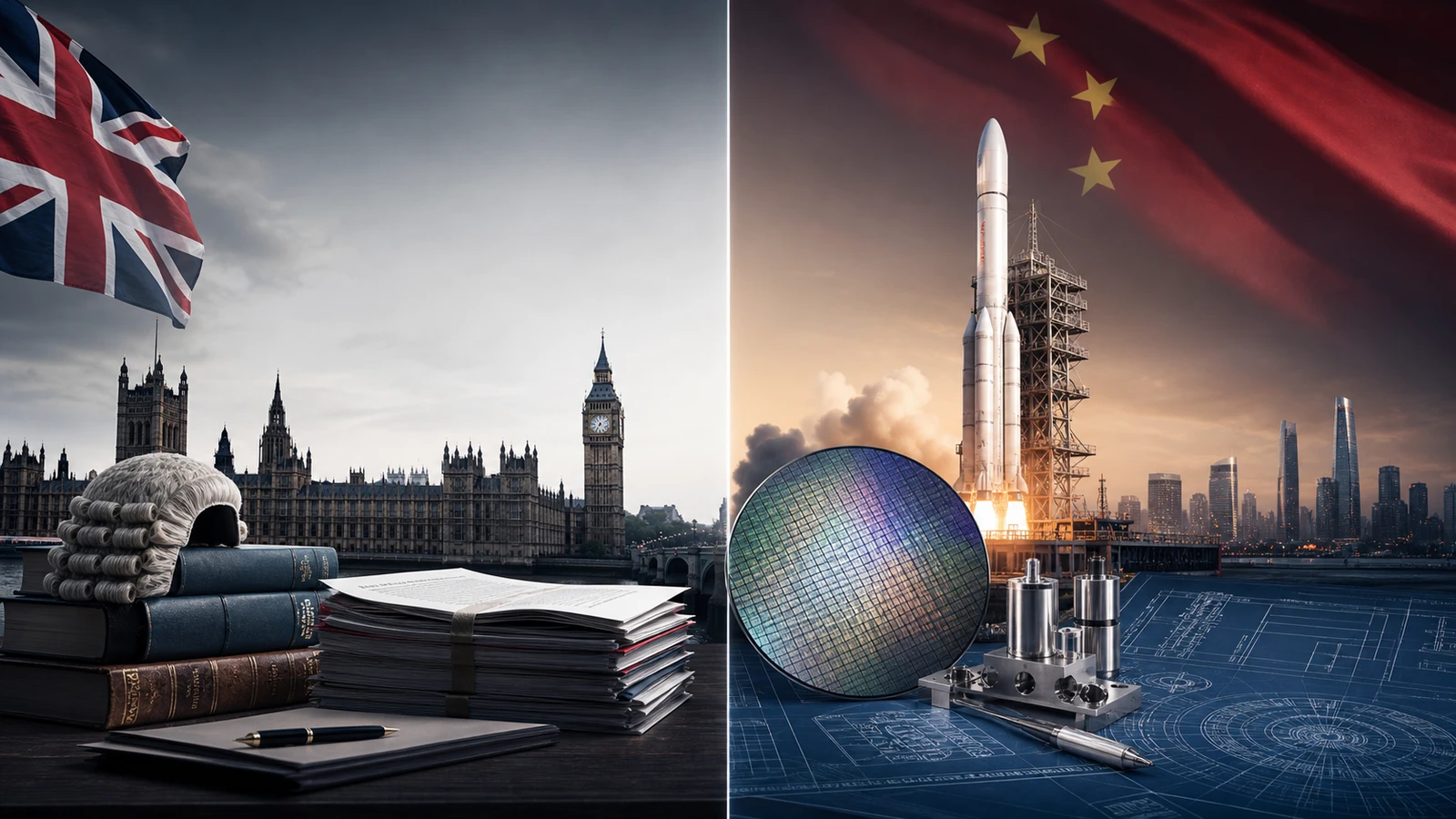
UK China leadership backgrounds expose two very different pipelines into power. One still rewards law, politics and political economy. The other has deliberately elevated engineers, aerospace scientists and nuclear specialists. That contrast does not prove that technocracy is superior, but it does raise a hard question for any country trying to govern AI, semiconductors, energy systems and industrial renewal.
Executive Summary
UK China leadership backgrounds reveal a structural divide. The UK political class remains heavily shaped by law, PPE, economics, party politics and advisory roles. China’s senior leadership, especially since the 20th Party Congress in 2022, includes a visible cohort of engineers, aerospace specialists, nuclear safety experts and industrial technocrats.
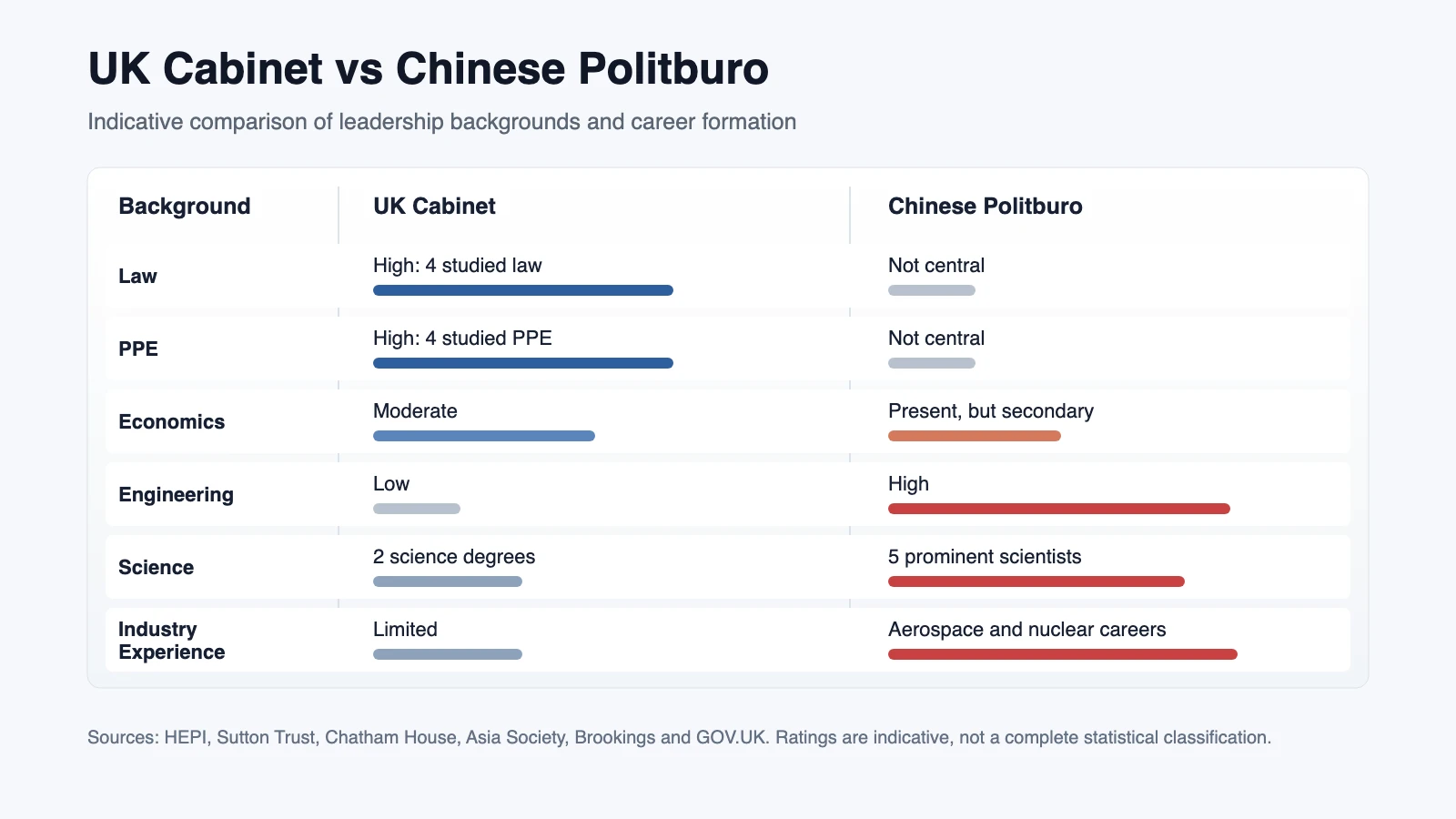
- HEPI found that law and PPE were the two most common undergraduate subjects in Keir Starmer’s first Cabinet, with four members each.
- HEPI also found that only two members of that Cabinet had studied science degrees.
- Chatham House identified five prominent scientists elevated to the Chinese Politburo in October 2022.
- Asia Society analysis identifies eight STEM technocrats in the 20th CCP Politburo, up from five in the previous lineup.
- The comparison is not democracy versus authoritarianism. It is about whether technical literacy is now a strategic requirement of national leadership.
UK China Leadership Backgrounds: What the Comparison Shows
The UK China leadership backgrounds comparison starts with a simple observation: the two systems promote different kinds of people into the room where national priorities are set.
Britain’s senior government is still drawn largely from law, politics, economics, public affairs, unions, voluntary organisations and the professional machinery of Westminster. China, by contrast, has pushed a visible group of engineers and scientists into the upper levels of party-state leadership.
That does not make China a model to copy. Political loyalty, censorship and the suppression of dissent are not incidental features of the Chinese system. But it does make the composition of its leadership strategically relevant. China is trying to govern a technological economy with people who have spent parts of their careers inside technical systems.
Britain is trying to do the same with a political class still largely trained to argue, legislate, regulate and communicate.
The UK: Law, PPE and the Professional Political Class
Keir Starmer’s first Cabinet was widely described as socially broader than many of its predecessors. The Sutton Trust analysis of the Labour Cabinet highlighted a sharp fall in privately educated ministers and a Cabinet whose school backgrounds were more representative than earlier Conservative administrations.
Yet educational diversity is not the same as professional diversity. The Higher Education Policy Institute’s analysis of Starmer’s first Cabinet found that law and PPE were the two most common undergraduate subjects, each studied by four Cabinet members. It also found that only two members had studied science degrees.
The Prime Minister’s own route fits the pattern. GOV.UK records that Keir Starmer studied law at the University of Leeds, completed postgraduate legal studies at Oxford, qualified as a barrister, became Queen’s Counsel, and served as Director of Public Prosecutions before entering Parliament.
Rachel Reeves brings a more economic profile. As Chancellor, she is the government’s chief financial minister, and GOV.UK describes her current responsibilities across growth, fiscal policy, productivity, capital markets and economic security. Her background in PPE, economics and the Bank of England makes her one of the more technically policy-literate members of the Cabinet, but it is still a political economy route rather than an engineering or industrial one.
David Lammy, appointed Deputy Prime Minister, Lord Chancellor and Secretary of State for Justice on 5 September 2025, reinforces the legal profile. His GOV.UK biography records legal study at SOAS and Harvard Law School, a call to the Bar, and legal work before Parliament.
There are important exceptions. Angela Rayner left school at 16, worked as a care worker and rose through the trade union movement. Wes Streeting worked in voluntary sector leadership before entering Parliament. These are substantial institutional experiences outside Westminster. They matter. But they are not technical or industrial formation in the sense relevant to semiconductors, AI infrastructure, nuclear build-out or grid-scale decarbonisation.
The dominant British pathway still produces capable political operators: people trained in argument, procedure, media handling, stakeholder management and parliamentary arithmetic. Those skills are real. The weakness is that they rarely come from years spent building, testing, scaling or operating complex technical systems.
China: Engineers and Scientists at the Top
The Chinese picture is different. The 20th Party Congress in October 2022 confirmed a shift that had been building through Xi Jinping’s tenure. Chatham House described the appointment of five prominent scientists to the Politburo as evidence of a shift in policy emphasis from fast growth towards resilience against external shocks. That same assessment linked the change to Beijing’s concern over dependence on overseas suppliers for semiconductors and other critical components.
This is the practical face of technocracy in China: Chinese technocrats are being used to strengthen China engineering leadership in sectors that Beijing sees as strategically decisive.
Asia Society’s Decoding Chinese Politics project identifies eight technocrats with STEM educational and professional backgrounds in the 20th CCP Politburo, up from five in the previous Politburo.
Xi Jinping’s own background is part of the story. He studied chemical engineering at Tsinghua University before the political career that made him General Secretary. Under his leadership, China has made technological self-reliance a central principle of statecraft, from advanced manufacturing and space to batteries, electric vehicles and semiconductors.
Li Qiang, Premier of the State Council, studied agricultural mechanisation and management engineering. Brookings records that he began work at an electromechanical irrigation and drainage station, later governed Zhejiang, Jiangsu and Shanghai, and oversaw the period in which Tesla established its largest overseas plant in Shanghai.
Ding Xuexiang, now a senior member of the Politburo Standing Committee and first-ranked Vice Premier, has an engineering background and spent his early career in materials research. His formation was not in electoral politics or public communications but in research, management and party work inside industrial Shanghai.
Ma Xingrui is the most striking example. Brookings’ profile of Ma Xingrui records degrees in mechanical and electrical engineering, mechanics and doctoral mechanics, followed by a career at Harbin Institute of Technology, the Chinese Academy of Space Technology, the China Aerospace Science and Technology Corporation, and the China National Space Administration. He served as chief commander for Chang’e 3, China’s first lunar surface exploration mission.
Yuan Jiajun followed a similar aerospace route, spending more than two decades in the space industry and becoming chief designer of the Shenzhou spacecraft. Li Ganjie studied nuclear reactor engineering and safety at Tsinghua before becoming a nuclear safety official and later Minister of Ecology and Environment. The Ministry of Ecology and Environment’s official profile records his nuclear reactor engineering education and early career at the National Nuclear Safety Administration.
Chen Jining, Mayor of Beijing and member of the Politburo, holds a doctorate in civil and environmental engineering from Imperial College London. Again, the pattern is not a decorative degree in science. It is technical formation followed by institutional power.
Key Insight
China’s technocrats are not simply scientists invited to advise politicians. In several cases, they are former engineers, research leaders and industrial managers who became politicians. That distinction matters because it changes what senior leaders are likely to understand instinctively: systems integration, manufacturing constraints, programme risk, supply chains and the time required to move from prototype to production.
The Cosmos Club as a Systemic Pattern
The rise of China’s aerospace-linked officials is often described as the “cosmos club”. The term matters because it points to a pipeline rather than a collection of impressive biographies.
Cheng Li’s China-US Focus analysis, based on Brookings research, describes how China’s aerospace and aviation research institutes became cradles of party cadre training. The same analysis notes the importance of Beihang, Northwestern Polytechnical University and Harbin Institute of Technology in producing many of the leading technocrats now visible in Chinese politics.
The logic is not just that engineers are clever. It is that aerospace, nuclear, semiconductor and advanced manufacturing programmes create people who understand complex supply chains, capital intensity, testing regimes, programme failure, long-cycle investment and national security constraints.
That matters in a state that sees technological self-reliance as a strategic priority. It also explains why China can maintain long-horizon industrial programmes even when individual projects underperform. The leadership culture has more people who understand how technical systems mature.
Head to Head: What Each System Produces
| Leader | Role | Educational background | Career before high politics |
|---|---|---|---|
| Keir Starmer | UK Prime Minister | Law at Leeds; postgraduate legal studies at Oxford | Barrister; Director of Public Prosecutions |
| Rachel Reeves | UK Chancellor | PPE and economics | Bank of England and financial-policy career before Parliament |
| David Lammy | UK Deputy Prime Minister and Justice Secretary | Law at SOAS and Harvard Law School | Barrister and legal career before Parliament |
| Angela Rayner | Former UK Deputy Prime Minister | No degree; left school at 16 | Care worker and UNISON official |
| Xi Jinping | China President and CCP General Secretary | Chemical engineering at Tsinghua | Party and provincial career built on technical education |
| Li Qiang | China Premier | Agricultural mechanisation; management engineering | Electromechanical irrigation station; Zhejiang, Jiangsu and Shanghai leadership |
| Ma Xingrui | Chinese Politburo member | Mechanical and electrical engineering; PhD mechanics | Aerospace scientist; China Aerospace Science and Technology Corporation; Chang’e 3 mission commander |
| Yuan Jiajun | Chinese Politburo member | Aircraft design and engineering | Chief designer of Shenzhou spacecraft; aerospace executive |
| Li Ganjie | Chinese Politburo member | Nuclear reactor engineering and safety | Nuclear safety engineer; National Nuclear Safety Administration; environment minister |
| Chen Jining | Chinese Politburo member and Mayor of Beijing | Civil and environmental engineering | Environmental scientist and university leader |
Why This Matters
The professional formation of senior leaders shapes the questions they ask. A Cabinet formed around law, PPE and politics will tend to see problems through legislation, regulation, fiscal control, negotiation and messaging. A Politburo with aerospace engineers, nuclear specialists and industrial managers is more likely to think in terms of systems, production capacity, supply chains and long-cycle technical programmes.
This distinction is not abstract. The most important policy questions now facing advanced economies are technical as well as political: AI governance, energy transition, nuclear delivery, grid constraints, semiconductor security, robotics, biosecurity, industrial resilience and advanced manufacturing.
On those questions, technical literacy at the top is not a luxury. It affects whether ministers can interrogate expert advice, distinguish a plausible pilot from a scalable deployment model, understand why a semiconductor process node matters, and recognise whether an energy project is constrained by technology, infrastructure, permitting, offtake or finance.
That is the same commercialisation problem explored across TimHarper.net’s work on technology commercialisation, deep tech, semiconductor clusters, real-world AI and sensing, and energy transition infrastructure. Technical capability does not become national capability until someone understands the route from laboratory or policy paper to deployment at scale.
Why It Matters
Britain does not need to copy China’s authoritarian technocracy. It does need to ask whether a political system dominated by lawyers, economists and communicators has enough technical depth to govern a decade defined by AI, semiconductors, energy systems, advanced manufacturing and industrial resilience.
What Britain Does Well
There is a danger in overstating the case. The British system produces strengths that should not be dismissed. A legal background can produce precise thinking, procedural discipline, respect for evidence, constitutional restraint and sensitivity to individual rights. Those are not minor virtues in a democracy.
Britain also has deep technical resources around government: the Government Chief Scientific Adviser, departmental chief scientific advisers, UKRI, the National Engineering Policy Centre, SAGE structures, the OBR, the Bank of England, select committees and an independent civil service. Ministers do not operate alone.
The problem is not the absence of advice. It is the gap between receiving expert advice and being able to challenge, integrate and act on it. A minister does not need to be a semiconductor process engineer to make semiconductor policy. But a minister does need enough technical and industrial literacy to understand why apparently small differences in capability can determine whether a strategy is credible.
The UK has often been strong at research and weaker at scaling. That is why the country’s recurring science commercialisation gap matters. The issue is not simply money. It is leadership, institutions, procurement, capital structure, manufacturing capacity and the discipline to turn discovery into deployment.
The Limits of the Chinese Model
China’s technical leadership profile has its own liabilities. Chatham House makes clear that the elevation of scientists to the Politburo also rewards loyalty to Xi Jinping. In an authoritarian system, technical expertise does not guarantee open debate, institutional challenge or the willingness to deliver unwelcome truths upward.
That is the central contradiction. China has more engineers and scientists near the top, but less political freedom around them. A technically literate system can still make bad decisions if dissent is punished, incentives are distorted or loyalty overrides evidence.
Nor should Britain romanticise technocracy. Engineers can be poor politicians. Scientists can underestimate social legitimacy. Industrial planners can misread markets. The answer is not to replace democratic politics with technical management. It is to strengthen the technical competence of democratic politics.
Implications for Founders, Policymakers and Investors
For founders, the contrast changes how strategic markets should be read. Chinese technocratic leadership can create a more coherent environment for large state-backed technology programmes, but a more constrained environment for individual entrepreneurship, dissenting views and heterodox experimentation. UK leaders may be more receptive to founder-friendly language and market-led innovation, but less able to assess the underlying technology without extensive advisory support.
For policymakers, the lesson is not to import China’s system. It is to recruit, promote and listen to more people who have spent meaningful time in engineering, science, manufacturing, infrastructure, energy, AI, biotechnology and industrial finance. The UK cabinet backgrounds problem is not that ministers are unintelligent. It is that too few have been formed by the systems they now have to govern.
For investors, China’s leadership profile signals persistence. When Beijing identifies semiconductors, space, AI, clean energy, batteries or advanced manufacturing as strategic sectors, those are not short electoral-cycle talking points. They are multi-decade industrial bets backed by a leadership culture that increasingly understands the underlying technology.
Conclusion
Britain’s political class is good at politics. The question is whether that is enough when the most consequential decisions in government are technical, industrial and infrastructural.
China has answered in its own way: by promoting rocket scientists, nuclear engineers and industrial technocrats into provincial leadership and the Politburo. That may produce better technical execution. It may also produce better-credentialled authoritarianism. Both can be true.
The useful lesson for liberal democracies is narrower and more practical. Governing a technologically complex society requires leaders who can understand technology from the inside, or at least understand enough to challenge those who do. If the UK wants credible industrial strategy, AI policy, semiconductor resilience and energy transition delivery, it needs more than lawyers who can brief well and economists who can model trade-offs. It needs senior political leadership with lived experience of building difficult things.
Sources
- HEPI: The higher education backgrounds of Keir Starmer’s new Cabinet
- Sutton Trust: Analysis of the Labour Cabinet
- GOV.UK: The Rt Hon Sir Keir Starmer KCB KC MP
- GOV.UK: The Rt Hon Rachel Reeves MP
- GOV.UK: The Rt Hon David Lammy MP
- GOV.UK: The Rt Hon Peter Kyle MP
- Chatham House: China’s new scientists
- Asia Society Policy Institute: Decoding Chinese Politics
- Brookings: Ma Xingrui profile
- Brookings: Li Qiang profile
- Ministry of Ecology and Environment: Li Ganjie profile
- China-US Focus: The careers of China’s rocket scientists in the party leadership