
UK Physics Cuts: Cutting Physics to Fund AI Is How You Lose Both
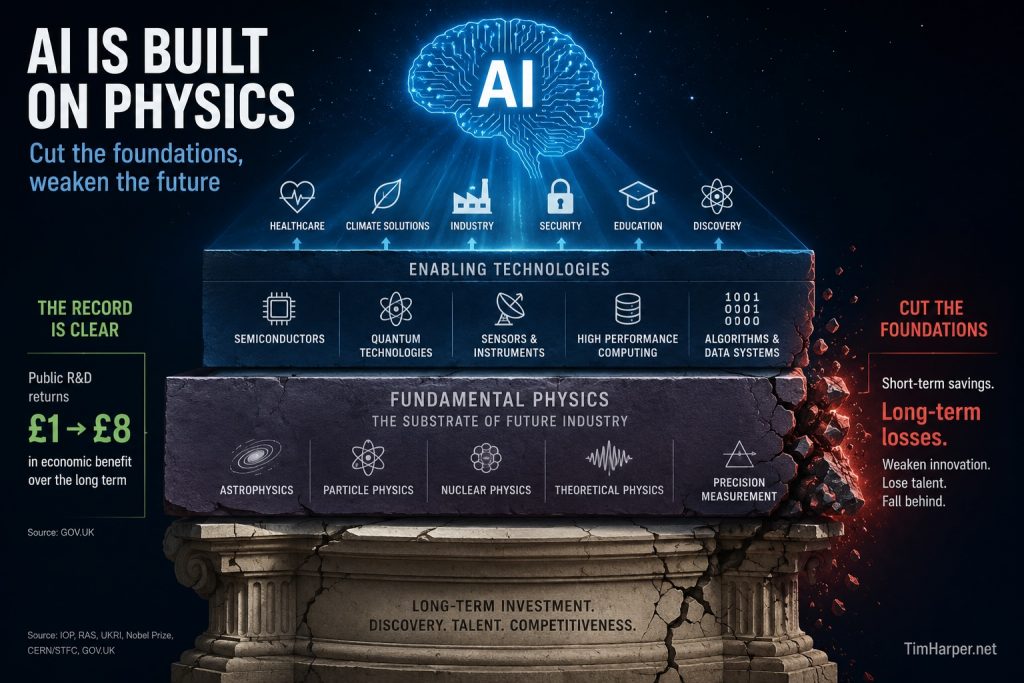
UK physics cuts are being framed as a way to make room for artificial intelligence. That gets the industrial logic backwards. AI is not an alternative to physics; it is downstream of physics. It depends on semiconductors, sensors, energy systems, statistical mechanics, quantum theory, advanced materials and the research culture that produced them. Cut the foundations and the AI layer above them gets weaker, not stronger.
Executive Summary
- STFC-funded physics areas, including particle physics, astronomy and nuclear physics, are under serious pressure.
- UKRI says AI is its biggest single investment area for 2026-2030, with GBP1.6bn directly targeted at the sector.
- The 2024 Nobel Prize in Physics recognised foundational work behind machine learning.
- Fundamental research creates the future industrial base, often long before anyone can describe the market it will enable.
The UK physics cuts in context
The current dispute is not a normal argument about marginal grant adjustments. The Institute of Physics says foundational STFC-funded areas in particle physics, nuclear physics and astronomy have already faced damaging cuts, with around 15% removed from research grants last year, hundreds of researcher jobs lost, and projects paused or cancelled. It also says decisions involving 20%, 40% and 60% future cuts are due in summer 2026.
The Royal Astronomical Society’s STFC briefing puts the issue in stark budgetary terms: a record UKRI settlement is being accompanied by a severe squeeze on the part of the system that funds astronomy and particle physics. In public reporting, researchers have described proposed reductions of about 30% to astronomy, particle physics and nuclear physics, while some teams have been asked to model much deeper scenarios.
At the same time, UKRI is making a deliberate pivot towards AI. The government’s AI announcement describes GBP1.6bn targeted directly at AI over four years, and UKRI’s AI strategic framework says that record investment will sit alongside AI spending woven through the wider UKRI budget.
That is the political economy of the moment: visible, applied AI on one side; long-horizon fundamental physics on the other. It looks like a choice between the future and the past. It is not. It is a choice between funding the visible application and funding the system that keeps producing the next application.
Why AI depends on physics
The simplest rebuttal to the cuts is the 2024 Nobel Prize in Physics. John Hopfield and Geoffrey Hinton received the prize “for foundational discoveries and inventions that enable machine learning with artificial neural networks.” The Royal Swedish Academy’s official explanation is explicit that the laureates used tools from physics to develop methods that underpin modern machine learning.
This was not a branding accident. Hopfield networks used an energy landscape drawn from spin systems. Boltzmann machines drew from statistical physics. The mathematical structures behind modern AI were not born from a government priority list labelled “AI”; they came from people moving between physics, information theory, mathematics and computation.
The dependence is also physical in the ordinary industrial sense. AI runs on chips whose design and manufacturing depend on semiconductor physics, photolithography, materials science, metrology, vacuum systems and precision instrumentation. It senses the world through cameras, LIDAR, inertial systems, magnetometers, force sensors and spectroscopy. It is trained in data centres constrained by power electronics, cooling, grid capacity and thermal management.
This is why the distinction between “physics funding and AI” is misleading. AI capability is not just algorithms. It is a stack. At the bottom of that stack is fundamental physics research in the UK and elsewhere. Above it sit semiconductors, quantum devices, sensors, advanced materials, energy systems and computing infrastructure. The AI models are the visible layer, but they are not the foundation.
This is the same pattern visible in frontier robotics. In my analysis of the humanoid robotics market, the bottleneck is not only software intelligence. It is actuators, batteries, sensors, dexterous manipulation, compute, manufacturing and deployment data. Likewise, AI gives robots brains, but touch gives them dexterity. Physics is not a side discipline in that story. It is the operating system of the physical world.
The false economy of short-term research priorities
The case for shifting money into AI is understandable. Ministers want growth, productivity and visible applications. The UK has real strengths in mathematics, computer science, life sciences, engineering and responsible AI. There is nothing wrong with funding AI, nor with using AI to accelerate research.
The error is treating fundamental physics as the funding reserve from which applied AI can be financed. That is a false economy because the two are not substitutes. They are linked stages in the same industrial pipeline.
The government’s own evidence points in that direction. The GOV.UK analysis of public R&D says the evidence for substantial positive returns from public R&D is strong and that public investment plays a distinctive role where private incentives underfund long-term, uncertain work. Those spillovers are exactly why basic research matters: the commercial return is often captured outside the original project, sector or decade.
Short-term priority setting is attractive because it offers the illusion of control. Name the target. Move the budget. Demand outcomes. But frontier technologies rarely emerge in straight lines. They come from adjacent discoveries, instrumentation improvements, failed experiments, better measurement, new materials and people trained to think across disciplines.
The UK already struggles with the middle of this chain. My piece on technology commercialisation argues that turning emerging technologies into successful businesses depends on more than invention. It needs patient capital, procurement, scale-up capability, standards, manufacturing partners and customers. Cutting the research base makes that commercialisation problem harder, not easier.
What history says about “useless” science
The history of modern industry is full of research that looked commercially irrelevant until it was not.
The transistor came from attempts to understand electrons in solids. The World Wide Web came from CERN’s need to share information across a distributed particle physics community. STFC’s CERN benefits page lists the web, medical imaging, radiotherapy technologies, software tools and sensor systems among the technologies linked to CERN’s research environment. None of those outcomes can be explained by a narrow near-term impact metric at the point of discovery.
MRI traces back to nuclear magnetic resonance. LEDs depend on semiconductor materials. Quantum technologies draw on decades of work that originally looked abstract. The 2024 Nobel in Physics recognised machine learning work rooted in physics. The lesson is not that every physics grant becomes a trillion-pound industry. It is that no serious industrial strategy can know in advance which piece of foundational science will become the next platform technology.
This matters especially for particle physics funding UK policy, astronomy funding cuts UK debates and nuclear physics funding UK decisions. The value is not limited to the headline experiment. It includes instrumentation, cryogenics, detector design, data systems, magnets, imaging, precision engineering, software, international collaboration and the training of people who can work at the edge of uncertainty.
That is also why the phrase “commercially irrelevant” is often a warning sign. It usually means the market has not yet caught up with the science.
Why this matters for UK competitiveness
The UK is not going to buy its way to foundational AI leadership by reallocating grant money in 2026. The frontier models are dominated by US firms. Much of the compute supply chain runs through US and Taiwanese companies. Data-centre ownership and platform control sit heavily with hyperscalers. The UK can and should build AI applications, assurance, adoption, sector-specific tools and research capability. But that is not the same as owning the whole stack.
The UK does have genuine depth in fundamental science, advanced materials, quantum technologies, precision instrumentation, life sciences, university research and frontier engineering. That is the base from which future industrial options emerge. It is also the base that makes the UK credible to investors, multinational R&D teams and global scientific talent.
This is the logic behind my analysis of the global semiconductor cluster race. Competitive advantage comes from dense capability systems: research, skills, suppliers, infrastructure, customers, capital and policy moving together. A country that weakens its research base while chasing the current application layer is not becoming more strategic. It is becoming more dependent.
The same lesson appears in energy and industrial strategy. Hydrogen, batteries, advanced materials, sensors and AI infrastructure all need patient technology development before they become bankable deployments. In battery weight and fleet decarbonisation, the hard constraints are physical. In the shift from hydrogen projects to AI data-centre demand, the constraint is infrastructure. In each case, physics is not a decorative academic discipline. It is the thing the spreadsheet eventually runs into.
What policymakers should do
First, stop presenting AI and physics as competing priorities. AI is a strategic application area. Fundamental physics is part of the strategic base that makes future applications possible. Funding one by hollowing out the other is bad portfolio management.
Second, protect early-career researchers in STFC-funded fields with actual funding, not just rhetoric. Losing postdoctoral cohorts has a compounding effect. Laboratories lose momentum, supervisors stop taking risks, international partners adjust their expectations, and talented people move to systems that look more serious.
Third, separate unavoidable cost pressures in large facilities and international subscriptions from the grant base that trains people. CERN, Diamond, ISIS and other facilities are not luxuries, but facility cost inflation should not be allowed to destroy the research communities that make use of them.
Fourth, require an explicit long-term capability assessment before making irreversible reductions. The question should not be whether every programme can promise a product by 2030. It should be what options the UK loses if a field, facility or talent pipeline is allowed to decay.
Finally, connect fundamental science to commercialisation without pretending they are the same activity. The UK needs stronger translation, better procurement, patient capital and better scale-up pathways. It does not need to turn every physics department into a short-term product unit.
Deep-Tech Strategy
If you are working on deep-tech commercialisation, frontier technology strategy or research translation, get in touch.
Closing argument
The 2024 Nobel Prize in Physics should have made the point impossible to miss. Modern AI is built on ideas that came from physics, long before AI became a ministerial priority or an investment category. That is not an exception. It is how deep technology works.
The UK can invest in AI and protect fundamental physics. It should do both. But cutting physics to fund AI misunderstands where AI came from and where the next wave of industrial capability will come from. The country does not strengthen the future by weakening the disciplines that create it.
AI is built on physics. Cut the foundations, and you weaken the future.