Most reports on EasyH2Power have focused on its latest funding round, but the figure that caught my attention was something else entirely: a claimed endurance of up to 30 hours for a hydrogen-powered unmanned aircraft. If that figure stands up, it may tell us rather more about the near-term direction of hydrogen aviation than the amount of money raised.
EasyH2Power, a Tsinghua University spin-out, is also developing higher-power fuel-cell systems for passenger aircraft and eVTOLs. Those programmes naturally attract attention, although they are unlikely to produce meaningful revenue soon. The smaller drone business is less conspicuous, but potentially much closer to a viable market.
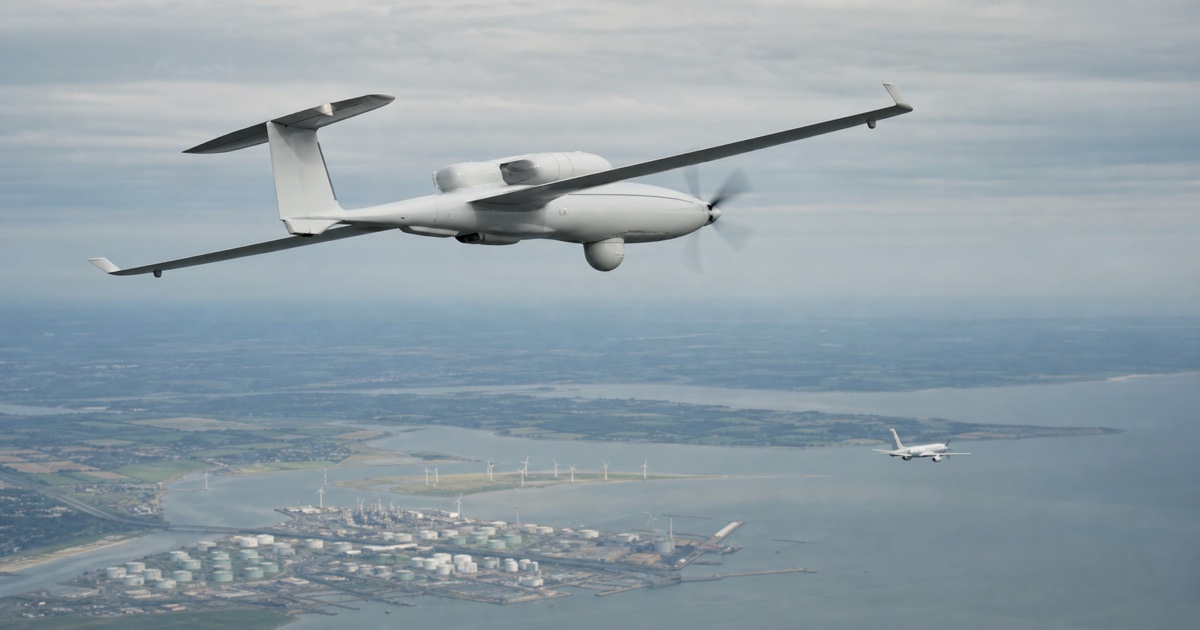
In April 2025, a 50kg hydrogen-powered unmanned aircraft developed by AVIC Chengdu Aircraft Industrial Group and Tsinghua University completed a 30-hour continuous flight. It carried an electro-optical payload, transmitted imagery over 5G and demonstrated operation from a non-standard runway.1 One demonstration cannot establish a mass market, but it does raise an interesting question about where hydrogen might first become commercially useful in aviation.
Passenger aircraft need a new propulsion system, fuel infrastructure, certification rules, maintenance procedures and airline confidence, all at roughly the same time. The requirements for a long-endurance hydrogen UAV are rather less daunting. It has to remain airborne long enough to do something valuable, operate quietly enough for the intended mission and deliver enough economic benefit to justify the fuel cell, tank and hydrogen supply. For some surveillance, inspection and communications applications, that may prove a more manageable starting point than carrying passengers.
What EasyH2Power’s funding tells us about hydrogen aviation
EasyH2Power, or 易氢动力, says it has completed an angel-plus financing round worth tens of millions of yuan. The Chinese technology publication 36Kr names Hongniao Qihang Fund and the Guizhou Science and Technology Innovation Angel Fund as lead investors, with the Shuimu Tsinghua Alumni Seed Fund and several other investors participating.2
There is no public transaction document against which the amount, valuation or terms can be checked. Like most funding announcements, the information has come from the company and the publication reporting it. The same applies to several of the operating figures. That does not mean they are wrong, but it does mean they should be treated as claims until they are independently demonstrated.
The 30-hour flight has at least been corroborated outside EasyH2Power by a Tsinghua University report quoting AVIC Chengfei. EasyH2Power says its fuel-cell system powered the aircraft, although Tsinghua’s report does not identify the supplier. The reported 24-hour flight in 2026, several million yuan of first-half drone revenue, a full-year target of tens of millions of yuan and a supplier relationship with COMAC all originate with the company or with media interviews based on company information. I could find no separate confirmation from COMAC or the named investors.
Even with those qualifications, the product strategy is reasonably clear. EasyH2Power is developing liquid-cooled systems from 30kW towards roughly 100kW and eventually 300kW for larger aircraft. At the same time, it has moved into air-cooled systems below 10kW for drones, where development cycles are shorter and the airworthiness requirements are less demanding.
EasyH2Power describes these as two parallel technology tracks: one aimed at drones and smaller aircraft, the other at larger aviation applications. Commercially, however, the two appear closely linked. Revenue from products that can reach the market sooner could help finance the much longer and more expensive process of developing and certifying systems for larger aircraft. The drone business should also generate operating data, build supplier relationships and expose the company to the unglamorous reliability problems that only appear when equipment is used by customers rather than engineers. It is a practical example of the wider problem explored in this site’s analysis of technology commercialisation.
Hydrogen aviation economics: why fuel cells do not yet beat kerosene
EasyH2Power founder Zhang Kexun argues that using hydrogen will soon cost less than aviation kerosene in China. At first sight, the claim appears plausible. Hydrogen contains almost three times as much energy per kilogram as kerosene, and a fuel cell can convert a larger share of that energy into useful power than a small combustion engine. Unfortunately, neither fact tells us what an operator will actually pay.
China’s July 2026 domestic aviation kerosene reference was about RMB8,030 per tonne, or RMB8.03/kg. That was unusually high. The 2025 average was approximately RMB5,658 per tonne.3
The National Energy Administration’s China Hydrogen Development Report 2025 recorded an average hydrogen production-side price of RMB28/kg in December 2024 and a consumer-side refuelling price of RMB48.6/kg. Those averages cover several hydrogen production routes, not green hydrogen alone.4
China’s new hydrogen application pilot aims to reduce end-user hydrogen below RMB25/kg nationally by 2030 and towards RMB15/kg in advantaged regions.5 Those are policy targets rather than current market prices, and the difference is important because producing hydrogen is only the beginning of the cost chain. The International Energy Agency’s Global Hydrogen Review 2025 reaches a similar broad conclusion, identifying cost, infrastructure and demand as continuing constraints. The same delivered-cost problem runs through the site’s broader work on hydrogen economics and hydrogen infrastructure and logistics.
Green hydrogen must be purified, compressed or liquefied, transported, stored and dispensed before it reaches an aircraft. Electricity usually dominates the production cost. At 50–55kWh per kilogram, every RMB0.10/kWh added to the electricity price increases the electricity input by roughly RMB5–5.5/kg, before allowing for the electrolyser, water, compression, transport or profit.
A 2025 provincial cost study estimated that green hydrogen production in 2030 could range from about US$1.44/kg in resource-rich Gansu to US$5.82/kg in Guangdong.6 This illustrates a familiar problem in hydrogen economics: the lowest-cost production is often some distance from the customer. Aviation adds another complication because airports and remote UAV operating sites need reliable fuel of consistent purity, not simply cheap hydrogen at the electrolyser gate. Long-distance supply introduces many of the same trade-offs examined in the analysis of liquid hydrogen transport and ammonia.
To make a more useful comparison, the table below converts each fuel price into the cost of useful energy. It uses lower heating values of 12kWh/kg for kerosene and 33.3kWh/kg for hydrogen. The assumed conversion efficiencies are 40% for a large aviation turbine, 30% for a small piston engine, 20% for a small turbine and 55% for a fuel cell followed by a 92% efficient electric drivetrain. The fuel-cell and turbine assumptions are informed by technical material from the US Department of Energy and NASA.7 These remain analytical assumptions rather than manufacturer guarantees, but they are sufficient to show the scale of the problem.
| Fuel and powertrain | Fuel price | Useful energy | Fuel cost per useful kWh |
|---|---|---|---|
| Kerosene, large turbine | RMB5.66/kg (2025 average) | 4.8kWh/kg | RMB1.18 |
| Kerosene, large turbine | RMB8.03/kg (July 2026) | 4.8kWh/kg | RMB1.67 |
| Kerosene, small piston engine | RMB8.03/kg | 3.6kWh/kg | RMB2.23 |
| Kerosene, small turbine | RMB8.03/kg | 2.4kWh/kg | RMB3.35 |
| Hydrogen, fuel cell and motor | RMB48.60/kg (2024 consumer average) | 16.85kWh/kg | RMB2.88 |
| Hydrogen, fuel cell and motor | RMB25/kg (2030 national target) | 16.85kWh/kg | RMB1.48 |
| Hydrogen, fuel cell and motor | RMB15/kg (advantaged-region target) | 16.85kWh/kg | RMB0.89 |
At the July 2026 kerosene price, delivered hydrogen would have to fall to roughly RMB28/kg to match the fuel-only cost of a turbine operating at 40% efficiency. Against the lower average kerosene price in 2025, the break-even point is nearer RMB20/kg. The current average consumer price of RMB48.6/kg is nowhere close, so the suggestion that hydrogen is already on the verge of undercutting kerosene for passenger aircraft is difficult to support.
The calculation becomes more favourable when hydrogen is compared with a small, inefficient turbine, and it can approach a piston engine if the fuel is available at a favourable price. Even then, battery-electric power remains cheaper and mechanically simpler for shorter missions. Hydrogen begins to make commercial sense only when the mass of batteries, charging delays or the cost of flying repeated short sorties outweigh the additional cost and complexity of the hydrogen system. In other words, the economics depend at least as much on the job being done as on the price of the fuel.
Why hydrogen drones alter UAV economics
The economics of unmanned aircraft are quite different from those of an airline. Airlines generate revenue by transporting passengers from one place to another. Operators of inspection or surveillance drones are effectively selling endurance: the ability to remain over a pipeline, power line, coastline or border for as long as the task requires. Extending the useful time over the target can therefore be worth considerably more than the energy consumed in getting there.
A battery multirotor may fly for 20 to 45 minutes. Efficient battery fixed-wing aircraft can remain airborne much longer, which is why the familiar claim that battery drones last only half an hour is too crude. Even so, adding endurance by fitting more batteries eventually becomes self-defeating because the aircraft has to lift the additional cells as well as the payload.
A hydrogen system separates power from stored energy to a greater extent. The fuel cell determines the continuous power available, while the tank determines much of the endurance. A smaller battery is normally retained to cope with take-off loads and rapid changes in demand. This arrangement is less attractive for a highly manoeuvrable aircraft with frequent power peaks, but it can work well for the relatively steady cruise of a fixed-wing surveillance platform.
There is now enough activity outside the laboratory to make some provisional comparisons, although the published figures need careful handling.
South Korea’s Doosan Mobility Innovation lists two hours of unloaded flight and a 3kg maximum payload for its DS30W. The Chinese JOUAV CW-25H, using a Doosan power module, is listed by the US Army’s equipment database with up to 330 minutes of endurance and a 4kg payload. Israel’s Heven H2D55 advertises 100–120 minutes and roughly 4.5–7kg payload depending on the product version. Britain’s Project RACHEL demonstrated a one-hour multirotor flight carrying 5kg.8
These are not directly comparable aircraft. Some endurance figures are achieved without a payload, several are company specifications, and the 30-hour Chinese flight involved a specialised 50kg fixed-wing aircraft rather than an industrial quadcopter. Nevertheless, commercial hydrogen UAVs are beginning to occupy the two-to-five-hour range, while specialised demonstrators have flown much longer.
That level of endurance could change the economics of inspection and surveillance. If one aircraft can replace four shorter battery sorties, an operator may need fewer launches and battery changes, less vehicle movement along a linear asset and fewer interruptions in the data. Labour, transport and the cost of missed coverage can easily exceed the value of the fuel. This is why a hydrogen drone can be commercially competitive even when hydrogen itself remains more expensive than electricity.
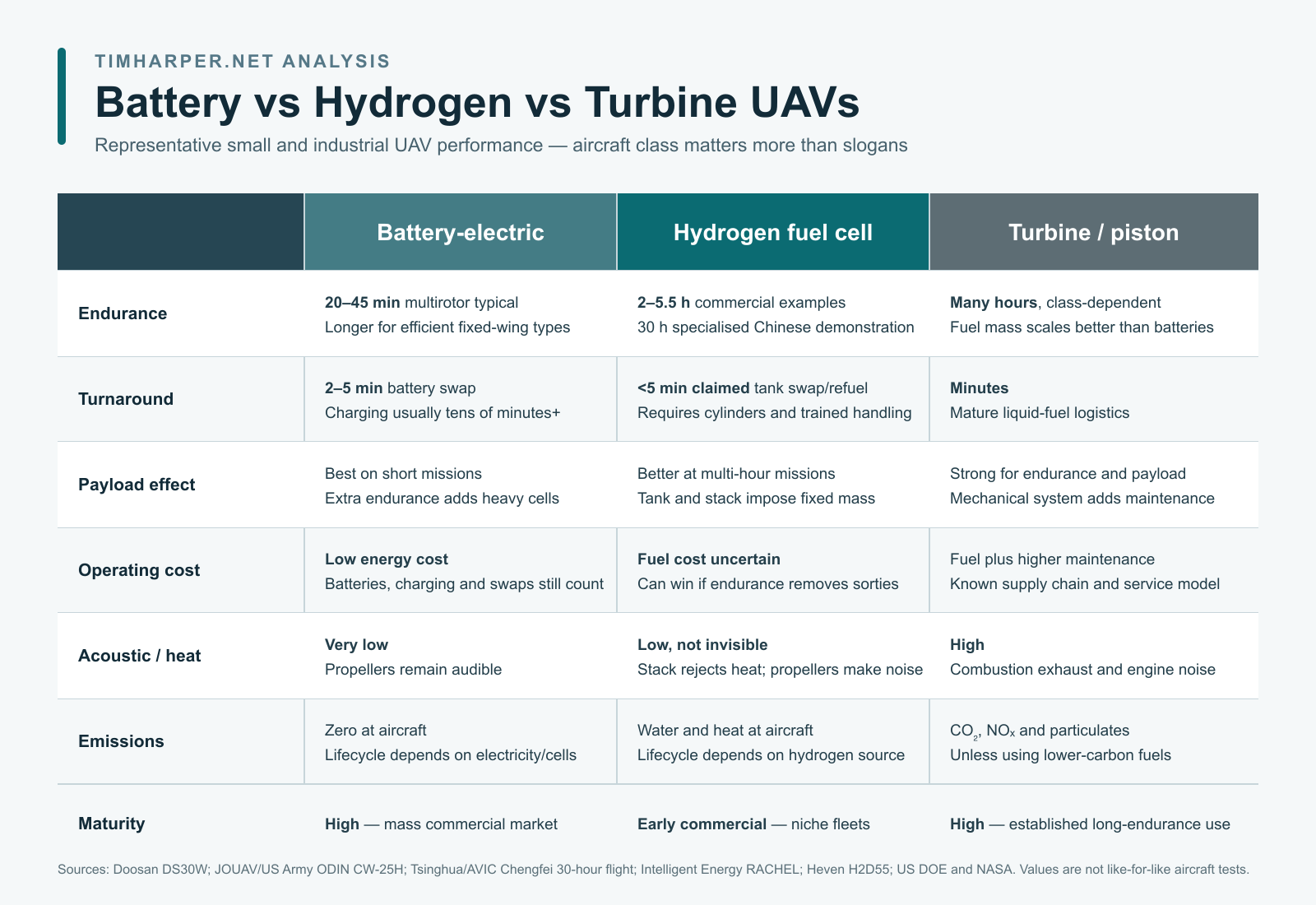
None of this makes hydrogen the obvious choice for every unmanned aircraft. For short flights near a depot, batteries remain cheaper, simpler and more mature. A fuel cell still needs a battery buffer for high-power manoeuvring, adding mass and another component to manage. At the other end of the market, a heavy-fuel piston engine may remain the practical option for very long missions with substantial payload because liquid fuel is easy to transport and maintenance crews already understand the machinery.
Methanol fuel cells may offer easier liquid-fuel logistics, but direct-methanol systems have lower power density and efficiency. Reforming methanol into hydrogen adds heat, equipment, start-up time and carbon emissions. They may suit some persistent, low-power systems without removing the wider aircraft-integration problem.
For the moment, hydrogen’s most defensible niche appears to be multi-hour electric flight in applications where low noise, rapid turnaround and zero emissions at the aircraft have an operational value. Whether that niche is large enough to support a substantial aviation fuel-cell industry remains to be seen.
Military hydrogen drones: a useful but limited defence market
Fuel cells are quieter than combustion engines and reject heat at a much lower temperature than a turbine exhaust. US Army testing of a fuel-cell ground vehicle reported a 75–90% improvement in acoustic signature compared with a HMMWV and identified possible thermal-signature benefits.9 Those findings are relevant to unmanned aircraft, although they should not be confused with silence or invisibility.
The propeller continues to make noise, while a fuel cell converting a little more than half of the hydrogen’s energy into electricity must dispose of the remaining heat. Radiators, pumps and cooling airflow can all be detected. A hydrogen aircraft may have a lower acoustic and thermal signature than an equivalent combustion-powered aircraft, depending on the configuration and operating conditions, but it is not inherently stealthy.
The endurance advantage is better established. The US Naval Research Laboratory flew its Ion Tiger for 26 hours on compressed hydrogen in 2009 and 48 hours on liquid hydrogen in 2013.10 Fuel-cell UAVs have therefore been technically credible for years. Their limited adoption by armed forces is better explained by economics and logistics than by an inability to fly.
Military supply chains already move kerosene, diesel and heavy fuel in large quantities. High-purity hydrogen introduces cylinders, compressors or cryogenic equipment, leak management and a separate distribution system. Producing it in theatre requires electricity, treated water and compression, with refrigeration added if liquid hydrogen is required. All of this equipment has to be transported, protected and maintained.
The experience of Ukraine points in both directions. Persistent intelligence, surveillance and reconnaissance, lower signatures and rapid development cycles have all become more valuable. At the same time, the war has demonstrated the importance of systems that are cheap enough to be lost in large numbers. RUSI describes this as attritable mass, while CSIS has documented Ukrainian procurement and development loops built around commercial technology, purchasing at unit level and rapid feedback from operators.11
A hydrogen UAV is unlikely to compete with a cheap battery-powered FPV drone in that environment. The aircraft is more expensive and its fuel supply considerably more complicated. The more plausible military applications sit further behind the front line, in maritime surveillance, border patrol, communications relay, long linear-route reconnaissance and persistent observation, where the aircraft is expected to return and additional endurance has a measurable value.
Defence procurement could still help finance rugged fuel cells, lightweight tanks, control systems and manufacturing capacity. We have seen something similar before with technologies ranging from semiconductors to satellite navigation. It is worth remembering, however, that military customers can also pull suppliers towards costly bespoke specifications with little relevance to civilian operators. Defence demand may provide an industrial bridge for hydrogen aviation, but there is no guarantee that the bridge leads all the way to a passenger aircraft.
EasyH2Power and China’s hydrogen aviation strategy
EasyH2Power makes more sense when viewed as part of China’s wider industrial system than when treated simply as a Chinese equivalent of ZeroAvia. China’s 2022 hydrogen plan brought fuel production, storage, transport, fuel cells and demonstration projects into the same policy framework. The 2024 government work report then identified both hydrogen and the low-altitude economy as new sources of growth, while a subsequent general aviation equipment plan set an ambition for a trillion-yuan low-altitude market by 2030.12 This policy setting is examined in more detail in China’s hydrogen strategy for 2026.
The Civil Aviation Administration of China now operates a national civil UAV management platform, 17 civil unmanned aviation test zones and three test bases. In 2026 it created a department dedicated to low-altitude safety, while provinces and cities have been adding their own aircraft, infrastructure and procurement programmes.13 This creates places in which new systems can be tested and early customers can be found, although policy support should not be mistaken for assured demand.
Less than a third of China’s low-altitude airspace was accessible to general aviation in 2023, according to State Information Center research reported by the Associated Press. Certification remains slow, airspace is restricted and many proposed routes have yet to demonstrate a commercial purpose. The announcements and test zones will therefore have to be followed by regulatory access and routes for which customers are prepared to pay.
China does, however, have considerable experience in bringing the relevant institutions together. EasyH2Power says its technology builds on two decades of Tsinghua fuel-cell research. Its reported investors include a fund established for Tsinghua students and young alumni, as well as a provincial state-guided angel fund intended to attract early hard-technology companies and co-investment into Guizhou.14 The company also says it works with an AVIC aircraft manufacturer while selling into civilian inspection and logistics markets.
This combination of university research, alumni capital, provincial policy, state-owned aviation expertise and early commercial applications is familiar from other Chinese technology sectors. It does not ensure that an individual company will succeed, but it can shorten the distance between a laboratory prototype, a demonstration programme and a first customer. A similar effort to connect technology, standards, infrastructure and operating data can be seen in CATL’s battery and mobility strategy.
AVIC Chengfei is a defence aircraft manufacturer, which gives the 30-hour programme an obvious dual-use relevance. There is not enough public evidence to conclude that EasyH2Power itself belongs to a formal military-civil fusion programme. The more defensible observation is that technical experience can move between civil and defence applications more readily within this institutional structure than it often does in the West.
Western hydrogen aviation companies have generally started with the aircraft and worked backwards towards the market. ZeroAvia is pursuing certification of a 600kW system for aircraft carrying 10–20 passengers. H2FLY completed four liquid-hydrogen HY4 flights in 2023, including one lasting more than three hours. Intelligent Energy has completed the £54 million H2GEAR research programme and is developing larger aviation systems while continuing to sell smaller UAV fuel cells.15
Universal Hydrogen attempted to address propulsion and fuel logistics together for regional aircraft. It flew a modified Dash 8 but closed in 2024 after failing to raise the capital needed to continue.16 Its experience is worth remembering. Demonstrating that an aircraft can fly is only one part of commercialisation; certification, aircraft conversion and a new fuel-distribution system can consume a great deal of capital years before regular revenue becomes available.
Doosan provides a different comparison. It commercialised a two-hour drone and fuel-cell power pack before moving towards larger aviation opportunities, a sequence much closer to the path now being followed by EasyH2Power. China is working with the same physics as the West, but appears to be approaching the market in a different order.
How the hydrogen aviation market may develop
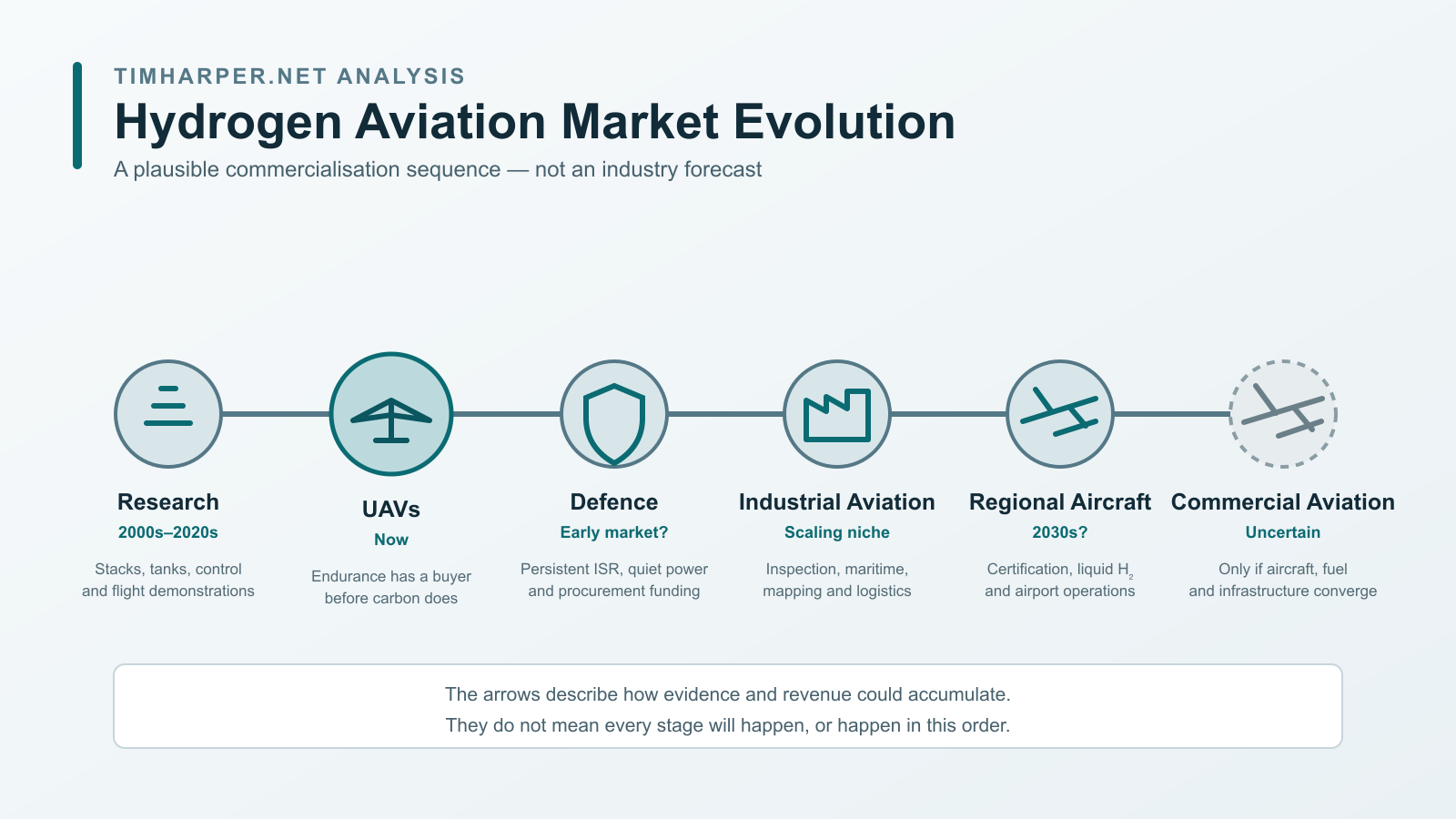
The suggestion that military drones could finance the eventual development of hydrogen passenger aircraft is appealing, but the evidence supports a more limited interpretation. Hydrogen UAVs do appear to offer a useful performance advantage over batteries in selected multi-hour missions. Products are available and several endurance records are credible. Operators in industrial inspection, maritime monitoring, surveying, emergency response and some intelligence and surveillance roles may value additional time in the air enough to pay a premium for it.
There are equally substantial reasons for caution. Hydrogen remains expensive when delivered to the point of use, and cylinders erode much of its theoretical mass advantage. Fuel-cell aircraft still require batteries for peak power and equipment to manage heat. Supplying fuel in the field is awkward, while battery energy density will continue to improve. Conventional engines are also difficult to displace in applications where payload, ruggedness and access to an established fuel supply matter more than noise or emissions.
It is also worth remembering that an air-cooled drone fuel cell below 10kW is a very different product from a certified 300kW aviation powerplant. Selling smaller systems can teach EasyH2Power about controls, suppliers, cold starts, vibration, servicing and the way customers actually use the equipment. Those lessons are valuable, but they do not remove the need to prove altitude performance, redundancy, durability, failure containment and many thousands of hours of safe operation before passengers can be carried.
A plausible development path therefore begins with drones, followed perhaps by defence and industrial aviation. After that may come a much longer period in which regional-aircraft programmes attempt to bring together fuel supply, airport infrastructure, certification and finance. Some will succeed, while others will probably encounter the same capital constraints that brought Universal Hydrogen to an end. There is unlikely to be a smooth progression from a 10kW drone system to a commercial airliner.
The HyPRIME analysis on this site reached a similar conclusion by looking at the problem from the infrastructure side. As that article argued, demonstrating flight addresses only one part of the problem. Hydrogen aviation becomes an industry when fuel production, handling, refuelling, maintenance and regulation can be repeated routinely and at an acceptable cost.
EasyH2Power has not demonstrated that China will lead hydrogen aviation, and several of its commercial claims still need independent confirmation. What caught my attention is that the company may have found a practical way to continue learning while the market for larger aircraft develops. If long-endurance UAV customers pay for early products, if defence procurement supports improvements in reliability and manufacturing, and if China’s low-altitude economy creates enough useful operating markets, EasyH2Power will not have to wait for hydrogen passenger aviation before building a business.
Whether that proves sufficient to support the much larger systems planned for regional aircraft remains to be seen. For the next several years, however, hydrogen aviation may be shaped less by airlines than by customers who simply need an unmanned aircraft to stay in the air for longer.
Notes and Sources
Primary reporting
- 1. Tsinghua University’s report on the 30-hour AVIC Chengfei hydrogen UAV flight (Chinese). ↩
- 2. 36Kr’s Chinese-language EasyH2Power financing report and company interview, cross-checked against EasyH2Power’s account of its role in the flight. ↩
Government and regulatory sources
- 3. Chinese domestic aviation kerosene price series and the July 2026 transport-sector price report (Chinese). ↩
- 4. National Energy Administration, China Hydrogen Development Report 2025 (Chinese PDF). ↩
- 5. China’s 2030 hydrogen application pilot targets, as published by Xinhua/TEDA. ↩
- 12. China’s 2021–2035 hydrogen industry plan, 2024 Government Work Report and general aviation equipment plan (Chinese). ↩
- 13. CAAC on general aviation and low-altitude regulation, and the State Council announcement of the low-altitude safety department. ↩
- 14. Tsinghua University on the Shuimu Tsinghua Alumni Seed Fund and the Guizhou government’s technology angel investment policy (Chinese). ↩
Independent technical analysis
- 6. Peer-reviewed provincial analysis of green hydrogen production costs in China, read alongside the IEA Global Hydrogen Review 2025. ↩
- 7. US Department of Energy fuel-cell efficiency comparison and NASA analysis of small gas-turbine efficiency constraints. ↩
- 9. US Army acoustic and thermal testing of a fuel-cell ground vehicle. ↩
- 10. US Naval Research Laboratory report on the liquid-hydrogen Ion Tiger endurance flight. ↩
- 11. RUSI on attritable unmanned systems and CSIS on lessons from Ukrainian drone procurement. ↩
- 16. Aviation Week reporting on Universal Hydrogen’s liquidation. ↩
Company technical information
- 8. Published specifications from Doosan Mobility Innovation, the US Army ODIN entry for the JOUAV CW-25H, Heven Drones and Intelligent Energy’s Project RACHEL. Product figures are not treated as like-for-like independent flight trials. ↩
- 15. Programme updates from ZeroAvia, H2FLY and Intelligent Energy. ↩
The energy-equivalent fuel costs are original calculations from the cited price and efficiency data. They exclude aircraft capital cost, maintenance, tanks, batteries, fuel logistics, carbon pricing and infrastructure utilisation.
Editorial note: This article draws on English- and Chinese-language sources. Company performance claims have been identified as such and, wherever possible, cross-checked against independent sources. Where independent verification was not available, this has been stated in the text.