The Future of Liquid Hydrogen Carriers: Why They’re Being Built, Who the Customers Are, and How Economics Compare to Ammonia
Why Liquid Hydrogen Carriers Are Being Built Now
The decision to invest billions in liquid hydrogen carrier infrastructure reflects strategic imperatives rather than current economic superiority over ammonia. Japan’s legally binding targets under its Hydrogen Society Promotion Act commit the nation to consuming 3 million tonnes of hydrogen by 2030, escalating to 12 million tonnes by 2040 and 20 million tonnes by 2050[2][72][88]. These volumes vastly exceed what can be produced economically within Japan given limited renewable energy resources and high domestic electricity costs[34].
The Japanese government has allocated ¥321.12 billion ($2.9 billion) through NEDO’s Green Innovation Fund specifically for large-scale hydrogen supply chain establishment, with target supply costs of 30 yen/Nm³ (~$2.50/kg) by 2030 and 20 yen/Nm³ by 2050 to achieve fossil fuel parity[36][39]. This represents one of the world’s largest single national commitments to hydrogen infrastructure, signaling that import logistics are central—not ancillary—to Japan’s decarbonization strategy.
The Suiso Frontier Validation
Kawasaki Heavy Industries’ successful completion of the Suiso Frontier pilot voyage in February 2022 provided critical proof-of-concept for intercontinental LH2 transport[2][34]. The 1,250 m³ carrier completed a 9,000 km round trip from Australia’s Latrobe Valley to Kobe, Japan, demonstrating the technical viability of cryogenic hydrogen shipping at -253°C with manageable boil-off losses using vacuum-insulated double-wall tank technology[34][106].
The contracted 40,000 m³ follow-on vessel represents a 32-fold capacity increase, moving from pilot to pre-commercial scale[2][16]. At approximately 2,800 tonnes of LH2 per voyage, this vessel would deliver roughly 9,200 tonnes of hydrogen annually on a single supply chain assuming 3-4 voyages per year—still modest relative to Japan’s 3 million tonne 2030 target but sufficient to validate commercial-scale operations before committing to planned 160,000 m³ vessels capable of 10,000+ tonnes per voyage[9][34].
European Market Diversification: The Oman-Europe Corridor
While Japan dominates current LH2 carrier development, Europe’s entry through the Oman-Netherlands-Germany corridor signals geographic diversification of demand[73][76]. The Joint Development Agreement signed in April 2025 among 11 partners—including Hydrom (Oman’s national hydrogen orchestrator), OQ, Tata Steel Nederland, Hamburger Hafen und Logistik (HHLA), and Hynetwork—establishes the world’s first commercial-scale liquid hydrogen import corridor with targeted deliveries by 2029[73][79].
Europe’s strategic drivers differ from Japan’s in critical respects. European steel producers face acute pressure from the Carbon Border Adjustment Mechanism (CBAM) and are pursuing hydrogen-based DRI pathways to avoid carbon tariffs on imports[86]. However, renewable electricity costs in Germany and the Netherlands remain elevated relative to Middle Eastern solar resources, making hydrogen import more economically rational than domestic electrolysis for industrial feedstock applications[23][41].
The corridor’s emphasis on ECOLOG’s “net-zero boil-off” vessel technology represents a targeted response to LH2’s primary economic vulnerability—cargo loss during transport[13][49][58]. While conventional LH2 carriers experience 0.5-1% daily boil-off (9× higher than LNG), advanced multilayer insulation combined with onboard reliquefaction systems can theoretically eliminate cargo loss, fundamentally altering transport economics for long-haul routes exceeding 10,000 km[13][68].
Customer Segmentation: Who Will Buy Liquid Hydrogen?
Understanding the customer base for LH2 imports requires disaggregating hydrogen demand by end-use application, as different sectors exhibit divergent preferences for pure hydrogen versus hydrogen carriers like ammonia. This segmentation explains why substantial investment in LH2 infrastructure persists despite ammonia’s current maritime transport cost advantages.
Power Generation: The Ammonia-Dominant Segment
Japan’s power sector represents the largest near-term hydrogen/ammonia demand source but favors direct ammonia combustion rather than LH2 imports with subsequent cracking. The Ministry of Economy, Trade and Industry (METI) has set a target of 3 million tonnes per year of ammonia fuel consumption by 2030, primarily through establishing 20% co-firing rates at existing coal-fired power plants[85][88].
Leading utilities including JERA, Kansai Electric, and ENEOS are proceeding with demonstration projects targeting 50% ammonia co-firing by 2028-2030 at plants like Hekinan, with eventual progression to 100% ammonia-fired generation[44][91]. This pathway bypasses LH2 entirely—ammonia is shipped as a liquid carrier and burned directly in modified boilers or gas turbines, avoiding the energy penalty and capital cost of cracking infrastructure[90][91][93].
Steel Industry: The Primary LH2 Customer Base
The steel sector emerges as the natural customer for LH2 imports due to process requirements that strongly favor pure hydrogen over ammonia. Japan’s steel industry alone requires an estimated 20 million tonnes of hydrogen by 2050 to transition from blast furnace-basic oxygen furnace (BF-BOF) routes to hydrogen-based direct reduction of iron (H2-DRI) coupled with electric arc furnaces (EAF)[38][41].
Major Japanese steelmakers including Nippon Steel are developing DRI pathways with commercial deployment targeted for the 2030s and full-scale conversion by the 2040s[35][86]. The H2-DRI process reduces iron ore using pure hydrogen at 800-1000°C to produce sponge iron (DRI), which is then melted in an EAF to produce steel with 90-95% lower CO2 emissions than conventional routes[86][92].
Using ammonia instead of pure hydrogen in this application creates severe economic penalties. Cracking ammonia requires 11.2 MWh/t H2 plus purification through pressure swing adsorption (PSA) at 75% efficiency, meaning 1.33 tonnes of ammonia must be processed to yield 1 tonne of usable hydrogen[23][24]. For a steel plant consuming 500,000 tonnes H2 annually, this would necessitate a 665,000 tonne/year cracking facility with annual electricity consumption exceeding 7.5 TWh—more than the entire EAF steelmaking process itself[41].
By contrast, vaporizing imported LH2 requires only 0.5 MWh/t H2 and delivers 99.9% purity hydrogen suitable for DRI with no purification infrastructure[23]. The total cost of ownership analysis by Roland Berger shows that for industrial offtakers requiring 20 tonnes per day or more of pure hydrogen, delivered LH2 (including liquefaction and maritime transport) is cost-competitive with or superior to ammonia imports plus cracking[23].
| Customer Segment | Annual H2 Demand | Preferred Carrier | Rationale |
|---|---|---|---|
| Power Generation | 3M tonnes (Japan 2030) | Ammonia | Direct combustion avoids cracking costs; 20-50% co-firing in coal plants |
| Steel (DRI-EAF) | 20M tonnes (Japan 2050) | LH2 | Pure H2 required for reduction process; cracking adds €0.9/kg penalty |
| Fuel Cell Vehicles | Variable by region | LH2 | 99.97% purity required; cracking+purification prohibitive for small stations |
| Maritime Fuel | Growing (2030+) | Ammonia | Direct fuel use; toxicity manageable with established protocols |
| Chemical Feedstock | Existing gray H2 users | Context-dependent | Large refineries favor ammonia+cracking; smaller users favor LH2 |
Mobility and Fuel Cell Applications: Premium for Purity
The fuel cell electric vehicle (FCEV) refueling sector represents a smaller but strategically important LH2 customer segment. Daimler Truck’s GenH2 program demonstrates liquid hydrogen’s suitability for long-haul heavy-duty transport, having achieved a 1,047 km single-tank range under real-world conditions in 2023[9]. The company’s partnership with HHLA and Kawasaki to develop LH2 supply chains through the Port of Hamburg explicitly targets truck refueling as a primary end-use[9].
Fuel cells impose exceptionally stringent purity requirements—ISO 14687-2 standards require 99.97% minimum purity with contaminant limits of <0.2 ppm total sulfur, <0.1 ppm ammonia, and <5 ppm nitrogen—to prevent catalyst poisoning and membrane degradation[24][67]. Vaporized LH2 naturally achieves 99.99+% purity because impurities freeze out during liquefaction, making it “fuel cell ready” without additional processing[23][67].
Hydrogen derived from cracked ammonia contains residual ammonia (typically 1,000-5,000 ppm after cracking even with 99% conversion efficiency), nitrogen, and synthesis catalyst particles, requiring multi-stage purification[24][98]. PSA systems reduce ammonia to acceptable levels but at the cost of 25% hydrogen losses and €0.30-0.50/kg in additional processing costs[24]. For refueling stations operating at 1-3 tonnes per day, building dedicated cracking and purification infrastructure is economically prohibitive—delivered LH2 becomes the only viable option[24].
Economic Comparison: Liquid Hydrogen Versus Ammonia Transport
The economic viability of LH2 carriers hinges on a nuanced comparison with ammonia across multiple dimensions: maritime transport costs, energy conversion losses, infrastructure capital requirements, and end-use compatibility. Recent techno-economic analyses provide quantitative clarity on the conditions under which each carrier holds competitive advantages.
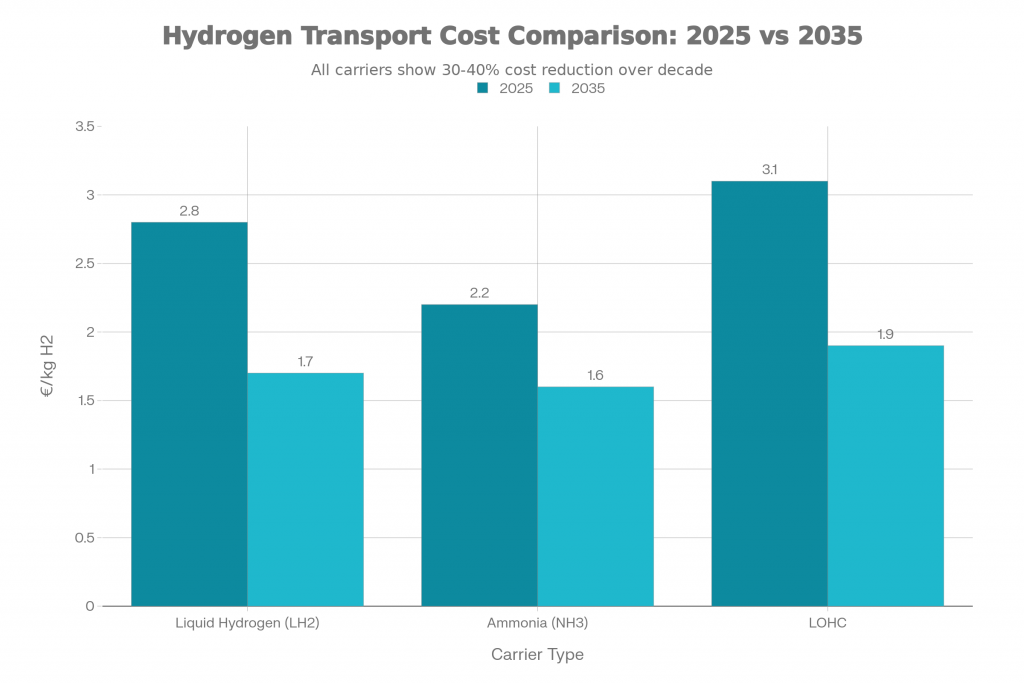
Comparative analysis of hydrogen transport costs across carrier technologies, demonstrating that liquid hydrogen (LH2) faces a cost penalty on long-distance maritime routes due to high liquefaction energy requirements and boil-off losses, while ammonia benefits from mature infrastructure and lower boil-off rates. By 2035, cost convergence is expected as both technologies scale. Data source: Roland Berger 2025 analysis.
Maritime Transport Cost Analysis
Roland Berger’s 2025 total cost of ownership (TCO) model for large-scale harbor-to-harbor transport (Arabian Gulf to Rotterdam, 12,000 km by sea vessel, 73,000 tonnes H2 annually) establishes the baseline for intercontinental LH2 economics[23]. Ammonia achieves a delivered TCO of €2.2/kg H2 compared to €2.8/kg for LH2—a 21% cost penalty driven primarily by three factors: liquefaction energy requirements, boil-off losses during voyage, and capital-intensive storage infrastructure[23].
Breaking down the LH2 cost structure reveals where disadvantages concentrate: conversion (liquefaction) contributes €0.9/kg (32% of TCO), storage at origin and destination €0.8/kg combined, vessel transportation €0.2/kg, and reconversion (vaporization) only €0.1/kg[23]. By contrast, ammonia’s conversion (Haber-Bosch synthesis) costs just €0.5/kg, but reconversion (cracking back to hydrogen) imposes a €0.9/kg penalty—more than one-third of ammonia’s total TCO[23].
This cost architecture explains the strategic appeal of direct ammonia use for power generation. When ammonia is burned without reconversion, its effective TCO drops to approximately €1.3/kg on a hydrogen-equivalent basis, making it decisively superior to LH2 for combustion applications[23][91]. However, for industrial users requiring pure hydrogen who must incur the cracking cost, the gap narrows substantially—€2.2/kg for ammonia delivered+cracked versus €2.8/kg for LH2 delivered+vaporized.
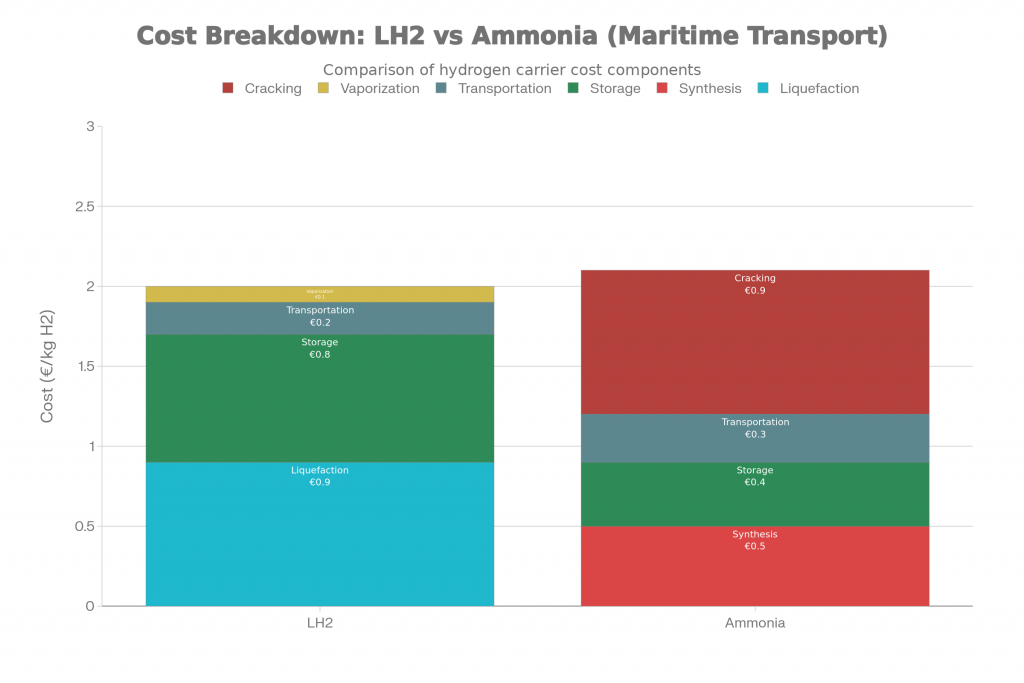
Comprehensive comparison of liquid hydrogen (LH2) versus ammonia as maritime hydrogen carriers, highlighting trade-offs between energy density, handling complexity, and total cost of ownership. While LH2 offers higher purity and simpler reconversion, ammonia’s superior volumetric density and lower boil-off rate make it more cost-effective for long-distance maritime transport despite higher cracking costs.
Energy Efficiency and Conversion Losses
The energy penalty embedded in each pathway constitutes a critical economic factor often obscured by focusing solely on transport costs. Liquefying hydrogen requires 10-20 kWh/kg in current industrial facilities, with optimized large-scale plants (200+ tonnes per day) targeting 11-13 kWh/kg by 2030[61][64][67]. This represents approximately 35% of the lower heating value (LHV) energy contained in the hydrogen itself—a substantial loss that must be paid for with renewable electricity.
Ammonia production via the Haber-Bosch process requires 5.75 MWh/tonne H2 (equivalent to ~8 kWh/kg H2) for synthesis, approximately half the energy of LH2 liquefaction[23]. However, the cracking process to recover hydrogen adds 11.2 MWh/tonne H2 back-end, bringing total round-trip energy consumption to approximately 17 MWh/tonne—comparable to or slightly exceeding the LH2 pathway[21][23].
A detailed study by the Kleinman Center for Energy Policy finds that the break-even point for choosing LH2 over ammonia based on energy efficiency occurs at approximately 11 days of storage duration[21]. Before this threshold, LH2’s lower conversion energy outweighs its higher boil-off losses (0.5-1% daily vs. 0.025% for ammonia). Beyond 11 days—typical for intercontinental maritime transport with 20-30 day voyages plus pre-shipment and post-arrival storage—ammonia’s superior retention of energy potential during long-duration storage tips the efficiency balance in its favor[21][63].
Boil-Off Management and Cargo Loss
Boil-off gas (BOG) management represents LH2’s most severe technical and economic challenge. The extreme temperature differential between cryogenic liquid hydrogen at -253°C and ambient conditions (a 270-280°C gradient) drives continuous heat ingress despite sophisticated vacuum-insulated tank designs[68]. Even with multi-layer insulation, current LH2 carriers experience boil-off rates of 0.5-1% per day—nine times higher than LNG (-162°C, 0.05-0.1% daily) and 20-40 times higher than liquid ammonia (-33°C, 0.025% daily)[59][63][68].
For a 40-day round-trip voyage (20 days loaded transit, 10 days port operations, 10 days ballast return), cumulative cargo loss reaches 20-40% without boil-off mitigation measures[68]. Kawasaki’s 40,000 m³ carrier would therefore lose 560-1,120 tonnes of a 2,800-tonne cargo—representing €1.4-2.8 million in product value at €2.50/kg delivered cost.
Industry has developed two mitigation strategies, each with distinct trade-offs. The first approach, used on LNG carriers and planned for Kawasaki’s vessels, captures boil-off gas and uses it as fuel in dual-fuel engines, offsetting diesel consumption[2][17]. This recovers energy value but does not prevent cargo loss—the hydrogen is consumed for propulsion rather than delivered to the customer. The second approach employs onboard reliquefaction systems that recondense the boil-off gas, theoretically achieving “net-zero” cargo loss[13][49][58].
ECOLOG’s claimed “net-zero boil-off” vessel design for the Oman-Europe corridor, if achieved at commercial scale, would fundamentally alter LH2 transport economics by eliminating the 20-40% cargo loss factor[49][58]. However, reliquefaction units add substantial capital cost (estimated €5-10 million per vessel) and consume 30-40% of the energy content of the recondensed hydrogen for refrigeration compressors, partially negating the benefit[68].
Cost Convergence Outlook to 2035
Both LH2 and ammonia transport costs are projected to decline substantially by 2035 as technologies mature and scale economies materialize, with the cost gap narrowing from 21% in 2025 to near-parity by 2035[23]. Roland Berger models LH2 TCO declining 40% to €1.7/kg (from €2.8/kg) driven by: (1) liquefaction plant efficiency improvements from 13 kWh/kg to 10 kWh/kg through optimized hydrogen-neon mixed-refrigerant cycles, (2) reduced boil-off rates via advanced insulation materials and active reliquefaction, (3) vessel scale-up to 80,000-160,000 m³ capacity, and (4) learning curve effects on capital costs[23][67].
Ammonia costs decline more modestly—27% to €1.6/kg—as synthesis technology is already mature with limited efficiency improvement potential[23]. Cost reductions concentrate in the cracking segment, where nascent technologies (ruthenium catalysts operating at 550°C rather than 800°C nickel-based systems) promise 30-40% energy savings[15]. However, cracking technology remains far less mature than Haber-Bosch synthesis, creating execution risk around achieving projected cost targets[21][24].
| Scenario | LH2 Advantage When… | Ammonia Advantage When… |
|---|---|---|
| Transport Distance | Short (<500 km): liquefaction cost amortized over fewer km | Long (>5,000 km): low boil-off and mature infrastructure |
| End-Use Purity | High-purity required (fuel cells, DRI, electronics): 99.97%+ | Direct combustion (power, marine fuel): no reconversion needed |
| Customer Scale | Small (1-20 t/day): cracking infrastructure uneconomical | Large (>50 t/day): dedicated cracking facilities viable |
| Infrastructure | Greenfield sites: no legacy ammonia handling capability | Existing ammonia infrastructure: ports, storage, safety protocols |
| Safety/Regulatory | Urban ports: flammability easier than toxicity constraints | Industrial zones: established ammonia handling protocols |
Supply Chain Development and Commercialization Timeline
The global liquid hydrogen carrier sector is transitioning from pilot demonstration to commercial-scale deployment through three distinct geographic corridors, each at different stages of maturity and facing unique technical and commercial challenges.
Japan-Australia Corridor: Pioneer Phase
The Japan-Australia hydrogen supply chain represents the most advanced LH2 project, building on the successful February 2022 pilot voyage of the Suiso Frontier[2][34][106]. Japan Suiso Energy (JSE) broke ground on the Kawasaki LH2 Terminal at Ogishima in Kawasaki City in November 2025[103]. The facility will integrate maritime cargo handling (loading/unloading capable of processing 40,000 m³ carriers), liquefaction capacity, regasification for pipeline distribution, and truck loading for overland transport[103].
Parallel construction of the 40,000 m³ carrier at Kawasaki’s Sakaide Works targets completion and operational trials by fiscal year 2030[2][16][103]. This timeline positions commercial operations to commence in the early 2030s—approximately nine years from pilot to commercial scale[109].
Oman-Europe Corridor: First Mover to Commercial Scale
The Oman-Netherlands-Germany corridor represents the first project designed from inception for commercial rather than demonstration operation, targeting initial deliveries by 2029—a dramatically compressed timeline relative to the Japan-Australia pathway[73][76]. ECOLOG’s vessel design, with 30,000 m³ capacity and claimed “net-zero boil-off” capability, represents a technological leap beyond Kawasaki’s design if the boil-off mitigation can be achieved at scale[49][58].
The corridor’s target of RFNBO (Renewable Fuel of Non-Biological Origin) compliance under EU regulations creates an additional quality threshold—hydrogen must be produced using renewable electricity meeting stringent additionality and temporal correlation requirements[73].
Additional Development Projects
Multiple additional supply chains are in development stages, driven primarily by HD Hyundai’s partnerships and Middle Eastern producers’ diversification strategies. The February 2024 memorandum of understanding among HD Korea Shipbuilding & Offshore Engineering, Woodside Energy (Australia), Hyundai Glovis, and Mitsui O.S.K. Lines to develop an 80,000 m³ LH2 carrier by 2030 represents Korean shipbuilders’ challenge to Kawasaki’s first-mover position[50][53][56].
HD Hyundai received Approval in Principle from DNV in September 2024 for an electric propulsion system powered by hydrogen dual-fuel HiMSEN engines, allowing flexible switching between diesel and hydrogen to utilize boil-off gas[56]. The 80,000 m³ capacity—double Kawasaki’s initial commercial vessel—reflects confidence in scale-up economics[50].
Competitive Dynamics: Why Not Just Use Ammonia?
The persistence of LH2 carrier development despite ammonia’s clear advantages in maritime transport costs and infrastructure maturity demands explanation. This section examines the specific market segments and use cases where LH2 retains competitive relevance.
The Reconversion Cost Barrier for Industrial Applications
For industrial hydrogen users requiring pure H2 as a chemical feedstock or reducing agent, ammonia’s transport cost advantage is partially or fully offset by cracking infrastructure requirements. Reconversion contributes €0.9/kg to ammonia’s TCO—more than the €0.6/kg combined cost differential for LH2’s liquefaction and boil-off penalties on long-haul routes[23].
Steel industry DRI applications exemplify this dynamic. A 2 million tonne per annum integrated DRI-EAF steel mill requires approximately 350,000 tonnes of pure hydrogen annually[41][86]. Using ammonia would necessitate a 460,000 tonne/year cracking facility (accounting for PSA efficiency losses) with capital costs of €150-200 million and electricity consumption exceeding 5 TWh/year[23][24][41].
By contrast, receiving vaporized LH2 requires only heat exchangers and pressure control equipment, with total capital costs under €10 million for equivalent throughput and electricity consumption of 175 MWh/year (98% lower than cracking)[23]. Over a 20-year facility life, the capital cost differential alone adds approximately €0.40/kg to ammonia’s effective delivered cost for steel industry applications—narrowing ammonia’s transport cost advantage from 21% to 7%[23][41].
Purity Requirements and Fuel Cell Applications
Hydrogen fuel cells impose exceptionally stringent purity specifications—ISO 14687-2 standards require 99.97% minimum purity with contaminant limits of <0.2 ppm total sulfur, <0.1 ppm ammonia, and <5 ppm nitrogen—to prevent catalyst poisoning and membrane degradation[24][67]. Vaporized LH2 naturally achieves 99.99+% purity because impurities freeze out during liquefaction and remain in boil-off streams, making it “fuel cell ready” without additional processing[23][67].
Hydrogen derived from cracked ammonia contains residual ammonia (typically 1,000-5,000 ppm after cracking even with 99% conversion efficiency), nitrogen, and synthesis catalyst particles, requiring multi-stage purification[24][98]. PSA systems reduce ammonia to acceptable levels but at the cost of 25% hydrogen losses and €0.30-0.50/kg in additional processing costs[24].
Toxicity Constraints and Port Operations
Ammonia’s acute toxicity creates operational constraints that may limit adoption in specific geographies despite economic advantages. The substance’s OSHA permissible exposure limit of 25 ppm (with immediate danger to life and health at 300 ppm) requires extensive safety systems including gas detection networks, water curtain emergency response systems, and exclusion zones around storage and handling facilities[98][105][107].
The UK Maritime and Coastguard Agency’s interim guidance for ammonia-fueled vessels emphasizes toxicity mitigation as a primary design driver, requiring redundant ventilation systems, specialized crew training, and emergency containment protocols that add substantial cost and operational complexity[99][102][105].
By contrast, liquid hydrogen’s primary hazards—flammability and cryogenic burns—are more familiar to port operators with LNG experience and do not require population exclusion zones (though ignition source control and ventilation remain critical)[63][98]. For ports located in urban areas or with mixed-use waterfront development (e.g., Hamburg, Amsterdam, Rotterdam), authorities may prove more willing to approve LH2 import terminals than ammonia facilities handling comparable throughput[9][52][55].
Outlook and Strategic Implications
The liquid hydrogen carrier sector through 2035 is best characterized as a strategic technology hedge rather than a consensus bet on LH2 dominance. Multiple pathways for hydrogen transport (LH2, ammonia, LOHCs, pipelines) will likely coexist, with market share determined by application-specific requirements, regulatory developments, and the pace of cost reduction through scale and learning effects.
Base Case: Coexistence and Niche Specialization
The most probable scenario sees LH2 capturing 15-25% of long-distance maritime hydrogen transport by 2035, concentrated in applications where purity requirements, reconversion costs, or toxicity constraints favor pure hydrogen delivery[23][110]. Japan’s steel sector (20 million tonnes H2 demand by 2050), European DRI-EAF conversions (potentially 5-10 million tonnes by 2040), and fuel cell mobility applications represent a combined addressable market of 30-35 million tonnes annually—sufficient to justify commercial-scale LH2 infrastructure even if ammonia dominates power generation and direct-use applications[35][38][86].
Under this scenario, Kawasaki’s Japan-Australia corridor achieves commercial viability at 1-2 million tonnes annual throughput by 2035 (requiring 6-10 vessels of 40,000-80,000 m³ capacity), while ECOLOG’s Oman-Europe pathway serves 500,000-1 million tonnes for Tata Steel and other European industrial users[73][109]. Ammonia maintains dominant position for power generation (Japan’s 30 million tonne 2050 target), direct marine fuel applications, and large industrial users with cheap co-located electricity enabling economical cracking facilities[85][91][96].
Critical Uncertainties
Several factors will determine which scenario materializes:
- Regulatory resolution on ammonia toxicity: If port authorities in Europe and Asia impose stringent exclusion zones or limit ammonia throughput at urban ports, LH2’s relative safety profile becomes a decisive advantage despite cost penalties[99][102][105].
- Steel industry decarbonization pace: Slower-than-expected DRI-EAF conversion due to high capital costs or technical challenges would reduce the primary LH2 customer base, while aggressive decarbonization timelines driven by CBAM and similar policies would expand addressable market[86][89].
- Boil-off technology breakthrough: Successful demonstration of ECOLOG’s “net-zero boil-off” technology at commercial vessel scale represents the primary variable that could expand LH2’s market share beyond niche applications[49][58].
- Relative progress in hydrogen production costs: If renewable electricity costs in export regions (Middle East solar, Australian wind) decline faster than in import regions (Japan, Germany, Netherlands), the value proposition for any form of long-distance hydrogen transport strengthens[41][72].
The route to commercial scale for liquid hydrogen carriers depends on supply chain maturity, not vessel engineering alone. Export terminals, liquefaction plants, ships, import terminals and industrial customers must be commissioned at compatible volumes and dates. A technically successful carrier can still be stranded if either end of the corridor is late or underused. That coordination challenge explains why early projects favour large anchor customers whose purity requirements and contracted demand can justify an otherwise expensive logistics chain.
Conclusion
Liquid hydrogen carriers are being built not because they offer universally superior economics to ammonia, but because they serve specific market segments where purity requirements, reconversion costs, or application constraints make ammonia technically or economically unsuitable. Japan’s steel industry (requiring pure H2 for direct reduction of iron), fuel cell mobility applications (demanding 99.97% purity), and European industrial users seeking to avoid €150-200 million cracking facility investments represent a combined addressable market of 30-35 million tonnes annually by 2040-2050—sufficient to justify commercial LH2 infrastructure despite a 20% cost premium on pure maritime transport costs[23][35][38][86].
The customers for LH2 imports are primarily large-scale industrial hydrogen users (steel mills, refineries, chemical plants) requiring pure hydrogen as a chemical feedstock or reducing agent, where ammonia’s €0.9/kg reconversion cost penalty offsets its €0.6/kg maritime transport advantage[23][24]. Secondary customers include fuel cell refueling networks and potentially aerospace applications where ammonia is technically incompatible[9][67].
Economic comparisons reveal conditional rather than absolute competitive advantages: ammonia is decisively superior (€2.2/kg vs €2.8/kg) for long-distance maritime transport followed by direct combustion use in power generation or marine propulsion, while LH2 becomes competitive or superior when reconversion costs are included or for shorter transport distances[23][24][91]. By 2035, substantial cost reductions in both pathways (to €1.6-1.7/kg) will narrow the gap to near-parity, making application requirements rather than pure cost the decisive selection factor[23].
The strategic logic for building LH2 carriers now reflects infrastructure lock-in dynamics, technology hedging, and first-mover positioning in what could become a multi-billion dollar sector post-2035, rather than confidence in near-term economic superiority over ammonia. The key insight is that hydrogen transport will likely remain a heterogeneous ecosystem with multiple coexisting vectors serving distinct end-uses, rather than converging to a single dominant technology.
Sources and References
This analysis draws on over 110 primary sources including industry announcements, technical reports, government policy documents, and peer-reviewed research. Key sources are cited inline throughout the article. Below are selected primary references:
- Kawasaki Heavy Industries (2026). “Contract Signing for World’s Largest 40,000 m³ Liquefied Hydrogen Carrier.” Marine Link. Link
- Roland Berger (2025). “Hydrogen Transportation: Technologies and Economics.” Technical Report. Link
- U.S. Department of Energy (2024). “Delivery Technologies Analysis: Hydrogen Carrier Scenario Analysis Model (HCSAM).” Link
- Hydrogen Council (2024). “Suiso Frontier: Toward a New Era of Hydrogen Energy.” Link
- Gasunie (2025). “Historic Agreement Signed for World’s First Liquid Hydrogen Import Corridor Between Oman, the Netherlands and Germany.” Link
- Renewable Energy Institute & Agora Industry (2025). “Green Iron Trade: Unlocking Opportunities for Japan.” Joint Study Report. Link
- Additional references available inline throughout the article with direct hyperlinks to authoritative sources including NEDO, METI, HD Hyundai, ECOLOG, DNV, and academic research institutions.