The important question is no longer simply how many batteries CATL can manufacture. It is what kind of company CATL is trying to become.
For most investors and industrial strategists, CATL is still understood as the world’s largest battery manufacturer. That description remains true. It is also becoming incomplete.
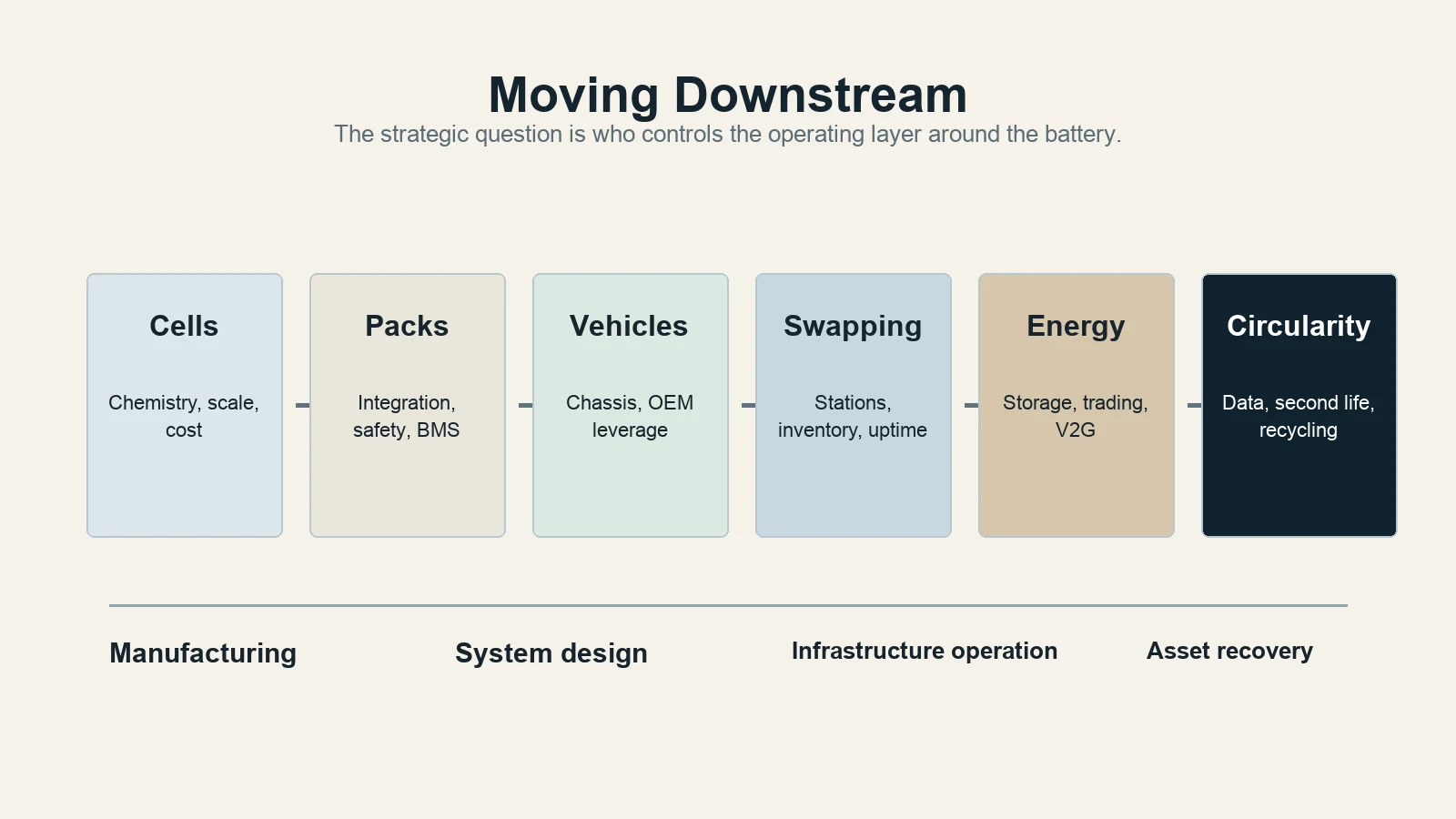
Over the past decade CATL has moved from cells into packs, battery management systems, energy storage, battery swapping, battery leasing, battery diagnostics, battery recycling, skateboard chassis, zero-carbon industrial parks and electric mobility infrastructure. Each move can be explained individually. Together they raise a more strategic question:
Is CATL still primarily a battery manufacturer, or is it becoming an infrastructure company whose products happen to include batteries?
This is not an article about battery swapping. Battery swapping matters, but only because it exposes a larger strategy. A company that controls the battery, the standard, the battery health record, the swap network, the charging profile, the residual value, the second-life pathway and the recycling loop controls far more than a component. It controls the operating layer of electric mobility.
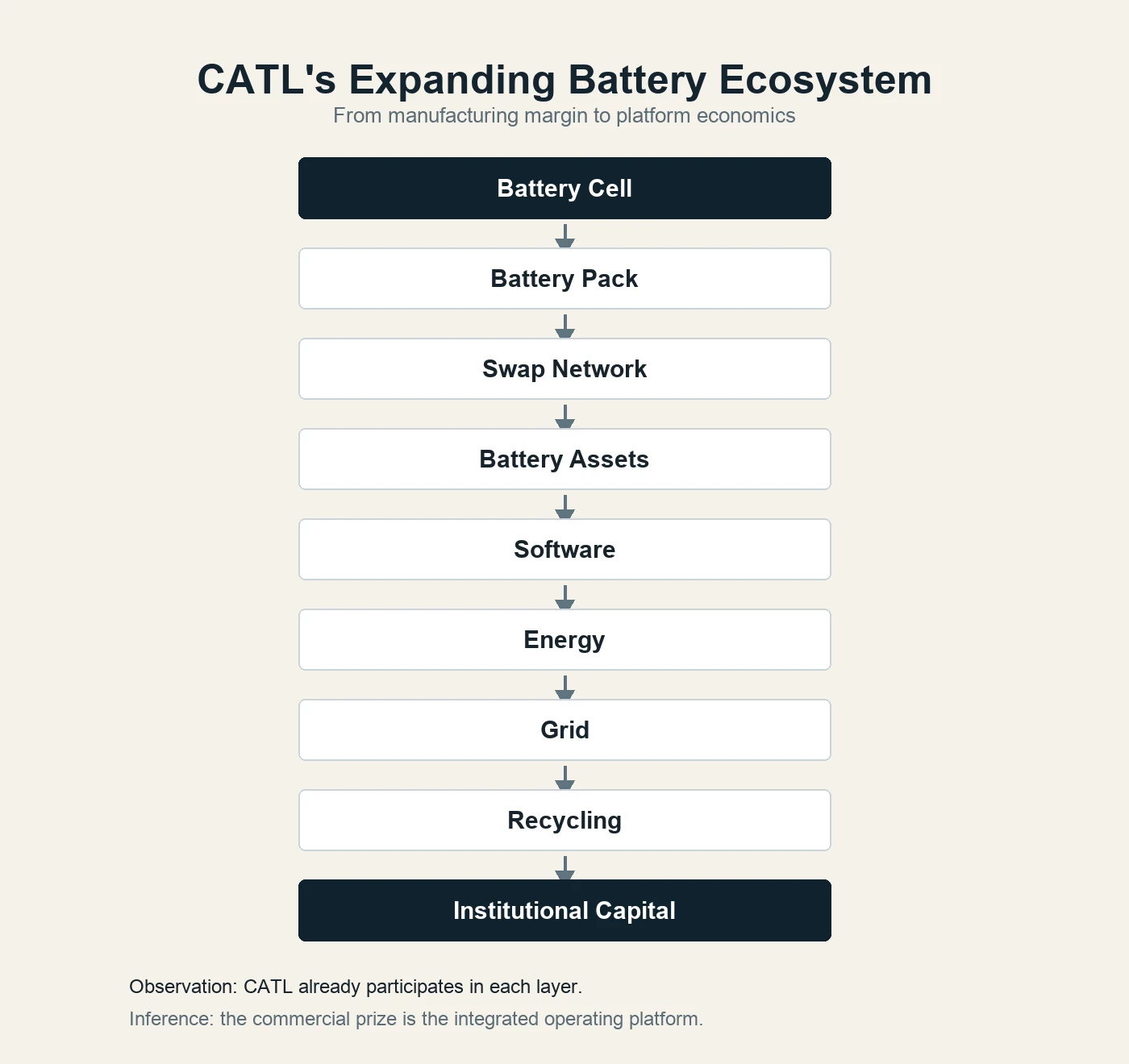
That conclusion should not be overstated. CATL has not already become the Microsoft, Visa, Apple, AWS or Rolls-Royce of batteries. It remains a manufacturing company with enormous exposure to cell price, capex cycles, OEM bargaining power, geopolitics and technology risk. But the evidence increasingly suggests that CATL is trying to capture more of the battery value chain by combining manufacturing, standards, infrastructure, software, energy services and asset management into a single ecosystem.
Executive Summary
- CATL is still a battery manufacturer, but that description is becoming too narrow. The company now participates in cells, packs, BMS, energy storage, battery swapping, battery services, recycling, software, zero-carbon infrastructure and chassis platforms.
- The strategic logic is vertical integration around the battery. CATL appears to be moving from selling electrochemical products once to managing battery assets across their operating life.
- Battery swapping is not the whole strategy. It is one visible mechanism for standardising packs, separating battery ownership from vehicle ownership and turning batteries into managed infrastructure assets.
- The standards question is central. If CATL can make its battery format and service architecture common across OEMs, control of the standard may become more valuable than the sale of individual batteries.
- The opportunity is recurring revenue. Batteries can be sold, leased, monitored, upgraded, redeployed, recycled and financed. The lifetime revenue pool can exceed the one-off cell margin if utilisation, residual values and standards hold.
- The risks are material. OEM resistance, standard fragmentation, antitrust concerns, geopolitics, localisation requirements and technology change could all prevent CATL from becoming the infrastructure platform it appears to be building.
The Evidence Boundary
There are three levels of claim in this analysis.
- Observation: CATL publicly operates across battery manufacturing, energy storage, battery swapping, lifecycle services, recycling, diagnostics and zero-carbon infrastructure.
- Pattern: Those activities collectively move CATL downstream from component supply into asset operation, standards and services.
- Inference: CATL appears to be building an operating system for electric mobility. That is a strategic interpretation, not a completed fact.
What Business Is CATL Really In?
The conventional answer is simple: CATL is in the lithium-ion battery business. It designs and manufactures power batteries for electric vehicles and energy storage batteries for stationary systems. That remains the revenue engine. CATL’s own 2025 reporting says its power battery sales volume reached 343 GWh and its energy storage battery sales volume reached 121 GWh. The company also states that it has led the global power battery market for nine consecutive years and the global energy storage battery market for five consecutive years.
Those figures make CATL a manufacturing giant. They also give it the base from which a different kind of company can be built. A battery company with weak scale has little leverage over OEM design, charging standards, fleet contracts or recycling flows. A battery company with CATL’s scale has a different option: it can try to make the rest of the system organise around its batteries.
The question is therefore not whether CATL will stop manufacturing batteries. It will not. The question is whether manufacturing is becoming the anchor product in a broader infrastructure system.
The Evolution: From Cell Supplier To System Owner
CATL’s progression is easier to see when it is treated as a value-chain map rather than a list of product launches.
| Layer | What CATL is doing | Strategic implication |
|---|---|---|
| Battery cells | Manufacturing lithium-ion cells at global scale. | Core cost advantage, process know-how and customer access. |
| Battery packs and BMS | Integrating cells into packs, thermal systems and battery management. | More control over safety, performance, warranty and data. |
| Battery swapping | Developing swap formats, stations and service models. | Separates the battery from the vehicle sale and turns it into a managed asset. |
| Standard battery formats | Promoting common blocks and cross-model compatibility. | Creates the possibility of network effects across OEMs. |
| Battery leasing and asset management | CATL describes service activities including leasing, maintenance, diagnostics, trading, recycling and battery finance. | Moves revenue from one-off sale to lifetime asset management. |
| Skateboard chassis | Developing integrated chassis platforms that combine battery, drive and vehicle architecture. | Potentially reduces OEM dependence and pulls vehicle design around CATL’s battery architecture. |
| Energy storage and microgrids | Supplying utility, commercial and industrial energy storage and zero-carbon industrial park systems. | Extends the battery from transport into power infrastructure. |
| Grid services and data | Battery monitoring, dispatch, charging control and health analytics become more valuable as deployed assets grow. | Turns operational data into a defensible asset. |
| Recycling and circularity | CATL promotes lifecycle services and recycling capabilities through subsidiaries and service brands. | Creates a route back to critical minerals, residual value and regulatory compliance. |
This does not prove a single master plan. Large industrial groups often expand opportunistically. But the direction is consistent: CATL is moving closer to the customer, closer to the grid, closer to the asset owner and closer to the material loop.
Follow The Money
A traditional battery company earns when a battery is sold. It may also earn through warranty, replacement sales or service, but the economic event is the sale of the pack.
An ecosystem company earns differently. It can sell the battery, lease the battery, manage the battery, monitor the battery, upgrade the battery, recycle the battery, finance the battery and redeploy the battery into a second-life use. It can also sell the software and energy services around the battery.
That difference matters because the battery is a high-value asset with a measurable operating history. A vehicle tyre wears out and is replaced. A battery degrades, but it also produces data every day: state of health, charge behaviour, temperature exposure, cycle count, depth of discharge, rapid-charge frequency, residual capacity and safety events. That data can determine warranty risk, financing cost, second-life value and recycling timing.
The larger lifetime revenue pool looks like this:
| Revenue opportunity | Traditional battery model | CATL ecosystem model |
|---|---|---|
| Initial battery sale | Primary revenue event. | Still present, but may be internalised into battery pools or leasing structures. |
| Battery leasing | Usually external to the cell supplier. | Potential recurring income if CATL or CATL-linked vehicles own the battery pool. |
| Monitoring and diagnostics | Limited unless the supplier has operational access. | Ongoing software and data layer tied to safety, warranty and utilisation. |
| Upgrade and replacement | Dependent on OEM relationship. | More direct if the pack is standardised and separated from vehicle ownership. |
| Energy services | Usually outside the battery sale. | Possible through storage, controlled charging, swap hubs and grid interaction. |
| Second life and recycling | Often captured by recyclers or waste processors. | Potentially captured by the same ecosystem that owns the battery health history. |
| Financing | Usually held by banks, leasing companies or OEM captives. | Battery health data can support financing, insurance and residual value products. |
How much larger is the opportunity? Public data is not sufficient to calculate a precise multiplier. But directionally the answer is clear. A one-off pack sale monetises manufacturing margin. A managed battery asset can generate revenue from availability, kilometres, energy throughput, health guarantees, software, financing and residual value.
That is why the Rolls-Royce comparison is useful. Rolls-Royce’s “Power by the Hour” and later TotalCare model shifted the commercial focus from selling engines to selling engine availability and long-term service. The airline bought thrust and uptime. Rolls-Royce managed maintenance, reliability, data and lifecycle economics.
The battery equivalent would be “energy by the mile.” The fleet does not primarily buy a battery. It buys access to usable energy, availability, uptime and residual value protection.
The analogy is imperfect. Jet engines are more specialised, more durable and more tightly tied to aircraft certification than EV batteries. A battery has faster technology change and may face more commodity price pressure. But the strategic logic is similar: the manufacturer earns more if it manages the asset over its life rather than merely selling the equipment at delivery.
Standards Are The Real Prize
Battery swapping is often judged as a convenience feature: can the driver replace a battery faster than they can charge? That is the wrong strategic lens.
The real question is whether a battery format can become a standard.
CATL’s Choco-Swap and earlier EVOGO concepts point in this direction. Public reporting on the Choco-Swap ecosystem describes standardised battery blocks, cross-OEM model compatibility and a plan to deploy stations at scale. CATL’s own service materials also describe an ambition to provide lifecycle battery services, including maintenance, leasing, trading, recycling, diagnostics, data and financial insurance services.
If that architecture becomes common across vehicle brands, the battery moves closer to a platform standard. The closest analogies are not perfect, but they illuminate the logic:
- USB: the connector becomes valuable because it reduces friction across many devices.
- Shipping containers: the standard matters more than any individual container because it coordinates ships, ports, trucks, cranes and warehouses.
- Windows and Android: the operating system creates a software and hardware ecosystem around a common platform.
- Visa: the network earns by coordinating transactions across banks, merchants and consumers.
The battery version would be a physical-digital standard: pack dimensions, thermal interfaces, safety systems, BMS protocols, station robotics, data interfaces, warranty rules, leasing terms and recycling records.
Does controlling the standard become more valuable than selling batteries? It can, but only if the standard is adopted by enough OEMs and station operators. If every vehicle maker insists on proprietary pack geometry, CATL sells batteries. If many OEMs design around a CATL-compatible format, CATL influences the system architecture.
This is where the Apple comparison needs discipline. Apple controls hardware, operating system, services, payments, distribution and customer identity. CATL does not have Apple’s consumer relationship, brand control or closed software stack. It sells mainly into OEM and infrastructure channels. But CATL may be seeking an industrial equivalent: control the hardware format, the operating data, the service layer and the recurring revenue mechanisms around the asset.
Infrastructure Ownership
The infrastructure question is broader than swap stations. CATL’s strategy touches battery inventory, energy storage systems, microgrids, industrial parks, grid interaction, data platforms and recycling loops.
CATL’s partnership with Octopus Energy in Europe is a useful example because it moves battery swapping into infrastructure finance. The announced plan refers to more than 30 electric truck hubs, support for more than 300,000 electric lorries by 2035 and up to GBP 30 billion of private investment across the market. Whether those targets are achieved is a separate question. The important point is that the plan is framed as infrastructure, not simply vehicle hardware.
The Sinopec relationship is equally revealing. A battery manufacturer does not partner with one of China’s largest fuel retailers merely to sell cells. The logic is site access, energy retailing, customer flow, grid connections, real estate and the gradual conversion of liquid-fuel infrastructure into electric-energy infrastructure. The swap station is the visible unit. The strategic asset is the energy node.
This resembles traditional infrastructure in several ways: high upfront capex, network density, utilisation risk, site value, long-term contracts, operational reliability and financing structure. It also differs from traditional infrastructure in one critical way. The most valuable asset inside the station is not a passive pipe, tower or cable. It is a degrading electrochemical asset that can become obsolete.
That makes CATL’s involvement rational. A generic infrastructure fund can own land and equipment. CATL can understand battery degradation, pack safety, charging curves, residual value and recycling timing. If those are the hard parts of the asset class, CATL has a natural right to play.
Asset Ownership: Batteries, Data And The Customer Relationship
The previous question in battery swapping was: who owns the batteries? The larger CATL question is:
- Who owns the infrastructure?
- Who owns the battery health history?
- Who owns the customer relationship?
- Who owns the operating platform?
- Who owns the data that determines financing and residual value?
Battery ownership alone is not enough. If an infrastructure fund owns a pool of batteries but CATL owns the diagnostic standard, the replacement pathway, the warranty algorithm and the recycling channel, CATL still controls much of the economic system. If an OEM owns the customer but the vehicle is designed around CATL’s swappable pack and battery data protocol, CATL has leverage over operating economics.
The most valuable asset may be the battery health record. A used battery with a trusted operating history is financeable. A used battery without reliable data is a risk object. In that sense, battery data could become the equivalent of an aircraft maintenance log, a vehicle service record or a credit history.
This is where CATL begins to look less like a component supplier and more like an asset operating company. The asset is not only the battery. It is the battery plus its data history, service record, warranty status, residual value model and recycling claim.
NIO: Partner, Template Or Acquisition Target?
NIO matters because it has done what many battery-swapping sceptics said would not happen: it has built a large operating network and trained customers to treat battery swapping as a normal part of EV ownership.
CATL and NIO announced cooperation in 2025 to develop battery swapping in China, including technical standards, service networks, capital collaboration and business cooperation. Some market reports have also discussed CATL interest in NIO Power. Those acquisition reports should be treated as unconfirmed unless and until formally announced.
Even without an acquisition, the strategic signal is clear. NIO has real operating experience: station deployment, customer behaviour, battery inventory, swap uptime, charging profiles and service workflows. CATL has manufacturing scale, battery technology, financing leverage and relationships across multiple OEMs. The combination points toward standardisation beyond one vehicle brand.
For CATL, NIO is not just a customer. It is a laboratory for battery-as-a-service economics. It shows how battery ownership can be separated from vehicle ownership, how pack upgrades can be sold over time and how the swap station can become a customer touchpoint.
The risk is that NIO’s strength also shows the limits of the model. Swapping works best when vehicles are designed for the same pack architecture and a dense network already exists. That is much easier inside one brand than across a fragmented global OEM landscape.
Why Skateboard Chassis Matter
CATL’s move into skateboard chassis and integrated vehicle platforms is sometimes treated as a side project. Strategically, it may be central.
If the battery is the platform, vehicle architecture matters. A swappable battery is not just a pack. It requires structural integration, crash protection, thermal routing, electrical interfaces, locking systems, software integration and serviceability. OEMs that design vehicles around proprietary architectures can limit CATL’s ability to standardise.
A CATL-controlled chassis changes that bargaining position. It can make the battery format native to the vehicle architecture. It can lower the engineering burden for smaller OEMs. It can reduce CATL’s dependence on each automaker’s internal platform decisions. It can also make battery swapping easier by designing the vehicle from the battery upward.
This is a strategic move downstream. It does not mean CATL wants to become a car brand. It means CATL may want more influence over the layer where battery design becomes vehicle design.
Data: The Underpriced Asset
Battery data is one of the least discussed parts of CATL’s strategy. It may become one of the most important.
At scale, CATL can learn how batteries degrade across chemistries, climates, drivers, routes, vehicles, charging regimes, grid conditions and use cases. That data has commercial value in at least seven ways:
- Warranty pricing: better degradation data improves warranty reserves.
- Predictive maintenance: early fault detection reduces safety and uptime risk.
- Financing: battery health records support residual value and debt sizing.
- Fleet optimisation: packs can be matched to duty cycles based on state of health.
- Grid services: batteries can be dispatched without damaging lifetime value.
- Second life: used packs can be graded for stationary storage applications.
- Recycling: end-of-life timing and chemistry data improve material recovery economics.
This is where the AWS and NVIDIA analogies are useful, if used carefully. AWS became powerful because it turned compute infrastructure into a scalable service layer. NVIDIA became powerful because its hardware sits inside a software, developer and data-centre ecosystem. CATL’s equivalent would be battery infrastructure plus the operating intelligence that makes batteries bankable, safe and useful across mobility and grid applications.
The analogy fails if it implies software margins or monopoly economics. Batteries are physical assets with commodity exposure. But the direction is similar: value migrates from the product to the platform that governs product deployment.
Circular Economy And Battery Passports
Recycling is not just environmental housekeeping. It may become a strategic revenue layer.
CATL’s recycling materials describe lifecycle management, waste-battery recycling and recovery of key materials. That matters commercially because the battery supply chain is exposed to lithium, nickel, cobalt, manganese, graphite and regulatory pressure. A company that controls battery health data and return flows is better positioned to control material recovery.
Regulation strengthens this logic. The EU Battery Regulation creates requirements around sustainability, recycled content, due diligence and battery information. From February 18, 2027, electric-vehicle batteries and industrial batteries above 2 kWh placed on the EU market must have an electronic battery passport. That makes battery identity, chemistry, manufacturing origin, use history and end-of-life data more valuable.
The circular model could look like this: CATL manufactures the pack, monitors it in service, leases it through a mobility application, redeploys it into stationary storage, recycles it at end of life and feeds recovered materials back into new batteries. That is not yet a closed loop at global scale. But it is the direction regulation and resource security are pushing the industry.
Who Ultimately Benefits?
If CATL succeeds in building a battery infrastructure ecosystem, the beneficiaries will not be limited to CATL shareholders.
Infrastructure funds may finance swap networks, energy storage projects and station real estate. Utilities may benefit from controlled charging, grid services and distributed storage. Pension funds may see contracted battery infrastructure as a long-duration asset, provided degradation and technology risk can be priced. Private equity may invest in service companies, recyclers, software platforms and regional operating companies. Project finance lenders may back station networks if utilisation is contracted by fleets or OEMs.
But CATL itself would remain unusually well positioned because it can sit at the junction of battery cost, battery knowledge, pack supply, standards, data and recycling. That junction is where much of the margin could accumulate.
The comparison with telecom towers is useful. Mobile network operators once owned much of their tower infrastructure. Over time, tower companies and infrastructure funds realised that passive shared infrastructure could be financed separately. Battery infrastructure may follow a similar path, but with a difference: the “tower” contains the most complex and depreciating part of the system. That makes technical asset management more important than in passive real estate.
Why This Could Fail
The case for CATL as an emerging infrastructure company is strong enough to take seriously. It is not strong enough to assume success.
There are at least eight risks.
First, OEM resistance. Automakers do not want to become low-margin body builders around someone else’s battery platform. They may accept CATL cells but resist CATL standards.
Second, standard fragmentation. Battery standards create value only if many parties adopt them. Multiple incompatible swap formats would destroy network effects and trap capital in underused inventories.
Third, competition law. A battery company that controls the standard, the network, the data and access terms may face antitrust scrutiny, especially if rivals believe the system discriminates against non-CATL batteries.
Fourth, technology change. Faster charging, higher energy density, solid-state batteries or new chemistries could weaken the case for swapping or shorten asset lives.
Fifth, geopolitics. CATL faces scrutiny in the United States and Europe because batteries are now strategic infrastructure. Security concerns, trade restrictions, tariff policy and local-content rules can limit global infrastructure ambitions.
Sixth, localisation. Europe and the United States may not accept Chinese-controlled battery infrastructure at the core of transport and grid systems without local manufacturing, local data governance and local ownership structures.
Seventh, capital intensity. A swapping network requires batteries, stations, grid connections, land, fire systems, software and maintenance. Low utilisation can turn a network into a warehouse of depreciating assets.
Eighth, residual value uncertainty. Infrastructure investors like predictable assets. Battery residual values depend on chemistry, warranty, policy, second-life demand, recycling economics and technology substitution.
These risks do not invalidate the strategy. They define the conditions under which it can work.
The Strategic Read
CATL should not be described as having already become an infrastructure company. That would be too strong.
A more defensible conclusion is this: CATL appears to be trying to capture more of the battery value chain by building an ecosystem that links manufacturing, standards, infrastructure, software, energy services, financing, asset management and recycling.
Battery swapping is one component of that strategy. Energy storage is another. Recycling is another. Skateboard chassis are another. Battery health data may become the connective tissue.
The prize is not just selling more cells. It is controlling the architecture through which electric mobility is financed, operated, upgraded and recycled.
That is why the question for investors and industrial strategists is not simply whether CATL’s next battery is cheaper, safer or more energy dense. The question is what business CATL is really trying to build.
If the twentieth century was shaped by companies that owned oil infrastructure, could the twenty-first century be shaped by companies that own battery infrastructure?
Sources And Evidence Base
- CATL 2025 annual results and strategic update, including power battery, energy storage and service ecosystem disclosures.
- CATL recycling and lifecycle management materials.
- Octopus Energy and CATL European electric trucking infrastructure announcement.
- NIO and CATL battery swapping cooperation announcement.
- Associated Press reporting on CATL battery swapping and standardised swap packs.
- Rolls-Royce TotalCare services for the engine-availability comparison.
- EU Regulation 2023/1542 on batteries and waste batteries, including battery passport requirements.