
Field Note · Climate · Media Economics
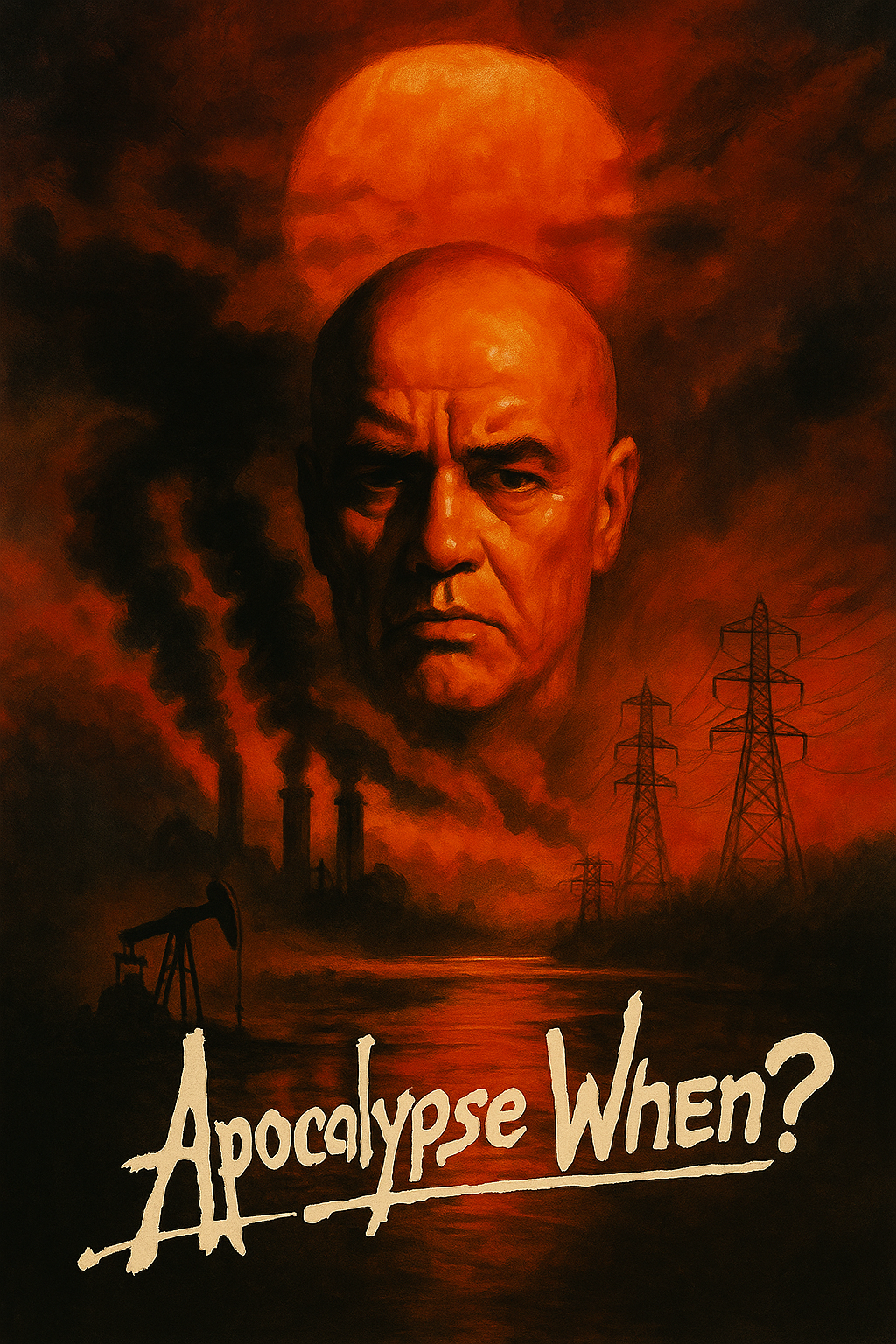
Apocalypse When?
A field note on climate panic, media economics, and the people who quietly get the real work done
This field note explores how climate panic, media incentives and political theatrics distorted climate discourse, while engineers, founders and operators quietly built the systems that actually cut emissions and secure our future.
The long sweep of climate politics has always been shaped as much by human psychology as by atmospheric physics. Climate change is real, measurable and serious, yet our instinct for peer approval and easy money has repeatedly derailed attempts to handle it responsibly.
Matt Ridley’s article in The Spectator captures the whole arc of that distortion with uncomfortable accuracy, tracing how climate concern morphed into a kind of touring spectacle rather than a sober policy debate.
From crisis to background noise
For years, activists dependent on donations were pushed toward ever more extreme messaging. Catastrophe attracts attention; attention attracts money, especially when social media algorithms reward outrage and fear over nuance. The media, operating in a click-driven economy, amplified the most dramatic predictions and worst-case scenarios, while quieter stories about incremental progress sank without trace.
Meanwhile the public, bombarded with four decades of escalating warnings, gradually became numb to it all. In the UK, the share of people “very” or “fairly” concerned about climate change has slipped from mid-80s to around 80 percent since 2021.
YouGov’s climate concern tracker shows acceptance remaining high while urgency flattens. When everything is a crisis, nothing feels like one.
Yesterday’s environmental panics
The piece tracks what this cycle produced: a long parade of once-fashionable environmental nightmares, from overpopulation panics in the 1970s to acid rain, the ozone layer, nuclear winter, and imminent species collapse. Acid rain and the ozone hole were and are real issues, but their media framing followed the same pattern: intense public alarm, simplified villains, then quiet technical and regulatory work that reduced sulphur emissions and phased out CFCs.
The US EPA Acid Rain Program and The Montreal Protocol are examples of how engineering and regulation solved the problem without apocalypse narratives.
Climate became the master narrative because it could always be projected into the future; any quiet year could be dismissed as a lull before the storm. Meanwhile, governments, corporations and institutions learned to ride the wave. If money, politics, shareholder value or public distraction required a louder story, someone could always wrap it in climate language. And anyone who questioned exaggeration, even while accepting climate reality, could easily be labelled “denier” and sidelined.
Incentives inside the system
Scientists who knew rhetoric was drifting away from data often stayed silent because alarm funded their work. Academic incentives reward citations, media attention and grant-friendly language, which nudges communication toward simplified narratives and bold claims. Politicians, grappling with messy local issues, found it useful to offload failings – from drainage-driven flooding to energy price spikes – onto “the climate,” a villain that never answers back.
Corporations enjoyed the cover and subsidies. Oil and gas majors could advertise tiny low-carbon pilots as transformational while expanding production. Consumer brands launched glossy “climate-neutral” ranges based on opaque offsetting schemes. Almost nobody inside this ecosystem had a strong incentive to turn the volume down.
The great climbdown
Now the trend is in retreat. The UN-convened Net-Zero Banking Alliance has been hit by a wave of departures: the six largest US banks have quit, along with institutions in Canada, Japan and Australia. The alliance has been forced to soften its 1.5 °C alignment expectations as political and financial realities reassert themselves.
Corporations are quietly stepping back from unrealistic net-zero targets as it becomes clear that 1.5 °C-compatible trajectories cannot be reconciled with current capex cycles and supply chains. In the US, climate has slipped down the campaign agenda behind energy security and the cost of living. In Europe, legislators are relaxing parts of the ESG and reporting regime, from delays to the Corporate Sustainability Reporting Directive (CSRD) to national rollbacks of boiler bans and combustion-engine phase-outs. The financial and political incentives that once inflated the narrative are evaporating.
Where the real work happens
Through all of this, the people actually trying to address the problem have been easy to miss. Engineers building dependable low-carbon systems: grid operators integrating record wind and solar; nuclear teams squeezing life-extension uprates from existing plants; gas networks trialling hydrogen blends and biomethane. Researchers refining process efficiencies in steel, cement and fertilisers, where marginal improvements in kiln design, waste-heat recovery or electrolysis efficiency quietly remove millions of tonnes of emissions.
Operators and founders are struggling to turn promising ideas into commercially viable infrastructure: hydrogen refuelling corridors for trucks that work at scale; diversified battery supply chains; carbon-capture projects that run reliably rather than as conference photo-ops. None of this relies on doomsday language. None of it fits the media template. But it is the only work that shifts the real numbers on emissions, resilience and energy security.
After the panic
Climate change remains a material and measurable challenge, with rising temperatures, shifting weather patterns and physical risks already affecting infrastructure and agriculture. But the feverish industry that grew around scaremongering – emergency declarations, theatrical protests and branding exercises dressed as policy – is the part collapsing under its own weight. Public attention will move on to the next crisis that promises better engagement metrics, just as it moved from peak plastic panic to pandemics to geopolitics.
Activists who depend on visibility will pivot to whichever cause keeps them in circulation, whether AI risk, demographic decline or a future fashionable emergency. The hyperbole will drain away. And after the noise subsides, the people who actually secure the future of our species will still be working: grid planners, process engineers, network operators, project financiers and founders turning spreadsheets into substations.
They were there before the panic. They will be there after it.
#ClimateReality #EnergyTransition #InnovationNotHysteria #TechOverHype #BornToDisrupt