Bigger Brains Need Better Senses
Robot touch matters more, not less, as Humanoid’s KinetIQ Ascend shows robot intelligence beginning to improve faster than robot perception. That is good news for Humanoid. It also exposes the next bottleneck in Physical AI: a robot cannot reason from information its sensors never collect.
For several years the robotics market has been asking whether humanoids can become intelligent enough to work outside a demonstration bay. That question is still valid. But it is no longer the only question.
The better question is now narrower and more useful: when a robot has a competent visual policy, reinforcement learning, real-world rollouts and fleet infrastructure, what information is still missing?
Humanoid’s answer is partly that more robot time can close the last mile of reliability. My view is slightly different. Robot time will improve the policy. It will also make the missing observations more expensive. Better brains need better senses.
Summary
Humanoid’s KinetIQ Ascend is a serious robotics signal. The company reports real-world reinforcement learning on bimanual humanoid hardware, with throughput and success-rate gains on production tasks. The stronger interpretation is not that software alone will solve manipulation. It is that once policies improve, the value of better observation rises.
- Vision-language-action models can generalise, but they still act through incomplete observations.
- Reinforcement learning can suppress failure modes when those failures are visible to the reward system.
- Touch, force, shear and slip sensing expose contact events that cameras often cannot see.
- Tactile sensing remains comparatively underfunded beside humanoid bodies and robot foundation models.
Key Takeaways
- Humanoid should be taken seriously. KinetIQ Ascend is not another walking demo. It is an attempt to build the learning loop industrial robots will need.
- The evidence is promising, not complete. The company reports large gains, but the public data is still company-published rather than peer-reviewed.
- Better AI increases the sensor problem. A weak policy wastes data. A strong policy exposes which data the robot never had.
- Touch is not a cosmetic feature. It measures contact, slip, shear, friction and local force during the part of manipulation where vision is least informative.
What Humanoid Actually Announced
Humanoid says KinetIQ Ascend extends its KinetIQ framework with end-to-end, vision-guided reinforcement learning for manipulation VLAs. The company describes real-world RL on bimanual humanoid hardware, running around the clock on production tasks rather than only in simulation.
The reported numbers are material. On industrial machine feeding, Humanoid says RL increased throughput by 42%. On item handover, throughput rose by 85% and success improved from 80% to 98%. On bimanual tote handling, throughput more than doubled and success rose from 78% to 99%.
Those figures are worth using, but not worshipping. They are company-published results. They are not a broad benchmark for all industrial manipulation. The stronger point is methodological: Humanoid measured gains against a concurrent baseline to avoid mistaking environmental drift for learning progress. That is the kind of discipline robotics needs more of.
The announcement also shows why imitation learning has limits. A behaviour-cloned policy can copy a demonstrator, but it inherits the demonstrator’s speed, assumptions and blind spots. RL gives the robot a route to test actions against the task itself, within its own hardware dynamics.
That is why Humanoid deserves a positive reading. The company is not claiming that a humanoid form alone creates value. It is focusing on the operational tests that industrial customers eventually care about: throughput, interventions, failure modes, safety stops and the ability to keep learning after deployment. Those are better indicators than another controlled video because they connect technical progress to station economics. An investment assessment of sensing and manipulation needs evidence about sustained task performance under those operating conditions.
The Intelligence Layer Is Moving Quickly
Humanoid is not working in isolation. Google DeepMind’s RT-2 showed how vision-language models can be adapted into robot control policies. Gemini Robotics pushed the same direction with a generalist VLA built on Gemini 2.0. Nvidia’s GR00T N1 and Physical Intelligence’s pi-zero point to the same architectural shift: robot control is becoming a foundation-model problem.
That matters commercially because software can improve across fleets. A better policy can be copied. A better training loop can compound. A useful recovery skill can become part of the operating layer rather than remain a one-off intervention by a human operator.
It also changes the bottleneck. If the policy is crude, almost every failure can be blamed on control. Once the policy is competent, failures become more diagnostic. Did the robot fail because it could not plan, or because it did not know the object had shifted inside the grasp?
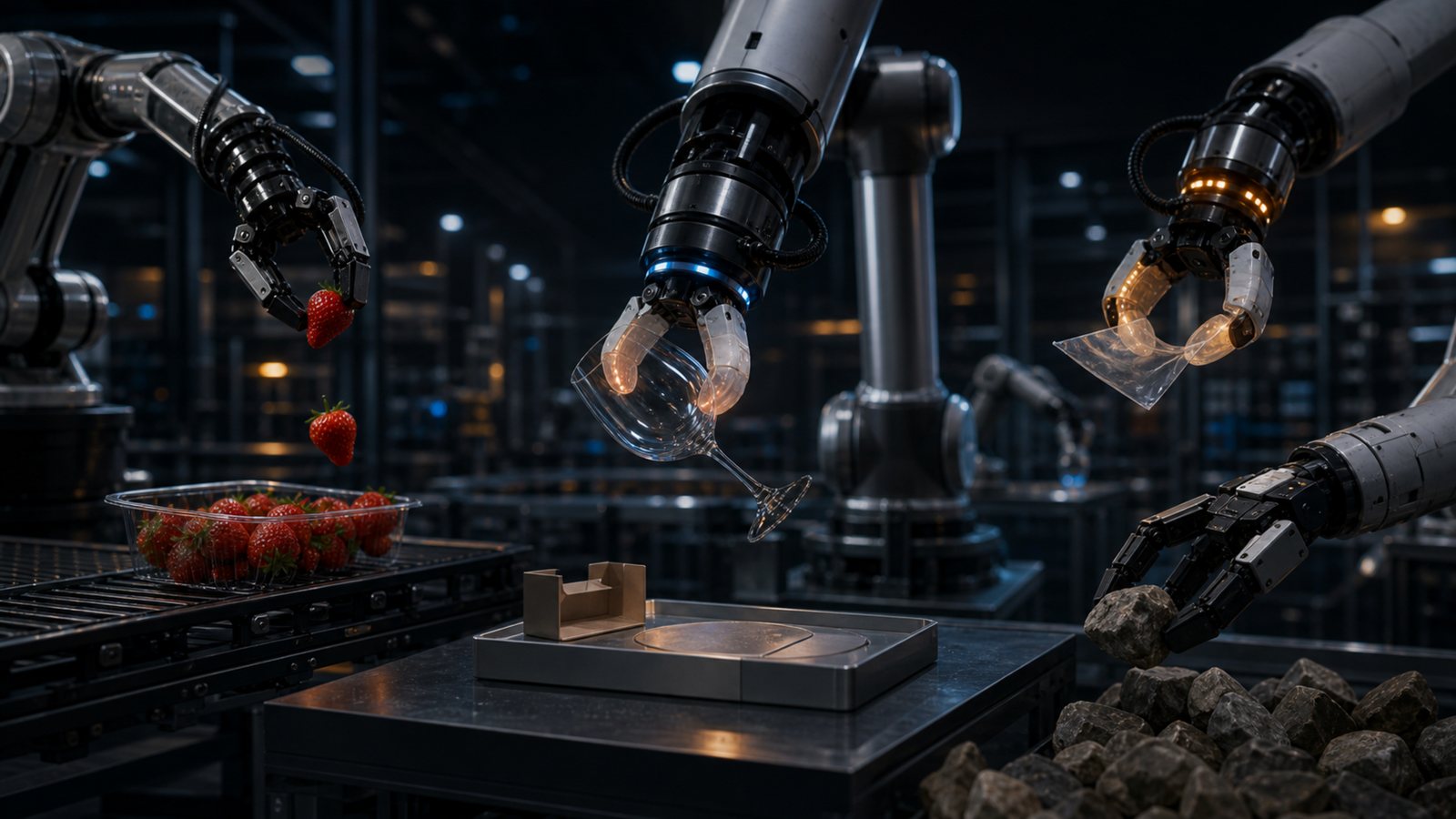
That distinction is central. Large models can interpolate over missing words and infer likely intent. Physical systems are less forgiving. If a strawberry is slipping, a package seam is catching, or a bearing ring has rotated under a fingertip, the model cannot infer that reliably unless the sensor stream contains evidence.
Reinforcement Learning Rewards What It Can Observe
RL is powerful because it turns failure into information. But the information still has to enter the learning system. Rewards can penalise a failed pick, a dropped tote or an unsafe force threshold. They do not automatically explain the contact mechanics that caused the failure.
This is why observability matters. In reinforcement learning, the state representation defines what the policy can condition on. If the robot sees only external images and joint positions, it may learn useful correlations. It may not learn the first millisecond of slip, the changing shear pattern under a fingertip, or the local friction that determines how much force is enough.
The tactile RL literature is beginning to show the same point empirically. Recent work on tactile-based reinforcement learning reports that even sparse binary contact signals can be critical for dexterity when proprioception fails to register robot-object motion. Tac2Motion reports higher data efficiency and more robust contact-rich hand manipulation when tactile observations and tactile reward shaping are used. Tactile pushing work shows that rich touch can produce reliable manipulation even without vision in constrained tasks.
The evidence is not uniform. Tactile hardware adds cost, bandwidth, durability and integration problems. Some tasks can be solved with vision, force-torque sensing and careful fixturing. But the more general the robot, the weaker that escape route becomes. General-purpose work contains contact events that cannot be engineered out of the environment.
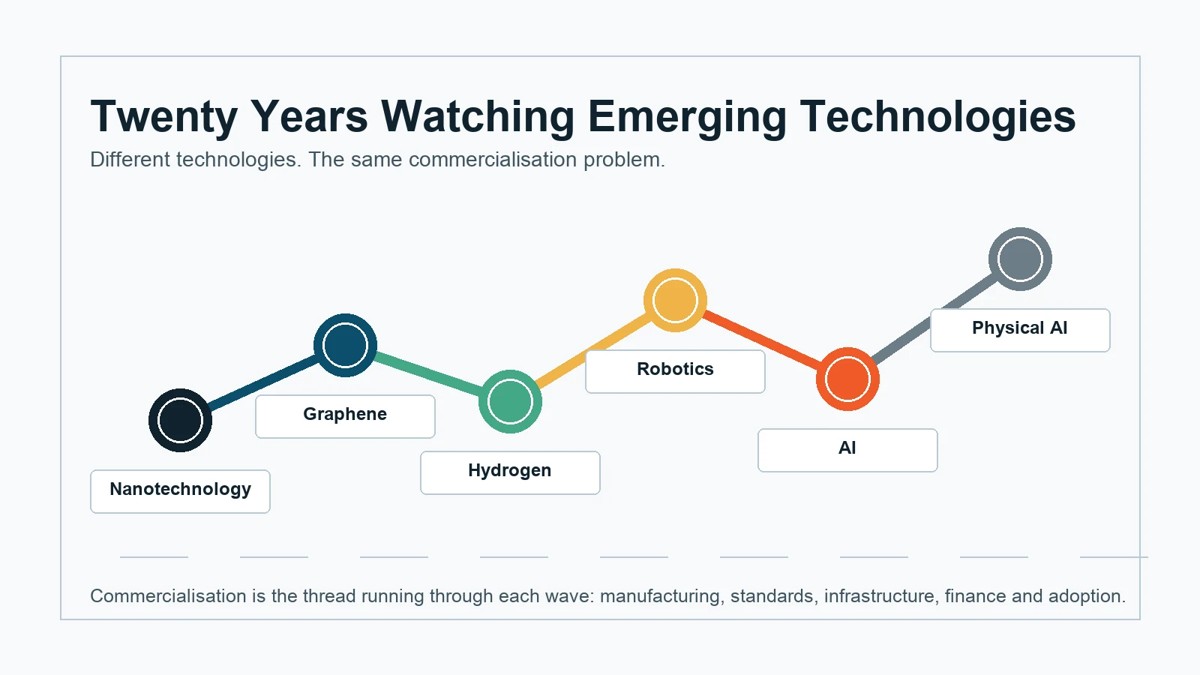
This is the same commercial pattern I have written about before in Humanoid Robots Are Raising Billions. The Missing Piece Is Touch and As AI Gives Robots Brains, Touch Will Give Them Dexterity. The market pays attention to bodies and models first. The deployment bottleneck often sits in the less glamorous and harder to solve sensing layer.
| Layer | What improves | What remains hard |
|---|---|---|
| Behaviour cloning | Copies human demonstrations efficiently. | Can inherit speed limits, hidden assumptions and causal confusion. |
| Reinforcement learning | Optimises against task outcomes and hardware dynamics. | Needs rewards, safe exploration and enough observable state. |
| Vision-language-action models | Connect perception, language and action in one policy. | Can miss contact-level events hidden from cameras. |
| Tactile sensing | Adds force, slip, shear, texture and contact localisation. | Must be robust, cheap, compact and useful to the control stack. |
Robot Touch Is The Missing Observation Layer
Human hands make the point without needing much romance. Fingertips combine mechanoreceptors, proprioception and reflexive grip control. We adjust force before conscious reasoning catches up. We manipulate without staring continuously at the object because contact information is doing work that vision cannot.
Robots are starting from a thinner sensory base. Cameras can classify the object and estimate pose. Depth sensors can help with geometry. Wrist force-torque sensors can detect aggregate loads. None of those fully replace local tactile fields at the fingertip, especially when the object deforms, rotates, slips, occludes itself or changes contact patch during motion.
GelSight, DIGIT, TacTip, GelTip and newer electronic skins each attack part of this problem. The designs differ, but the commercial question is consistent: can the sensor survive real work, fit into a useful hand, produce data at the right speed, and make the policy better enough to justify the cost?
That last clause matters. Tactile sensing should not be sold as an imitation of human biology. It should be judged as an industrial input. If touch reduces mispicks, damage, intervention rates or training time, it has value. If it merely creates beautiful contact images that the policy cannot use, it remains a laboratory feature.
The Capital Is Not Yet Balanced
Investment is still concentrated in the visible layers. Figure AI has been valued at tens of billions of dollars. Apptronik has raised about $1 billion and is reported at more than a $5.5 billion valuation. NEURA Robotics announced up to $1.4 billion of funding in June 2026. Physical Intelligence raised $400 million in 2024 for robot foundation models, and further robot-brain rounds have followed across the sector.
By comparison, tactile sensing remains a small funding category. There are exceptions and acquisitions, but few touch-focused companies command the same capital attention as humanoid bodies, robot operating systems or foundation-model labs. That looks inefficient.
The reason is understandable. Investors prefer scalable software, platform control and large visible markets. Sensors look like components. Components look lower margin. Hardware also carries manufacturing risk. But robotics often punishes clean software narratives. If the robot cannot observe the contact state, the most elegant policy still has to guess.
This is where the commercial opportunity sits. Tactile sensing does not need to become the most valuable layer in robotics. It only needs to become necessary to the layers already attracting capital.
Kirisense And The Direction Of Travel
Kirisense is one example of where this may head. The company is developing tactile sensing for force, movement and slip at the point of contact, with a Royce-backed project focused on a shear-sensing robotic fingertip. I am not presenting Kirisense as the subject of this article. The subject is the broader shift from robot intelligence to robot observability.
Still, the timing is instructive. As Humanoid, Figure, Google DeepMind, Nvidia and Physical Intelligence push the intelligence layer forward, the market will become less tolerant of blind manipulation. The useful robot is not the one with the most impressive model. It is the one that turns model capability into dependable physical work.
Conclusion
Humanoid’s KinetIQ Ascend announcement should be read positively. It shows a serious company attacking the right problem: industrial reliability through real robot learning, not only better demonstration videos. The reported gains are exactly the kind of evidence the sector needs.
But the deeper lesson is not that reinforcement learning removes the need for better sensors. It is the opposite. RL makes the observation problem more visible. Once a robot can learn from failure, the quality of the failure signal becomes central.
Physical AI will not be won only by larger models. It will be won by systems that close the loop between perception, action, contact, failure and recovery. Vision-language-action models give robots a better brain. Tactile sensing gives that brain something essential to think with.
As robots become more intelligent, touch becomes more important.
Sources And Evidence Base
- Humanoid: KinetIQ Ascend
- The Guardian: UK robotics, Humanoid and Siemens deployment context
- RT-2: Vision-Language-Action Models Transfer Web Knowledge to Robotic Control
- Gemini Robotics: Bringing AI into the Physical World
- Nvidia GR00T N1: An Open Foundation Model for Generalist Humanoid Robots
- Physical Intelligence pi-zero: A Vision-Language-Action Flow Model for General Robot Control
- Enhancing Tactile-based Reinforcement Learning for Robotic Control
- Tac2Motion: Contact-Aware Reinforcement Learning with Tactile Feedback
- Sim-to-Real Deep Reinforcement Learning for Tactile Pushing
- Improved GelSight Tactile Sensor for Measuring Geometry and Slip
- DIGIT tactile sensor for in-hand manipulation
- Henry Royce Institute Industrial Collaboration Programme