The useful question is not whether a battery can be swapped quickly. It is whether the swap network lowers the cost of freight electrification, or simply moves the battery, depreciation and technology risk from fleet balance sheets onto infrastructure investors.
CATL and Octopus Energy have framed their European heavy-truck battery swapping plan as a way to unlock electric trucking at scale. The announcement refers to more than 30 electric truck hubs, support for more than 300,000 electric lorries by 2035 and up to GBP 30 billion of private investment across the market.
Those numbers should not be read as a transport-technology claim. They should be read as an infrastructure finance claim.
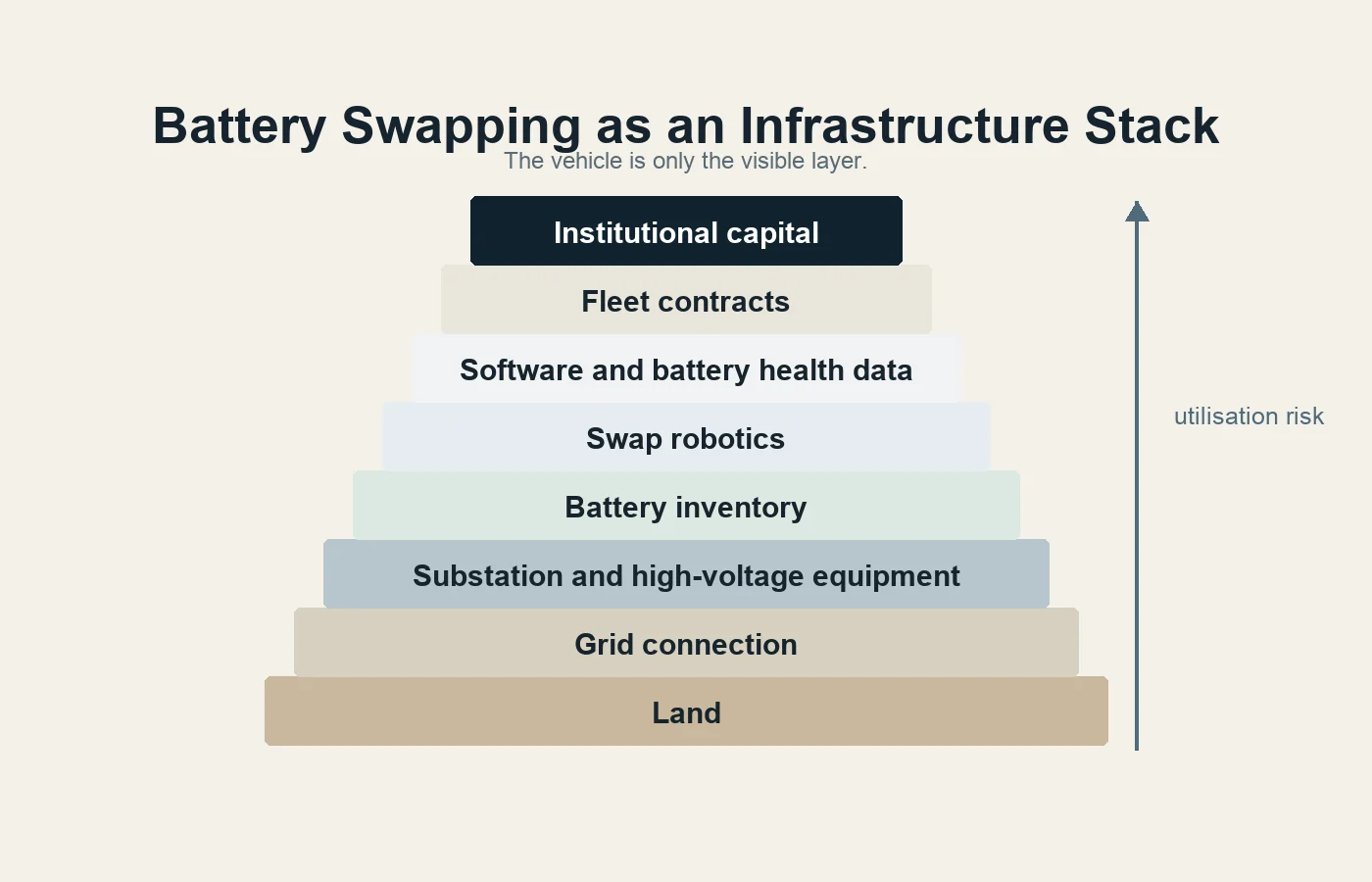
If 300,000 heavy trucks are swap-enabled, Europe does not avoid buying batteries. It buys more batteries than trucks. It also buys station inventory, reserve packs, grid connections, charging hardware, fire systems, software, insurance, degradation management and replacement capex. The fleet operator may own less, but the system owns more.
That makes battery swapping interesting, but not automatically cheaper. It begins to resemble aircraft leasing, rail rolling-stock leasing, container leasing, telecom towers, data centres and grid storage: long-lived or semi-long-lived assets financed by specialist owners and monetised through contracted availability.
The core question is therefore simple:
Does battery swapping reduce cost, or merely change who owns the assets and who carries the financial risk?
Executive Summary
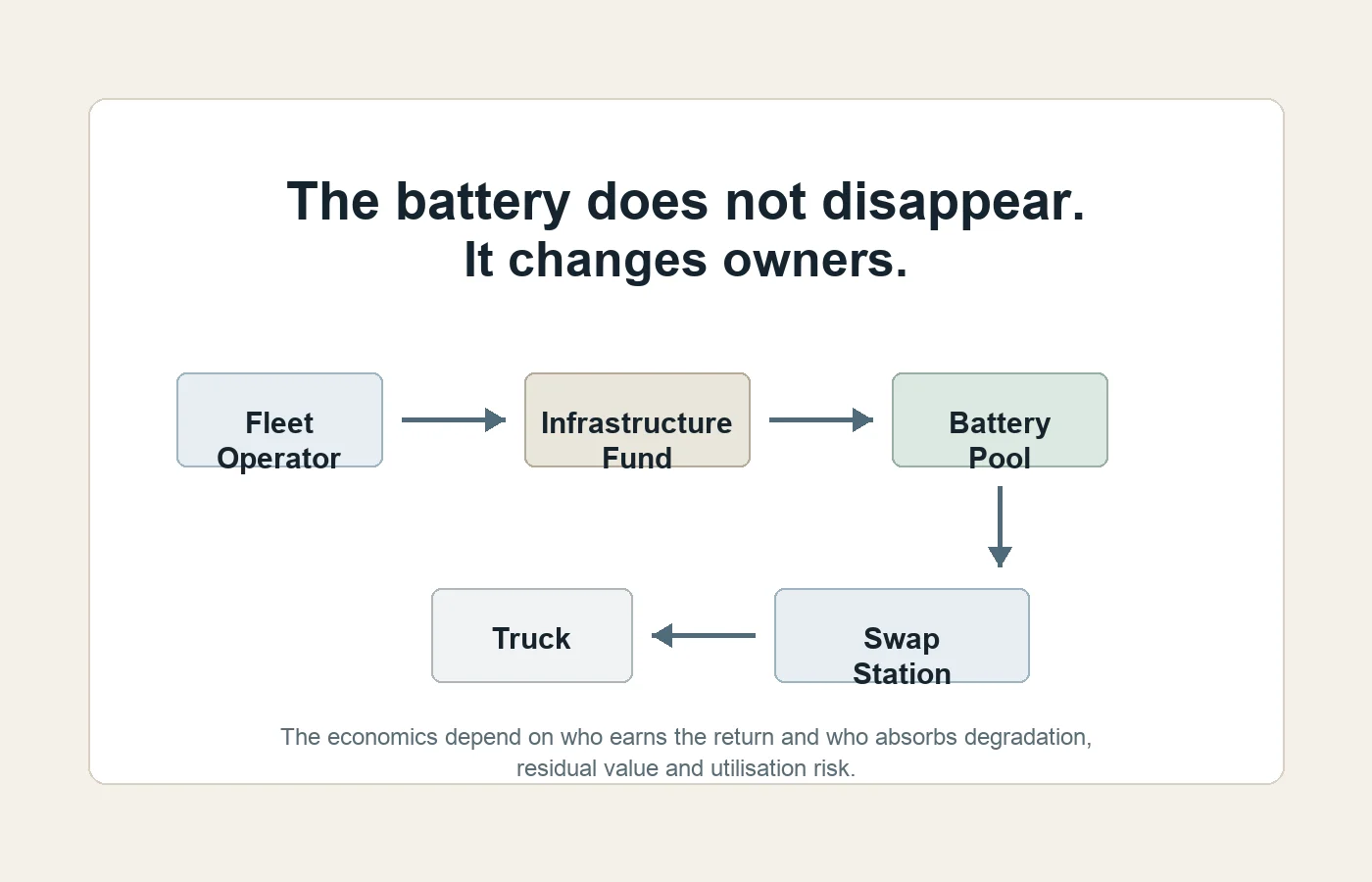
- Battery swapping does not remove battery capex. It moves it from the truck buyer to a battery owner, station owner, leasing vehicle, utility, infrastructure fund or project finance structure.
- At 300,000 swap-enabled HGVs, the system probably needs 360,000 to 600,000 heavy-truck packs. A realistic inventory multiple is 1.2x to 2.0x the truck population once charging dwell time, maintenance, damaged packs, reserve inventory and peak demand are included.
- Battery inventory alone can absorb GBP 16 billion to GBP 48 billion of capital. A base case of 450,000 packs, 500 kWh each and GBP 120/kWh implies about GBP 27 billion tied up in batteries before stations, grid connections, land, civil works and fire systems are included.
- The business model is utilisation-sensitive. A dense, standardised network can produce a credible infrastructure asset. A fragmented or underused network turns into expensive idle battery inventory.
- The closest analogy is not diesel refuelling. It is a hybrid of aircraft leasing, telecom towers, energy storage and regulated utility infrastructure, but with weaker residual values and faster technology obsolescence than aircraft.
- The model can create genuine value under narrow conditions: high route density, common standards, bankable fleet contracts, cheap electricity, patient capital and disciplined inventory management. Without those conditions it is mainly financial engineering.
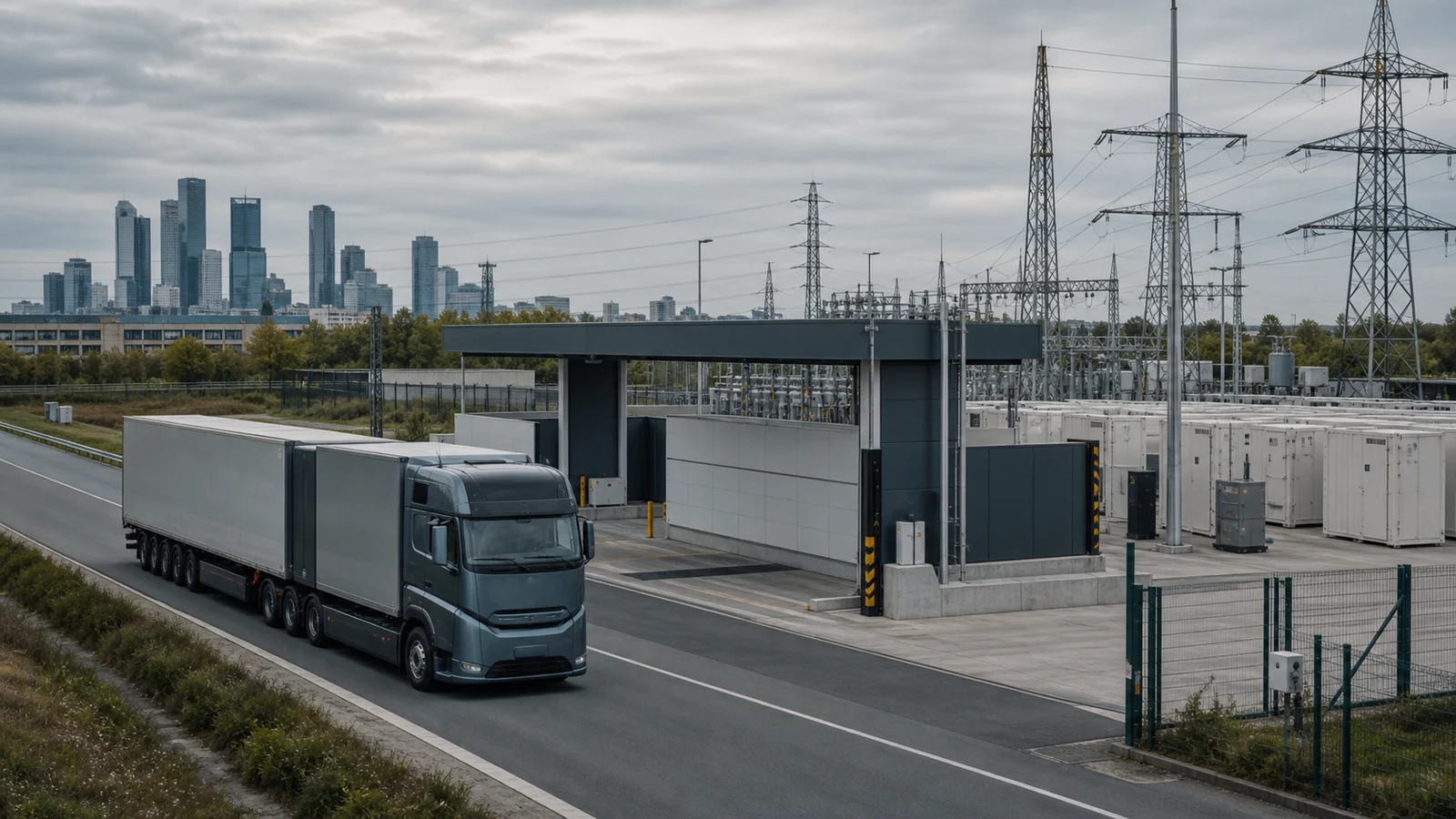
Key Takeaways
- Battery swapping economics are balance-sheet economics. The question is not only whether a swap is fast, but who finances the battery inventory and at what return.
- Off-balance-sheet does not mean cheaper. If the fleet does not own the battery, a battery SPV, leasing company, utility, infrastructure fund or project finance vehicle does.
- Inventory turns are decisive. A station with idle batteries is not a fuel forecourt. It is a capital warehouse full of depreciating assets.
- Standardisation is the investment risk. If multiple OEM formats emerge, the same freight demand is divided across incompatible battery pools.
- The model works only under disciplined conditions. High utilisation, cheap power, stable standards, bankable contracts and patient capital must all align.
Off Balance Sheet Does Not Mean Cheaper
The common claim is that removing the battery from the truck reduces vehicle capex. That is true for the buyer’s invoice. It is not the same as reducing system cost.
Every pack still has to be manufactured, purchased, financed, insured, monitored, cooled, repaired, recycled and eventually replaced. The only change is the identity of the capital provider.
In a truck-owned-battery model, the fleet operator buys a vehicle with a large electrochemical asset embedded in it. In a swapping model, the operator buys or leases a cheaper glider and then signs a long-term energy, availability or battery-as-a-service contract. The balance sheet moves from the haulier to the swap network. That is the same commercial question behind any serious fleet decarbonisation economics exercise: does the operating system improve, or has the cost simply moved?
That can still be valuable. Fleet operators often have limited appetite for battery residual value risk. A specialist asset owner may manage degradation better, finance at a lower cost, diversify across users and optimise batteries across stations. But the cost has not disappeared. It has been securitised, contracted and redistributed.
This is also where accounting matters. Under IFRS 16, many lease arrangements that used to be described as off balance sheet now create a right-of-use asset and lease liability for the customer if the customer controls the use of an identified asset. A generic access contract to a battery pool may be treated differently from a lease of specific packs, but the broad lesson remains: moving ownership away from the fleet does not make the economic obligation vanish. It changes its form.
The First Hard Number: Battery Inventory
Octopus and CATL have described a European network capable of supporting more than 300,000 electric lorries by 2035. The Financial Times has also reported the plan as a major European battery-swapping push. That figure is useful because it allows the hidden inventory question to be tested.
The minimum number of packs is not 300,000. At any moment, some batteries are in trucks, some are charging, some are waiting for the next vehicle, some are under maintenance, some are quarantined after damage, some are degraded below preferred range and some are reserve inventory needed for peak traffic and station reliability.
A simple inventory multiple can be estimated as:
Required packs = trucks in service + packs charging + reserve and maintenance inventory.
If a truck swaps once per day and the replacement battery needs five hours of controlled charging, the charging inventory alone is about 21% of the in-service fleet. Add 10% to 25% for reserve, damaged packs, maintenance, imbalance between stations and peak demand, and the multiple moves quickly into the 1.3x to 1.6x range. If charging is slower, demand is peaked or standards fragment, 2.0x is not a strange number.
| Inventory case | Pack multiple | Packs required for 300,000 trucks | Battery capital at 500 kWh and GBP 120/kWh | Interpretation |
|---|---|---|---|---|
| Very tight system | 1.2x | 360,000 | GBP 21.6bn | Requires high standardisation, predictable demand, fast charging and limited reserve margin. |
| Base case | 1.5x | 450,000 | GBP 27.0bn | Allows charging inventory, maintenance reserve, damaged packs and operational buffer. |
| Conservative | 1.8x | 540,000 | GBP 32.4bn | More realistic if demand is peaked, routes are uneven or packs are held locally for service reliability. |
| Fragmented / stressed | 2.0x | 600,000 | GBP 36.0bn | Multiple standards, lower interoperability or high reserve requirements turn inventory into trapped capital. |
The battery-cost assumption can be argued. BloombergNEF put average lithium-ion battery pack prices at USD 115/kWh in 2024, but heavy-truck swap packs are not commodity passenger-car packs. Some Chinese LFP pack costs may be below the GBP 120/kWh modelling assumption used here. European truck-grade packs, swap hardware, warranties, thermal systems, safety certification and import or localisation requirements may push the effective installed battery asset cost above it. At GBP 90/kWh, the 1.5x case is GBP 20.3 billion. At GBP 160/kWh, it is GBP 36.0 billion.
The important point is not the false precision. It is the order of magnitude. A network for 300,000 swap-enabled trucks is not mainly a few pieces of station machinery. It is a multi-tens-of-billions battery inventory platform.
The Station Is A Capital Warehouse
Diesel distribution has working capital, but diesel is not a long-lived asset sitting on shelves. A forecourt tank holds fuel inventory. A swap station holds depreciating electrochemical capital.
That distinction matters. A battery waiting at a station is not just energy. It is a financed asset with a cost of capital, degradation risk and opportunity cost. If it is idle, the owner is earning nothing while time, chemistry and technology move against it.
China’s heavy-truck swapping model shows why station utilisation is the centre of the economics. Public reporting on CATL’s Qiji heavy-truck standard points to standardised packs, swap stations designed around multiple battery positions and several Chinese truck manufacturers adopting compatible models. CATL has also extended standardised swapping into light trucks, according to CnEVPost reporting on the 2026 light-truck ecosystem. That is the right industrial logic: standardise the pack, aggregate demand and keep the station inventory turning.
But Europe is not China. European road freight is fragmented across borders, OEMs, route structures, regulations, grid queues and financing markets. The station cannot be analysed as a clever machine. It has to be analysed as a capital warehouse that earns money only when enough trucks use the same batteries often enough.
| 30-hub European network test | Low use | Base use | High use |
|---|---|---|---|
| Swap-enabled trucks supported | 75,000 | 300,000 | 300,000 |
| Swaps per truck per day | 0.45 | 0.85 | 1.00 |
| Average swaps per hub per day | 1,125 | 8,500 | 10,000 |
| Energy per hub per day at 500 kWh per swap | 563 MWh | 4,250 MWh | 5,000 MWh |
| Average power per hub before losses | 23 MW | 177 MW | 208 MW |
| Financial read-through | Underused but grid-manageable | Large industrial energy node | Utility-scale infrastructure site |
This is the second hard conclusion. A network large enough to serve 300,000 heavy trucks from 30 hubs is not a conventional charging network. Each hub becomes a large industrial load, battery warehouse and logistics node. Grid connection and power procurement become core investment risks, not background details.
Who Owns The Returns?
The returns do not naturally belong to the fleet operator. In a mature swapping model, the fleet operator buys uptime and energy access. The economic surplus, if there is any, is split among the parties that own the bottleneck assets.
| Party | Return source | Risk absorbed | What the fleet operator is buying |
|---|---|---|---|
| Battery SPV or leasing company | Battery rental, per-kWh fee, residual value upside | Degradation, residual value, obsolescence, replacement timing | Battery availability without owning the pack. |
| Station infrastructure owner | Swap fee, availability charge, land and grid access value | Station utilisation, grid connection cost, mechanical reliability, fire systems | Access to an energy node on required routes. |
| Utility or energy retailer | Electricity margin, flexibility, balancing and customer lock-in | Power price volatility, grid charges, flexibility revenue cannibalisation | Energy procurement and load management. |
| Infrastructure fund / pension capital | Contracted yield from long-term fleet offtake | Counterparty risk, refinancing risk, policy risk, stranded asset risk | Lower upfront capex in exchange for long-term service payments. |
| OEM or pack-standard owner | Vehicle sales, platform royalties, battery ecosystem control | Standardisation failure, competition-law scrutiny, customer resistance | A compatible truck and access to the network. |
| Public sector | Decarbonisation, industrial policy, grid planning outcomes | Guarantees, grants, planning exposure, stranded public support | Emissions reduction and freight electrification capacity. |
If the model works, institutional investors earn infrastructure-like returns from contracted energy availability. If it fails, the losses are likely to sit where they usually sit in early infrastructure markets: equity sponsors, battery lessors, lenders, public guarantee schemes, insurers and ultimately customers through higher tariffs.
The Aircraft Leasing Analogy Is Useful, But Dangerous
Aircraft leasing became powerful because airlines needed expensive assets, aircraft had long economic lives, global secondary markets existed, residual values were analysable and lessors could diversify across airlines and geographies. Airlines exchanged ownership for flexibility and capital-light growth.
Battery swapping has a similar surface structure. The fleet operator avoids owning the most expensive component. A specialist owner buys the asset, leases access and earns a spread. Institutional capital can enter an operating asset class with contracted cash flows.
But the differences are material.
| Characteristic | Aircraft leasing | Heavy-truck battery swapping | Investment implication |
|---|---|---|---|
| Asset life | Often 20+ years for airframes with major overhaul cycles | Battery economic life may be 5 to 10 years depending on cycle intensity, chemistry and warranty | Battery assets need faster capital recovery. |
| Residual market | Global, specialised, imperfect but deep | Uncertain, chemistry- and standard-specific, affected by degradation and regulation | Residual value risk is much harder to underwrite. |
| Technology stability | Airframe types evolve slowly | Cell chemistry, pack design, energy density and safety rules can change quickly | Obsolescence risk is central. |
| Standardisation | Aircraft types are certified and globally recognised | Swap formats may fragment by OEM, pack owner or region | Liquidity depends on standards becoming durable. |
| Asset degradation | Maintenance-intensive but inspectable and overhaulable | Electrochemical degradation is usage-, temperature- and state-of-charge-dependent | Data quality and battery health management become financeability requirements. |
The aircraft analogy therefore supports the financing logic, not the residual value assumption. Batteries can be leased, but they are not aircraft. They are degrading, fast-improving, chemistry-dependent assets whose secondary value can be destroyed by a better cell, a new standard or a safety rule.
Four Simple Financial Scenarios
The model below is deliberately simple. It excludes electricity commodity cost and asks what infrastructure charge is required to cover capital return, battery replacement and operating cost. It assumes 500 kWh packs, 30 hubs and varying adoption, inventory, pack cost and cost of capital.
| Scenario | Fleet served | Inventory multiple | Battery capex | Total capital including stations/grid | Annual energy throughput | Required infra charge before electricity |
|---|---|---|---|---|---|---|
| Optimistic | 300,000 trucks | 1.2x | GBP 16.2bn | GBP 20.2bn | 54.8 TWh | GBP 0.07/kWh |
| Base | 300,000 trucks | 1.5x | GBP 27.0bn | GBP 33.0bn | 46.5 TWh | GBP 0.17/kWh |
| Conservative | 180,000 trucks | 1.7x | GBP 21.4bn | GBP 27.4bn | 21.4 TWh | GBP 0.37/kWh |
| Bear case | 75,000 trucks | 2.0x | GBP 12.0bn | GBP 17.0bn | 6.2 TWh | GBP 0.90/kWh |
The result is intuitive. At high utilisation, battery swapping can look like infrastructure. At low utilisation, the capital charge becomes too large before electricity is even bought. A truck operator may still see lower vehicle capex, but the network tariff has to recover the capital somewhere.
The base case is not obviously impossible. GBP 0.17/kWh before electricity is high but not absurd if the alternative is downtime, expensive megawatt charging, payload constraints or depot power upgrades. The bear case is different. A GBP 0.90/kWh infrastructure charge before electricity would make the model very difficult to defend except in special operations where uptime is extremely valuable.
Utilisation Is The Whole Business Model
Battery swapping has high fixed cost, high working capital and low marginal labour per transaction. That is a classic utilisation business. The station owner wants trucks arriving predictably, using common packs, paying contracted tariffs and turning inventory quickly.
Several things can break that assumption:
- Slow truck adoption: stations are built ahead of demand and battery inventory sits idle.
- OEM fragmentation: multiple incompatible packs divide the same corridor demand into smaller pools.
- Megawatt charging improves: fleets may prefer direct charging if dwell time can be absorbed at depots or rest stops.
- Hydrogen gains share in payload-sensitive routes: the addressable swap market narrows.
- Battery energy density rises quickly: older packs become less useful before fully depreciated.
- Grid connections lag: stations exist physically but cannot charge enough packs at the required rate.
- Fleet routes are less regular than assumed: a station network built for corridors misses the real operating pattern.
In each case the consequence is the same: utilisation falls, inventory turns fall, and the required tariff rises.
Grid Services Are A Side Bet, Not The Base Case
Swap stations will be tempted to present grid services as an additional revenue stream. In principle, a site holding many batteries can charge when power is cheap, delay charging when the grid is stressed, and provide flexibility services.
That value should be included carefully, not used as a plug number.
First, most truck batteries are there to serve trucks. A pack reserved for frequency response may not be available for a late-arriving vehicle. Second, grid-service markets saturate. Frequency response and ancillary service revenues tend to fall when many batteries chase the same products. Third, market access depends on metering, aggregation, grid connection, software, warranty permissions and cycling limits.
The more defensible view is that grid services can reduce net energy cost and improve station economics at the margin. They should not be required to make the core business case work. If a station only earns its target return because every battery also earns attractive grid revenue, the model is relying on a revenue pool that competitors will erode.
Hydrogen Is A Capital Efficiency Comparison, Not A Culture War
The battery-versus-hydrogen debate usually becomes too simplistic. The infrastructure-finance comparison is more useful.
Hydrogen has high delivered fuel cost, immature supply chains and difficult station economics. The IEA’s Global Hydrogen Review 2025 shows how slowly low-emissions hydrogen supply is still scaling. But hydrogen does not require hundreds of thousands of expensive onboard energy assets to sit in station inventory. Battery swapping has lower energy cost, higher drivetrain efficiency and potentially lower maintenance, but it creates a very large battery balance sheet outside the truck. That is why the right comparison is not a generic BEV-versus-hydrogen argument, but a route-level infrastructure comparison, as in hydrogen economics and hydrogen truck deployment analysis.
| System | Economic strength | Capital weakness | Best fit |
|---|---|---|---|
| Battery swapping | Low electricity cost, fast vehicle turnaround, centralised battery management | High battery inventory, technology obsolescence, standardisation dependence | Dense repeatable corridors, ports, mines, depots and hub-to-hub freight. |
| Depot or megawatt charging | Fewer spare batteries, simpler ownership, lower network complexity | Downtime, depot grid upgrades, peak power demand, route constraints | Return-to-base and planned-dwell operations. |
| Hydrogen | Fast refuelling, lower onboard energy mass, less idle electrochemical inventory | High fuel cost, low infrastructure utilisation risk, supply-chain immaturity | Payload-sensitive, long-range or high-utilisation routes where battery mass and dwell time matter. |
Battery swapping wins if utilisation is high enough to amortise the inventory. Hydrogen becomes more interesting where the capital cost of idle batteries and the operational cost of battery mass outweigh the fuel-cost penalty. Neither answer is universal.
Standardisation Risk Is The Investment Risk
CATL’s advantage is not just cell manufacturing. It is the possibility of making a battery format into an infrastructure standard. If a pack becomes common across OEMs, the owner of that standard can aggregate demand, reduce stranded inventory and make stations financeable.
But European OEMs have reasons to resist a single externally controlled battery standard. Batteries affect vehicle architecture, payload, safety certification, service strategy, warranty economics, software control, customer data and aftermarket revenue. A truck maker may not want the most valuable part of the electric vehicle ecosystem to be controlled by a battery supplier and energy retailer.
European regulation currently gives strong signals for public charging and hydrogen refuelling through the Alternative Fuels Infrastructure Regulation. It does not create an equivalent mandatory heavy-truck battery swapping standard. The separate EU Batteries Regulation also matters for lifecycle, recycling and producer-responsibility assumptions. That leaves the market to discover standards commercially, unless policymakers intervene later on interoperability.
Competition law could also matter. A dominant battery standard can create efficiency, but it can also create gatekeeping power. Investors should ask whether the network is open, whether OEMs can participate on fair terms, who controls battery data and whether fleets can switch providers without replacing vehicles.
The Hidden Assumptions
The model only works if several assumptions hold at once:
- High utilisation: stations must process enough swaps to turn inventory rapidly.
- Cheap finance: battery inventory is capital-intensive, so WACC has a direct effect on tariff levels.
- Stable standards: packs must remain usable across many trucks and model years.
- Predictable degradation: warranties and tariffs depend on knowing how packs age under heavy cycling.
- Stable battery prices: rapid price falls help future procurement but damage the residual value of existing packs.
- Cheap electricity: the infrastructure charge is only one part of the delivered energy cost.
- Grid access: hubs need industrial-scale connections, not just attractive land near roads.
- Fleet density: corridors need enough common users to justify local battery inventory.
- Government support: grants, planning, grid acceleration or guarantees may be needed before demand is bankable.
- Residual value: second-life or recycling value must be real enough to underwrite financing assumptions.
The two assumptions that matter most are utilisation and standardisation. Cheap debt can improve a weak project, but it cannot rescue a station built for the wrong trucks or an inventory pool split across incompatible formats.
Is This Becoming A Regulated Infrastructure Asset?
It may be. The more the model scales, the less it looks like a vehicle feature and the more it looks like essential freight infrastructure.
A mature swap network would have the characteristics infrastructure investors like: high upfront capex, local monopoly tendencies, long-term contracts, predictable demand from essential services, grid interconnection, real assets and potential inflation-linked tariffs. It could also become policy-relevant if governments depend on it for zero-emission freight corridors.
That creates a possible path toward quasi-regulated infrastructure. If fleets cannot decarbonise without access to swap corridors, and if those corridors require patient capital, governments may eventually be asked to support standardisation, guarantee utilisation, regulate access or allow utility-style returns.
That would not be unusual. Electricity distribution, telecom towers, rolling stock and some energy-storage assets all moved from technology deployment into infrastructure finance once the bottleneck asset became essential. Battery swapping could follow that path. It sits close to the same questions explored in battery storage, infrastructure deployment and technology commercialisation: where does the investable bottleneck actually sit?
But there is a catch. Regulated or quasi-regulated infrastructure normally requires durable assets and predictable demand. Batteries are not naturally durable in the same way as wires, towers or concrete. The station may last. The battery pool turns over. That means the model needs both infrastructure finance and asset-leasing discipline.
The Answer
Battery swapping can reduce economic cost, but only under specific operating conditions.
It creates genuine value when it keeps trucks moving, avoids uneconomic depot power upgrades, standardises battery assets across many vehicles, charges packs in ways that extend life, buys electricity intelligently and turns inventory fast enough to earn an infrastructure return. In that case, the battery owner is not merely hiding capex. It is performing a useful financial and operational function that a fleet operator may be poorly placed to manage.
It becomes financial engineering when the main benefit is that the truck invoice looks lower while the system carries more idle batteries, more residual value risk and more long-term contractual obligation. In that case, fleet operators are not escaping battery economics. They are exchanging asset ownership for an infrastructure service contract.
The distinction is not philosophical. It is measurable. Ask five questions:
- How many packs are required per truck after charging dwell time and reserve inventory?
- How many swaps per station per day are contractually supported, not merely forecast?
- Who absorbs degradation, obsolescence, fire, insurance, recycling and residual value risk?
- What infrastructure charge per kWh is required before electricity cost?
- What happens to that charge if utilisation is 30% lower than planned?
If those answers are strong, battery swapping is an investable infrastructure model. If they are weak, it is a clever way to move an expensive battery from one balance sheet to another.
FAQ
Does battery swapping reduce the cost of heavy truck electrification?
It can, but only when utilisation is high, standards are common and battery inventory turns quickly. It does not remove battery capex; it reallocates ownership, depreciation and residual value risk to the battery or infrastructure owner.
How many batteries are needed for a heavy-truck swapping network?
A network serving 300,000 swap-enabled HGVs probably needs more than 300,000 packs. A realistic inventory multiple is roughly 1.2x to 2.0x the truck population once packs in trucks, packs charging, reserve inventory, maintenance and damaged packs are included.
Who earns the return in a battery swapping model?
The return is likely earned by the parties that own the bottleneck assets: battery leasing companies, battery SPVs, station infrastructure owners, utilities, project finance vehicles and infrastructure funds. Fleets usually pay through long-term energy, availability or battery-as-a-service contracts.
Is battery swapping becoming an infrastructure asset class?
It may become a quasi-infrastructure asset class if stations are standardised, highly utilised, contracted with fleets and treated as essential freight infrastructure. The main difference from classic infrastructure is that the battery pool degrades and faces faster technology obsolescence than assets such as towers, wires or land.
Sources and Evidence Base
- Octopus Energy, CATL and Octopus team up to unlock electric trucking across Europe.
- Financial Times, China’s CATL bets battery swapping will cut costs for Europe’s electric trucks.
- CnEVPost, CATL launches standardized battery swap pack for heavy trucks.
- CnEVPost, CATL launches China’s first standardized light-truck battery swap ecosystem.
- IFRS Foundation, IFRS 16 Leases.
- Regulation (EU) 2023/1804 on alternative fuels infrastructure.
- Regulation (EU) 2023/1542 concerning batteries and waste batteries.
- International Energy Agency, Global Hydrogen Review 2025.
- International Energy Agency, Global EV Outlook 2025.
- ICCT, total cost of ownership comparison of truck decarbonization pathways in Europe.
- BloombergNEF, lithium-ion battery pack price survey 2024.
- Ai, Cheng and Qi, Optimizing Urban Electric Vehicle Charging and Battery Swapping Infrastructure: A Location-Inventory-Grid Model.
- Chen et al., Battery Valuation and Management for Battery Swapping Station with an Intertemporal Framework.
- Attia et al., “Knees” in lithium-ion battery aging trajectories.
- Modo Energy research on GB battery storage revenues and ancillary service market dynamics.