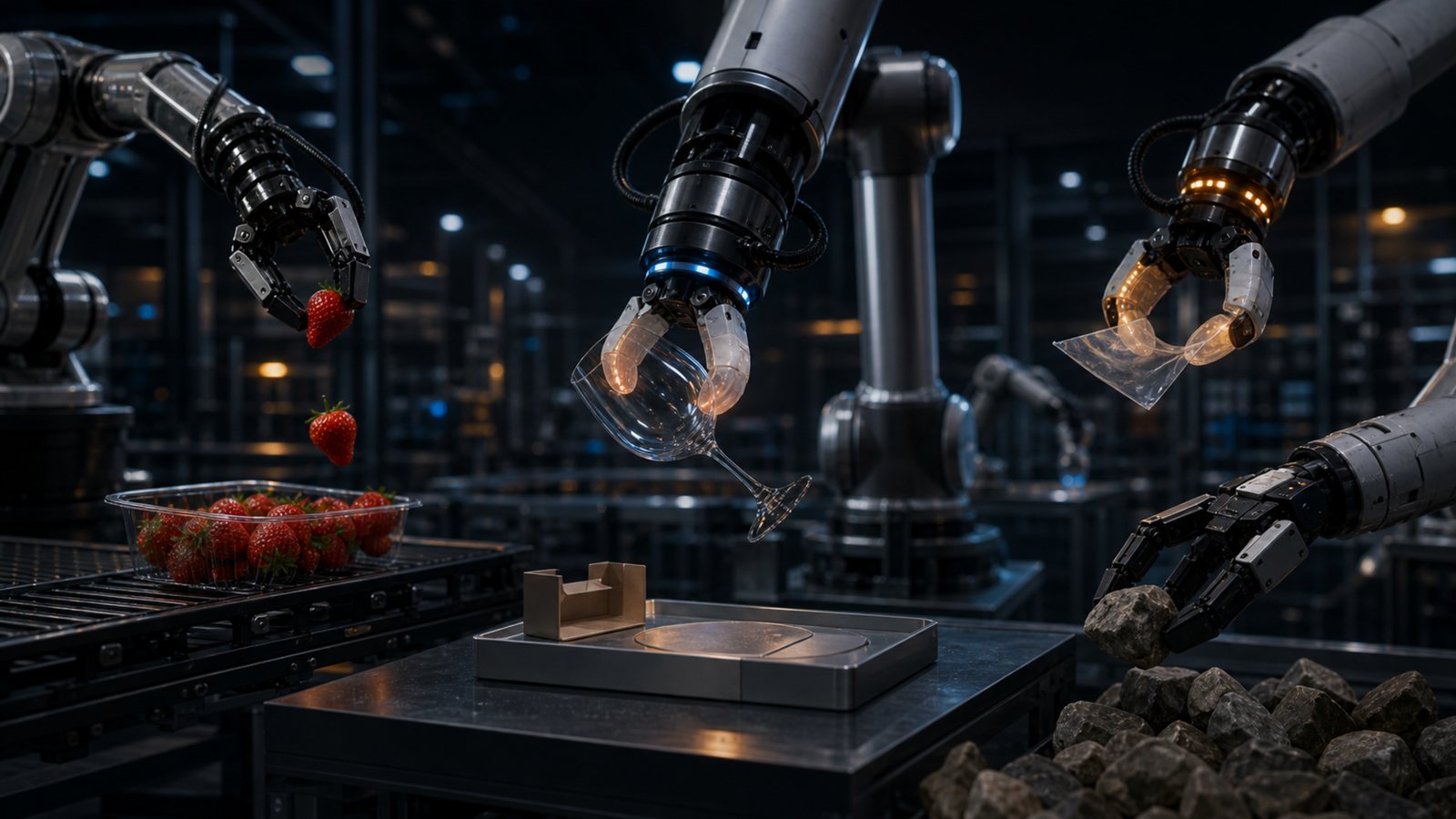
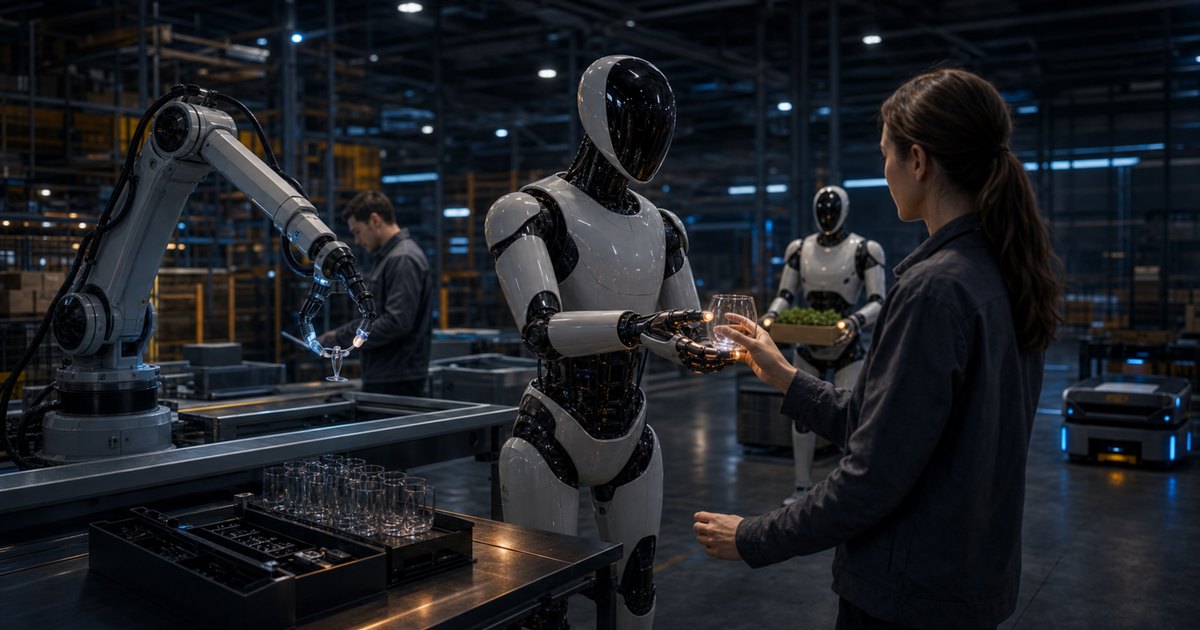
Humanoid robotics in 2026 is advancing on three different clocks: technical capability, manufacturing readiness and the economics of useful work. Meta’s rapid prototype development and Agility Robotics’ SPAC redemptions show why progress on one does not settle the others.
By Tim Harper. Published and researched to 3 November 2026.
Summary
Existing robot platforms are shortening development cycles, industrial customers are expanding deployments, and manipulation models are becoming more capable. Commercial returns depend on productive utilisation, task speed, reliability and the human assistance required. An illustrative tote-handling model below puts a humanoid at $0.348 per successful transfer, against $0.460 for human labour and $0.098 for conventional automation.
Meta reportedly built a humanoid prototype with Fourier in three months. Agility’s shareholders approved its public-market transaction while redeeming approximately $261.8 million from the SPAC’s trust. One development shows how quickly an AI company can obtain a physical research platform; the other shows the financial demands of turning robots into an operating business. Together they expose the gap between building a capable machine and supplying dependable work at an attractive price.
Meta’s three-month humanoid prototype
The Information’s original report identifies Max as Meta’s prototype built with Fourier. TNW’s account of that reporting describes a roughly 48kg, 1.5-metre machine with five-fingered hands, a facial display and NVIDIA Jetson Thor computing. Development of Max 2 began in September, with a redesigned torso, improved hands and additional sensors planned.
The programme combines Meta’s robotics organisation with Chinese hardware expertise. Meta acquired Assured Robot Intelligence in May, adding robot-learning expertise to Meta Superintelligence Labs. Meta told The Information that its Fourier work was for internal research and experimentation, with no plans to sell these units. The reports provide no public task-success benchmark or intervention rate for Max.
The commercial significance is the shortened route to experimentation. Buying a developed body lets an AI team concentrate on perception, learned control and manipulation rather than recreating every actuator and gearbox. NVIDIA’s onboard computing supplies another reusable component. That could support a market in which hardware manufacturers and intelligence developers specialise, provided interfaces, calibration and safety systems become sufficiently transferable. Different bodies still have different reach, compliance, joint dynamics and sensing: software portability has to be engineered.
Meta already has a broader embodied-AI research base. Its FAIR robotics work includes tactile representations, the Digit 360 fingertip and hardware-software interfaces for robot hands. These technologies address how machines learn through physical interaction, a problem that continues after a prototype can walk.
Agility Robotics: commercial progress meets the cost of capital
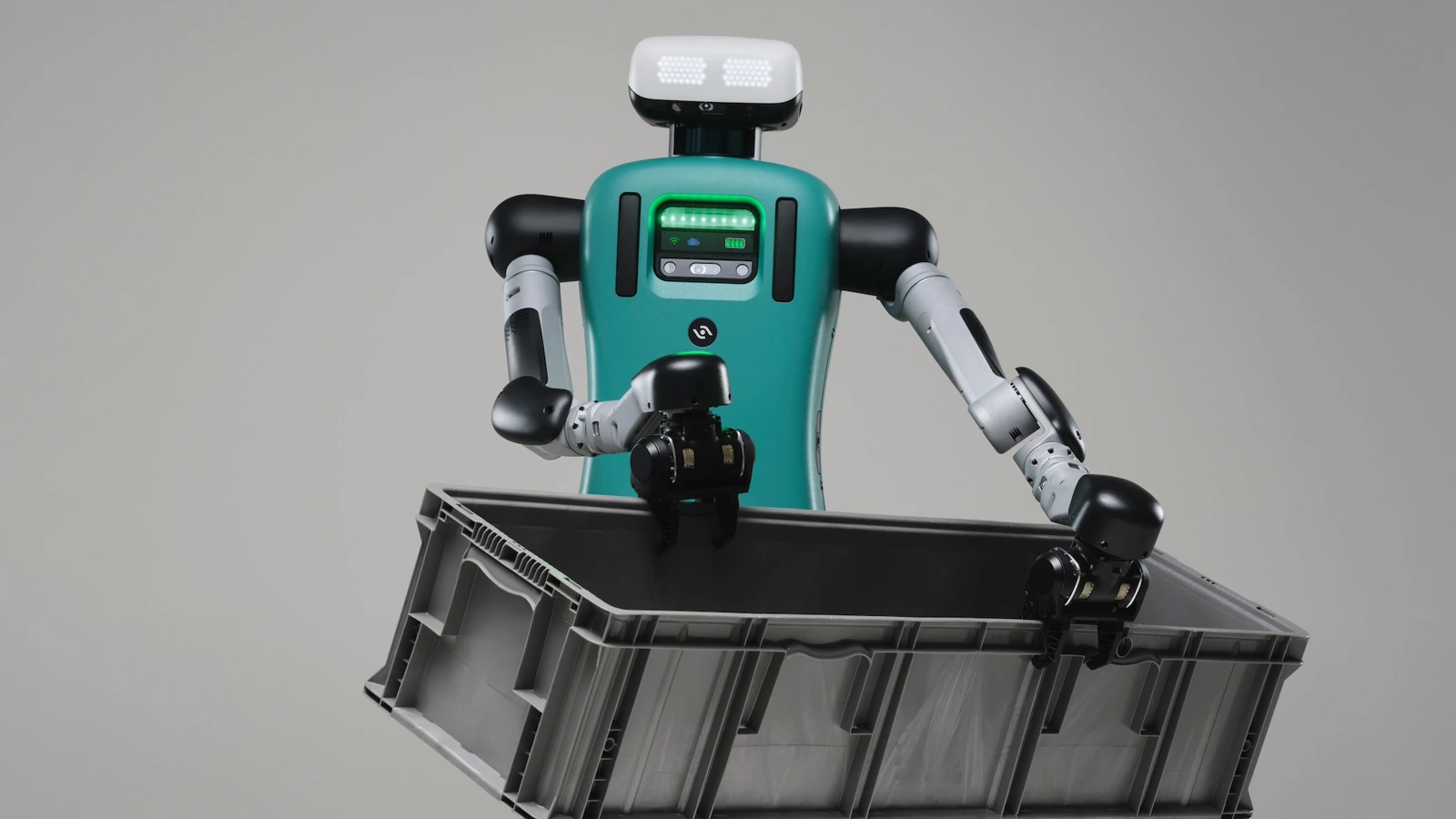
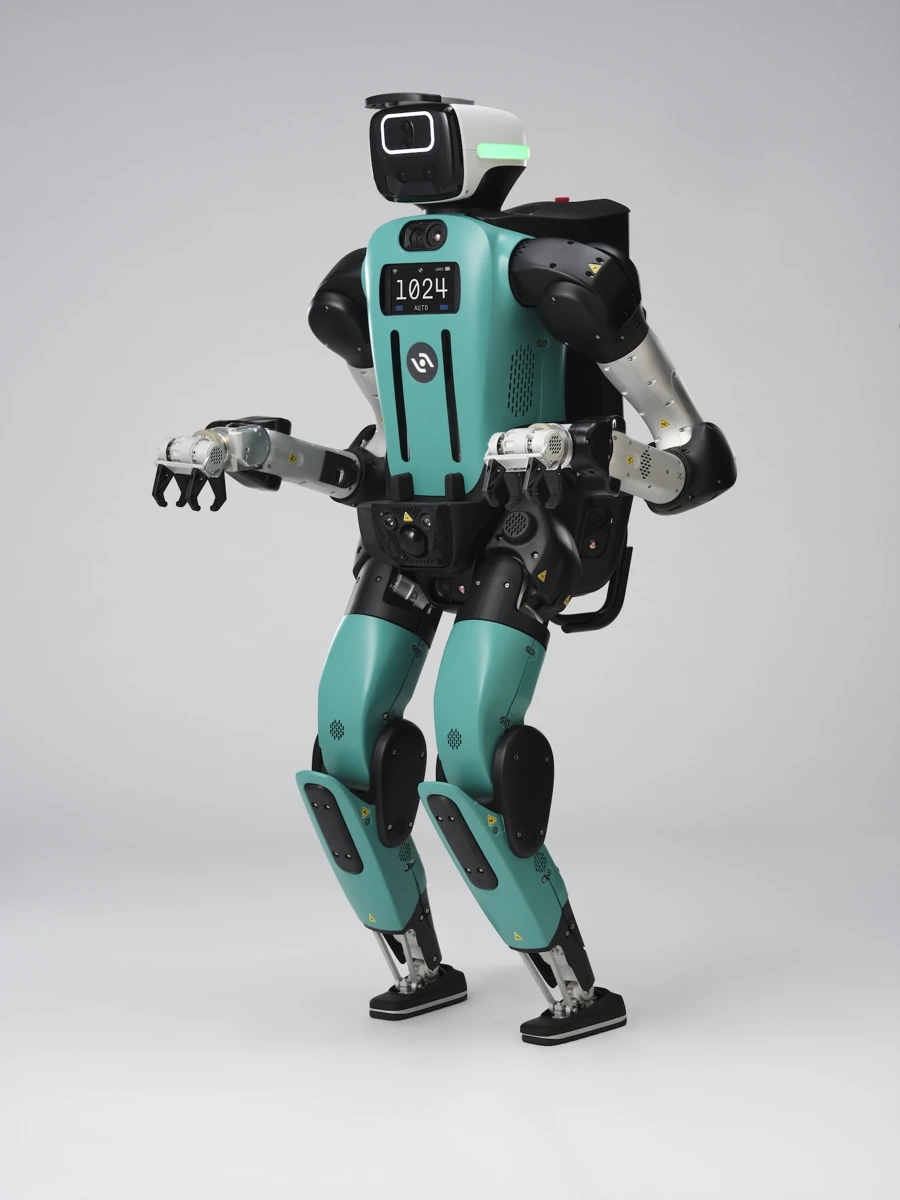
Agility has taken the harder route into customer operations. GXO and Agility’s October update reports more than 100,000 totes moved at the Flowery Branch warehouse under their commercial agreement. Expansion to North Carolina and Tennessee is scheduled for early 2027, initially using Digit 4. This is a customer extending a relationship after operating experience.
The AGCO agreement concerns a pilot expected to start in 2027. Agility also reports three unnamed manufacturers in paid programmes, alongside relationships with Toyota Motor Manufacturing Canada, Schaeffler and Mercado Libre. Paid evaluation establishes customer commitment; its conversion into wider deployment determines the eventual business.
The financing needs careful reconstruction. A special purpose acquisition company, or SPAC, raises money into a trust before identifying an operating business to acquire. Agility’s June 24 announcement valued its existing equity at $2.5 billion before new money. The June investor presentation used approximately $420 million of trust cash and $200 million of private investment in public equity, or PIPE, for roughly $620 million gross. It illustrated $46 million in fees and $574 million reaching the balance sheet.
| Financing measure | US$ million | Basis |
|---|---|---|
| Initial IPO trust deposit | 414.0 | December 2025; prospectus |
| Trust used in June announcement | ~420.0 | No-redemption assumption; includes accrued interest |
| Original PIPE / gross proceeds | ~200.0 / ~620.0 | June announcement |
| Original illustrative fees / net cash | ~46.0 / ~574.0 | June investor model |
| November redemptions | 261.8 | November 2 SEC filing |
| November remaining trust / PIPE | 164.1 / 201.0 | Expected closing proceeds |
| Equity already received | 100.0 | July 2026 financing |
| Revised expected gross capital | 465.1 | Remaining trust + PIPE + earlier financing |

The November 2 SEC filing records 25,451,804 shares redeemed, approximately 61.5% of the relevant Class A shares. The remaining trust contributes $164.1 million. Add the $201 million PIPE and $100 million already raised, and the revised gross total is $465.1 million. The latter funding came through July agreements for future equity, according to the merger prospectus. Trust plus PIPE therefore supplies $365.1 million at closing before fees; the cash balance also reflects spending since the earlier funding.
Approval and redemption coexist because shareholders can vote for a merger and still reclaim their share of the trust. Keeping the share exchanges a cash-backed security for exposure to the operating company, its valuation, dilution and execution risk. Redemption therefore measures how much trust capital remains invested through this vehicle. It cannot identify each investor’s motivation. The PIPE investors are making a different commitment, while strategic investors may also value manufacturing and technology relationships.
There are substantial execution demands to assess. Agility’s prospectus reports 2025 net sales of $1.782 million and a net loss of $138.086 million; $1.132 million of sales came from related parties. The $2.5 billion valuation prices future scale. Agility’s October commercial update describes the $300 million-plus orders as potential multi-year value dependent on milestones, features and specifications. The June deck relates that figure to 1,000 Digit 5 robots on three-year service contracts, including customer warrants.
Digit 5 early access is planned for the first half of 2027 and general availability by year-end. RoboFab’s 10,000-robot annual figure describes designed capacity. Manufacturing, customer acceptance and service delivery must turn that capacity and order value into cash. As of this article’s cut-off, closing is expected on November 4 and Nasdaq trading on November 5. No revised equity valuation or final post-redemption net-proceeds figure was identified in the closing update.
Tesla, Figure and the race towards production
Tesla’s third-quarter update says Optimus production has begun on its Fremont high-volume lines. Its capacity table labels California “Early Ramp” and Texas “Construction”, without an annual robot output figure. The January update described Gen 3 as the first design intended for mass production, incorporating a new hand and targeting eventual capacity of one million robots annually.
Manufacturing expertise helps Tesla industrialise actuators, wiring, batteries and assemblies. Autonomous manipulation adds a separate development cycle: gathering representative physical data, learning contact behaviour and validating recovery from errors. Changing a hand during production changes tooling and components as well as the behaviour a controller must learn. The October update supplies neither an Optimus selling price nor a unit manufacturing cost, external delivery count or quantified internal labour saving. Musk’s $20,000–$30,000 long-term price ambition at the 2024 We, Robot event is a target for scale, not a current quotation.
Figure supplies a useful view of both advances. In April, it reported more than 350 Figure 03 robots produced and a demonstrated one-per-hour manufacturing cycle, with robots allocated across research, data collection and commercial development. Its September Helix 2.5 evaluation reported 56% end-to-end success across three behaviours in 30 previously unseen homes, against 9% without Index pretraining. Figure counted safety interventions as failures. Those results show measurable generalisation and the remaining distance to dependable household service.
Industrial evidence is stronger where the customer reports it. BMW says Figure 02 handled over 90,000 components in approximately 1,250 operating hours during its Spartanburg pilot, supporting production of more than 30,000 cars. Figure subsequently brought Figure 03 to BMW for a sequencing workflow. Its September 2025 funding announcement disclosed over $1 billion committed at a $39 billion post-money valuation. Capital supports the fleet and learning infrastructure; deployment economics determine the return.
Other programmes reinforce the industrial route. Boston Dynamics has opened a manufacturing-task training centre for Atlas with Hyundai. Apptronik’s February financing extension brought its Series A total above $935 million to support Apollo production and deployment. Factories provide bounded tasks, operating data and engineering teams capable of integrating new equipment.
The real economics of humanoid robots
Customers need the cost of useful output. For a warehouse tote transfer, success means picking up the tote, moving it to the specified destination and placing it intact and correctly. A missed grasp consumes time; damage and incorrect placement can disrupt downstream operations. A humanoid must compete with human handling, a fixed robot cell, conveyors and mobile platforms fitted with simpler manipulators.
Consider an illustrative US-dollar scenario, rather than a claim about any manufacturer’s measured performance. All three options serve the same defined transfer workflow across a 4,000-hour annual operating window. Robot assumptions are deliberately explicit because public deployment data does not yet establish a standard cost curve.
| Assumption or result | Humanoid | Human labour | Conventional cell |
|---|---|---|---|
| Installed capital / operating life | $120,000 / 5 years | — | $180,000 / 7 years |
| Scheduled annual hours | 4,000 | 4,000 paid | 4,000 |
| Demand utilisation / productive paid time | 80% | 85% | 80% |
| Availability / recovery downtime | 90% / 5% | Included above | 95% / 1% |
| Attempts per productive hour / success | 60 / 98% | 90 / 99.5% | 180 / 99.5% |
| Support minutes per productive hour | 6 | — | 1.8 |
| Annual productive hours | 2,736 | 3,400 | 3,010 |
| Successful annual transfers | 160,877 | 304,470 | 539,019 |
| Annual cost | $56,041 | $140,000 | $52,636 |
| Cost per productive hour | $20.48 | $41.18 | $17.49 |
| Cost per successful transfer | $0.348 | $0.460 | $0.098 |
The humanoid’s $100,000 purchase price is an assumed selling price, separate from its manufacturer’s production cost. Another $20,000 covers integration, grippers, charging and training. Annual charges include $8,000 maintenance and replacement parts, $6,000 software and $2,000 insurance. Electricity costs $0.15 per productive hour. Human assistance consumes six operator minutes per productive robot hour, charged at $35 an hour.
Capital is recovered over five years at 8%, with no residual value. This annual capital charge includes financing and capital recovery, so adding depreciation again would double-count the investment. The conventional cell costs $180,000 installed, lasts seven years and carries $14,000 annual maintenance, software and insurance, $0.30 hourly electricity and 1.8 minutes of human support per productive hour.
Productive robot hours equal scheduled hours × demand utilisation × availability × time remaining after recovery stops. For the humanoid, 4,000 × 80% × 90% × 95% gives 2,736 productive hours. Multiplying by 60 attempted transfers an hour and 98% success gives 160,877 successful transfers. Annual cost is $56,041: $20.48 per productive hour, or $0.348 per successful transfer. Failed attempts remain in the time denominator; additional product damage and downstream disruption require a site-specific charge.

The human case uses $35 per paid hour, 85% productive time, 90 attempts per productive hour and 99.5% success. It produces 304,470 successful transfers at $0.460 each. The conventional cell assumes 80% demand utilisation, 95% availability, 1% recovery downtime, 180 attempts an hour and 99.5% success: $0.098 per transfer. Its $17.49 productive-hour cost and faster cycle make it the clear choice where the workflow supports fixed automation.
These are different output capacities. Matching the human case’s throughput requires approximately 1.89 humanoids under a linear scaling assumption, before allowing for whole-machine purchases and fleet coordination. Labour savings only become cash savings when a deployment removes paid hours, avoids hiring or releases a constrained production step. A fraction of an employee’s time is not automatically recoverable expenditure.
Utilisation and intervention can outweigh purchase price
Halving the humanoid’s assumed purchase price to $50,000 reduces transfer cost to $0.271. Halving demand utilisation to 40% raises it to $0.635; halving cycle speed raises it to $0.697. Increasing supervision to 30 minutes per productive hour takes it to $0.586. At a $200,000 purchase price, it reaches $0.504. A three-year life produces $0.451, doubled maintenance $0.398, 70% availability $0.430 and 20% recovery downtime $0.402. Each change holds the other inputs constant.

Under the base assumptions, the humanoid needs approximately 58% demand utilisation to match the human unit cost. That is the economic value of dependable multi-task operation: filling otherwise idle hours. Moving between jobs helps only when reconfiguration, travel and additional training leave a net gain in productive output.
Agility’s own October investor model illustrates $8,500 monthly service pricing and a roughly five-year working life, using about 120 working hours a week. At $102,000 annually, the service fee alone is $16.35 per scheduled hour at 6,240 hours, or $37.28 per productive hour at our scenario’s 2,736 hours. Contract scope determines which maintenance, software and deployment costs are included. Robotics-as-a-Service transfers ownership and service obligations to the supplier; customers still need enough useful throughput.
Domestic robotics makes assistance especially consequential. 1X advertises NEO at $20,000 for early-access ownership or $499 a month, with US deliveries starting in 2026. Its order page describes basic autonomy and scheduled expert supervision for unfamiliar tasks. It publishes no general intervention-hours ratio. If a service needed one human hour for every two productive robot hours, support at an assumed $25 an hour would add $12.50 per robot hour before hardware and overhead. Improving autonomy therefore changes the service business as much as the demonstration.
Why dexterous manipulation matters commercially
Locomotion brings a robot to the workstation. Manipulation determines what happens there. Grasp planning chooses contact points and approach; feedback establishes whether contact actually occurred and whether the object remains secure. Normal force acts into the contact surface. Shear acts along it. Changes in contact and local sliding can reveal an unstable grasp before an object is dropped.
Vision can locate a component yet lose sight of the contact inside a hand or fixture. Force and tactile feedback let a closed-loop controller adjust grip and movement as conditions change. Sensor latency matters because a correct observation arriving after the object slips has little operational value. Integration matters because signals must share timing, calibration and coordinate systems with the controller.
The DIGIT tactile-sensor research illustrates how optical sensing can recover detailed contact information. Camera-based fingertips trade rich spatial observations against illumination, processing and packaging requirements. Pressure arrays, strain measurements and wrist force sensors offer other combinations of information, cost and durability. A predictable tote with a robust handle may need only a simple gripper and contact confirmation; deformable packaging or connector insertion can demand much more.
KiriSense’s geometry-encoded optical approach uses a kirigami-inspired structure to produce distinguishable responses to normal and shear loading before electronic interpretation. Its published proof of concept demonstrates distinct optical responses; quantitative characterisation and robot integration are the next development steps. The approach illustrates a different allocation of complexity between mechanics, sensing and computation. My tactile-sensing guide examines those architectural choices in detail.
For every architecture, the commercial measure is improved task performance over a service life. A fingertip must withstand contamination, repeated contact and replacement. Training data must cover friction, wear and object variation. Better sensing earns its cost through fewer damaged products, fewer interventions and more successful operations.
China’s role in humanoid hardware
Fourier’s role in Meta’s programme shows the value of an established hardware organisation. A humanoid combines motors, gear reduction, bearings, encoders, power electronics, batteries, cameras and hands. Manufacturing advantage grows through supplier qualification, consistent tolerances, assembly yield and access to replacement components. Nearby suppliers can shorten the iteration between a failed joint and a revised production part.
Pricing shows the breadth of available platforms. Unitree lists its basic G1 at $13,500, excluding shipping and duties, and explicitly directs customers needing secondary development to the EDU version. That is a hardware offer with a defined configuration. Turning it into a supported industrial worker adds software, integration, application engineering and service. Comparing that price directly with a complete deployment obscures the work between them.
American companies bring strengths in learned control, computing platforms, capital and industrial integration, while Chinese firms also develop AI and software. The useful comparison is between capabilities within the supply chain. As the earlier analysis of Unitree and physical AI explains, low-cost bodies expand experimentation. Durable margins depend on who supplies the scarce capability required for reliable customer output.
What will determine the winners?
The case for humanoids is strongest where human-shaped reach and mobility avoid expensive rebuilding, where tasks change enough to penalise fixed machinery, and where reliable operation fills several shifts. Legs and general-purpose hands earn their additional cost when they open valuable work that simpler equipment cannot reach economically. On a stable, high-throughput line, conventional automation retains formidable advantages.
Meta demonstrates a faster route to a research body. Agility demonstrates customer progress alongside the capital needed to industrialise it. Tesla and Figure are working through production and learning at the same time. Their next decisive evidence will be repeat deployments, productive hours, intervention rates and customer returns across ordinary operating conditions. The commercial question remains specific: what useful work can a humanoid perform economically that the best available alternative cannot?
Further analysis: the robotics research hub, robotics investment and the allocation of capital, and the operating evidence examined in robotics and physical-AI due diligence.
Sources and methodology
Financial reconstruction uses the June 24 investor presentation, merger prospectus and November 2 SEC filing linked above. Company announcements establish reported specifications, production plans and commercial arrangements; BMW supplies customer-side operating evidence. Meta prototype details originate with The Information and are attributed through its original report and TNW’s account.
The cost model is an original scenario calculation using the stated inputs. It does not estimate any named manufacturer’s achieved unit cost. Sensitivities change one input at a time; additional damage, taxes, site overheads and downstream disruption are excluded. Photography and press imagery are credited in their captions.