
Tactile sensing for robotics measures physical contact so that a robot can adjust its actions. Robotic tactile sensors can measure contact, normal and shear forces, slip, pressure distribution, vibration, texture and contact geometry, depending on the sensing architecture. Robotic touch is an information problem as much as a sensor problem: the robot needs enough information, quickly enough, to make the correct physical decision.
Research cut-off: 30 September 2026. Published: 30 September 2026. Last reviewed: 6 October 2026. This technical reference will be maintained as the field develops.
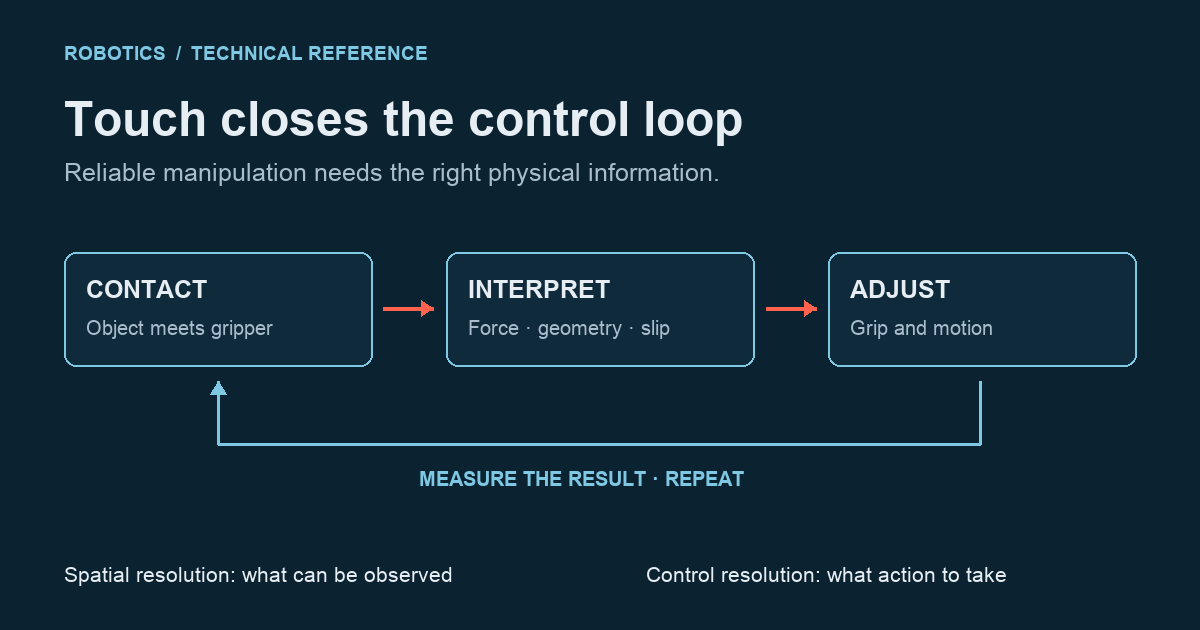
Table of contents
Summary
Robotic touch becomes valuable when uncertainty remains after contact: an object shifts, packaging collapses, a connector jams or a cable catches. Different tasks require different combinations of force, shear, contact geometry and slip information. There is no universally best tactile sensor.
How much detail can a sensor see? Does that detail help the robot choose what to do? These are different questions. This guide calls them spatial resolution and control resolution. Detailed tactile images can be essential for metrology and precision manipulation. A warehouse gripper may primarily need dependable force, load direction and slip information.
The commercial test includes integration, computation, calibration, replacement and downtime. Touch earns its place when it expands the range of economically viable autonomous work. The Robotics and Physical AI research hub explores that wider transition from capable machines to useful automation.
Why touch matters after contact
Vision identifies objects, estimates their position and orientation, guides a manipulator towards them and monitors much of its surroundings. Contact introduces hidden states. A camera looking at a closed gripper may not see which part of a packet is carrying the load, whether a connector is aligned inside its socket, or whether the edge of a contact patch has begun to slide. Tactile sensing measures consequences of that interaction at, or mechanically connected to, the contact interface. The distinction between perceiving an object and controlling its interaction is central to IEEE’s review of tactile information.
Consider a parcel starting to slip. Waiting until the whole object visibly moves may leave too little time to recover. Local deformation or vibration can reveal instability earlier. With a connector, resistance can mean successful engagement, misalignment or obstruction; force direction and contact geometry help distinguish them. A deformable pouch can change shape as the fingers close, making a visually plausible grasp mechanically poor.
Food introduces a related trade-off: increasing grip force may prevent a drop but bruise the product. Cable routing requires tension without snagging, and in-hand manipulation deliberately changes contact points while keeping the object controlled. Each task needs a different combination of sensing and mechanics. Compliance, fixturing, vacuum sensing or a wrist force sensor may already provide enough control.
A closed loop repeatedly measures the result of an action and corrects the next action. A tactile stream that is recorded but never affects motion has not closed that loop. As discussed in the site’s analysis of AI sensor technology, the value of better intelligence depends partly on which physical states are observable.
Vision and planning
↓
Approach
↓
Physical contact
↓
Tactile measurement
↓
Local interpretation
↓
Grip or motion adjustment
↺ New contact state is measured again
What a robot actually needs to sense
Contact is the simplest question: has something touched the sensing surface? It is different from knowing where the contact occurred, how the load is distributed or how the object is moving against the surface.
Normal force, shear force and slip are not the same thing
Normal force is the load acting approximately perpendicular to the contact surface. Shear force is the tangential load acting along it. Measuring both reveals not only how hard the robot is gripping, but also the direction in which the object is loading the fingertip. On a curved fingertip, those directions must be related to the fingertip and robot coordinate systems before a controller can use them.
Incipient slip begins when part of the contact patch moves while other regions remain stuck. Gross slip is the macroscopic relative movement of the object against the contact surface. The distinction matters because a robot can detect increasing tangential load or local slip before the object visibly moves, then tighten the grasp, reduce acceleration or reposition a finger. This is why normal force, shear and slip in robotic manipulation are separate control signals rather than different names for the same event.
GelSight slip research shows how membrane motion and shear distortion can provide complementary evidence, including rotational slip. The useful signal depends on the sensor: local deformation, high-frequency vibration, marker motion or a change in the relationship between normal and tangential load can all reveal declining contact stability.
Torque describes a twisting effect. A grasp can resist translation yet allow an object to rotate. Torque may be measured directly by a force/torque transducer or estimated from the positions and directions of distributed forces. A single pressure value cannot generally distinguish these cases. Pressure itself is force per unit area: the same total force concentrated at an edge can be more damaging than a broadly distributed load.
Contact location says where the interaction occurs. Contact distribution describes its extent and how the load is shared. A fingertip touching a corner, a flat face or several separated features can produce similar net force but require different motion. An array’s individual sensing elements are often called taxels, the tactile counterpart of pixels. Their number does not alone determine localisation accuracy, force accuracy or useful coverage.
Vibration describes fast mechanical fluctuations from impact, rubbing or sliding. Texture can be inferred from spatial surface detail, vibration during motion, or both; the answer depends on contact force and scanning speed. Surface geometry concerns features such as edges, ridges and curvature. To estimate hardness or compliance, the robot presses or probes the object and relates the applied force to the resulting deformation. These distinctions are developed in research on tactile perception of object properties.
Temperature matters when handling hot components, monitoring a process or distinguishing materials through heat transfer. A surface temperature reading and an inference about thermal properties are different measurements. Extra modalities are useful only if the task or operating environment needs them. A logistics gripper may prioritise contact, normal force, shear and slip; an inspection instrument may need detailed geometry; a dexterous hand may need distributed contact information as well as joint state.
Spatial resolution and control resolution
Imagine two sensors watching the same grasp. One resolves every ridge pressed into a fingertip; the other reports grip force and the direction in which the object is starting to move. The first sees more surface detail. Either could provide the better basis for control, depending on what the robot is trying to do. Spatial resolution describes how finely the contact surface can be observed. It is distinct from force resolution, force accuracy and sampling rate.
This guide uses control resolution as an analytical framework: the amount of tactile information required to make the next useful control decision. It asks whether the system can distinguish physical states that require different actions. For a gripper, those actions might be maintain force, increase force, reduce acceleration, reposition a finger or release and retry. For insertion, they might be advance, rotate, back away or search along a surface. The necessary information changes with the action set, object uncertainty, allowable damage and time available for correction.
Detailed tactile imaging is valuable when contact shape changes the required action. It can reveal a tilted connector, a surface defect or the edge of a slipping contact patch. Surface inspection, metrology, texture recognition and precision assembly can justify that detail. Rich observations also help researchers train models for a wider range of tasks.
A warehouse gripper often has a smaller set of immediate questions: have I made contact, how hard am I gripping, which way is the load moving, and is it starting to slip? Fast normal-force, shear and slip feedback may answer them. If a flexible packet folds or shifts within the fingers, contact location and shape may become important too. The task determines how much information is enough.
Find that point through task trials. Start with vision, joint feedback and any existing force control, then measure what tactile sensing adds to completed tasks, damage, intervention and reliability. Removing individual signals reveals which ones change the robot’s decisions. This is how control resolution becomes a practical design tool: retain the information that makes manipulation work, including under wear and unfamiliar conditions.
The main tactile sensing technologies
A transduction mechanism converts a physical change into a readable signal. Much of the final performance comes from the structure around that mechanism: skin thickness, stiffness, electrode or magnet layout, packaging, electronics and calibration. Tactile Robotics: An Outlook places these technologies within the broader challenge of integrating sensing, action and manufacture.
Piezoresistive: force changes electrical resistance
Piezoresistive materials change resistance when strained; flexible force-sensitive composites can also change their conductive contact networks under compression. A circuit converts that resistance change into a voltage or digital reading. Patterned arrays provide a pressure-related map, while suitable mechanical structures can separate additional force components. The basic construction of commercial force-sensitive resistors is described by Interlink Electronics.
Thin form factors, comparatively simple readout and established printing or lamination processes make this family attractive for contact confirmation and distributed pressure sensing. Data usually consists of sampled channel values rather than images, although a large array still needs wiring, scanning and calibration. Reliable shear measurement needs a structure and calibration that separate lateral loading from compression.
Hysteresis means that loading and unloading follow different responses. Drift means that the signal changes over time under otherwise similar conditions. Repeated deformation can alter conductive paths, adhesives and interfaces. Tekscan’s integration guidance emphasises load application, mounting and protection from shear; its conditioning guidance explains why calibration should follow initial loading. Low component cost is useful, but assembly-dependent behaviour can make precision force measurement more expensive than the sensor price suggests.
Capacitive: deformation changes an electric field
A capacitor stores charge between electrodes. Contact changes electrode separation, overlap or the intervening dielectric, changing capacitance. Arrays can map normal loading; differential electrode arrangements can also estimate shear. Thin structures, sensitivity and modest readout power suit fingertips and electronic skins.
Capacitance changes may be small relative to parasitic capacitance from cables, nearby conductors and the packaging itself. Shielding, grounding and local conversion electronics keep the useful signal distinct from those effects. Shielded soft force sensors shows how electrical shielding can be combined with normal and shear sensitivity.
Outputs are typically channel values, with computation needed for baseline correction, cross-talk compensation and conversion into force or contact location. Compression set, dielectric ageing, electrode damage and delamination can change the relationship between force and signal. Capacitive sensing is appropriate where thin, distributed and potentially multi-axis contact feedback outweighs the difficulty of integrating stable electrical measurements into a moving, deforming structure.
Piezoelectric: strong information about changing contact
Piezoelectric materials generate charge when mechanically stressed. Their dynamic response makes them useful for impacts, vibration, transient contact and slip-related disturbances. A small number of channels can still require substantial sampling bandwidth when the information of interest is a fast waveform.
Charge leakage and the measuring electronics limit sustained static-force measurement. Quasi-static measurements are possible over an appropriate measurement window; indefinite static measurement is a different requirement. Kistler’s force-sensor manual explains this distinction. A vibration-sensitive piezoelectric layer can consequently complement another modality that measures the continuing grip load.
Integration requires suitable high-impedance or charge-amplifier electronics, mechanical coupling and filtering. The sensing material may be a stiff ceramic or a flexible polymer, with different packaging and fatigue behaviour. Shock resistance and electrode adhesion need application-specific assessment. Piezoelectric sensing is particularly relevant when the timing and character of contact changes matter more than a persistent pressure map, as illustrated by research on a rigid–soft hybrid tactile sensor.
Triboelectric: contact generates dynamic electrical signals
Triboelectric sensors combine contact electrification with electrostatic induction. Contact, separation or sliding between materials changes charge distribution and produces an electrical signal. This supports flexible, lightweight sensing structures and dynamic event detection without an externally excited sensing element.
“Self-powered” describes the signal-generation mechanism; it does not mean that amplification, digitisation, communication and robot control require no power. Waveform interpretation can depend on contact conditions, motion and the environment. High-impedance readout, humidity sensitivity, surface contamination and repeated-contact wear are practical concerns. Research into triboelectric tactile sensors for robot hands explores the opportunities and remaining challenges.
Flexible e-skins and hybrid devices are active research areas. A 2025 triboelectric–magnetoelastic study combines signals to infer object properties. Industrial development centres on making such responses repeatable through wear and environmental change. Bounded dynamic-contact tasks and complementary sensing layers are plausible early applications.
Optical and vision-based: making contact visible
The usual vision-based architecture is deformable surface → illumination → camera → image processing. The contacting surface deforms against an object; controlled lighting makes that deformation visible to an internal camera. Some designs reconstruct surface geometry from illumination, while others track markers or internal features. Yuan, Dong and Adelson’s GelSight paper explains how a reflective elastomer surface becomes an observable replica of the contacting object.
These sensors are scientifically powerful because an image preserves spatial relationships. Geometry, texture, contact boundaries and deformation patterns can be analysed together or supplied to learned models. Force is usually inferred from deformation and calibration rather than directly read from each camera pixel. TacTip research illustrates another optical approach, observing internal marker movements, while GelSlim addresses fingertip packaging and robustness within the GelSight family.
The engineering costs are camera, illumination, optical path, deformable skin, image transport and processing, all fitted into the gripper. Wear changes the surface; lighting and assembly variation affect images; cables and heat affect integration. GelSight’s robotics documentation describes the robotic sensor interfaces. Its separate metrology products have different measurement specifications: accuracy belongs to the particular instrument and calibration.
Rich optical information is commercially credible when it avoids expensive misassembly, reveals defects or supports manipulation that simpler measurements cannot resolve. Where only a grasp-stability signal is required, extracting that feature near the sensor may be preferable to transporting every image to a central processor.
Magnetic: observing a deforming magnetic structure
Magnetic tactile sensors place magnets or magnetic particles in a compliant structure and measure field changes with Hall-effect sensors or magnetometers. Displacement changes the field pattern. Calibration or a learned model maps that pattern to normal force, shear or contact location. Raw outputs are generally a set of magnetic-field channels, rather than a camera image.
The attraction is a passive contact skin above protected electronics. Meta and Carnegie Mellon’s ReSkin uses a magnetic-particle elastomer and learns to adapt across skins. AnySkin develops replaceability and transfer between sensor instances further. This makes maintenance part of the sensing architecture: replace the exposed material while retaining the electronics beneath it.
External magnetic fields, motors, nearby magnets and ferromagnetic objects can disturb the measurement. Temperature and elastomer behaviour also change the relationship between field and force. Calibration and testing in the assembled hand are therefore important. Magnetic sensing suits replaceable fingertips and multi-axis feedback where those effects can be controlled.
Fluidic, pneumatic and MEMS: transmitting contact to a pressure sensor
A compliant cavity, channel or encapsulating material can transmit contact-induced pressure to a protected sensing element. Pneumatic designs use air; fluidic designs may use liquids. Microelectromechanical systems, or MEMS, are miniature fabricated devices, not a separate physical sensing principle: a MEMS pressure chip can itself use capacitive or piezoresistive readout.
Harvard’s work on MEMS barometers demonstrates tactile arrays made from commercial pressure chips and circuit boards. More recently, fluidically innervated lattices embed sealed air channels in a compliant fingertip and infer contact from their pressure changes. These illustrate different ways of coupling an exposed mechanical structure to sensing electronics.
Channel outputs can be compact, but pressure transmission spreads information. Cavity geometry, shared channels, compressibility, leakage and mechanical cross-talk influence localisation and dynamic response. A single pressure reading does not generally identify an arbitrary contact distribution. Encapsulation can protect electronics, while puncture, failed seals and damaged tubing create different failure modes. Suitable applications include compliant grippers and distributed contact detection; food applications also need hygienic surfaces, suitable seals and resistance to cleaning.
Wrist force/torque sensing and the proprioceptive baseline
A wrist force/torque sensor measures the net forces and moments transmitted between arm and end-effector. ATI’s technical overview describes six-axis measurement and established uses including assembly, testing, grinding and polishing. It provides compact, interpretable data and can sit away from the wearing fingertip surface. Payload compensation, mounting stiffness, overload capacity and controller integration remain important.
Net wrist loading cannot generally reveal how several fingers share a load. Opposing grasp forces may largely cancel at the wrist, even while the fingers compress a fragile object. A wrist sensor and local tactile sensors can therefore be complementary. Equally, an insertion task dominated by net reaction forces may not require a tactile image of every contact.
Proprioception measures a robot’s own state, including joint position, torque and motor current. Differences between expected and observed joint effort can reveal external contact. Sensorless localisation research from Sapienza and Brown’s UniTac whole-robot touch work demonstrate how existing robot sensors can localise external contact.
The inference depends on robot geometry, dynamics and contact assumptions. Friction, gearbox behaviour, model error and multiple simultaneous contacts can make different physical situations difficult to distinguish. It adds little exposed hardware, but can add modelling and computation. Sometimes the cheapest tactile sensor is no additional tactile sensor at all. Dedicated sensing must justify its incremental information and task performance against that option.
Multimodal sensors and electronic skins
A multimodal sensor combines complementary observations, for example continuing force with vibration and temperature. An electronic skin distributes sensing across a surface. These describe how sensing is organised; either can combine several transduction mechanisms. Their usefulness comes from matching the combination and coverage to the contacts the robot must control.
DIGIT 360 research combines optical touch with other modalities and on-device processing. It illustrates that rich measurement and local computation can coexist. Larger e-skins introduce a different integration problem: interconnects must survive bending, stretch and joint motion, while damaged sections should ideally be replaceable without replacing the whole surface. Modality fusion also needs synchronisation and an explanation of how conflicting measurements affect control.
Comparing tactile sensing technologies
The table compares typical architectures and their practical trade-offs. Data and compute requirements depend on the number of channels, processing location and task. Mechanically encoded sensing overlaps the other rows because it describes how the structure organises information before a transducer measures it.
| Technology | Principal measurement | Main strength | Main limitation | Data/compute burden | Durability considerations | Likely applications |
|---|---|---|---|---|---|---|
| Piezoresistive | Resistance; force or pressure after calibration | Thin, simple readout; flexible arrays | Hysteresis, drift; mounting dependence | Channel samples; array scanning and correction | Conductive-path fatigue, bonds and shear exposure | Contact confirmation; pressure mapping; grippers |
| Capacitive | Capacitance; normal/shear or contact map | Sensitive, thin distributed sensing | Parasitics and mechanical/electrical cross-talk | Channel samples; local conversion and calibration | Dielectric creep, electrode damage, delamination | Fingertips; e-skins; compliant manipulation |
| Piezoelectric | Stress-induced charge; dynamic contact | Vibration and transient response | Limited indefinite static measurement | Few channels may require fast waveform sampling | Material-dependent brittleness or flex fatigue; bonding | Impact, texture and slip-related dynamics |
| Triboelectric | Contact-generated charge or voltage | Flexible, self-generated dynamic signals | Environmental and contact dependence; maturity | Waveforms, event features or learned inference | Surface wear, contamination and encapsulation | Research e-skins; dynamic-contact detection |
| Optical / vision-based | Images of surface deformation | Detailed geometry and rich representations | Optical packaging, image processing and skin changes | Image streams; geometry or model inference; local reduction possible | Gel/coating wear, scratches and optical consistency | Precision manipulation; inspection; texture; research |
| Magnetic | Field changes from deforming magnetic structure | Multi-axis information; separable skin/electronics | External fields and inverse-mapping ambiguity | Field channels plus calibration or learned mapping | Skin ageing; magnet placement; replaceable interfaces | Fingertips; normal/shear feedback; replaceable skins |
| Fluidic / MEMS | Pressure transmitted through cavities or compliant media | Protected electronics; adaptable compliant structures | Pressure spreading, cross-talk and leakage | Pressure channels; geometry-dependent inference | Puncture, seals, tubing and overload | Soft grippers; distributed contact; surface exploration |
| Wrist F/T | Net forces and moments at wrist | Compact, established force-control interface | Does not resolve arbitrary local finger contacts | Small wrench vector; compensation and control | Overload and mounting; less exposed than contact skin | Assembly; insertion; polishing; process monitoring |
| Proprioceptive | Joint effort/state; inferred external contact | Uses existing sensors; little exposed extra hardware | Friction/model errors; multiple-contact ambiguity | State streams; model or learned estimation | No added contact skin; drivetrain ageing affects inference | Contact detection/localisation; baseline or sensor fusion |
| Mechanically encoded | Designed deformation observed by a chosen transducer | Structure can separate useful contact responses | Task-specific mechanics; tolerance and fatigue limits | Compact outputs; calibration and model dependent | Folds, cuts, stress concentrations and repeatable replacement | Emerging force-direction sensing; application-specific skins |
Mechanical encoding and mechanical preprocessing
Every tactile sensor has mechanics. Mechanical encoding deliberately designs those mechanics so that different interactions produce distinguishable responses before the signals reach software. A compliant structure might compress symmetrically under normal loading and tilt asymmetrically under shear. Electrode, optical or magnetic measurements can then observe that distinction.
Mechanical metamaterials obtain useful behaviour from their internal architecture as well as their constituent material. Origami uses folding; kirigami adds cuts that permit rotations, bending and opening patterns. Work on modular origami and kirigami metamaterials shows how geometry can set local mechanical behaviour. For touch sensing, that offers a way to make selected forces produce recognisably different movements.
The 2026 origami capacitive e-skin study applies that idea directly. Its structure distributes deformation so that normal and shear loading produce different capacitive responses, which modelling and machine learning interpret. Nearby simultaneous contacts remain harder to separate because their deformations overlap. Geometry helps distinguish the inputs; software completes the interpretation.
A tactile camera sees deformation. Software then works out what that deformation means. A mechanically encoded sensor attempts to make different forces produce recognisably different signals in the first place. Mechanical preprocessing is a useful description: the structure performs part of the work of separating the physical inputs. Both approaches can be combined in one sensor.
Dense-observation architecture
Contact → dense tactile observation → high-dimensional inference → control
Mechanically encoded architecture
Contact → engineered deformation → compact measurement → control
Mechanical encoding offers a route to reducing computation by making the structure itself separate some of the physical inputs. The trade-off is that the same geometry sets stiffness, movement range and stress concentrations. A structure designed to distinguish normal force from shear may reveal less about fine surface texture. Manufacturing tolerances and fatigue also affect how consistently it produces those signals.
KiriSense: geometry-encoded tactile sensing
KiriSense takes a geometry-first approach to tactile sensing. Its kirigami-inspired structure is designed so that different mechanical loads produce distinguishable deformation patterns before those patterns are optically measured. This geometry-encoded tactile sensing makes the mechanical structure part of the information architecture.
The approach is an example of mechanical preprocessing: rather than relying on software alone to distinguish physical state from a dense observation, the sensor geometry performs part of that separation mechanically. Normal loading produces a different structural response from lateral shear, allowing compact optical measurements to carry information about force direction.
Proof-of-concept work with the University of Sheffield has demonstrated distinct responses to normal and shear loading, including the asymmetric response expected under shear. KiriSense is developing the architecture for robot fingertips requiring normal, shear and slip information without a conventional high-resolution tactile image stream. The earlier article on touch and dexterity gives the wider robotics context.
Disclosure: Tim Harper is a founder and Chair of KiriSense.
Tactile data, bandwidth and local computation
Different tactile technologies produce very different amounts of information. A camera-based fingertip can generate a continuous stream of images that must be interpreted to extract contact, force or slip. A simpler sensor may output those variables directly after calibration. For one fingertip the difference may be unimportant. Across five fingers, two hands and potentially hundreds of sensing points, it becomes a system-level design issue.
The important question is therefore not simply how much tactile information a sensor can collect, but how much of that information the robot needs to make the next physical decision.
Each additional stream needs a route through the hand, processing time and space in memory. Moving images to a central computer can increase wiring and network demands. Processing them locally reduces transport but puts electronics, power consumption and heat close to the fingers. The design choice is where to turn observations into useful control signals.
Timing matters because the hand keeps moving while measurements are processed. A contact image from one instant and a joint angle from another can put the inferred contact in the wrong place. Buffering and variable processing times can also delay a correction until after the object has slipped. A useful system keeps measurements synchronised and makes the delay from contact change to motor response short and predictable.
Edge processing places interpretation near the sensing surface, hand or robot controller. A fingertip can send contact location, force or slip confidence while retaining images locally for diagnosis. DIGIT 360’s on-device processing illustrates this direction. The benefit comes from doing useful work near the contact: a small output still arrives late if its interpretation takes too long.
Event-driven sensing reports significant changes, such as contact onset or the first signs of slip, instead of continuously sending every measurement. Local feature extraction can combine those fast alerts with slower updates of grip force and contact location. The controller still needs enough detail to recognise important gradual changes, such as a pouch slowly collapsing. Thresholds and retained features must follow the task.
Does the robot need the raw tactile observation, or only the information necessary to control the interaction? Inspection, model training and fault diagnosis can justify retaining rich data. Routine control may use a compact set of features from the same sensor. Separating those uses allows detailed sensing and efficient control to coexist.
Tactile AI, foundation models and world models
Tactile AI converts sensor observations into estimates or actions. A sensor-specific model might learn how a particular gel deforms under force, or recognise slip from its images. A tactile foundation model aims to learn reusable features from many contact examples, then adapt them to tasks such as force estimation, material recognition or manipulation. Its value is reducing how much must be learned again for each task.
Sparsh demonstrated self-supervised representations for vision-based tactile sensors. AnyTouch, published at ICLR 2025, combines static and dynamic information with learning across sensors. AnyTouch 2, accepted at ICLR 2026, extends this research towards force-aware perception over time. Together they move tactile learning beyond training a separate model from scratch for every sensor and task.
Cross-sensor generalisation is difficult because devices differ in geometry, illumination, marker layout, material response and output modality. Transfer between optical sensors is a narrower achievement than transfer between an optical image, magnetic-field channels and a pressure array. Cross-Sensor Touch Generation, at CoRL 2025, addresses heterogeneity through generated observations. Generated data should still be checked against the contact physics and the target sensor’s failure modes.
A world model predicts what may happen after an action. In manipulation, that means anticipating how the object and contact will change if a finger moves or grip force increases. Visuo-Tactile World Models, released in February 2026, studies how touch can improve those predictions and support planning. The July 2026 TouchWorld preprint separates vision-language planning, tactile prediction, action generation and rapid tactile correction. This remains a research architecture, with a clear attraction: planning can use physical feedback rather than relying entirely on what the robot sees.
In hierarchical control, vision and language organise relatively slow decisions about what to do, while local touch corrects the contact during execution. If an object moves inside the grasp, a local controller can adjust force without waiting for the high-level planner. When tightening would damage the object or fail to stop the slip, it can request a slower motion, a new grasp or a retry. Fast feedback and slower planning have different jobs.
Data scarcity remains physical. Collecting tactile data requires contact, controlled motion and often reference measurements; labels for force, friction or slip are harder to obtain than images from the internet. Simulation can expand coverage, but friction, compliant skins, wear and contamination create a gap between simulated and real observations. A credible evaluation separates training objects and sensor instances from test objects and instances, includes replaced or aged skins, and measures closed-loop success rather than representation scores alone.
The wider AI, Sensing & Compute hub examines the relationship between physical measurements and machine intelligence. For tactile AI, the practical question is whether the model handles variation that simpler processing cannot: new objects, different skins or changing contacts. A reliable threshold is enough for some tasks; others justify a learned model.
Durability, calibration and maintainable construction
A tactile sensor sits where the robot meets its environment. Abrasion, compression, shear, puncture, dust, water, oils, cleaning chemicals, temperature changes and overload can all change its behaviour or end its useful life. A laboratory cycling test under a smooth, perpendicular indenter answers a much narrower question than repeated handling of sharp, dirty or chemically aggressive objects.
Sensitivity often benefits from compliance: a small load produces a measurable deformation. That same compliance can introduce creep, hysteresis and vulnerability to damage. A protective layer may extend life while spreading contact, filtering vibration or changing friction. The correct compromise depends on which physical signals the controller needs. Lifetime depends on the skin, contact material, loading and environment, so it must be measured under representative conditions.
Replaceable construction offers a useful pattern: replaceable contact layer → sensing structure → protected electronics. ReSkin and AnySkin show why separating the wearing surface from electronics is attractive. Optical gels and other sensing skins can also be modular. The replacement procedure must also restore calibration and predictable controller behaviour.
Calibration connects signals to quantities or decisions. It may include zeroing, normal and shear loading, contact position, loading and unloading cycles, temperature response and tests under combined forces. Sensor-to-sensor variation matters at manufacture; drift matters during use; replacement creates another distribution shift. Consistent manufacture and calibration help a controller use the same readings across a fleet.
Manufacturing scalability therefore involves more than choosing inexpensive materials. The manufacturer needs control of moulding, curing, coating, alignment, bonding and sealing, plus repeatable end-of-line checks. A design with inexpensive parts but extensive manual calibration can be difficult to scale. Conversely, a more expensive module may reduce commissioning effort if its interface and calibration are predictable.
Durability testing should reproduce the actual contact materials, loads, speeds, contamination and cleaning routine, then track sensing performance through that exposure. Operators also need a clear failure signal, an accessible replacement procedure and a known recalibration step. A sensor that fails recognisably and can be replaced quickly is easier to keep in service.
Replacement time can matter more than purchase price. A skin that is inexpensive but requires a stopped cell, specialist attendance and model retraining may be costly in operation. Spare availability, accessible connectors, stored calibration records and straightforward fault diagnosis affect the usable economics of touch.
Economics: total cost and the automation envelope
Total cost of ownership (TCO) puts the sensor in the context of the whole operation. Compare costs and benefits over the same operating period and task volume:
Tactile TCO = hardware + integration + compute + calibration + replacement parts + maintenance + downtime.
Economic value = additional successful tasks + increased throughput + lower damage + fewer exceptions + reduced human intervention.
Translate the benefits into money using the operation’s actual margins and costs. Integration covers mechanical changes, wiring, controller work and qualification. Compute covers hardware, energy and software support. Downtime adds the value of lost production, taking care not to count the same loss twice. This often changes the comparison between a cheap sensing element and a complete, maintainable module. For investors evaluating a sensing or robotics company, robotics technology diligence can examine whether those performance and cost assumptions hold at system level.
A controlled comparison should measure useful completed output, rather than successful grasps in isolation. A grasp may succeed but leave an object damaged, misoriented or too late for the next process. Faster motion may increase throughput while creating more exceptions. A tactile system creates economic value only when its net effect improves the task after those consequences are included.
This guide uses the automation envelope as an analytical framework: the set of objects, conditions and tasks that a system can handle autonomously within acceptable speed, quality and intervention limits. Touch can expand that envelope by making variable friction, hidden contacts or deformation manageable. That may be more valuable than a small improvement on rigid, well-fixtured parts already handled reliably by conventional automation.
There is also a cost to maintaining that expanded envelope. New packaging, a different cleaning chemical or a replacement skin may invalidate assumptions. The business case should track sustained operation across those changes. This is why robotics investment and deployment economics should be read separately: capital raised shows investor appetite; repeatable customer performance establishes value.
Where tactile feedback can earn its place
Logistics and e-commerce
Mixed stock-keeping units, or SKUs, bring different sizes, packaging stiffness and friction to the same picking system. Vision may identify a graspable region but not the friction of a wet pouch or the stiffness of a partly empty packet. Acquisition confirmation, force limitation, shear and incipient-slip feedback can help the gripper distinguish a secure pickup from an unstable one.
The relevant action may be to reduce acceleration or change grasp location rather than apply more force. A useful trial includes unfamiliar packaging, partially filled containers, damaged cartons and contamination representative of the workflow. The comparator should include existing vacuum, motor-current or wrist-force signals. Imaging becomes attractive where contact geometry explains failures that these signals cannot resolve; a compact local signal may suffice elsewhere.
Commercial success should include delivery to the correct downstream pose, damage and exception handling. A sensor that improves initial pickup but creates frequent cleaning stops may shrink the effective automation envelope once operating time is considered.
Food and agriculture
Food combines variable geometry with compliance, ripeness and damage sensitivity. Force alone may not reveal a concentrated pressure point, and a firm-looking surface can conceal soft tissue. Contact distribution and controlled probing may help, but a controller must avoid converting measurement into damage.
Hygiene, sealed construction, washable geometry and suitable food-contact surfaces belong in the design from the beginning. Water, oils and cleaning chemicals challenge seals and materials differently from dry compression. Replacing a surface must preserve both sensing behaviour and the cleaning procedure. The choice of sensing technology follows these operating requirements as well as the measurement needed.
A meaningful application trial measures bruising after an appropriate interval as well as immediate pick success, and includes product variation and cleaning cycles. These requirements connect touch to the wider operating constraints discussed in agricultural technology. A useful fingertip must survive the process as well as handle the product.
Advanced manufacturing
Connectors, seals, cables and flexible components create contact states that are difficult to infer from external vision alone. During insertion, a rising load can indicate seating or jamming. Force direction, local geometry and the history of motion help distinguish them. Cable routing adds distributed tension and friction; seal placement requires detecting folds, uneven seating or excessive local compression.
Richer information can be economically justified when a failed operation damages a high-value assembly or creates a defect that is expensive to discover later. Optical geometry may be valuable for alignment or inspection. Wrist force/torque sensing may be sufficient for a constrained insertion, while fingertip sensing can reveal how the part moves within the grasp.
The appropriate comparison includes fixtures, compliance mechanisms and process redesign. A reliable mechanical guide may remove uncertainty more cheaply than measuring it. Where product variation makes dedicated tooling expensive, tactile feedback can make the same cell useful across a broader part family.
Humanoids and dexterous robotics
Dexterous manipulation involves coordinated changes in contact: rolling, sliding, regrasping and moving an object within the hand. Several contacts can occur on one finger, and useful support may come from the palm or a finger’s side. Fingertip-only sensing can therefore leave important interactions unobserved. Whole-hand coverage adds wiring, calibration, wear surfaces and data-handling requirements.
A humanoid does not need a single uniform skin specification everywhere. Fingertips used for manipulation, palms used for support and arm surfaces used for contact detection may need different information. Local processing can preserve fast physical feedback while a higher-level system coordinates the hands and body. Replaceable surfaces are particularly important when contact is varied and less predictable than in a guarded industrial cell.
Commercial offerings illustrate this diversity. Shadow Robot’s sensor range includes optical sensing and magnetic Hall-effect tactile fingertips. Its technical specification distinguishes raw tactile data from calibration at the host. The robot controller then uses those measurements to coordinate the grasp.
Touchlab develops thin tactile sensing layers and fingertips and reports integration work involving Shadow hands. Its study material includes tactile teleoperation with HaptX gloves. Teleoperation can demonstrate useful contact feedback and support data collection, but a human closing part of the control loop is different from autonomous deployment.
GelSight Mini supplies optical tactile observations for robotics and research. Tesollo’s account of its DG-5F development describes interfaces compatible with external force/torque and tactile modules. This modular approach lets the sensing configuration follow the application; the supplied sensors and calibration depend on the chosen package.
Commercial usefulness depends on sustained dexterity: how often the hand completes unfamiliar tasks, detects failure, recovers and returns to work after maintenance. The site’s humanoid robotics coverage provides the broader market context, while touch as a missing manipulation capability explains why locomotion alone is an incomplete measure of usefulness.
Market context and the earlier tactile winter
The underlying robotics base gives tactile sensing a substantial platform for growth. In its 24 September 2026 release, the International Federation of Robotics reports approximately five million industrial robots operating worldwide in 2025, with more than 600,000 installations during that year. These are industrial-robot figures, not counts of tactile-equipped hands or prospective sensor purchasers.
The IFR’s 30 September 2026 service-robot release adds another useful distinction: transport and logistics robots are primarily moving materials and deliveries. Their sensing needs differ from those of robots that grasp and manipulate the goods. The same release describes humanoid deployment as constrained by manipulation, maintenance and the business case, with many applications still specialised or involving teleoperation.
Tactile sensing does not need to be fitted to every robot to become a significant component business. A defensible opportunity assessment starts with suitable applications, the share where touch changes task economics, sensing locations per machine, replacement demand and achievable revenue per system. It should separate new equipment from retrofits and hardware revenue from software or service revenue. The installed robot population is context for that calculation, not a shortcut to a total addressable market.
Nathan Lepora’s 2026 historical analysis describes 1995–2009 as a “tactile winter”, between earlier foundational growth and later expansion. The history matters because tactile sensing was studied long before today’s embodied-AI investment. Better sensors alone do not explain renewed commercial interest.
The tasks expected of robots have changed. Structured industrial processes often remove uncertainty through fixtures and repeatable parts. Mixed-object handling, flexible assembly and dexterous work expose uncertainty during contact. Demand for touch strengthens when uncertainty at contact limits commercially useful automation. Better materials, electronics and learning methods help meet it, but task requirements give those improvements their economic purpose.
Choosing sufficient information for reliable manipulation
Robotic touch is an information problem as much as a sensor problem. The robot needs enough information, quickly enough, to make the correct physical decision. The engineering target is the minimum sufficient physical information for reliable manipulation, with room for wear, uncertainty and unfamiliar objects.
That optimum differs by task. Metrology needs detailed surface information. Precision assembly needs contact geometry and force. Logistics often prioritises grip stability and slip. Dexterous and humanoid robotics need scalable, distributed touch that can support changing contacts across a hand and cooperate with vision, proprioception and higher-level planning.
For a difficult inspection or assembly task, that sufficient information may be extensive. For a stable grasp, it may be a compact set of force and slip signals. The useful measure is control resolution: can the robot distinguish the states that call for different actions, and respond in time?
Tactile sensing becomes commercially important when it stops being treated as an interesting sensor and becomes part of the closed-loop architecture of manipulation.
Frequently asked questions
Is a force sensor the same as a tactile sensor?
The categories overlap. A wrist force sensor reports net load transmitted through a mounting point. A local tactile sensor can report contact at a finger or skin patch, and an array may distinguish contact location or distribution. The right choice depends on which physical states the task needs to distinguish.
Which tactile sensing technology is best for robots?
There is no universal winner. Compare the required information, contact geometry, timing, environmental exposure, calibration and total cost. Optical imaging can be valuable for detailed geometry; other architectures may supply adequate force or slip information with fewer output channels.
Does tactile AI eliminate calibration?
A learned model can absorb part of the calibration process or adapt across sensor instances. Replacement skins, ageing and temperature can still change its inputs. Testing across those conditions shows whether the model has learned a transferable relationship or the quirks of one sensor.
Does every humanoid need high-resolution skin everywhere?
Different surfaces perform different jobs. Distributed contact detection, multi-axis fingertips and detailed imaging may be combined. The design should follow the tasks and failure modes rather than applying the same spatial resolution across the entire body.
Author and disclosure
References and evidence base
Primary research and official technical documentation underpin this guide. Sources are also linked beside the relevant explanations. Control resolution, the automation envelope and the TCO framework are editorial analysis.
- IEEE — A Review of Tactile Information: Perception and Action Through Touch (2020).
- normal force, shear and slip in robotic manipulation.
- Dong, Yuan and Adelson — Improved GelSight Tactile Sensor for Measuring Geometry and Slip (2017).
- Robotic Tactile Perception of Object Properties: A Review (2017).
- Tactile Robotics: An Outlook.
- Interlink Electronics.
- Tekscan’s integration guidance.
- conditioning guidance.
- Shielded soft force sensors.
- Kistler’s force-sensor manual.
- research on a rigid–soft hybrid tactile sensor.
- Research into triboelectric tactile sensors for robot hands.
- Self-Powered Multimodal Tactile Sensing Enabled by Hybrid Triboelectric and Magnetoelastic Mechanisms (2025).
- Yuan, Dong and Adelson — GelSight: High-Resolution Robot Tactile Sensors for Estimating Geometry and Force (2017).
- TacTip research.
- GelSlim.
- GelSight’s robotics documentation.
- Meta and Carnegie Mellon’s ReSkin.
- AnySkin.
- Harvard’s work on MEMS barometers.
- fluidically innervated lattices.
- ATI’s technical overview.
- Sensorless localisation research from Sapienza.
- Brown’s UniTac whole-robot touch work.
- DIGIT 360 research.
- Decoupling local mechanics from large-scale structure in modular metamaterials (2017).
- A bio-inspired origami capacitive robotic e-skin with multimodal sensing capabilities (2026).
- KiriSense.
- geometry-encoded tactile sensing.
- Proof-of-concept work.
- Sparsh.
- AnyTouch, published at ICLR 2025.
- AnyTouch 2.
- Cross-Sensor Touch Generation, at CoRL 2025.
- Visuo-Tactile World Models.
- July 2026 TouchWorld preprint.
- Shadow Robot’s sensor range.
- Shadow Robot — Dexterous Hand E technical specification (December 2024).
- Touchlab.
- Touchlab — tactile teleoperation study material.
- GelSight Mini.
- Tesollo’s account of its DG-5F development.
- IFR — Five Million Robots Now Operate in Factories Globally (24 September 2026).
- IFR — Global Sales of Professional Service Robots Surge 24 Percent (30 September 2026).
- Nathan Lepora — Tactile robotics: Past and future (2026).
Related research
Continue with the Robotics and Physical AI hub, AI, Sensing & Compute, AI sensor technology and robotics investment analysis. These provide the systems, computing and commercial context around this technical reference.