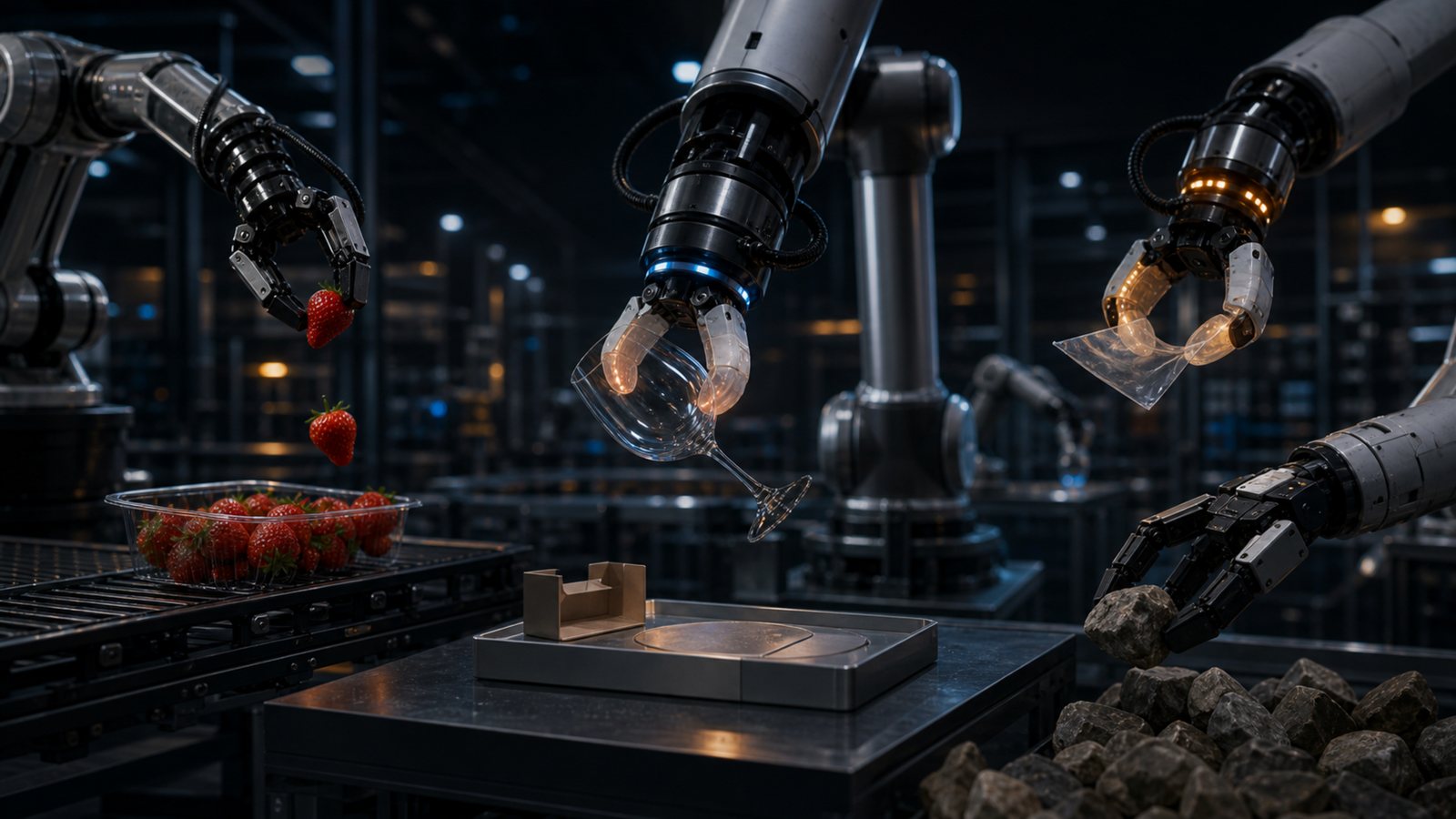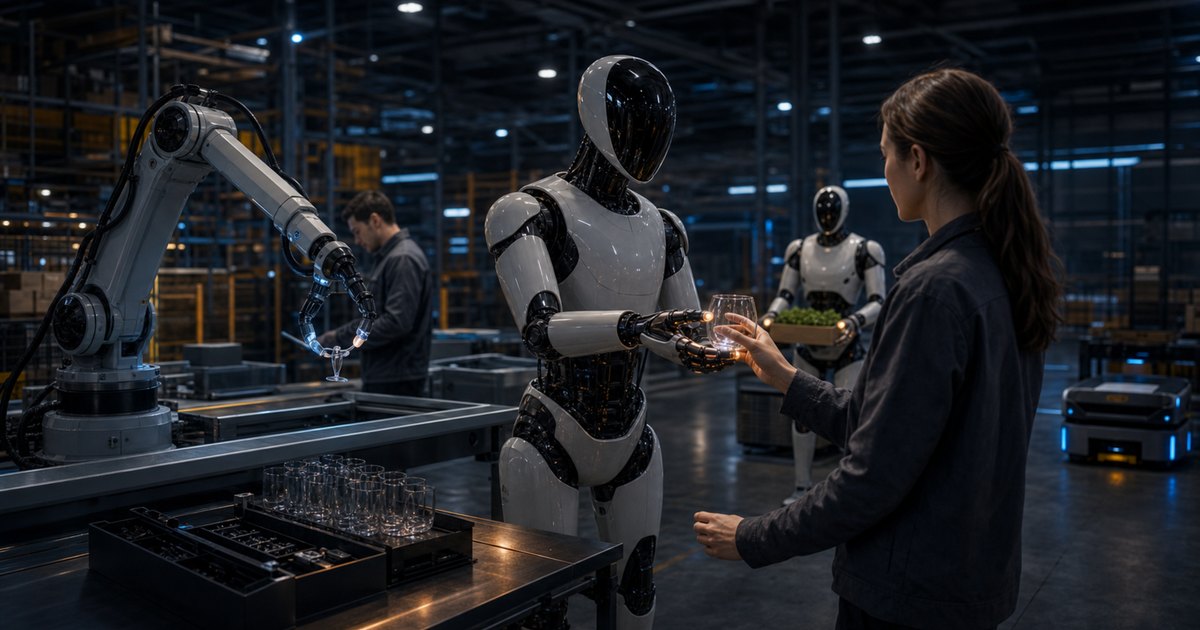
Research cut-off: 21 August 2026.
Unitree Robotics arrived on Shanghai’s STAR Market on 19 August with
the sort of debut that normally ends serious discussion. The company
sold 40.45 million new shares at RMB150.80, raised about RMB6.1 billion
(US$904 million), opened at RMB1,100 and closed at RMB845. That was a
460% first-day gain and a closing market capitalisation of RMB341.77
billion, close to US$50 billion. The retail tranche was 5,526 times
subscribed after final allocation. (Unitree
prospectus; SSE/Xinhua
Finance first-day data; Associated
Press)
The debut captured a market approaching an inflection point. Robot
bodies are becoming cheaper and more capable, manufacturing volumes are
rising, and embodied-AI models are improving quickly. Investors are
assigning value to the prospect that these three curves will converge
into a major new industry.
Unitree is already more than a robot-dog company with a photogenic
humanoid sideline. Humanoids accounted for 1.88% of its main-business
revenue in 2023, 27.68% in 2024 and 51.78% in 2025. Total revenue
reached RMB1.70 billion in 2025. The company shipped 5,511 humanoids
that year, with 5,215 meeting its criteria for recognition as sales. It
reported RMB590.75 million of adjusted attributable profit. Nearly 44%
of main-business revenue came from overseas.
The operating business confirms that humanoid robotics is crossing
from research category into industrial sector. The valuation prices in a
much larger opportunity than today’s revenue and deployments can
support, which leaves investors exposed to both genuine technological
acceleration and speculative excess.
On 20 August, the morning after the listing, founder Wang Xingxing
addressed the World Robot Conference in Beijing. Reuters
reported his belief that embodied intelligence is moving towards a
“ChatGPT moment”: a discontinuous improvement that would move robots
from narrow training towards broad usefulness. Chinese reporting of the
speech gives Wang’s benchmark greater precision. A robot placed in an
unfamiliar environment should be able to complete about 80% of tasks
across about 80% of unfamiliar scenarios using voice or text
instructions. He placed that threshold two or three years away on an
optimistic development path and five to ten years away if progress is
slower. (Global
Times; Chinese
speech transcript)
Wang’s message was optimistic about direction and uncertain about
timing. Public investors have valued Unitree at roughly US$50 billion
ahead of the software and generalisation breakthrough that its founder
associates with broadly useful robots.
The industry now has to progress through the sequence that creates
economic value:
locomotion → intelligence → manipulation → useful
work
Cheaper bodies and better models have accelerated the first two
stages. Manipulation increasingly determines whether that progress can
be converted into useful work.
Unitree’s IPO
changes the humanoid robotics story
Unitree’s IPO is a better industry marker than another funding round.
Private valuations can rely on small transactions, preferential terms
and limited disclosure. A mainland prospectus forces an issuer to define
revenue, units, customers, risks, related parties and capacity plans.
Public trading then supplies a visible, if volatile, price.
Unitree can manufacture and sell at a scale that most Western
humanoid developers have not publicly demonstrated. Its 2025 humanoid
shipment count is in the thousands. Lower entry prices have opened
demand beyond a handful of automotive pilots. Much of that demand still
comes from universities, research institutes, technology companies,
entertainment and data collection, creating a large installed base
before autonomous industrial work has reached comparable scale.
The
Robot Report’s initial analysis captured the issue neatly. It
reported that about 70% of Unitree’s humanoids went to universities and
research institutions and quoted industry executives questioning
durability, repeat business and commercial deployment. The exact segment
percentages are harder to reconcile from public filings, but the larger
point is supported: a large part of current volume is platform demand,
not labour replacement.
Research platforms put hardware in the hands of developers, create
data and train a generation of engineers on a common body. NVIDIA’s CUDA
business also grew as a platform before every GPU had a profitable AI
workload. Unitree’s installed base could play a similar enabling role,
although shipment graphs still reveal manufacturing adoption rather than
equivalent hours of productive labour.
From robot
dogs to a RMB1.7 billion humanoid business
Wang founded the Hangzhou company in 2016 after work on the XDog
quadruped. Laikago, AlienGo, A1, Go1, B1, Go2 and B2 established
Unitree’s reputation for making legged robots at prices below earlier
research machines. The H1, introduced in 2023, extended that
motion-control and actuator experience into a full-sized biped. G1
followed in 2024 as a smaller, cheaper developer platform. H2 arrived in
2025, followed by H2 Plus and lower-cost R1 variants.
The official
store, checked on 21 August, lists the R1 from US$4,900, the G1 at
US$13,500, the H2 at US$29,900 and H2 Plus at US$100,000. Delivered cost
can rise with hands, compute, EDU access, batteries, shipping and tax,
but these are still disruptive entry prices. A buyer can acquire a
bipedal platform for the cost of industrial equipment rather than a
bespoke research programme.
Unitree combines low-cost assembly with development across motors,
reducers, drives, control, sensing, lidar, hands, energy management and
embodied software. It assembles complete robots and key components
internally while outsourcing or buying selected non-core processing,
PCBA placement, moulding and machining. The disclosed detail supports a
vertically integrated model without assigning an exact in-house
percentage.
Its manufacturing model combines production to demand with safety
stock. Sales run through direct channels, agents and online platforms
including Tmall, JD, Shopify and Amazon. SDKs and developer tools
support research use, forming an early ecosystem around the hardware. A
mature marketplace for deployable industrial skills could extend that
platform advantage further.
The product-mix change is the clearest commercial signal:
| Year | Unitree total revenue | Humanoid share of main-business revenue | Humanoids recognised as sales |
|---|---|---|---|
| 2023 | RMB159.1m | 1.88% | 5 |
| 2024 | RMB392.8m | 27.68% | 412 |
| 2025 | RMB1,699.3m | 51.78% | 5,215 |
Source: Unitree
prospectus. Revenue share uses main-business revenue; total revenue
is shown separately.
In two years, humanoids moved from a marginal product line to the
majority of Unitree’s core business. Lower prices appear to have
unlocked demand that more expensive platforms could not reach. They have
also concentrated the company’s future around a category whose
applications, standards and competitive structure are changing
quickly.
What the IPO numbers
actually tell us
The IPO sold 40,446,434 new shares, 10% of the enlarged share
capital. Multiplying by RMB150.80 gives gross proceeds of RMB6.099
billion. Unitree plans to invest in embodied-intelligence models, robot
technology and products, manufacturing and working capital. Its proposed
manufacturing project could eventually provide annual capacity for
75,000 humanoids and 115,000 quadrupeds.
The project describes future capacity. Current output, shipments and
productive installations are separate measures.
At the first-day close, Unitree traded at approximately 201 times its
2025 revenue and 579 times its 2025 adjusted attributable profit by
simple arithmetic. Reuters
Breakingviews had already described the offer valuation as about 100
times earnings. The shares retraced sharply on their second day.
Investors are paying for an option on a much larger future industry
rather than valuing the current cash flows alone.
First-quarter 2026 revenue rose 68.49% to RMB422.84 million, while
adjusted attributable profit fell 52.55% to RMB40.25 million as costs
increased. Lower prices, heavier R&D and sales investment, and
growing competition are already changing the margin profile as volumes
rise.
The retail frenzy is best read as a mixture of scarcity and
narrative. Unitree is a rare profitable listed pure-play in a sector
associated with AI, advanced manufacturing and national strategy.
Chinese policy explicitly promotes embodied intelligence and real-scene
deployment. Domestic investors have limited alternatives offering direct
exposure. The stock also arrived after several years in which generative
AI rewarded capital placed around a platform shift.
The scarcity value and industrial logic are genuine. The trading
multiples show how much future progress has already been
capitalised.
The shipment
number that refuses to stay simple
The disagreement over Unitree’s shipment count reveals how immature
market measurement remains.
Unitree’s prospectus says it shipped 5,511 pure humanoid robots in
2025 and recognised 5,215 as sales. The 296-unit gap existed because
dispatched units had not yet met acceptance or revenue-recognition
conditions. An earlier public version of Omdia’s
market radar estimated about 4,200 Unitree general-purpose
embodied-intelligence robots, compared with 5,168 for AgiBot and 13,318
globally.
Unitree challenged that estimate, initially saying more than 5,500
robots had reached end customers and more than 6,500 had rolled off the
line. Its SSE inquiry response then explained the methodological
problem. Some counts include pure bipeds; others include wheeled
dual-arm machines and humanoid-like embodiments. Some count factory
roll-off, others shipment or delivery. Unitree’s disclosed 5,511
excludes wheeled dual-arm robots.
The company recalculated the relevant global pool at roughly 14,600,
which would give it about 37.6%. Later Associated
Press reporting attributed more than 5,000 each for Unitree and
AgiBot to Omdia and described a market of about 15,000, suggesting later
revisions.
Omdia built a cross-company estimate before full issuer disclosure,
while Unitree reported its own operational definition. AgiBot’s
portfolio includes wheeled machines as well as bipeds. “Humanoid
shipments” has yet to become a standardised metric, so leadership
rankings move with the treatment of morphology, factory roll-off,
shipment and acceptance. Productive hours remain a further, largely
undisclosed measure.
The 2026 humanoid robot
market
The market now includes enough serious platforms to compare
manufacturing evidence, pricing, commercial status and manipulation
hardware. Manufacturers use different definitions for shipments,
deliveries, production and orders, so the table keeps targets separate
from actuals.
| Company / platform | Country | Public price | Actual evidence | Target, order or capacity | Commercial status | Hands and contact sensing |
|---|---|---|---|---|---|---|
| Unitree G1/H2/R1 | China | R1 US$4,900; G1 US$13,500; H2 US$29,900 | 5,511 pure humanoids shipped in 2025; 5,215 sales | IPO project: 75,000/year capacity when ramped | Products sold, mostly research/platform demand; industrial output not disclosed | Configuration-dependent; H2 Plus reference uses tactile Sharpa hands |
| AgiBot A2/X2/G2 | China | Selected youth editions RMB98,000–198,000 | Omdia estimated 5,168 in 2025; company says 15,000th robot rolled off June 2026 | No comparable shipment target disclosed | Batch production and factory demonstrations; paid productive fleet undisclosed | OmniHand/SkillHand options; some vision-based fingertip sensing |
| UBTECH Walker S2 | China | Not disclosed | Company reports 1,079 full-sized embodied humanoids sold in 2025 | 5,000 annual capacity in 2026; orders over RMB800m reported | Automotive/electronics batches; autonomy and productive hours undisclosed | Five fingers; force-control claims; tactile detail limited |
| Fourier GR-3 | China | Not disclosed | Omdia estimated 300 in 2025 | Not disclosed | Research/service development | Five-finger option; sensing configuration undisclosed |
| Leju Kuavo | China | Not disclosed | Omdia estimated 500; filings/industry material cite 577 sales under another definition | Not disclosed | Education, research and pilots | Hand and sensing options vary |
| Galbot G1 | China | Not disclosed | Unit count not disclosed | Not disclosed | Wheeled dual-arm retail/industrial/medical pilots | Dexterous hands; tactile details not disclosed |
| LimX Oli | China | Not disclosed | Unit count not disclosed | Not disclosed | Developer platform and industrial development | Optional hands; detail not disclosed |
| Deep Robotics DR02 | China | Not disclosed | Unit count not disclosed | Not disclosed | IP66 industrial positioning; installed fleet undisclosed | Configuration-dependent |
| RobotEra L7/STAR1 | China | Not disclosed | Unit count not disclosed | Not disclosed | Research, performance and industrial development | Dexterous-hand options; tactile configuration undisclosed |
| Figure 03 | US | Not disclosed | More than 350 delivered from BotQ by April 2026, including internal/data uses | 12,000/year design capacity; 100,000 over four years | BMW work and other commercial development | Five-finger hands; tactile/force detail not fully public |
| Tesla Optimus | US | Not for sale | No customer shipments disclosed | Production expected later in 2026 | Internal production line and training academy | Five-finger hand shown; tactile detail not disclosed |
| Apptronik Apollo | US | Not disclosed | Shipment count not disclosed | Partner programmes with Mercedes-Benz, GXO and Jabil | Pilots/agreements | Five-finger hands; sensing detail not disclosed |
| Agility Digit | US | Reported RaaS about US$30/hour | Paid GXO deployment; unit count not disclosed | Not disclosed | Narrow commercial tote handling | Simple end effectors, not dexterous hands |
| Boston Dynamics Atlas | US | Not disclosed | Early production; count not disclosed | Hyundai programme through 2028 | Productised platform and pilots | Purpose-built hands; tactile detail not disclosed |
| Sanctuary Phoenix | Canada | Not disclosed | Shipment count not disclosed | Not disclosed | Retail/automotive pilots; teleoperation important | Highly dexterous, sensor-rich hands |
| 1X NEO | Norway/US | US$20,000 or US$499/month | No verified customer deliveries by 21 August | 10,000/year factory capacity; 100,000+ ambition | Pre-order/internal testing | Soft tendon hands; tactile specification undisclosed |
| NEURA 4NE-1 | Germany | Reservation; price undisclosed | No verified shipments | Release targeted for end-2026 | Development/reservation | Integrated force/torque sensing; local tactile detail undisclosed |
Figure’s “delivered” robots include units used for its own data and
development. AgiBot’s 15,000 is a cumulative production milestone across
several forms. UBTECH’s RMB800 million figure describes orders. Tesla
has given a production expectation, and 1X is taking pre-orders. Direct
comparisons require those categories to remain separate.
The clearest paid use is often the least human-looking manipulation.
Digit moves totes with simple end effectors. It is commercially relevant
precisely because the task has been narrowed enough to work.
China’s
hardware advantage and the US lead in AI
China’s early lead is strongest where physical industry matters.
Motors, reducers, bearings, batteries, power electronics, machined parts
and contract manufacturing are available inside dense supplier networks.
Domestic competitors iterate quickly and can test in electronics and
automotive factories. Lower prices expand the developer base. Central
and local policy brings facilities, procurement, demonstration zones and
data programmes.
China’s Ministry of Industry and Information Technology has moved
beyond broad strategy to real-scene
application programmes, asking regions to organise deployments in
production and daily life, collect data and explore insurance
mechanisms. AgiBot reached its 15,000th factory roll-off in June,
another measure of manufacturing momentum even though customer shipment
and productive deployment follow later stages.
The competitive picture varies by layer:
- Manufacturing and hardware cost: China leads on
visible volume, supplier density and entry price. - Actuators and components: China has broad capacity,
though PwC
China’s 2026 analysis still identifies gaps in some high-precision
reducers, dexterous hands and specialist chips. - AI and compute: the United States retains major
advantages in frontier models, GPUs, capital and platform software. - Industrial integration and safety: Europe retains
deep automation expertise and demanding manufacturing customers, with
lower public humanoid volumes. - Manipulation: strong laboratory results and pilots
exist in all three regions, leaving the general-purpose milestone
open. - Deployment data: China’s growing installed base can
provide an advantage when robots are instrumented and used in tasks that
generate suitable training data.
The United States has also made Chinese market access harder. FCC order
DA 26-786, released on 28 July, added foreign-produced advanced
robotic devices to the Covered List unless conditionally approved by the
Department of War. The rule blocks new FCC equipment authorisations for
covered future devices while leaving existing authorised robots in
place. It applies by place of production rather than making a
Unitree-specific finding.
Security concerns and regulatory actions have to be kept distinct
from proven misconduct. The proposed GUARD Act remains proposed
legislation. Commercially, Chinese OEMs face reduced access to an
important research and enterprise market, while US buyers lose some
low-cost hardware options.
From shipments to useful
robots
Humanoid progress is easiest to see in walking, running, dancing,
martial arts and backflips. These feats demonstrate actuator power,
balance, control and mechanical robustness. They are legitimate
engineering achievements.
Their economic value depends on how those capabilities carry into
repeatable work.
A demonstration can be rehearsed, scripted, teleoperated, cut between
takes or performed in a mapped environment with selected objects. A
worker must arrive repeatedly, deal with variation, recover from error,
avoid damage, meet cycle time, and remain available long enough to
justify capital and support cost.
The commercially useful questions are less cinematic:
- What percentage of the task is autonomous?
- How many human interventions occur per hour?
- What is mean time between failures?
- How many productive hours are achieved per shift?
- What are cycle time, damage rate and first-pass success?
- How long does a new object or task take to configure?
- Does the customer reorder after the pilot?
- What is the fully loaded cost per useful hour?
Public reporting rarely provides these numbers. Orders, partnerships,
rollout ceremonies, capacity and successful demonstrations dominate
while stable operating metrics are still developing.
A fixed industrial arm, conveyor, autonomous mobile robot or
purpose-built machine will often beat a humanoid on cost, speed, safety
and uptime in a structured task. Humanoid geometry earns its complexity
where mobility, human-compatible environments and task variability
create economic value. The return must cover the added cost of legs,
hands, batteries, sensing and software.
From
general intelligence to the final millimetres of a grasp
Dynamic locomotion has improved rapidly across serious platforms.
Falls, battery endurance, rough terrain and long-duration reliability
still require engineering, but the ability to manipulate variable
objects is becoming more commercially differentiating.
Contact changes the state of the world, which makes manipulation a
different class of problem.
Before contact, a camera can estimate object identity, geometry and
pose. After contact, the hand may hide the object. A bag deforms. A
cable flexes. A bottle rotates. A ripe fruit bruises. A smooth package
begins to slip. The robot must coordinate fingers, wrist, elbow,
shoulder, torso and sometimes both hands while the contact patch changes
faster than a high-level vision model should control it.
A robot that can pick unfamiliar products thousands of times without
dropping, crushing, misaligning or damaging them may create more
economic value than one with exceptional running speed.
Wang Xingxing made this problem unusually concrete at the World Robot
Conference. In the Chinese
transcript of his 20 August speech, he said today’s models can often
understand a task and generate broadly correct motion. Success then
breaks down in the last few centimetres or millimetres. A hand appears
to have almost grasped the object, but residual position error and the
final tactile feedback are not corrected well enough; the accumulated
error can cause the task-success rate to fall sharply. Global Times
reporting from the conference records the same example.
Wang was describing the gap between an AI model’s input and output
and the physical world rather than prescribing a particular sensor
architecture. His example still identifies the contact interface as a
critical failure point. Recognising an object and deciding to pick it up
are perception and planning problems. Correcting the last millimetres
after the fingers make contact requires information about what
physically happened.
Machine tending, connector insertion, assembly, food handling,
sorting, packing, laundry and tool use are contact-rich. They require
more than reaching the right position. They require controlling force
through uncertain materials and friction. Humans do this partly through
touch and fast local reflexes. Robots often try to infer it from
cameras, joint torque or wrist force.
Fixtures, compliant grippers, suction, conservative motion and
controlled lighting solve many constrained tasks efficiently.
General-purpose systems encounter more variation and have fewer
environmental constraints to rely on, increasing the value of direct
contact information.
As the task distribution broadens, contact information becomes more
valuable.
What vision, force
and touch each contribute
Vision locates objects, estimates pose and geometry, recognises
semantics, plans a collision-free reach and monitors the wider scene.
Touch adds information at and after the interface, particularly where
fingers occlude the view or the object’s friction, deformation and grip
stability cannot be inferred reliably from appearance.
| Modality | What it tells the robot | Where it is strong | Typical limitation |
|---|---|---|---|
| Vision / depth | Object identity, pose, geometry, motion and scene context | Planning before contact; large field of view | Contact may be occluded; appearance does not fully reveal friction, grip stability or internal deformation |
| Proprioception | Joint position, velocity, estimated torque and body configuration | Whole-body control and balance | Contact is indirect and often poorly localised |
| Wrist/ankle force-torque | Aggregate three-axis force and torque | Collision detection, insertion and force control | Low spatial resolution; multiple fingertip contacts are combined |
| Motor current / joint torque | Load inferred through the drivetrain | No extra fingertip hardware | Friction, transmission compliance and model error reduce precision |
| Local tactile sensing | Contact patch, normal/shear distribution, vibration, deformation and sometimes incipient slip | Grip correction and contact-rich manipulation | Cost, wiring, calibration, bandwidth, durability and integration |
Normal force acts roughly perpendicular to the contact surface. Shear
acts along it. Incipient slip is the local movement that begins before
an object visibly falls. Contact location and patch shape reveal whether
a grasp is centred or changing. Vibration can help identify texture or a
slipping interface. Compliance and deformation indicate how the object
or sensor skin is responding.
Tactile sensors measure different subsets of these quantities. A
wrist force-torque sensor may provide an excellent total load while
telling little about which fingertip is losing grip. A pressure array
may measure normal force without shear. A camera-based tactile fingertip
can produce dense surface geometry at the cost of more volume and
processing. A meaningful specification needs to identify the signal,
location, bandwidth and integration.
The emerging architecture is multimodal: cameras for the scene,
proprioception for the body, force/torque for aggregate interaction and
tactile sensing where local contact state affects success.
As explored in Why Better AI Makes
Robot Touch More Important Than Ever, more capable models allow
robots to attempt harder tasks. Those tasks create more contact-rich
situations and raise the value of better physical observations.
NVIDIA’s
tactile Unitree platform points in the same direction
NVIDIA supplied an unusually clear independent signal in May. Its Isaac
GR00T Reference Humanoid Robot combines a Unitree H2 Plus body,
Jetson AGX Thor compute, Isaac GR00T software, multiview vision and two
Sharpa Wave tactile five-finger hands.
The configuration is specific:
- 31 degrees of freedom in the Unitree body;
- 22 degrees of freedom in each hand, 75 across body and hands;
- a stereo head camera with 140° horizontal and 102° vertical field of
view; - wrist cameras for close manipulation and an IMU for motion;
- Jetson AGX Thor T5000 with 128GB unified memory and 2,070 FP4
TFLOPS; - Isaac Teleop for demonstrations, GR00T models, Isaac Sim and Isaac
Lab for training/evaluation, and Isaac ROS for deployment; - late-2026 availability.
Sharpa
says each fingertip contains more than 1,000 tactile pixels. Supplier
pages describe different sensitivity configurations across Wave
versions.
The reference system for frontier academic research combines
multiview vision with highly articulated tactile hands. NVIDIA’s own
description links dexterous manipulation, sensing, control and onboard
AI. Parallel grippers remain the efficient choice for many warehouse and
industrial tasks, while the five-finger design gives researchers a wider
manipulation envelope.
NVIDIA has selected AI + vision + proprioception +
force/torque control + local tactile information as the
development stack for sophisticated manipulation on its general Physical
AI research platform.
Wang identifies generalisation and final contact correction as
central obstacles. NVIDIA’s reference platform places tactile dexterous
hands on Unitree hardware. Recent research reports better performance on
contact-rich tasks when tactile information enters the control and
learning loop. These independent signals converge on the same
engineering requirement: intelligence has to remain connected to
physical feedback at the point of action.
NVIDIA’s broader strategy reinforces the direction. Cosmos world
models, Isaac Sim/Lab, synthetic data, teleoperation and GR00T connect
data generation, training, evaluation and on-robot inference. Robotics
teams need an end-to-end loop that can capture physical interaction,
learn a policy, test it and deploy it safely.
Does touch
actually improve robot performance?
Recent scientific work is beginning to quantify what touch
contributes, primarily in controlled laboratory tasks rather than
long-duration industrial operation.
TouchWorld, a July
2026 preprint, reports a hierarchical tactile system that combines
slower prediction with faster reaction. Across six long-horizon
laboratory tasks, the authors report 65.0% success in clean tests and
53.7% under human perturbation, improvements of 15.7 and 18.5 percentage
points over their strongest selected baseline. The tasks include error
recovery and changing contact; the results remain specific to an
unreviewed preprint and its experimental setup.
FORTE integrates
pneumatic sensing into a compliant gripper. Its authors report average
force error of 0.2N over a 0–8N range, slip detection within 100
milliseconds and 92% success handling selected fragile, slippery and
deformable objects including raspberries and crisps. The experiment
illustrates the mechanism under a defined set of tasks.
A GelStereo study
published in IEEE Transactions on Neural Networks and Learning
Systems reported 95.79% slip classification and demonstrated
closed-loop grasping and screwing. A 2026
neuromorphic visuotactile paper reported high-accuracy, low-latency
slip detection in selected bottle-cap tasks.
Together, the results show several commercially relevant effects:
- local contact signals can reveal a failure before it becomes visible
as a dropped object; - force and slip feedback can close a fast corrective loop;
- tactile observations can help learned policies distinguish
physically different states that look similar to cameras.
Suction, fixtures, compliant materials or slower motion remain
effective alternatives for many applications. Wider adoption of tactile
sensing will depend on surviving abrasion, impact, contamination and
repeated cycles while delivering calibrated, time-synchronised signals
to the control stack.
Commercial value appears when the complete system reduces failed
picks, damage, intervention or training time at acceptable cost.
Touch as a Physical AI data
layer
Tactile sensing can also become part of the training record,
extending its role beyond real-time control.
A useful robot trajectory can contain RGB and depth images,
language/task context, actions, joint positions, motor currents, torque
estimates, wrist forces, local contact, shear, slip, vibrations and
success or failure. That sequence gives a learning system more than an
outcome. It provides clues about why the outcome occurred.
Unitree makes this distinction in its own SSE response.
Autonomous-vehicle data mainly records a system trying to avoid contact.
Robot data contains active, controlled contact: force, touch, joint
torque, foot pressure and dual-arm coordination. That is a different
data problem.
For imitation learning, a tactile trace can show how a demonstrator
increased grip during an incipient slip. For reinforcement learning, it
can make failure states observable before a binary drop. For grasp
prediction, it can connect visual appearance to friction and
deformation. For vision-language-action models, it offers a path from
semantic intent to the local physics of execution.
RoboTacDex is one
example of this direction, assembling visual-tactile-action data for
dual-arm dexterous humanoid manipulation. GenForce attacks a related
problem: transferring force calibration across different tactile
hardware.
Compared with internet images and text, tactile datasets are small.
Sensors differ in geometry, units, sampling rate and drift, and physical
rollouts make contact data expensive. Cross-sensor transfer remains an
active research problem because a policy trained on one fingertip may
encounter a different signal distribution on another. Simulation helps,
although friction, soft materials and contact transitions are demanding
to model.
Tactile data has the potential to become a valuable Physical AI data
stream. Repeatable hardware, calibration, metadata and policies that
show measurable gains will determine whether it also becomes a
defensible commercial asset.
Choosing among tactile
architectures
Robotic touch covers several technologies solving different parts of
the contact problem.
- GelSight and DIGIT: optical elastomer sensors
produce dense images of surface geometry and can infer shear or slip
from marker motion. They offer rich spatial information, with trade-offs
in optics, volume, compute and elastomer wear. - SynTouch BioTac: a fluid-filled biomimetic
fingertip combines deformation, pressure, vibration and thermal
channels. It offers rich multimodal data in a fingertip-specific
package. - XELA uSkin: magnetic three-axis taxels measure
local normal and shear forces in thin modular patches suitable for
fingers, palms and grippers. Density and magnetic/temperature
compensation are design considerations. - Contactile PapillArray: soft optical pillars
measure local three-dimensional force and displacement, from which
torque, slip and friction can be inferred. The modular compliant design
differs substantially from camera-imaged gels. - TacTip: a soft optical biomimetic architecture
tracks internal pins to recover contact geometry and deformation. It has
a strong research and sim-to-real ecosystem. - Capacitive and piezoresistive arrays: potentially
thin and scalable, commonly strong in normal-pressure sensing. Shear,
hysteresis, drift and cross-talk depend heavily on design. - Magnetic soft sensors: compact three-axis response
with calibration and interference trade-offs. - Six-axis force/torque sensors: mature and valuable
at wrists, ankles and tool flanges, but they aggregate contact and do
not provide a dense fingertip map. - Tactile skins: extend coverage to palms, arms or
bodies, creating challenges in wiring, calibration, repair, durability
and cost.
Resolution alone offers a poor basis for comparison. A coarse, robust
3D force taxel may be more useful for a gripper than a dense optical
image. Fingertips and forearms require different packaging, while a
wrist force sensor may solve insertion without any artificial skin.
The human fingertip analogy is useful only up to a point. Commercial
robots do not need to recreate biology. They need the least complex
sensing architecture that delivers the required reliability.
From
the AI model to the fingertip: where KiriSense fits
Wang’s “ChatGPT moment” sets a demanding goal: robots that generalise
across unfamiliar tasks and environments from ordinary language
instructions. His grasping example identifies where model-level
competence currently loses contact with the physical world. The robot
understands the instruction, approaches the right object and produces an
almost-correct motion. The final correction after contact still
determines success.
That last few millimetres of a grasp require a different kind of
information from object recognition. The hand needs to detect when
contact begins, how force is distributed and whether the object is
stable inside the grasp. Normal force indicates how hard the robot is
pressing into a surface. Shear describes forces acting laterally across
that surface. Changes in shear and contact behaviour can reveal
incipient slip, when an object begins to move within the grasp before a
gross failure or drop becomes visible.
KiriSense
is developing a compact optical kirigami tactile-sensing architecture
aimed at extracting information associated with contact, normal force,
shear and slip. The architecture is particularly relevant to fingertips
and other constrained robotic surfaces, where useful contact information
has to be obtained within a limited hardware envelope. A Henry
Royce Institute-backed project with the University of Sheffield is
developing a shear-sensing fingertip demonstrator.
Wang’s benchmark depends on generalisation, yet his manipulation
example fails at the interface between fingers and object. KiriSense is
working on information from that interface. Wang framed the issue as
physical-model alignment rather than endorsing a particular sensor
architecture. Tactile information can contribute by giving the model and
controller evidence about what happened after the planned action entered
the physical world.
NVIDIA’s reference architecture and the recent tactile-manipulation
studies point in the same direction. More capable robot models are being
paired with richer contact information because intelligence needs a fast
physical feedback loop. KiriSense sits at that boundary between
increasingly capable AI and the object being handled. Its strategic
relevance can therefore increase as robot intelligence improves and
robots attempt a wider range of manipulation tasks.
Potential applications extend across dexterous humanoid hands,
warehouse picking, food handling, industrial manipulation, collaborative
robots, agricultural robotics, prosthetics and other embodied-AI
systems. Each presents different requirements for force range, geometry,
durability, integration and control, but all can benefit from earlier
knowledge that a contact state is changing.
For a deeper treatment of AI and robot observability, see Why Better AI Makes
Robot Touch More Important Than Ever.
Humanoids
could accelerate a much broader tactile-sensing market
Public attention concentrates on the company whose name is painted on
the robot, while the value stack extends through:
- actuators, motors, bearings, reducers and roller screws;
- dexterous hands and task-specific grippers;
- cameras, encoders, IMUs, lidar, force/torque and tactile
sensors; - batteries, power electronics and thermal management;
- edge compute and networking;
- simulation, teleoperation, synthetic data and model tooling;
- system integration, safety, fleet operations and maintenance.
TrendForce
has identified roller screws, force/torque sensors, hollow-cup motors
and other precision components as material shares of representative
humanoid bills of materials. Exact percentages vary by architecture, but
rising production creates component demand below the OEM layer. Its 2026
outlook forecasts sharp shipment growth and intensifying competition
across systems and components, influencing capacity investment
throughout the supply chain.
Component suppliers can grow across competing platforms without
depending on a single OEM becoming dominant. For KiriSense, potential
customers include humanoid manufacturers, dexterous-hand and gripper
companies, industrial-robot producers, research platforms, system
integrators and specialist manipulation businesses. Unitree’s success
can accelerate the category without becoming the only route to
market.
Humanoids may be an especially visible catalyst rather than the
entire tactile-sensing market. Industrial arms, cobots, warehouse
systems, food and agricultural robots, prosthetics and other machines
encounter many of the same contact, force, shear and slip problems. A
sensing architecture that solves a cross-platform manipulation problem
can participate in several growing markets.
Designs and interfaces are still evolving, qualification cycles can
be long, and some OEMs will integrate components internally. The
strongest supplier positions will come from measurable task improvements
and an integration path that works across several hands, grippers and
robot types.
What to watch from 2027 to
2030
The approaching inflection will become visible in operating evidence
as well as engineering milestones.
Hardware development will focus on safety, energy efficiency,
maintenance and field reliability. Hands need dexterity at acceptable
cost and durability. Sensors have to survive contamination and repeated
impacts. Battery swaps, charging, fleet orchestration and fall recovery
need routine procedures. More stable component interfaces would allow
suppliers to scale across platforms.
The intelligence stack is moving towards stronger generalisation and
faster recovery. A useful system should learn a new object without
thousands of bespoke demonstrations, detect when the world has diverged
from its plan, and request help before causing damage. Teleoperation
will remain valuable for data and exception handling; intervention
frequency will show how autonomy is progressing.
Manipulation brings scene perception, grasp selection, compliant
control, local contact feedback, failure prediction and recovery into
one reliability stack. Tactile sensing will create the most value where
local contact state materially changes task success, with the final
architecture shaped by task and cost.
Commercially, customers need a cost per useful hour. Purchase price
is only the start. Integrators must include engineering, supervision,
floor changes, safety, maintenance, downtime and support. A cheaper
robot that needs constant intervention can cost more than an expensive
specialised machine.
The most revealing metrics between 2027 and 2030 will be:
- autonomous productive hours per robot per month;
- interventions and safety stops per hour;
- first-pass task success and recovery success;
- cycle time relative to a person or specialised machine;
- object/part damage and mispick rates;
- uptime, mean time between failures and field-service cost;
- time and data required to learn a new task;
- repeat orders after pilots;
- gross margin after support and warranty;
- cost per useful hour alongside cost per body.
Customer mix will be equally revealing. Growth in repeat industrial
orders, accompanied by customer-disclosed output, would show the
transition from platform demand into useful work.
Conclusion: the
physical-AI inflection point
Unitree’s IPO shows that humanoid robotics has acquired the capital,
manufacturing scale and competitive ecosystem of a genuine industry.
Audited revenue, public equity, factories, component supply chains,
product families, exports and price competition now sit behind the
demonstrations.
China has established an early lead in hardware cost, iteration and
visible volume. The United States remains powerful in models, compute
and capital. Europe brings industrial integration and automation
expertise. The next competitive milestone is general-purpose work at
scale.
Wang Xingxing believes the industry is moving towards a robotics
equivalent of the ChatGPT breakthrough. His 80% benchmark describes a
machine that can enter unfamiliar environments, understand ordinary
instructions and complete most of the work it encounters. The timing is
uncertain, but the direction is ambitious and clear.
Reaching that threshold requires more than better language or vision
models. The robot has to close the loop between deciding what to do and
understanding what happened when its hand touched the object. Wang’s
final-millimetres example, NVIDIA’s tactile Unitree reference platform
and the emerging tactile-manipulation research all locate a critical
part of the challenge at the contact interface.
The progression is becoming clearer:
better bodies → better models → better manipulation → useful
physical intelligence
Tactile sensing sits directly in that progression, supplying
information about contact, normal force, shear and slip when a planned
action becomes a physical interaction. KiriSense is developing
technology aimed at that interface.
The scale of the opportunity extends beyond any single robot company.
As more machines acquire the intelligence to attempt variable physical
work, the ability to feel and correct contact becomes part of the
infrastructure of Physical AI. The commercial winners will turn that
closed loop between perception, intelligence, touch and action into
dependable work across factories, warehouses, farms, homes and other
environments built for people.