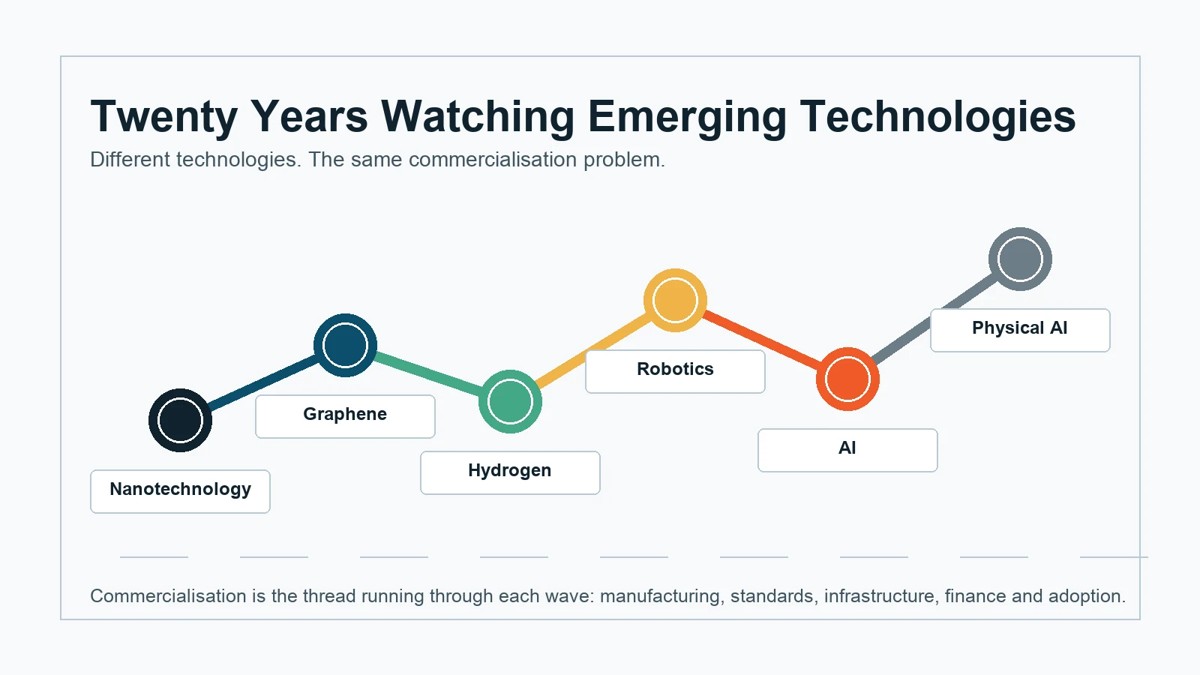
After two decades of writing about nanotechnology, graphene, hydrogen, robotics and AI, I have become less interested in the technologies themselves than in the uncomfortable distance between a breakthrough and an industry.
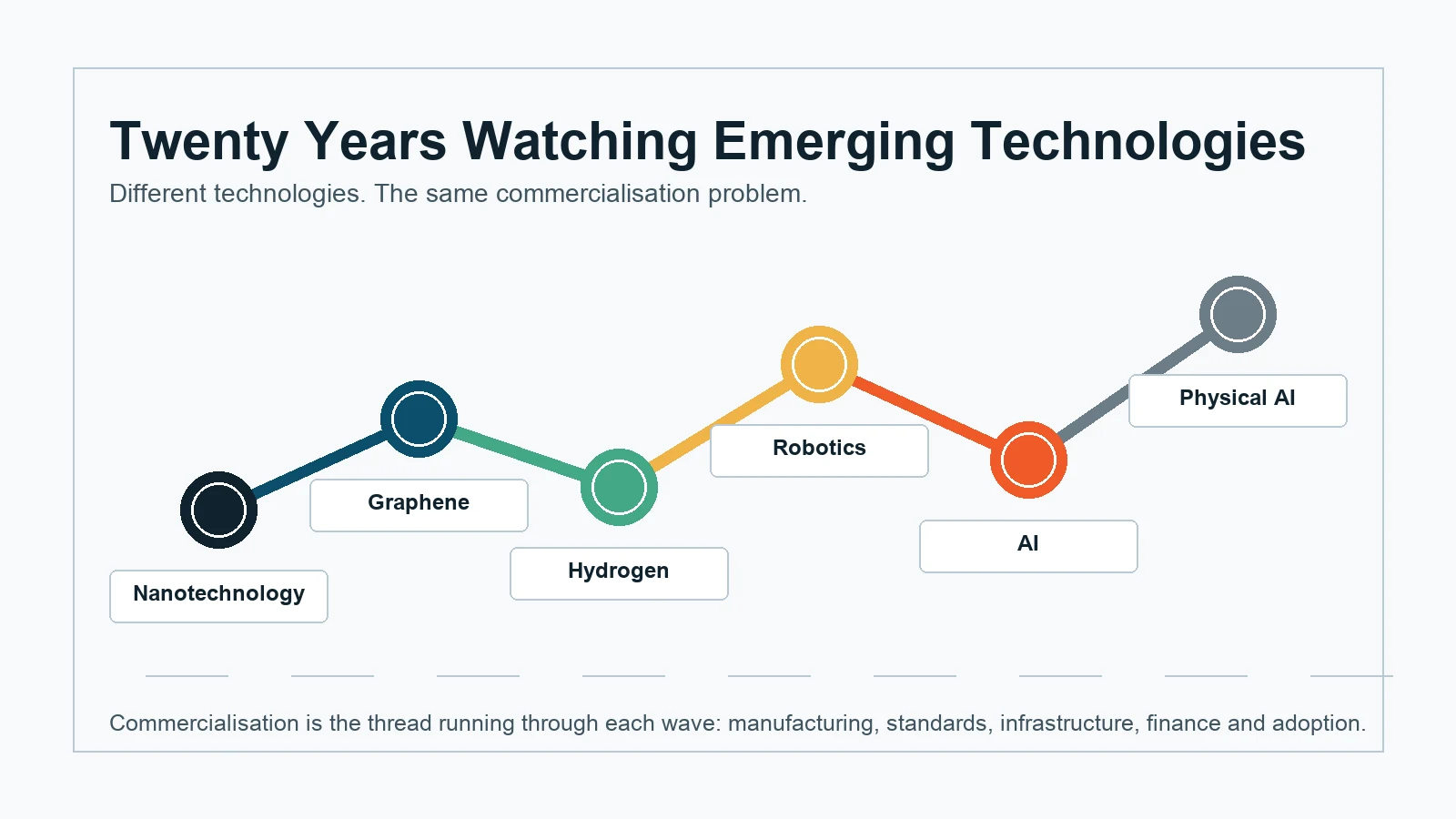
I did not start out thinking that was the subject. At the time it felt as if I was moving from one promising field to another. Nanotechnology led to advanced materials. Graphene led to membranes, composites and sensors. Cleantech led to fuel cells, hydrogen and batteries. Robotics led naturally to AI, and AI now seems to be dragging us back into the physical world of chips, power, factories, sensors and machines.
Only in retrospect does the pattern become obvious. I was not really following a sequence of technologies. I was following the same problem as it appeared in different clothing.
Why do some technologies become industries, while others remain demonstrations, grant applications, conference slides or investor narratives?
Looking Back, I Think I Was Following The Wrong Story
There is a slightly uncomfortable thing about looking back through old articles. You find the old certainties, the fashionable phrases, the optimism of a particular moment. You also find the questions that refused to go away.
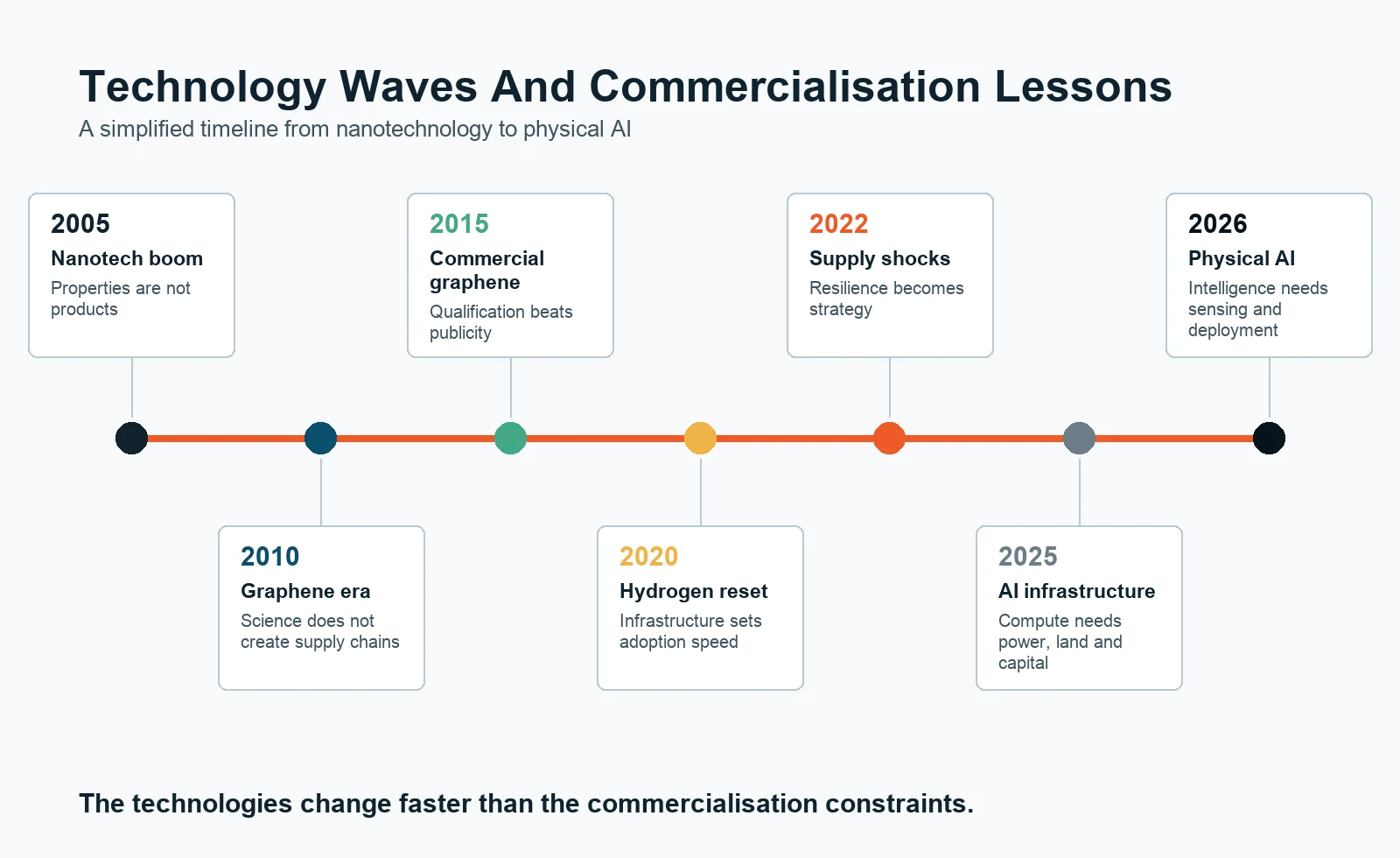
In the nanotechnology years the question was why such extraordinary control over matter did not immediately produce a new industrial revolution. In the graphene years it became why a material with remarkable properties could be so difficult to turn into a repeatable business. In hydrogen it became why a molecule that works perfectly well in demonstrations keeps running into cost, infrastructure and utilisation. In robotics and AI it is now taking another form: why an impressive capability is not the same thing as a deployable system.
Those are not separate questions.
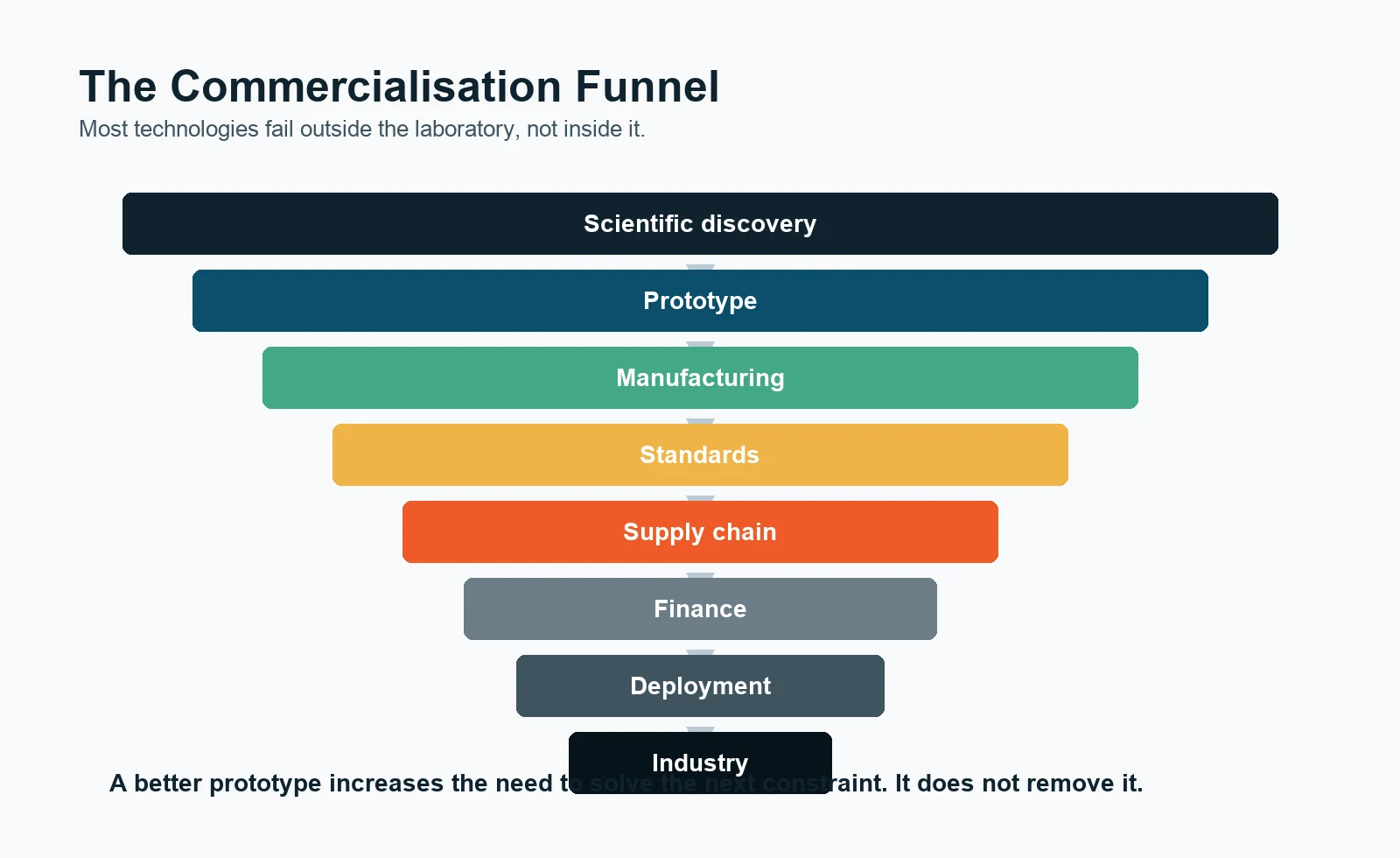
The public story of emerging technology tends to start in the wrong place. It starts with discovery. A new material, a new model, a new battery chemistry, a new robot. Discovery matters, of course. Without the science there is nothing to commercialise. But after twenty years of watching these waves rise, attract capital, disappoint, recover and sometimes quietly succeed, I have become wary of any technology story that stops at performance.
Performance is the beginning of the argument, not the end of it.
The Lab Was Usually The Easy Bit
That sounds dismissive, and it is not meant to be. Laboratories are difficult places. Good science is hard. Making a new material, proving a new reaction, sensing a new signal or training a useful model requires discipline and imagination. But the laboratory is still a relatively controlled environment. The outside world is not.
I saw this first with nanotechnology. The field was presented as if a scale of measurement could become an industry. Sometimes it could. More often it became an ingredient, a tool, a coating, a particle, a membrane, an instrument or a process improvement inside somebody else’s product. That made it commercially important and publicly invisible.
This is one reason I have never been persuaded by the simple claim that nanotechnology failed. Some of the hype failed. Some companies failed. Some applications were nonsense. But a great deal of nanoscale science disappeared into products, analytical equipment, manufacturing processes and materials engineering. That is not failure. It is what often happens to enabling technologies when they become useful.
It is also why the early arguments about science and industrial policy still matter. In Fixing The UK Economy Over A Pint In The Ilkley Brewery, the setting was deliberately ordinary, but the problem was not. Britain has never been short of good research. It has often been short of the industrial machinery needed to turn research into companies, factories, skilled jobs and exports.
That gap has followed me through almost every technology since.
Graphene Made The Problem Harder To Ignore
Graphene was the point at which the argument became impossible to avoid. It had everything a technology story is supposed to have: elegant science, Nobel recognition, exceptional properties, a city that could claim the discovery, plausible applications and a word that journalists could remember.
It also had a commercial problem that was easy to underestimate.
At events such as the Commercial Graphene Show, the interesting conversations were not really about whether graphene was remarkable. That was already settled. They were about which graphene, made how, at what cost, with what consistency, for which customer, inside which product, on what timescale. The further the conversation moved from physics towards procurement, the more complicated it became.
I wrote pieces such as Searching for Commercial Graphene at the Commercial Graphene Show, Did Manchester Miss Out By Not Patenting Graphene? and Graphene may well change the world but will it change Manchester? because graphene exposed a confusion that still affects emerging technology policy. We mistake ownership of discovery for ownership of industry.
Those are not the same thing.
A material is not commercial because it has exceptional properties. It is commercial when customers can specify it, manufacturers can make it repeatedly, standards bodies can define it, insurers and regulators can understand it, and supply chains can deliver it at a price that makes switching worthwhile. A composite manufacturer does not buy a Nobel Prize. A battery company does not buy a press release. A water company does not buy a promise of atom-thick membranes. They buy predictable performance inside their own constraints.
That is why the graphene story was misunderstood. The problem was not that graphene lacked potential. It was that the word graphene covered a family of materials, processes and quality levels. For some uses that flexibility was helpful. For customers trying to qualify a material inside regulated or long-life products, it created risk. A buyer needed to know defect density, flake size, contamination, dispersion behaviour, functionalisation and batch-to-batch variation. The famous headline properties were often not the properties that decided adoption.
Manchester’s question was never only whether it should have patented more. The deeper question was whether a city could build the patient, connected industrial ecosystem needed around a discovery: scale-up, standards, applications engineering, manufacturing customers, patient finance and enough commercial humility to let the market define the product.
I do not think that question has gone away.
Manufacturing Has A Way Of Humbling Everyone
One of the useful services manufacturing provides is that it does not care about rhetoric. It asks awkward questions in plain language. Can you make the same thing again? Can you make ten thousand of them? Can you make them with acceptable yield? Can you prove what you made? Can the customer process it without redesigning their factory? Can you still make money when the line is running on a wet Tuesday with ordinary staff and ordinary suppliers?
This is where many technology stories lose their glamour. It is also where they become real.
The old nanotechnology and graphene debates were full of arguments about properties. Strength, conductivity, surface area, permeability, sensitivity. Those were necessary conversations. But in factories the questions are usually less beautiful. What happens to the dispersion after six months? How does the coating behave when the substrate changes? What tolerance does the process really need? Does the supplier have a second source? What does quality control cost? How long will qualification take?
The same logic now applies to robots. A humanoid robot completing a polished demonstration is impressive, but it is still only the beginning of the manufacturing and deployment argument. The useful economic unit is not a video clip. It is uptime, intervention rate, maintenance cost, safety case, training burden, integration time and the customer’s willingness to reorganise work around the machine.
This is why I suspect some of today’s humanoid robotics companies resemble graphene companies more than software companies. They are selling a future shaped by extraordinary capability, but the hard part is not the existence of the capability. It is repeatability in messy environments. It is qualification. It is service. It is proving that the product can survive contact with customers who are not paid to be patient.
The companies that win may not be those with the most elegant robot. They may be the ones that build the dullest, most reliable deployment machine around it.
Infrastructure Keeps Winning
Once you start seeing technology through deployment, infrastructure becomes impossible to ignore. It is the part of the story that arrives late in public debate and early in real projects.
Hydrogen taught this rather brutally. The chemistry works. Fuel cells work. Electrolysers work. Internal combustion engines can burn hydrogen. None of that removes the need for cheap production, storage, transport, refuelling, safety rules, offtake contracts, utilisation and finance. Hydrogen’s hardest problem has often been less chemical than financial. Who pays for infrastructure before demand is certain, and who commits to demand before infrastructure exists?
The International Energy Agency’s Global Hydrogen Review 2025 captures the tension well: committed low-emissions hydrogen projects are increasing, but the sector is still constrained by cost, regulation, infrastructure and demand creation. That is not a failure of imagination. It is a reminder that energy technologies are systems before they are products.
This is why recent work on hydrogen economics, UK hydrogen infrastructure, hydrogen versus electric trucks and hydrogen combustion engines keeps returning to the same practical questions. Where is the fuel? What does it cost? How often is the asset used? Who carries the risk? Which duty cycles justify the infrastructure?
Battery swapping for heavy vehicles raises a similar set of questions. A fast swap is technically attractive, but the business is not just a machine that changes batteries. It is land, grid connections, battery ownership, depreciation, software, standardisation, fire safety, contracts and utilisation. The IEA’s work on EV charging follows the same logic: adoption and infrastructure have to move together, and neither side moves cleanly on its own.
Infrastructure has a habit of disciplining enthusiasm. It asks whether a technology can fit into roads, grids, ports, depots, factories, warehouses, hospitals, data centres and balance sheets. It turns “does it work?” into a more severe question: can anyone use it repeatedly without reorganising the world around it?
Money Has Its Own Physics
Technical people sometimes talk about finance as if it arrives after the serious work has been done. It does not. Finance shapes what can be built, how quickly, at what scale and with what tolerance for delay.
I saw this during the cleantech boom and bust, and I see it again in hydrogen, batteries, semiconductors, data centres and robotics. A technology can be viable in principle and unfundable in practice. A project can have social value and still fail to reach investment committee. A prototype can work, yet the first commercial plant can be too expensive, too risky or too dependent on policy to attract capital at the right cost.
This is where hydrogen is most revealing. Many discussions treat the problem as if cheaper electrolysers alone will solve it. Cheaper electrolysers help, but they do not magically create offtake, pipelines, storage, ports, refuelling stations, industrial users or long-term price certainty. Project finance does not believe in molecules. It believes in contracts, counterparties, guarantees, utilisation and risk allocation.
That may sound unsentimental. It is also why some technologies appear to move slowly despite genuine need. Decarbonisation is not only an engineering challenge. It is a capital allocation problem under political uncertainty.
Venture capital adds a different distortion. It can be extremely useful when risk is technical and speed matters. It is less comfortable when progress depends on factories, certification, infrastructure, slow customers and regulated markets. Some emerging technologies need patient industrial capital more than venture-style acceleration. Others need a sequence of capital types that do not naturally talk to one another.
This was one of the awkward truths behind the old article Innovation is not a Magic Sausage Machine. Inputs do not automatically turn into outputs. Research funding, incubators, accelerators, patents and press coverage do not guarantee industries. The conversion mechanism matters.
Every Breakthrough Creates A Coordination Problem
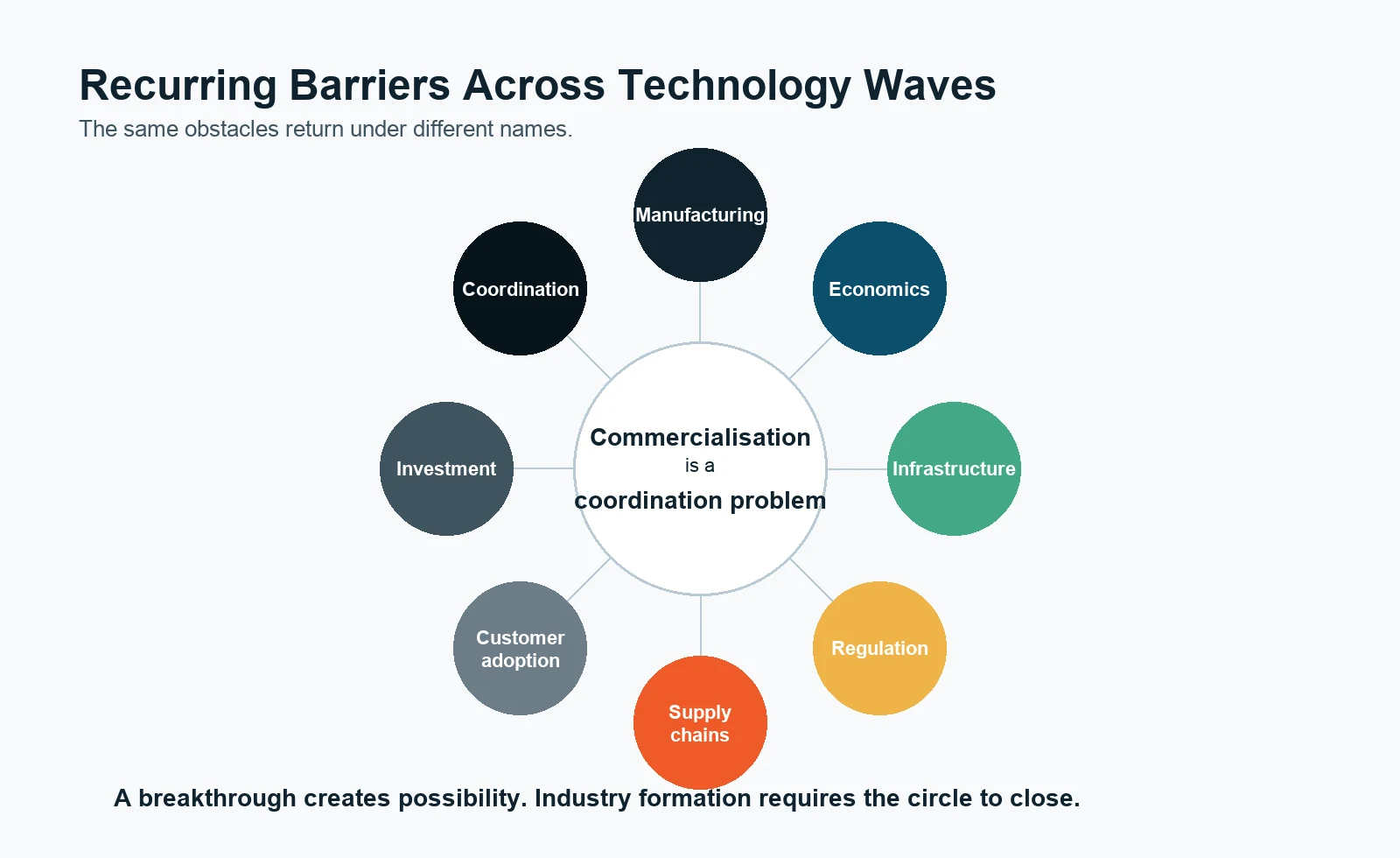
Commercialisation is often described as if one company simply pushes harder until the market gives way. Sometimes that happens. More often, a breakthrough creates a coordination problem.
New materials need standards, test methods, suppliers and reference applications. Hydrogen needs producers, transport, users, regulators and financiers. Battery swapping needs vehicle makers, fleet operators, station operators, utilities and battery owners to converge on compatible assumptions. Robotics needs hardware, software, integrators, safety frameworks, maintenance networks and customers who can redesign work. AI needs chips, power, data, governance, workflow integration and people willing to trust the output.
The frustrating thing is that each participant is often waiting for the others. Customers wait for lower cost and better evidence. Investors wait for customers. Infrastructure providers wait for utilisation. Regulators wait for clarity. Suppliers wait for volume. The technology may be improving while the system around it hesitates.
This is not always irrational. Waiting can be the sensible thing to do. The problem is that industries are not created by everyone waiting sensibly at the same time.
Supply Chains Ended The Innocent Phase
For years, supply chains were treated as background plumbing. Then COVID arrived, Russia invaded Ukraine, semiconductor shortages stopped production lines, energy prices moved violently, helium supply tightened, and critical minerals became a strategic topic rather than a mining footnote.
After that, it became harder to talk about emerging technology as if it floated above geography.
Semiconductors made the point most clearly. A missing chip can stop a car factory. The European Commission’s European Chips Act reflects a political recognition that chips are not just components. They are industrial capacity, defence capability, economic resilience and geopolitical leverage. The IEA’s Global Critical Minerals Outlook 2025 makes a similar argument for clean energy technologies: materials, processing and geographical concentration are part of the technology story.
This has changed the tone of industrial policy. The old assumption was that efficiency would take care of supply. The newer question is whether the efficient system is resilient enough when transport routes, export controls, energy prices, wars or pandemics intrude. That does not make every subsidy intelligent. It does make supply-chain geography part of strategy.
It also brings the argument back to manufacturing. A country that wants leadership in batteries, hydrogen, robotics, semiconductors or AI infrastructure cannot only fund research and hope the rest appears. It needs skills, factories, process knowledge, equipment suppliers, standards, patient customers and the willingness to learn from production.
Recent pieces on semiconductor clusters, China’s hydrogen strategy, CATL’s infrastructure strategy and semiconductor supply-chain risk all sit inside that shift. The technology is still important. Control over the system around it is becoming more important.
Robots Are Having Their Graphene Moment
Robotics now has the atmosphere that surrounded several earlier waves: extraordinary demonstrations, expanding capital, confident forecasts and a sense that the future has suddenly become visible. I understand the excitement. Some of the progress is real.
I also hear an echo.
With graphene, the mistake was to move too quickly from exceptional properties to inevitable markets. With humanoid robots, the risk is moving too quickly from impressive capability to inevitable deployment. A robot that can perform a task once is not yet a labour system. A robot that can walk across a stage is not yet a warehouse worker, care assistant, technician or construction labourer.
The awkward questions are familiar. Who installs it? Who trains the staff around it? Who updates it? Who carries liability? What happens when it fails at three in the morning? How much supervision does it need? How does it recover from edge cases? How many units are required before service economics work? What does the customer do with the existing workforce, building layout and safety procedures?
This is why the current robotics writing on humanoid robotics markets, touch as the missing piece and AI, brains and dexterity is not really about robots as spectacle. It is about when embodied machines become reliable enough, observable enough and cheap enough to be treated as infrastructure.
That may take longer than the most enthusiastic forecasts suggest. It may also happen in less glamorous places first. Factories, logistics sites, inspection tasks, defence, agriculture and maintenance may tell us more than stage demonstrations. Emerging technologies often become useful at the edges before they become iconic in the centre.
AI Is Becoming Infrastructure
AI looks different because software moves quickly and the public can touch it directly. That makes it tempting to treat AI as an exception to the pattern. I am not convinced it is.
Foundation models are already infrastructure. They require chips, data centres, power, cooling, networks, capital, data rights, engineering talent and governance. The IEA’s Energy and AI report is useful because it pulls AI back into the physical economy: there is no AI without electricity, land, equipment and grid connections, even if the user experiences it as software.
Inside companies, the pattern is also familiar. A model can perform well in a benchmark and still fail to create value because the workflow is poor, the data is fragmented, the procurement rules are slow, the risk owner is unclear or the organisation does not know how to change. Intelligence is not adoption. Capability is not implementation.
This is why I think AI is less a destination than a new layer of infrastructure. It will sit inside design, logistics, finance, customer service, energy systems, robotics, defence, manufacturing and research. In some places it will be visible. In others it will disappear into tools and processes, much as nanotechnology disappeared into materials and instruments.
The most interesting AI question may not be which model is cleverest. It may be where intelligence changes the economics of a system enough that customers reorganise around it.
Physical AI Brings The Argument Back To Matter
Physical AI is where many of these threads meet: sensors, semiconductors, robotics, materials, edge computing, manufacturing, AI and deployment. It is also a useful correction to the idea that intelligence alone is enough.
A robot can only reason from what it can sense. In a digital workflow, bad output can often be corrected and rerun. In a physical workflow, a bad action can damage a part, stop a line, injure someone or create a maintenance problem. That raises the standard for sensing, control, validation and safety.
Tactile sensing is a small example with large implications. Vision tells a robot a great deal, but not everything. Grip, force, slip, texture and contact matter when machines handle the physical world. KiriSense is one current illustration of that broader problem, but the point is not company-specific. Better AI increases the value of better physical feedback.
Here the old materials world and the new AI world meet. The future of embodied intelligence may depend as much on sensors, manufacturing tolerances, reliability and service models as on model size. That is a less glamorous claim than saying robots simply need better brains. It is probably closer to the truth.
The Useful Technologies Disappear
One of the oddities of technology success is that it often becomes less visible. The language of the boom fades. The capability remains.
Nobody wants to buy a hype cycle. They want cleaner water, cheaper energy, stronger materials, more reliable logistics, safer factories, better diagnostics, lower emissions or work that can be done with fewer errors. Once the technology becomes part of that outcome, the original label may matter less. This is why a great technology can look as if it has failed from the outside while it is quietly being absorbed by industry.
That thought makes me more cautious about both hype and disappointment. The first wave of enthusiasm is usually too confident. The first wave of disillusionment is often too harsh. Some technologies die. Some limp along for years because subsidies, fashion or capital keep them alive. Some become useful only after another part of the system changes: a standard appears, a supply chain matures, an incumbent weakens, a regulation shifts, a customer problem becomes expensive enough.
The archive of this site is valuable to me because it records those half-formed moments. Getting From Being Green to Voting Green was about the gap between environmental concern and political or economic action. Nanotech and Water: It Took Ten Years Just To Get To The Starting Line was about the patience required before an application becomes serious. Saving Our Village Shop With Technology? used a local problem to ask whether technology helps when the surrounding economics are wrong.
Different subjects. Same suspicion.
The technology is rarely enough.
What I Look For Now
I have become less impressed by the first demonstration and more interested in the second customer. The first customer may be an enthusiast, a partner, a grant-funded trial or a strategic buyer with reasons that do not generalise. The second and third customers tell you whether the market is beginning to understand the value without needing the full missionary effort.
I look for manufacturing evidence before market size. I look for standards before slogans. I look for boring procurement details. I look for service models, warranties, utilisation, training, integration costs and whether the customer can adopt without becoming an unpaid development laboratory.
I also look for humility. Not the performative kind, but the practical humility of companies that know where the bottleneck really is. Sometimes it is performance. Sometimes it is cost. Sometimes it is a missing component, a certification pathway, a financing structure, a weak supplier, a distribution problem or a customer who is interested but not yet in enough pain to act.
The best technology companies often know which problem they are actually solving. The weaker ones keep changing the story.
If there is a thread through twenty years of emerging technology writing, it is this: invention creates possibility, but implementation decides whether the possibility matters. That is not a neat conclusion. It leaves plenty unresolved. Some technologies deserve more patience than markets give them. Some deserve less. Some will matter precisely because they become invisible. Some will remain permanently interesting and commercially marginal.
But the recurring pattern is hard to ignore. Science opens the door. Manufacturing, infrastructure, finance, standards, supply chains, regulation and customers decide who walks through it.
For anyone trying to understand the next twenty years, that may be more useful than another forecast.
Sources And Evidence Base
- TimHarper.net historical archive inventory, 2005-2019.
- Getting From Being Green to Voting Green, originally published 2015.
- Did Manchester Miss Out By Not Patenting Graphene?, originally published 2016.
- Graphene may well change the world but will it change Manchester?, originally published 2017.
- Searching for Commercial Graphene at the Commercial Graphene Show, originally published 2015.
- Innovation is not a Magic Sausage Machine, originally published 2017.
- Nanotech and Water: It Took Ten Years Just To Get To The Starting Line, originally published 2018.
- IEA Global Hydrogen Review 2025.
- IEA Global EV Outlook 2025: Electric Vehicle Charging.
- IEA Global Critical Minerals Outlook 2025.
- IEA Energy and AI.
- European Commission: European Chips Act.
- Stanford AI Index Report.