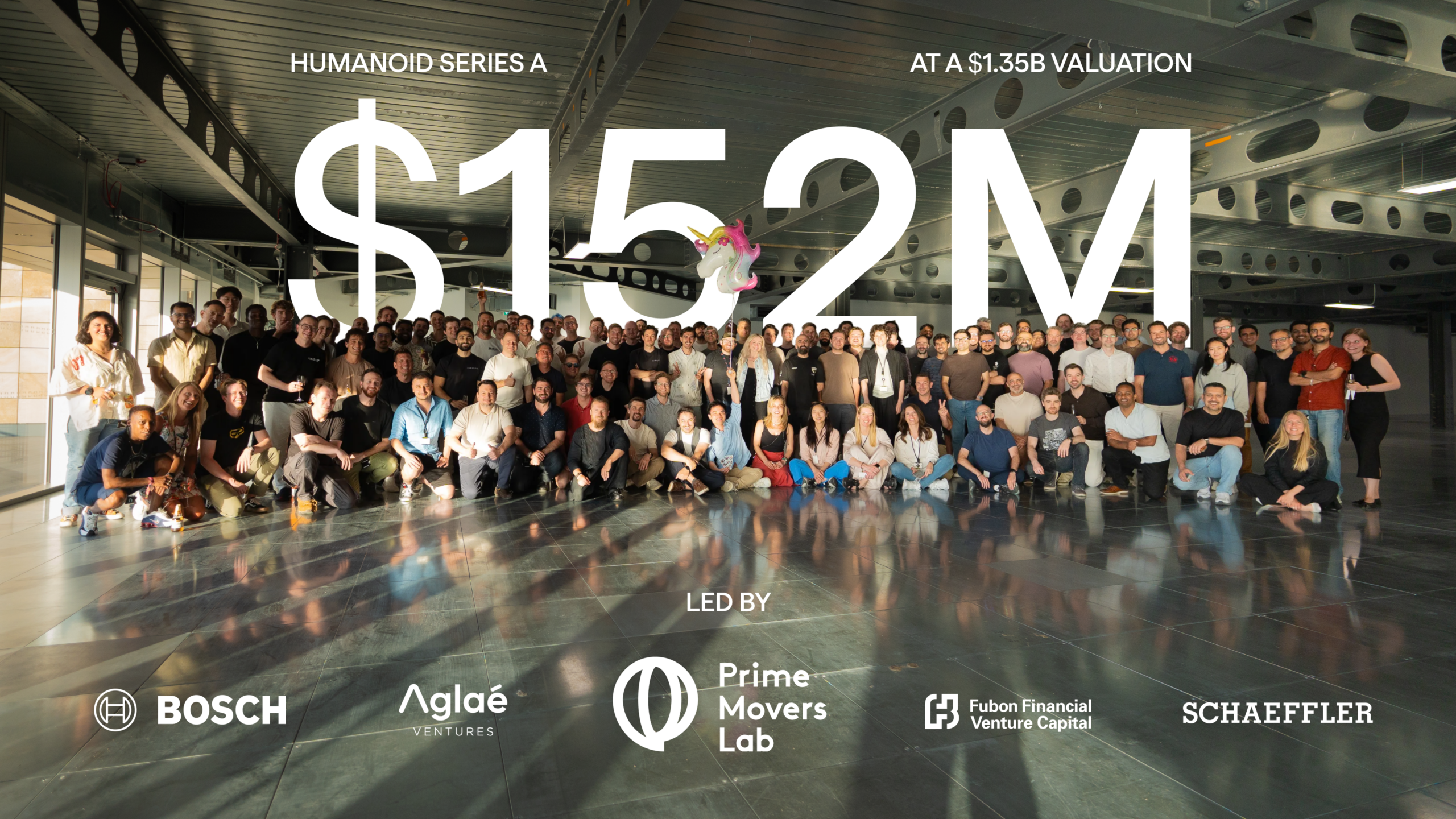
The interesting number in Humanoid’s new funding announcement is not $152 million. It is two years.
That is how long it has taken the UK-based company to reach a $1.35 billion post-money valuation. The round, led by Prime Movers Lab with Schaeffler, Bosch, Fubon Financial Holding Venture Capital and Aglaé Ventures, brings total funding to $270 million. Humanoid says beta deployments will begin in the fourth quarter of 2026, followed by mass manufacturing of its wheeled Alpha platform.
In another market this might look like an unusually enthusiastic Series A. In humanoid robotics it is becoming part of a pattern.
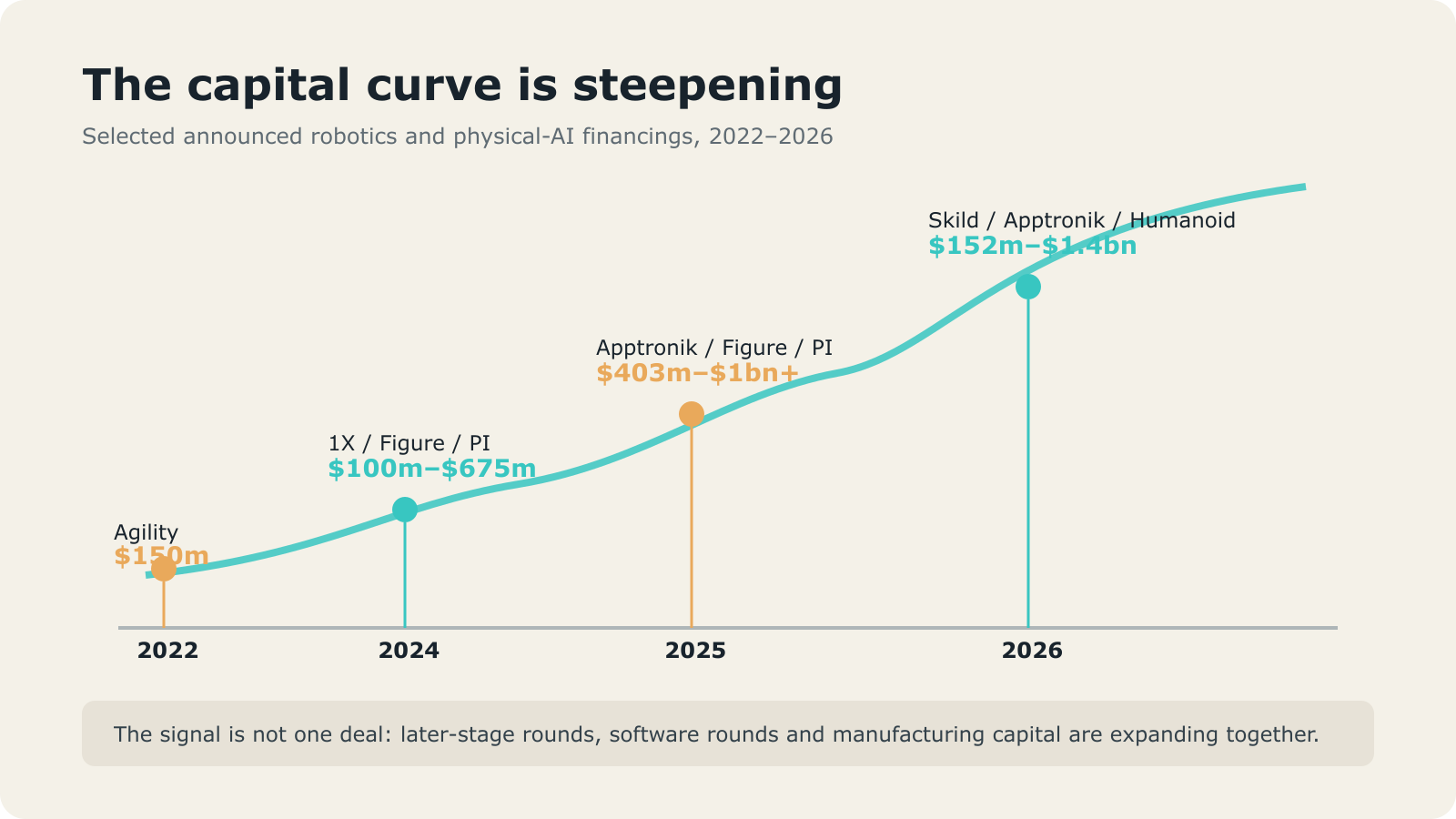
Figure AI raised more than $1 billion at a $39 billion valuation. Apptronik’s extended Series A has reached $935 million. Skild AI raised $1.4 billion for a general-purpose robot brain. Physical Intelligence raised $600 million. Agility Robotics has agreed a public-market transaction expected to provide more than $620 million in gross proceeds. Tesla is absorbing the development of Optimus into a capital expenditure programme that now spans AI compute, chips, vehicles and robotics.
This is no longer merely a robotics story. It is a capital-markets story about where investors think the next layer of computing value will be created.
What matters
- Capital is moving into robot bodies, foundation models, manufacturing and deployment at the same time.
- Strategic investors are becoming more important: Google, Nvidia, Amazon, Mercedes-Benz, Bosch, Schaeffler, John Deere and SoftBank are buying optionality across the stack.
- Industrial deployment is arriving before general-purpose autonomy. Warehouses, factories and logistics offer constrained tasks and measurable economics.
- Locomotion attracts attention, but manipulation determines usefulness. The competitive frontier is moving into hands, force control, tactile sensing and recovery from error.
- Europe still has strong robotics research and industrial customers, but much less scale-up capital than the US and less manufacturing momentum than China.
Why the rounds are getting larger
Humanoid robotics combines the cost structures of an AI laboratory, an electric-vehicle programme and an industrial automation business.
A credible company needs model-training compute, large engineering teams, custom actuators, batteries, hands, sensors, safety systems, manufacturing tooling, supply chains, customer integration and a field-service organisation. It must also collect real-world data while its product is still changing. Unlike a software company, it cannot distribute the next iteration at negligible marginal cost.
The size of recent rounds therefore reflects more than exuberance. It reflects the capital required to move from a laboratory prototype to a machine that can complete a shift.
Figure’s September 2025 Series C exceeded $1 billion and was explicitly intended to scale its Helix AI system, data collection, GPU infrastructure and BotQ manufacturing operation. Apptronik’s $935 million Series A brings Google and Mercedes-Benz together with John Deere, AT&T Ventures and the Qatar Investment Authority. These are not passive endorsements. They connect models, industrial sites, communications, agriculture, sovereign capital and potential customers.
The funding is also becoming larger because the market is trying to finance several difficult transitions simultaneously:
- From scripted behaviour to learned policies.
- From prototype manufacture to repeatable production.
- From supervised pilots to useful operating hours.
- From single tasks to reusable robot skills.
- From a robot sale to a supported deployment system.
The result is unusual venture financing. Series A rounds of several hundred million dollars are not really conventional early-stage rounds. They are industrialisation programmes wearing venture-capital labels.
Capital is spreading across the stack
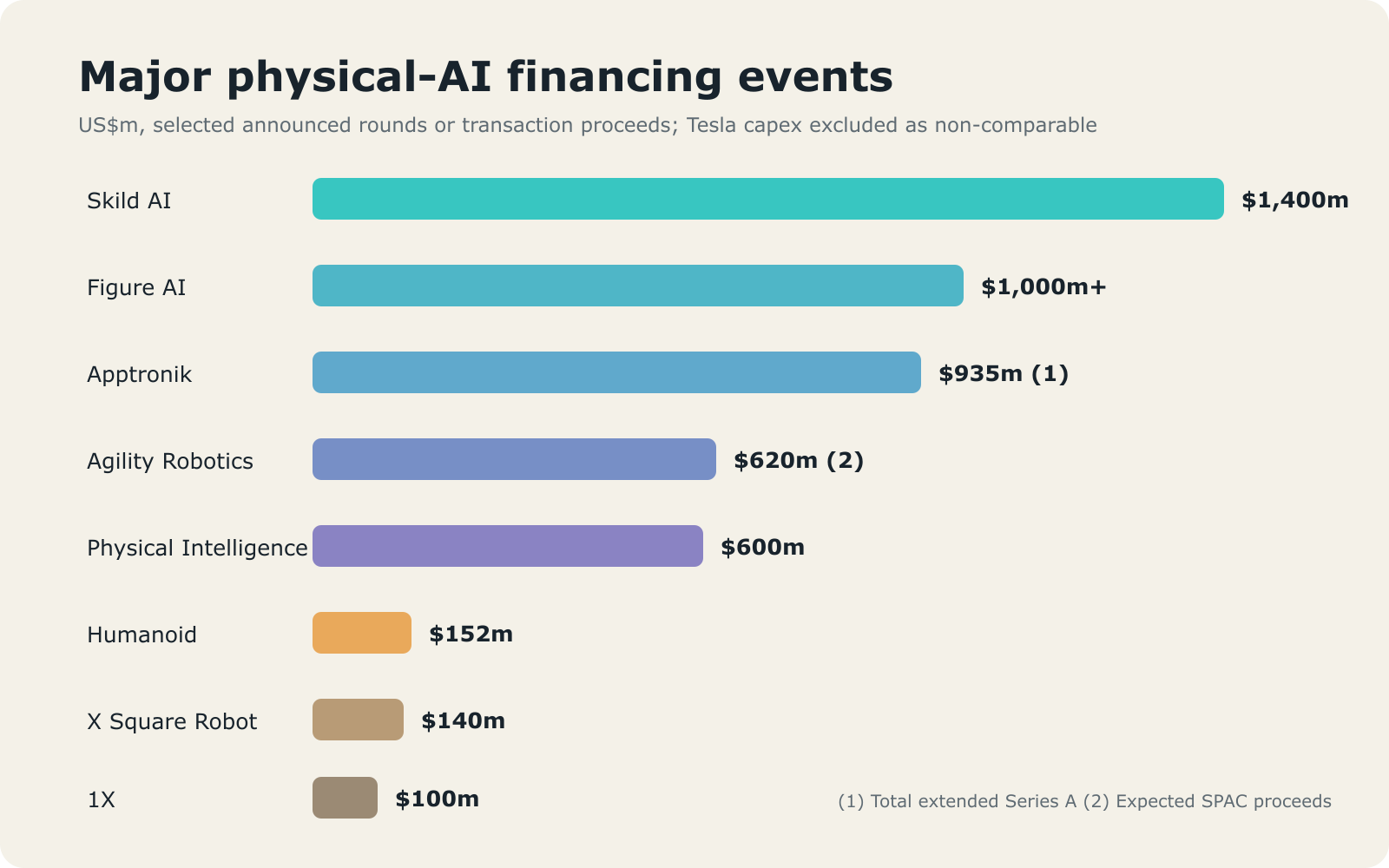
| Company | Announced financing | What investors are backing | Strategic signal |
|---|---|---|---|
| Skild AI | $1.4bn Series C | A general-purpose robot brain across many bodies | SoftBank, Nvidia, LG and Schneider Electric are backing a horizontal intelligence layer |
| Figure AI | $1bn+ Series C | Vertically integrated humanoid, models, data and manufacturing | Nvidia, Intel, Qualcomm and Brookfield link compute to deployment environments |
| Apptronik | $935m extended Series A | Apollo, production and industrial deployments | Google, Mercedes-Benz, John Deere and QIA combine AI, customers and patient capital |
| Agility Robotics | $620m+ expected transaction proceeds | Commercial deployment and Digit v5 scale-up | Amazon, Nvidia, Foxconn, Schaeffler and SoftBank support an operating system around the robot |
| Physical Intelligence | $600m round | Foundation models that can control different robots | CapitalG, Lux, Thrive, Index and T. Rowe Price are backing software leverage across hardware |
| Humanoid | $152m Series A | Wheeled and bipedal robots, KinetIQ AI and manufacturing | Bosch and Schaeffler provide industrial credibility and routes into factories |
| 1X | $100m Series B | Safe humanoids for domestic and enterprise environments | Earlier backing from OpenAI made embodied learning part of the investment thesis |
| Unitree | Series C amount undisclosed; $1.7bn reported valuation | Lower-cost, production-oriented humanoids and quadrupeds | Alibaba, Tencent and Geely connect AI, platforms and Chinese manufacturing |
These figures are not perfectly comparable. Apptronik’s number is the total extended Series A; Agility’s is expected transaction proceeds rather than a private round; and Unitree’s June 2025 Series C was reported at a $1.7 billion valuation without a reliably disclosed round size. Tesla cannot sensibly be put on the same chart because Optimus sits inside a corporate capital programme that also includes autonomy, compute, semiconductors, energy and vehicles.
That lack of comparability is itself informative. Capital is reaching physical AI through venture rounds, strategic investment, sovereign funds, corporate expenditure and public-market transactions. Investors are not waiting for one financing model to emerge.
Why investors are becoming more confident
Three assumptions have changed.
The first is that foundation AI models are becoming easier to access. They remain expensive to train at the frontier, but capable vision, language and action architectures are spreading through APIs, open models, research transfer and well-funded specialist laboratories. Owning a large model is no longer sufficient evidence of a durable advantage.
The second is that the physical world contains a much larger pool of economically valuable tasks than the digital world alone. Software can write a maintenance instruction, optimise a schedule or identify an object. It cannot lift a tote, load a machine, pack a mixed order, inspect a hot enclosure or help an older person out of a chair. Intelligence becomes productivity only when a physical system can act safely and reliably.
The third is deployment evidence. Agility says Digit has accumulated more than 65,000 operating hours across customer environments and has secured more than $300 million of multi-year orders for its next generation, subject to contractual milestones. Figure has been collecting production data at BMW. Apptronik is working with Mercedes-Benz and logistics operator GXO. Humanoid has announced a framework with Schaeffler for thousands of robots.
None of this proves that general-purpose humanoids are economically mature. Orders subject to milestones are not revenue, pilots are not repeat orders and operating hours are not necessarily profitable hours. But the evidence is now good enough for investors to believe that the remaining problems are engineering, manufacturing and deployment problems rather than a permanent scientific impossibility.
That distinction unlocks much larger pools of capital.
Why humanoids might become the general-purpose industrial robot
The case for the humanoid form is not that legs and a head are inherently efficient. A conveyor, fixed arm or autonomous mobile robot will remain superior when the environment and task can be redesigned.
The case is compatibility.
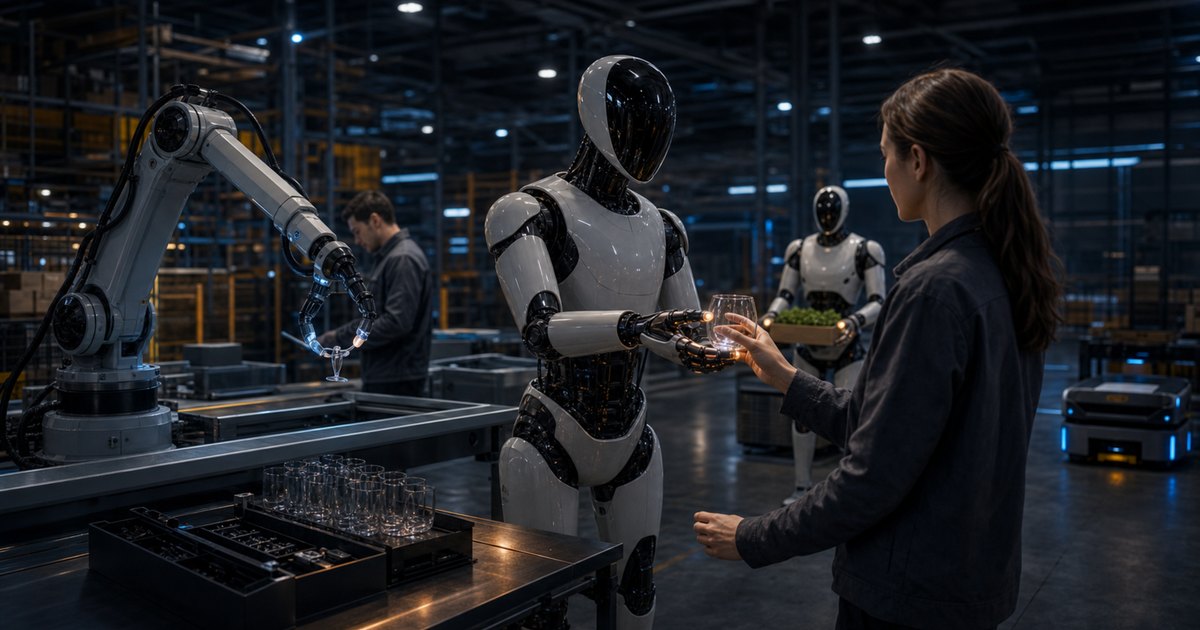
Factories, warehouses and tools were designed around human reach, hand dimensions, aisle widths, stairs, workstations and safety conventions. Rebuilding the environment can be more expensive than building a machine that fits it. A humanoid can, in principle, use existing infrastructure and move between tasks without a new automation cell for each one.
This makes the humanoid a candidate for the dominant general-purpose industrial robot, not the dominant robot of every kind. Specialised machines will continue to win high-volume, stable tasks. Humanoids become interesting in the broad middle: work that is repetitive enough to automate but variable enough that dedicated automation is difficult to justify.
The first commercial sectors are therefore likely to be:
- Logistics and warehousing, where tote movement, unloading, pallet handling and order preparation are repetitive and measurable.
- Manufacturing, especially material movement, machine tending, kitting and line-side replenishment.
- Retail and distribution, where mixed products and human-designed spaces reward adaptability.
- Hazardous inspection and maintenance, where avoiding human exposure has a clear value.
- Institutional service environments, once safety and manipulation improve.
Domestic robotics will be a much larger market if it works, but it is a harder first market. Homes are cluttered, unstructured and full of children, pets, liquids, stairs, fragile objects and liability. A factory can constrain a task and calculate a return. A kitchen rarely submits a capital request.
Manipulation is harder than locomotion
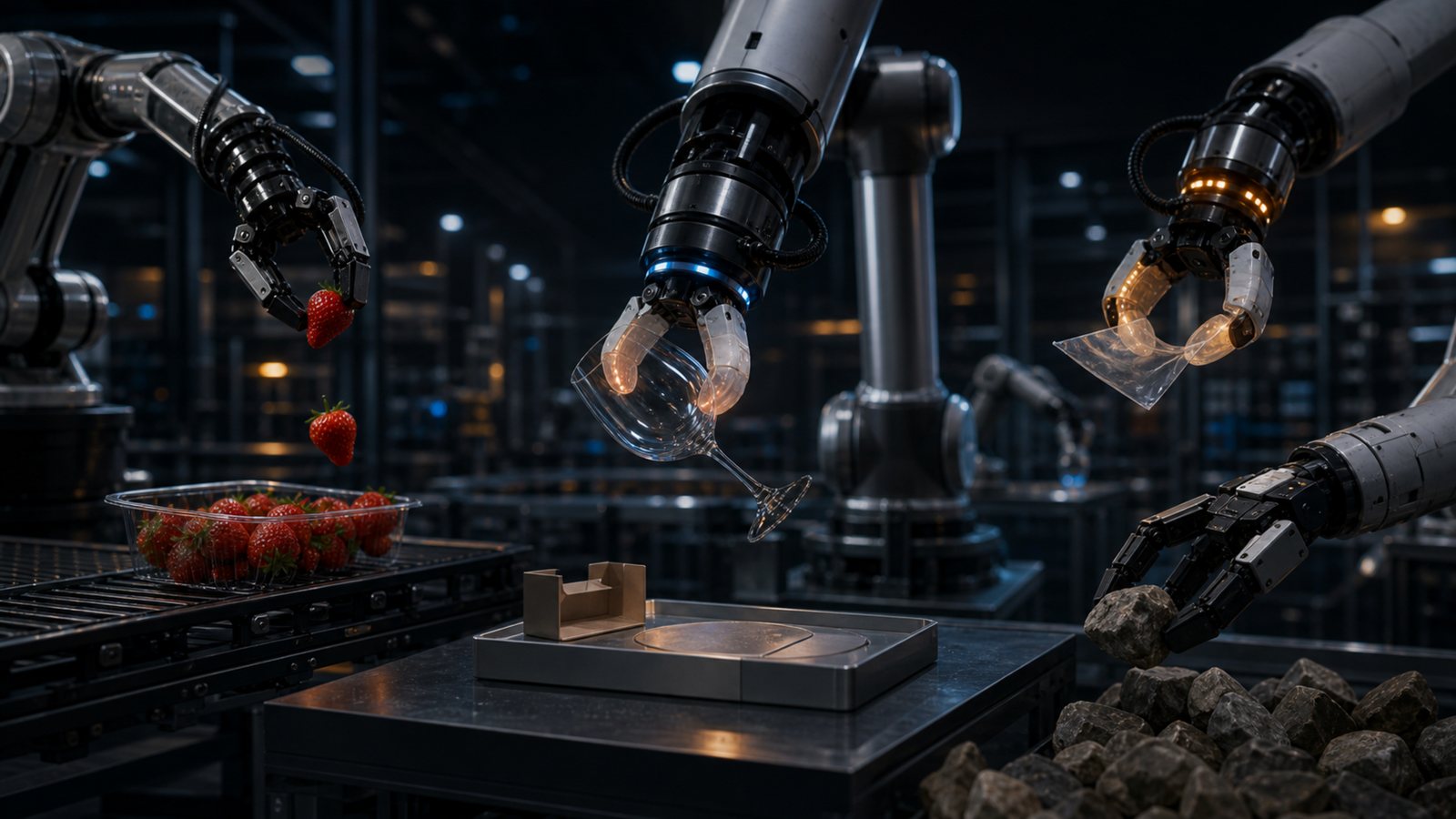
Humanoid demonstrations have trained us to watch the feet. We should increasingly watch the fingers.
Modern robots can walk, recover from pushes and traverse difficult ground with remarkable competence. Locomotion is not solved, particularly around safety, energy consumption and long-duration reliability, but it is becoming less differentiating.
Manipulation remains considerably harder because contact changes the problem. Before contact, vision can estimate the position and shape of an object. At contact, the robot must know whether the object is secure, deforming, rotating or slipping; whether the force is damaging it; and whether a neighbouring object has moved unexpectedly. The hand also occludes the camera at precisely the moment when more information is needed.
A warehouse tote is forgiving. A cable connector, plastic pouch, wet glass, garment or irregular component is not. The robot must coordinate fingers, wrist, arm, torso and sometimes both hands while controlling forces that cannot be inferred reliably from images alone.
This is why dexterity is becoming a key competitive differentiator. The useful question is not whether a robot can pick up an object in a demonstration. It is whether it can handle thousands of variations, detect a poor grasp early, correct it without human intervention and do so at a cycle time and damage rate that the customer will accept.
Bigger AI models need better sensors
This sounds counter-intuitive. If the model is becoming more intelligent, why should the hardware need more sensing?
Because a model cannot infer information that the system does not observe reliably.
Larger models can understand a task, generalise across objects and select a better action. That increased capability encourages operators to give robots harder work. Harder work produces more contact-rich situations, and those situations expose the limits of vision-only control.
Touch is likely to become as important to robotics as vision became during the previous AI wave. Machine vision turned cameras from passive inspection devices into sources of semantic information. Tactile sensing can do something similar for contact: turning force, pressure, shear and slip into a stream that a learned policy can use.
The commercial requirement is not a robot that feels like a human. It is a sensor-and-control loop that reduces dropped objects, damage, failed picks, intervention and training time. Tactile sensing belongs between perception and manipulation, where it can close the gap between a planned grasp and what is actually happening at the fingertips.
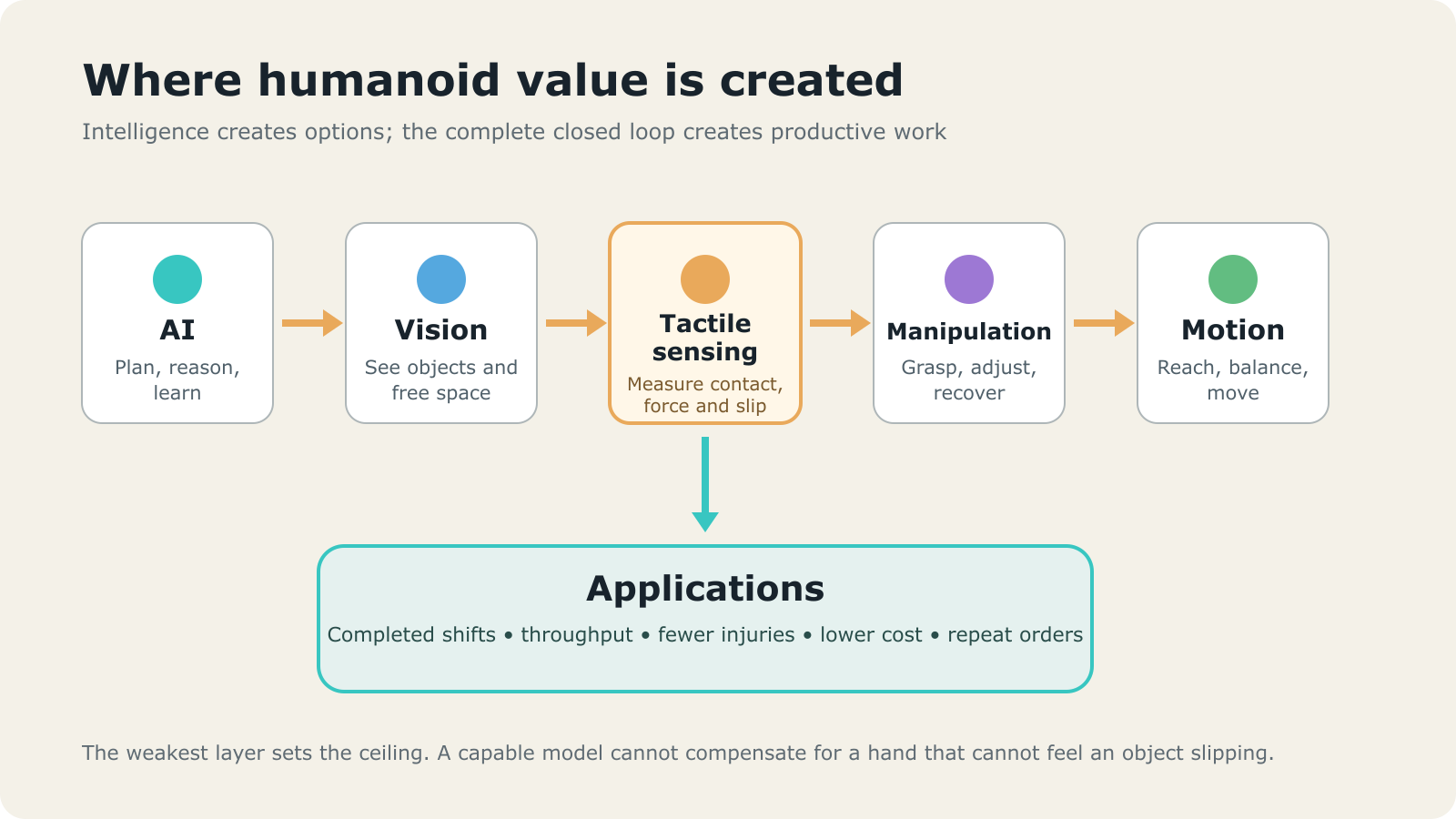
The investment implication is that value will not sit in one layer. Foundation models may become more interchangeable, but high-quality deployment data, hands, actuators, tactile sensors, safety systems, manufacturing yield and application integration remain stubbornly physical. The weakest layer sets the performance ceiling for the whole machine.
Three capital models are emerging
Tesla, Unitree and Agility expose three different routes into the market.
Tesla is treating Optimus as a manufacturing and AI programme inside a company with factories, battery expertise, computer vision, custom silicon and access to public capital. Its spending cannot be separated neatly from the rest of the company: Tesla said in July 2026 that annual capital investment would exceed $25 billion across robotics, autonomy, chips and related infrastructure. This is not a venture round, but it raises the competitive capital requirement for everyone else.
Unitree demonstrates the Chinese advantage in cost and production. China accounted for roughly 85% of global humanoid shipments in 2025 according to Barclays figures cited by the Associated Press; Omdia estimated that Unitree and AgiBot each shipped more than 5,000 units. These are not equivalent to thousands of autonomous workers completing shifts, but they create supply-chain learning, developer access and data at a scale Europe is not yet matching.
Agility offers the strongest current argument for disciplined commercial focus. Digit does not attempt to look or work exactly like a person. It targets material movement in controlled environments, supported by fleet software, integration and safety engineering. The form may be less theatrical, but the operating data is more valuable than another carefully edited demonstration.
The winning architecture may combine these approaches: Tesla’s vertical integration, China’s manufacturing economics and Agility’s deployment discipline.
China is financing an industrial ecosystem
US funding is easier to count because it arrives in large, named venture rounds. Chinese capital is distributed across private rounds, listed companies, municipal funds, state-backed guidance funds, customer procurement and investment by large technology and industrial groups. Comparing only headline Series A and Series C announcements therefore understates the Chinese position.
The company-level figures are already material:
| Chinese company | Recent financing evidence | Investors or capital source | Commercial signal |
|---|---|---|---|
| Galbot | More than $300m raised in late 2025, taking disclosed total funding to about $800m at a reported $3bn valuation | An earlier 2025 round was led by CATL; backing also includes state-linked Beijing capital | Capital is concentrating around embodied models, battery supply and industrial deployment |
| X Square Robot | RMB1bn, about $140m, reported in September 2025; more than RMB2bn raised across eight rounds | Alibaba Cloud and other Chinese investors | Investors are backing a horizontal embodied-AI model as well as robot hardware |
| Unitree | Series C amount undisclosed; reported valuation of RMB12bn, about $1.7bn | Alibaba, Tencent and Geely were reported among new investors | Lower prices and thousands of shipments provide manufacturing learning unavailable to most Western startups |
| AgiBot | Strategic round completed in 2025, amount undisclosed | LG Electronics and Mirae Asset joined a cap table that already included Chinese strategic and state-linked capital | More than 5,000 units shipped in 2025 according to Omdia |
| UBTech | Proposed roughly $400m Hong Kong share placement in November 2025 | Public-market capital, alongside established corporate and state relationships | A listed route to funding production, R&D and industrial orders rather than a Silicon Valley venture model |
The public layer is larger still. MERICS reports that China’s National Venture Capital Guidance Fund and three regional funds have allocated RMB1 trillion, roughly €120 billion, over 20 years for robotics and other strategic technologies. Beijing separately created a RMB100 billion AI and robotics fund. These are not humanoid-only allocations and should not be compared directly with a company funding round, but they reduce the cost of capital across laboratories, suppliers, factories and local deployment programmes.
China’s advantage is therefore not simply that it has more robot startups. In 2025 it had more than 140 humanoid manufacturers and more than 330 models. The stronger advantage is the feedback loop between capital, components, production and demand. Local governments finance companies and test centres; technology groups fund models; manufacturers reduce component cost; state-owned and industrial customers place early orders; and deployed machines generate operating data.
There is plenty of duplication in that system, and many of the 140 manufacturers will disappear. Shipment figures also include research, entertainment and demonstration units rather than autonomous productive workers. But a crowded market can still create strategic capability. China is using competition to discover which architectures, suppliers and applications survive.
Europe has industrial advantages—and a capital problem
Humanoid’s round matters because Europe is not short of the ingredients for robotics. It has automation companies, precision engineering, strong universities, automotive and logistics customers, safety expertise and an ageing workforce that makes productivity investment increasingly necessary.
Bosch and Schaeffler joining Humanoid’s round are therefore more important than the unicorn label. Strategic industrial investors can supply validation environments, engineering knowledge, procurement credibility and routes into production. They can reduce risks that financial capital alone cannot.
The scale gap nevertheless remains serious. Allianz has estimated that the US attracts seven times as much AI venture investment as Europe. China combines private capital with state support, dense component supply chains and a domestic manufacturing base already producing most of the world’s humanoid units.
Europe’s familiar failure mode is to fund excellent research, celebrate the prototype and then allow manufacturing, growth capital and platform control to migrate elsewhere. Robotics makes that particularly dangerous because learning moves with deployment. The region that builds and operates the largest fleets accumulates supplier capability, reliability data, application knowledge and lower unit cost.
One $152 million round does not close that gap. It does show that European industrial capital is beginning to recognise the risk.
The policy response should not be a state-sponsored humanoid photo opportunity. It should be scale-up finance, procurement, shared testing facilities, component supply chains, safety standards and customers willing to structure deployments around measurable productivity.
The investment case—and the reasons for caution
The bullish case is easy to state. Labour scarcity is structural, the addressable pool of physical work is enormous, AI capability is improving quickly and human-designed environments give the humanoid form a compatibility advantage.
The risks are equally substantial:
- Hardware reliability improves more slowly than software benchmarks.
- Manufacturing yield and field service can consume capital faster than expected.
- Teleoperation may remain hidden inside apparently autonomous deployments.
- A specialised robot may beat a humanoid on cost and uptime.
- Customers may delay orders until safety, integration and return on investment are clearer.
- Valuations can run far ahead of revenue.
Investors should therefore track completed shifts, task throughput, intervention rate, uptime, damage rate, support cost and repeat orders. Robot count matters, but only when the robots are doing useful work.
The current capital wave is a rational response to a genuine platform opportunity. It is also pricing in a great deal of progress that has not yet happened.
From intelligence to economic output
Humanoid’s $152 million Series A is not important because Europe has produced another unicorn. It is important because investors across venture capital, industry, sovereign wealth and public markets are converging on the same thesis: the next valuable AI platform will not live entirely inside a data centre.
Foundation models will continue to improve, but intelligence that cannot affect the physical world has a limited route into productivity. Robots provide that route. Humanoids are attracting the largest bets because they promise a reusable interface to an economy already designed around the human body.
The decisive competition will move below the headline model. It will be fought in hands, sensors, actuators, safety, manufacturing, deployment data and customer economics. KiriSense is one small example of the wider effort to give robots better tactile information at the point of contact.
The capital is arriving because investors can now see the outline of a platform shift. Whether the returns arrive will depend on something less glamorous: robots that can feel, recover and finish the shift.