Robotics, investment and industrial strategy · Research cut-off: 27 August 2026
XPeng has spent more than a decade learning how to build electric cars. It has factories, thousands of suppliers, its own driver-assistance software and hundreds of thousands of delivered vehicles behind it. On Friday 21 August 2026, the last trading day before it announced a financing for its humanoid-robot subsidiary, investors valued the entire listed company at about US$11.65 billion.
The following Monday, XPeng said that Dogotix Inc., the company developing its IRON humanoid, would be worth US$6.3 billion after the proposed financing. Dogotix lost RMB87 million in 2024 and RMB369 million in 2025. At the end of March 2026 its liabilities exceeded its assets by RMB447 million. XPeng has disclosed no sales figures for the company, and no evidence that IRON has yet generated appreciable revenue from outside customers.
Dogotix’s stated post-transaction valuation was about 54% of XPeng’s pre-announcement market capitalisation. Goldman Sachs reportedly calculated approximately 53% using an XPeng market value of about US$11.8 billion. The difference is rounding and share-count timing, not a different economic conclusion.
Dogotix remains under XPeng’s control, and the two valuations are not directly equivalent. The new investors are buying preferred shares with protections that public shareholders do not have, and only US$600 million of the announced US$900 million comes from independent investors. Even with those qualifications, the comparison is hard to ignore. A robotics operation that has barely begun commercial deployment is being valued at about 54% of the established carmaker that created it.
Investors are paying for the possibility that XPeng can reuse much of what it built for electric and autonomous vehicles: AI models that interpret the physical world, computers that run those models onboard, battery and motor engineering, experienced procurement teams and factories able to make complicated machines in volume. Most robotics start-ups have to develop a robot while also creating that industrial organisation. XPeng already has one.
The question is how useful it will be when the product changes from a car to a humanoid. Some of XPeng’s autonomous-driving work should carry across quite well, particularly vision, navigation and onboard computing. Manipulation is harder. A car is designed to avoid hitting things; a robot has to pick them up, move them and respond when they slip.
Only $600m of the $900m comes from outside investors
XPeng’s 22-page announcement to the Hong Kong Stock Exchange describes a conditional share purchase, not a completed funding round. Dogotix and its investors signed the agreement on 24 August. None of the conditions had been satisfied or waived when XPeng published it, and the company warned that the deal might not complete.
Swipe to compare →
| Subscriber | Binding initial subscription | Security and relevant rights |
|---|---|---|
| Independent investors | US$600m | Series A preferred shares: IDG Capital US$300m; Alibaba, Tencent and Gaorong Ventures US$100m each. |
| XPeng, through XPeng Dogotix Holdings | US$200m | Series A preferred shares, with transfer restrictions and without the outside investors’ redemption rights. |
| Companies owned by XPeng executives | US$100m | Ordinary shares: US$80m from a company owned by chairman and chief executive He Xiaopeng, and US$20m from one owned by co-president Brian Gu. |
| Possible additional investor | Up to US$15m | Series A preferred shares on the same price, if it joins within four months or another agreed period. |
| Executive warrants | US$123.35 purchase price; US$500m exercise price | Rights for He- and Gu-owned entities to acquire up to 246.688m ordinary shares. This is potential later capital, not part of the initial US$900m. |
Dogotix has therefore signed US$900 million of initial subscriptions, but just US$600 million is new money from independent investors. XPeng is putting US$200 million into its own subsidiary. Companies owned by He Xiaopeng and Brian Gu account for the remaining US$100 million. No part of the transaction had closed when it was announced.
Completion depends on the parties fulfilling their promises, obtaining the required consents and Dogotix adopting its 2026 employee share plan. XPeng’s own subscription was due by 1 September unless the parties agreed otherwise. Alibaba, Tencent and Gaorong were to pay within three business days of their conditions being met or waived, while the first IDG tranche could take up to 15 business days. A later closing covers more IDG shares and the executive warrants, with further approvals potentially required for money leaving China. XPeng had not issued a completion notice by this article’s 27 August research cut-off.
Investors are backing a carve-out that is not yet complete
Dogotix Inc. is incorporated in the Cayman Islands. Before the financing it was wholly owned by XPeng through a British Virgin Islands holding company called XPeng Dogotix Holdings Limited. Its four main operating subsidiaries are Guangdong Pengxing Intelligence, Guangdong Xiaopeng Embodied Technology, Shenzhen Pengxing Smart Research and Guangzhou Pengxing Intelligent Technology.
Registering a separate company did not make the robot operation self-contained. XPeng has up to 18 months after the investors’ first payment to move across staff, intellectual property, equipment, contracts, premises and other resources that Dogotix will need. The timetable can be changed by agreement. Investors have therefore accepted a US$6.3 billion valuation before XPeng has finished transferring the people and assets that allow the business to operate independently.
The agreed price is about US$2.027 for each Dogotix share. Applied to the 2.46688 billion existing shares, it gives a US$5 billion value before the transaction. The company’s stated US$6.3 billion value after it includes the initial subscriptions and assumes that the entire employee share pool is issued. It does not include the possible extra US$15 million investor or the executive warrants.
The employee plan can issue 469.503 million shares, or 15% of the enlarged company under the filing’s assumptions. XPeng will supply shares equal to eight percentage points of that pool, while Dogotix will create the other seven. Employees may receive options, restricted shares or similar awards, although prices and vesting conditions have not been disclosed.
XPeng will own 81.97% immediately after the basic subscriptions and will continue to control and consolidate Dogotix in its accounts. If the employee pool is filled, the extra US$15 million investment arrives and all the warrants are exercised, XPeng’s holding would fall to 68.41%.
The warrants could bring in another US$500 million. For an initial payment of US$123.35, companies owned by He and Gu receive the right to buy as many as 246.688 million ordinary shares. Exercising all of them would cost He’s company US$400 million and Gu’s US$100 million. This possible later payment is separate from the US$900 million headline round.
IDG, Alibaba, Tencent and Gaorong are buying preferred shares. These are not the same as the ordinary shares traded by public investors. If Dogotix is sold or wound up, a “liquidation preference” puts them ahead of ordinary shareholders in the queue for proceeds. Anti-dilution protection can adjust their position if later shares are sold more cheaply. They also receive first-refusal, co-sale, tag-along and rights to maintain their percentage in future fundraising.
The agreement offers further protection if Dogotix fails to complete a qualifying stock-market flotation within seven years of the investors’ first payment, or if other specified breaches occur. The investors can require Dogotix, its main subsidiaries or XPeng to buy back their shares. The price would be whichever is higher: the original investment growing at 8% a year, compounded, plus unpaid declared dividends; or 120% of the investment plus those dividends. The round still supplies an outside price for Dogotix, but it is not equivalent to US$900 million of investors buying ordinary shares without protection.
Dogotix is valued at about 54% of XPeng
The last unaffected US trading day was Friday 21 August. XPeng’s New York-listed American depositary shares closed at US$12.19 in the company’s historical-price record. An American depositary share, or ADS, is a US-traded certificate representing foreign shares; each XPeng ADS represents two ordinary shares, as the company’s second-quarter filing confirms.
XPeng reported a weighted average of 1.9127 billion ordinary shares for the quarter, equivalent to about 956.4 million ADSs. Multiplying that figure by US$12.19 gives an indicative market value of US$11.66 billion. Using the number of shares issued at a slightly different date produces a figure close to US$11.8 billion.
Hong Kong trading provides a useful check. XPeng closed there at HK$48.10 on 21 August. Multiplying that price by roughly 1.91 billion shares and converting Hong Kong dollars to US dollars gives about US$11.8 billion. The Hong Kong and New York securities represent the same company, so their values should not be added together.
On the New York calculation, US$6.3 billion divided by US$11.66 billion is 54.0%. Goldman Sachs reportedly arrived at 53% using US$11.8 billion for XPeng. That independent calculation checks out.
The ratio needs care. Dogotix remains part of XPeng, which will own 81.97% after the initial subscriptions. A negotiated private-company price with preferred-share protections is different from the price at which public shareholders trade every day. The comparison nonetheless shows how much investors are paying for a business that has yet to disclose external robot sales, relative to a parent that has spent years building and selling cars.
What building cars gives Dogotix
An autonomous car already performs several tasks that a mobile robot must master. It observes its surroundings through cameras and other sensors, works out where it is, identifies people and objects, predicts how they may move and plans a safe route. It has to do this quickly, using computers inside the vehicle rather than waiting for a distant data centre to respond.
XPeng has spent years turning those abilities into software that runs on machines in traffic. “Sensor fusion” means combining inputs from different sensors into one account of what is happening around the vehicle. Localisation tells it where it is. Its planning software then decides where and how to move. Those capabilities can help IRON travel through a shop, office or factory without following a line painted on the floor.
The tools behind the software may be just as useful. XPeng has computing systems for training large AI models, simulators for testing rare or dangerous situations and processes for selecting useful examples from large quantities of real-world data. Engineers know how to shrink a model so that it can run onboard and how to send improved software to a fleet. In AI, “inference” is simply the moment when a trained model uses new sensor data to make a prediction or choose an action.
XPeng’s Turing AI chip gives Dogotix a computer designed by the same group that develops its models. That could make it easier to tune speed, energy use and software together, while reducing reliance on an outside chip supplier. The chip alone does not make a capable robot, but Dogotix does not have to begin by choosing unfamiliar hardware and building all of its software tools around it.
Management also refers to world models, which are AI systems intended to predict how a scene may change after an action. A driving model might anticipate that a pedestrian will step into the road. A robot needs a more demanding version: if it reaches for a bottle, the model must account for the bottle’s position, the path of the arm and what may happen when the fingers make contact. Reinforcement learning, in which software improves through rewards and penalties during practice, can help train both kinds of machine. The available training problems are much larger for a humanoid.
A car moves on wheels over roads. It does not normally have to balance, and its control system is designed to avoid touching pedestrians, furniture and other vehicles. A humanoid has dozens of moving joints. It must remain upright while swinging an arm, carrying a load or being bumped. Its controller has to coordinate the whole body because moving one limb changes the balance of everything else.
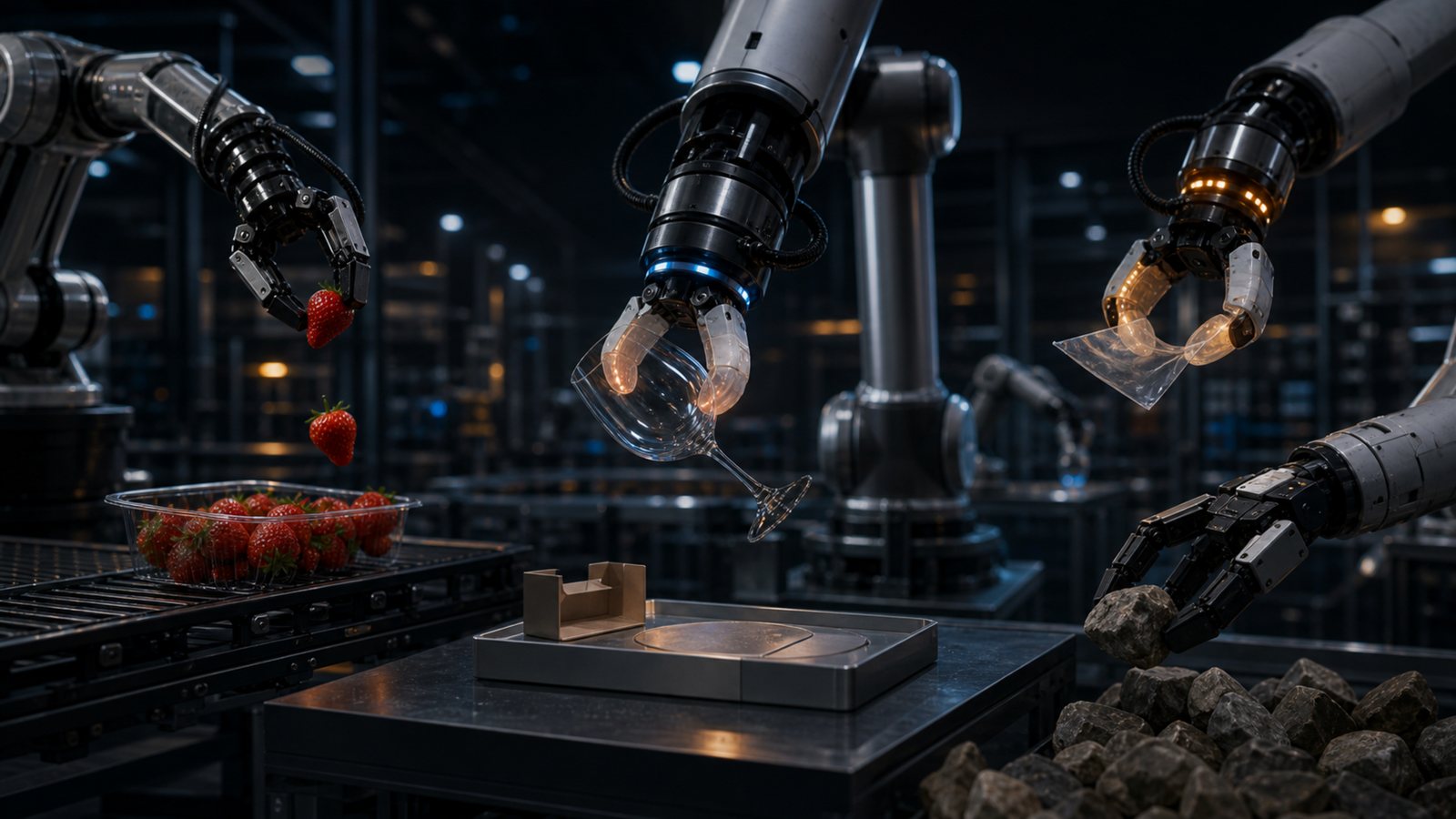
Picking up objects is harder than recognising them. A robot has to judge how firmly to grip something, detect when it begins to slip and adjust without crushing or dropping it. Proprioception gives the machine an internal sense of where its joints are and how they are moving. Force sensors measure the push or pull through a joint; tactile sensors measure contact at the hand or skin. This is the field explored in the site’s earlier article on why better AI increases the value of robot touch. Driving data cannot teach a hand how a soft bag deforms or how much force a glass can tolerate.
The mechanical engineering presents the same mixture of familiar and new work. XPeng already understands battery management, power electronics, cooling, electrical safety and motor control. An actuator—the motor, gears and controller that move a robot joint—has different demands from a car’s traction motor. It must be compact, quiet and able to reverse direction continually. Designers need high torque without excessive weight or looseness in the gears. Hands place similar components in an exceptionally small space and repeat the same movements thousands of times.
XPeng’s purchasing and manufacturing experience may save more time than any individual component. It already buys electronics and mechanical parts in large quantities, checks that suppliers can meet quality standards and traces failures back through production. Its factories have measurement systems, automated assembly, end-of-line tests and engineers who know how to turn prototypes into repeatable products. Dogotix will still need robot-specific tooling, tests and repair procedures, but it does not have to spend its first few years creating a manufacturing organisation from scratch.
XPeng told analysts that more than 85% of IRON’s suppliers also serve its automotive business. That refers to the companies in the supply chain, not to parts carried over from an XPeng car. The company has not said that 85% of IRON’s bill of materials—the itemised cost of everything used to build it—is shared with a vehicle.
IRON’s specification changed on the way to production
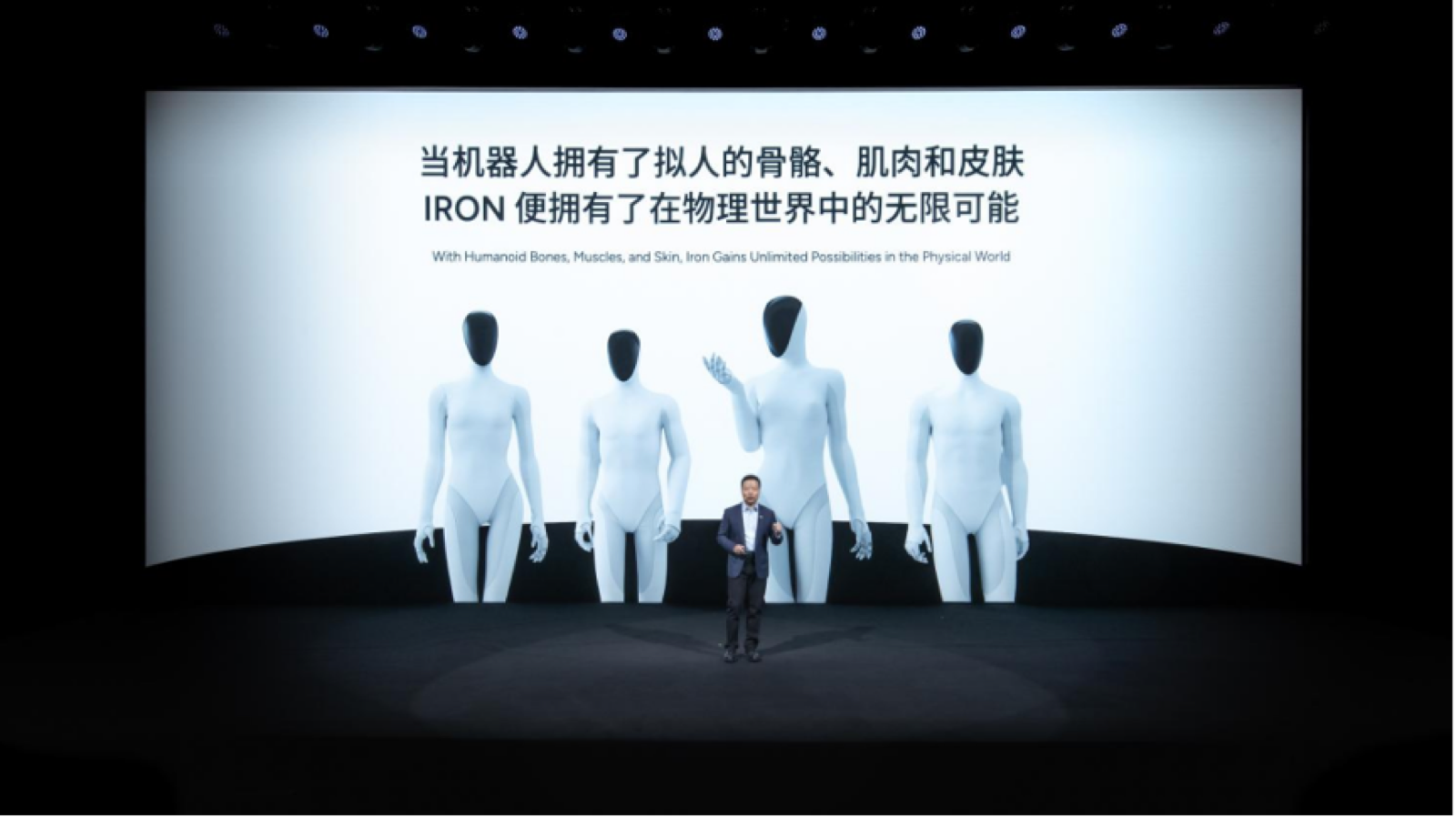
XPeng showed the first public IRON in 2024. At its November 2025 AI Day, it presented a much more human-looking machine with a flexible outer covering, a “bionic” spine and synthetic muscles. XPeng counted 82 degrees of freedom across the body and 22 in each hand. A degree of freedom is one independently controlled movement: a simple hinge has one, while a shoulder or wrist has several.
The 2025 robot walked across the stage with a smooth, rolling gait that led some viewers to wonder whether a person was inside. XPeng opened part of the covering during the event to show the mechanism. The demonstration established that the machine could walk convincingly in a prepared setting. It did not reveal how long the battery lasted, how much it could carry or whether it could complete useful work without help.
XPeng said that version used a solid-state battery and several kinds of AI model. A vision-language model, or VLM, connects images with words. A vision-language-action model, often shortened to VLA, also produces actions, such as moving towards an object after receiving a spoken instruction. The robot-specific system described by XPeng was intended to connect vision and language to physical tasks.
The production-oriented IRON described in the August 2026 financing announcement has 76 degrees of freedom across its body and 21 in each hand. Three Turing chips provide a claimed 2,250 TOPS, or trillion operations per second, using the low-precision arithmetic common in AI. TOPS is a rough measure of computing capacity, not a score for intelligence or practical performance. XPeng says its main AI model runs on the robot without a remote human controlling it and that the group designs the chips, controllers, movement modules and hands.
XPeng has not explained why the joint count fell. It may have simplified the robot for manufacturing or reliability, or merely changed the way it counts movement. The earlier machine was reported to be about 178cm tall and to weigh about 70kg, but those figures should not be treated as specifications for the 2026 version. XPeng has not published its current height, weight, battery capacity, running time, recharge time, payload, walking speed or resistance to dust and water. Nor has it released figures for the working life of the joints and hands or the average time between failures.
Public demonstrations show human-like walking, gestures and guided interactions. XPeng’s 2025 environmental, social and governance report names tours and shopping assistance as early jobs and describes work with steelmaker Baosteel on industrial inspection. It has not shown how often IRON completes those tasks successfully during a full shift at a paying customer.
The factory target is ahead of the order book
XPeng says it will begin producing IRON at scale by the end of 2026. The first machines are due to work in XPeng stores and on its campuses. Deliveries to outside retail and service customers in China and overseas are planned for 2027. On the second-quarter earnings call, He Xiaopeng said the monthly production capacity could reach several thousand robots from the middle or second half of 2027, provided demand justifies it. Brian Gu said it was too early to forecast how many would actually be made.
Reports of approximately 1,000 robots a month should not be read as current delivery guidance. Factory capacity is the maximum a line may be able to make. Actual output can be much lower, and a robot placed in an XPeng shop is different from one bought by an outside customer. Even a paid pilot does not show that the customer will return for a larger order.
XPeng says the production base is under construction, and some of the new money is earmarked for factories that will assemble the robot from start to finish. It has not disclosed firm customer orders or enough detail to judge how quickly those lines will fill. Baosteel is described as an application partner, but XPeng has not announced a binding order for a stated number of IRON robots.
Why XPeng is starting in shops
Many competing humanoid developers have gone first to factories and warehouses. Figure has worked with BMW; Apptronik has programmes with Mercedes-Benz, GXO and Jabil; Agility Robotics designed Digit to move containers; Tesla initially put Optimus to work in its own manufacturing operations. These workplaces repeat tasks, making it easier to measure speed, quality and labour savings.
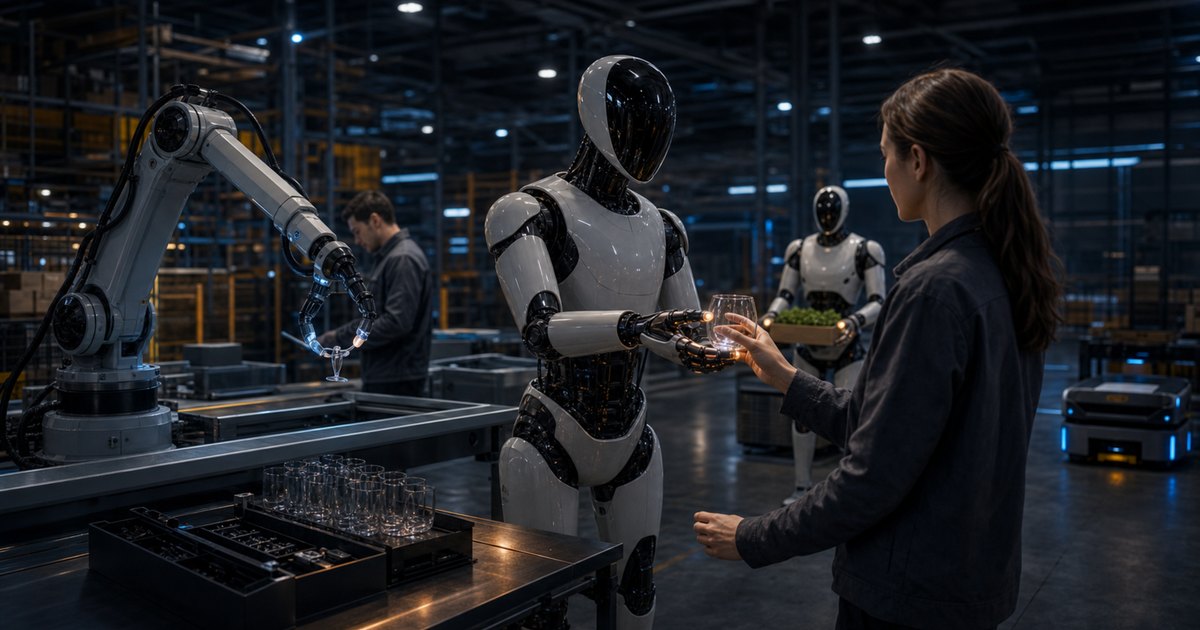
XPeng is beginning with reception, guiding visitors and retail assistance. IRON’s human appearance suits those roles, while XPeng’s network of roughly 740 stores gives Dogotix somewhere to put its first fleet. The surroundings are real and public, but the company controls them and has staff nearby when a robot needs help.
Management says these encounters will also feed what it calls a data flywheel: robots gather real-world interactions; engineers use the data to improve the Physical AI models that connect perception to movement; better models allow more jobs; more jobs produce more data. Stores expose IRON to changing layouts, visitors who behave unpredictably and a much wider range of speech and movement than a fixed factory cell.
Owning the first fleet should make it easier to record failures consistently, update every robot and compare the results across sites. The value of the resulting data will depend on what IRON actually does. Conversation and walking may improve a guide robot, but they teach relatively little about sorting parcels, loading a machine or handling unfamiliar objects.
Privacy rules may limit what can be recorded in public, and raw video is cheap compared with carefully labelled examples that show the instruction, the attempted movement, the human intervention and the eventual result. Rivals can collect similar material through remote-control centres, simulation and their own customer fleets. Dogotix will gain an enduring data advantage only if it can turn store interactions into robots that fail less often in tasks for which customers will pay.
What would make an expensive robot worth buying?
Dogotix’s short financial record consists mainly of spending. The HKEX filing reports unaudited losses after tax of RMB87 million in 2024 and RMB369 million in 2025. It gives no robot revenue, unit sales or outside customer count. Dogotix may have received small amounts that XPeng has not reported separately, so it would be wrong to state that revenue is zero. No appreciable external revenue has been identified in the public record.
The parent is operating on a different scale. XPeng delivered 103,295 vehicles in the second quarter of 2026 and collected RMB19.74 billion in revenue. Its total gross margin—the share of sales left after the direct cost of the products and services—was 20.7%. The vehicle margin was 12.1%. XPeng spent RMB2.91 billion on research and development and lost RMB1.34 billion in the quarter. Cash, restricted cash, short-term deposits and investments totalled RMB40.48 billion at the end of June. Deliveries reached 204,004 vehicles in the first seven months of the year.
Management believes one IRON could eventually generate more revenue and gross profit over its life than an average XPeng car, through the initial machine, software subscriptions and AI upgrades. He told analysts that robot prices in the market often run at 2.5 to three times their bill of materials and said IRON’s hardware margin should exceed the company’s vehicle margin. Brian Gu has also been reported as suggesting that a mature robot business could achieve a hardware gross margin above 50%. XPeng has not published a cost model to support either forecast.
A 50% hardware gross margin would require a US$100,000 robot, for example, to carry no more than US$50,000 of costs recognised as goods sold. Scarcity may support that price at first. Competition from Unitree and other Chinese manufacturers is already pushing hardware prices down. Actuators and dexterous hands remain expensive, while three AI chips, batteries, sensors, safety systems, the flexible covering and precision assembly all add cost. Warranties, replacement parts, field engineers and failed machines still have to be paid for, even if some appear elsewhere in the accounts.
Software could raise the profit earned over a robot’s life. Dogotix might charge for new task software, model improvements, fleet management, monitoring and maintenance. Customers will keep paying only if the machine saves more than it costs. A robot priced at several times a worker’s annual wage could still make sense if it works long shifts for years. The same machine could be uneconomic if it often needs a human to rescue it, breaks down regularly or takes weeks of engineering to learn each new task.
This is why the cost of a useful autonomous working hour is more revealing than the sticker price. It captures how much of the day the robot actually works, the cost of the people who supervise it, energy and repairs, and how long the machine lasts. Neither XPeng nor its main rivals publish enough information to calculate it.
How Dogotix compares with other humanoid companies
Private companies disclose funding and operating results unevenly, so the comparison below uses only figures that can be tied to company announcements, filings or high-quality financial reporting. Production targets and internal deployments are kept separate from paid work for outside customers.
Swipe to compare →
| Company | Latest relevant financing | Valuation | Production and deployment |
|---|---|---|---|
| Dogotix / XPeng IRON | US$900m conditional initial subscriptions, August 2026; US$600m from independent investors | US$5bn before the round; US$6.3bn after it under the filing assumptions | Internal and service demonstrations; scaled production targeted by end-2026; outside deliveries targeted in 2027; paid sales not disclosed. |
| Unitree | RMB6.10bn (about US$904m) STAR Market IPO, August 2026 | About US$9bn at issue; near US$50bn at first-day close | 5,511 pure humanoids shipped in 2025 and 5,215 recognised as sales, largely platform/research demand; profitable. |
| Figure AI | More than US$1bn initial Series C close, September 2025 | Reported US$39bn | BMW and other deployments; hundreds of robots described as delivered including internal/data units; customer economics not disclosed. |
| Apptronik | US$520m Series A-X in February 2026, taking Series A total above US$935m | Reported above US$5bn | Industrial pilots and programmes with Mercedes-Benz, GXO, Jabil and others; shipment volume not disclosed. |
| Humanoid | US$152m Series A, July 2026 | US$1.35bn post-money | Industrial deployments described; unit and paid-productivity data not disclosed. |
| UBTECH | Publicly listed; financing not directly comparable | Public market value changes daily | Reported 1,079 full-sized embodied humanoids sold in 2025 and batches in automotive/electronics; autonomy and productive hours undisclosed. |
Dogotix has attracted one of the largest financings given to a newly separated Chinese robot company without disclosed revenue. Larger valuations do exist. Figure was reportedly valued at US$39 billion, while Unitree briefly approached US$50 billion in its first day of public trading. Apptronik has raised more than US$935 million in its Series A, although that total came through an initial round and a later extension. Tesla’s Optimus programme cannot be separated reliably from the value of Tesla’s car, energy and AI operations, so it is omitted.
A wider review appears in Humanoid Robots in 2026: Unitree’s IPO, China’s Lead and the Race to Make Robots Useful. Unitree disclosed revenue, profit and definitions for sales and shipments before it listed. Dogotix has disclosed the financing terms and its production plan, but no comparable operating figures.
China’s EV supply chain is becoming a robot supply chain
An XPeng engineer developing a humanoid is close to companies already making motors, batteries, power electronics, cameras, controllers, sensors, circuit boards and precision automotive parts. Many grew alongside China’s huge electric-vehicle industry. They have production equipment, engineering staff and experience supplying demanding customers, which can shorten the time needed to redesign a component and bring down its cost.
Factories in the Pearl River Delta, Yangtze River Delta and other manufacturing centres also offer machining, electronics assembly and automated testing within a dense supplier network. Unitree’s falling robot prices give one indication of what can happen when components become easier to buy and manufacturers learn how to assemble them in volume. XPeng enters this market with existing purchasing contracts, quality engineers and factories of its own.
Government policy adds money and early places to use the machines. The Ministry of Industry and Information Technology’s 2023 plan called for progress in robot control, limbs and key components, a secure domestic supply chain and internationally competitive companies by 2027. Later national planning included embodied intelligence among the industries China wants to develop.
Local governments finance industrial parks and training centres, arrange demonstration projects and procurement, and offer incentives for suppliers to make components domestically. Shared test facilities allow developers to gather data in factories, care settings, shops and public services. This helps parts manufacturers and robot companies gain experience before private demand is large enough to support them.
An ageing workforce and pressure to raise manufacturing productivity provide a longer-term reason to automate. Government-backed orders can also make the young market look further advanced than it is. A robot sold to a training centre or research institute is still a sale, but it does not show that a factory, warehouse or retailer can earn a return from using it every day.
The operating numbers XPeng has not published
XPeng has published almost none of the operating data needed to judge whether IRON is commercially useful. The filing gives no paid external deployments, prices, daily utilisation, task success rate, human intervention rate, hours between failures, maintenance bill or repeat orders. A polished demonstration can show what the robot is capable of doing once. It cannot show how often the same task succeeds over hundreds of attempts.
Most humanoid companies are similarly reticent. They announce partnerships, planned factory capacity, pilot programmes and videos, while saying little about the work completed after the cameras leave. A customer needs to know:
- how many tasks the robot completes correctly each hour without help;
- how often a person has to intervene or the safety system stops it;
- how many hours it runs before something fails;
- how much time is lost to charging or changing batteries;
- what maintenance, spare parts and field support cost;
- how long installation and training take; and
- whether customers order more after operating the first machines.
A guide robot can attract visitors even when it saves no labour, and putting IRON in an XPeng store is as much product testing and marketing as it is work. Outside customers will apply a simpler test: does the robot perform enough useful hours to justify its price and support costs?
The difference between a demonstration and sustained work appears across the humanoid robotics and Physical AI research on this site. It is also a familiar problem in bringing emerging technologies into the market: technical progress creates a product only when customers can use it reliably and at a price they will pay.
Why investors may still be willing to pay $6.3bn
Most robotics start-ups have to recruit AI and hardware teams, build test laboratories, establish suppliers and work out how to manufacture the product at the same time as they develop the robot. They also need computing infrastructure, customer support and overseas distribution. XPeng already has much of this in place.
Its RMB40.48 billion cash position and RMB2.91 billion quarterly research budget give it room to fund costly development. Autonomous-driving teams already train large models, run simulations and deploy safety-related software to machines outside the laboratory. Vehicle engineers understand batteries, electrical power, cooling, interference between electronic systems and regulatory testing. Suppliers know XPeng’s quality requirements, and purchasing teams can negotiate using automotive volumes. The store network gives IRON its first workplaces, while XPeng’s overseas car business offers a starting point for service and support abroad. Robot approvals and customer relationships will still have to be earned country by country.
Dogotix can therefore spend more of its new capital improving the robot and building production lines, rather than assembling a company around it. The 85% supplier-overlap claim shows that it can call on businesses with which XPeng already works, even though the actual robot parts are often different. Separating Dogotix also brings in specialist investors, so XPeng’s car business does not have to supply every dollar.
Car companies work around multi-year model cycles, road certification and dealer service. Robot software may need much faster experiments as engineers learn how hands and bodies behave in new jobs. A shop is also a poor substitute for the factory and logistics tasks that may provide the largest early market. IRON’s human shape can make social interaction easier, but its flexible skin and numerous joints add parts that can wear or fail. XPeng has supplied a well-funded starting point. Dogotix still has to make the machine reliable, write software for specific jobs and persuade independent customers that it is cheaper or better than the alternatives.
What Dogotix will need to show by 2031
IRON does not need to become a universal household robot for today’s valuation to work. Dogotix could build a large business by performing a narrower range of service or industrial jobs reliably. By 2029–31, the evidence should be much easier to see.
The factories would need to be producing thousands of robots, rather than merely possessing the capacity to do so. Independent customers would have to buy them, use them beyond short pilots and return with larger orders. Published prices and margins would show whether manufacturing scale is reducing costs, while accounts would reveal whether software, maintenance and model upgrades are producing the recurring revenue management expects.
Dogotix would also need to release operating records from full shifts: how many hours IRON works without human help, how often it completes a task, how safely it recovers when something goes wrong and how long its hands and actuators last. Maintenance costs and time out of service would allow customers to compare a robot with a worker or a conventional automated machine. Overseas sales would require certified products and local support, not just demonstrations or distributor announcements.
XPeng has already demonstrated that it can build sophisticated electric vehicles at scale. Independent investors are now putting US$600 million into the possibility that it can do the same with humanoid robots, at a valuation equal to more than half of XPeng’s own pre-announcement market value. Whether that price looks cheap or wildly premature in five years will depend less on how convincingly IRON walks across a stage than on how many hours it can work without somebody having to help it.
Sources and further reading
- XPeng HKEX announcement: Dogotix subscriptions, redemption rights and equity incentive plan, 24 August 2026.
- XPeng second-quarter 2026 results, 24 August 2026.
- XPeng AI Day 2025: next-generation IRON, 5 November 2025.
- MIIT Guiding Opinions on the Innovative Development of Humanoid Robots.
- Humanoid Robotics Market 2026 and the Unitree IPO analysis.