Nearly $4.9 billion of disclosed capital went into robotics companies in August. The headline number is impressive, but the distribution of that money tells a more interesting story about where investors think robotics is heading.
Research cut-off: 24 September 2026.
Robotics companies raised $4.87 billion across 162 disclosed transactions in August 2026, according to data compiled by The Robot Report. The true figure will have been higher because the value of many transactions was not disclosed. A single month is not enough to establish an investment trend, but it does show where some very large amounts of capital are currently being deployed.
This was not simply money going into companies that happen to make robots. The largest concentrations were in humanoids and legged robots, followed by autonomous vehicles, defence, artificial intelligence and consumer robotics. Further down the table is another category that deserves attention: sensing. Increasingly capable AI has changed the robotics problem. Giving a machine intelligence is only useful if it can obtain sufficiently good information about the physical world and then act on it. For robots that need to manipulate objects, vision alone is unlikely to be enough.
The shape of August’s funding
The geographical distribution is striking. The Robot Report says Chinese companies accounted for approximately $2.44 billion of the disclosed capital during August, roughly half the global total. US companies accounted for about $1.27 billion. Its published country breakdown lists China twice, at $1.91 billion and $531.5 million. Taken together, those figures reconcile to approximately the $2.44 billion quoted in the accompanying analysis. I have treated this as a presentation or classification anomaly in the source data rather than trying to reassign individual transactions.
More important than the spreadsheet anomaly is what sits behind the number. Two Chinese transactions accounted for almost $1.8 billion on their own. Unitree Robotics raised approximately $905 million in its Shanghai IPO. The offer of 40.45 million shares at RMB150.80 raised about RMB6.1 billion, while the retail tranche was more than 8,000 times oversubscribed before final allocation, according to Shanghai Stock Exchange data and Reuters reporting. Unitree has become one of the most visible Chinese robotics companies, developing both quadrupeds and humanoids and, unlike many businesses attracting humanoid valuations, already shipping robots in significant numbers.
XPENG Robotics raised more than $900 million in a Series A financing that valued the business at more than $6.3 billion after the investment. XPENG said the money would fund physical-AI model development, humanoid mass production and commercial deployment of its IRON robot. The company announcement is supported by XPENG’s formal release and its Hong Kong regulatory filing, which describes approximately $900 million of subscription proceeds before any additional investor subscription or warrant exercise.
Those two transactions distort any simple comparison between countries or technologies. Remove them and the picture becomes considerably less dramatic, although the concentration is itself useful information. Investors are prepared to put very large amounts of capital behind companies they believe could become platforms in embodied AI: systems in which AI models perceive and act through physical machines.

The Robot Report separates companies developing humanoids from companies developing both humanoids and quadrupeds. On that basis, humanoids attracted $943.8 million during August and legged robots another $930.2 million. Combined, that is approximately $1.87 billion, or around 38% of all the disclosed capital for the month. The same breakdown puts autonomous vehicles at $455.5 million, military robots at $329.1 million, AI at $299 million and military drones at $279.3 million.
Again, the figures need context. XPENG accounts for almost all of the humanoid category, while Unitree dominates the legged-robot category. It would therefore be a mistake to conclude that hundreds of humanoid companies are suddenly being showered with capital. Investors are making very large bets on a relatively small number of companies that might be capable of turning humanoid robotics from an engineering programme into an industrial product.
There is also evidence that enthusiasm has begun to collide with financial reality. Reuters reported on 21 September that Chinese regulators were applying greater scrutiny to humanoid IPO candidates amid concerns about valuations and whether revenues linked to state-backed projects reflect independent commercial demand. Enormous funding rounds demonstrate investor appetite; they do not demonstrate that the underlying economics of humanoid robots have already been solved.
Capital is moving into the robotics stack
The headline-grabbing companies build complete machines, but a robot is an assembly of enabling technologies. It needs actuators to move, sensors to understand what is happening, processors to interpret those signals, control systems to coordinate movement, software to plan actions and increasingly sophisticated AI models to decide what to do next. August’s funding data shows capital flowing into this stack as well.
Motion-control companies attracted about $104.5 million. A company classified specifically as developing force sensors raised $14.8 million, and tactile-sensor companies attracted $148 million. The force-sensor figure corresponds to a RMB100 million round for Bluepoint Touch in The Robot Report’s data; the company describes the financing more broadly as a several-hundred-million-renminbi Series D, so the chart retains the dataset’s reported category value rather than substituting a different estimate.
The tactile figure came principally from Chinese sensing and robotics company PaXini Tech. Contemporary reporting based on the company’s announcement describes a RMB1 billion strategic financing, approximately $148 million at the conversion used in the August dataset. PaXini said the round brought cumulative fundraising to RMB3.5 billion. Some commercial databases label it a Series C and report a much lower cumulative dollar total, but the company-sourced figure is the more appropriate basis here.
Put the tactile and force-sensing categories together and roughly $163 million was invested in technologies concerned with giving machines a better understanding of physical contact. It is a small number beside the $900 million being put into a humanoid manufacturer, but it may represent one of the more interesting parts of the market.
Manipulation requires more than vision
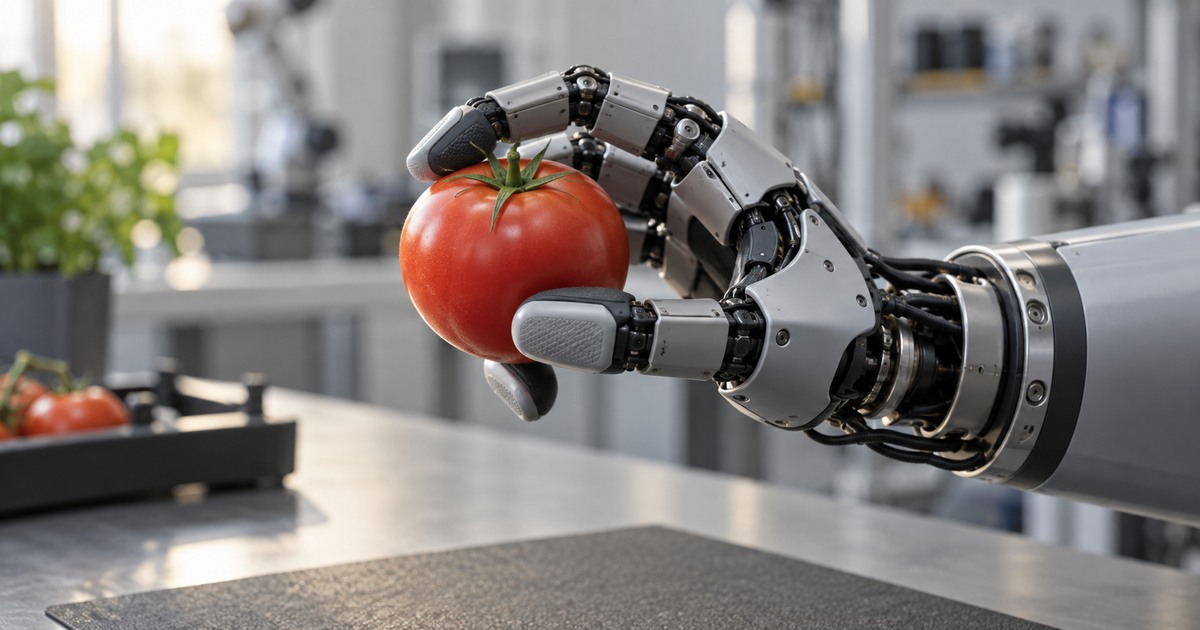
Modern robots have become extraordinarily good at seeing. Cheap cameras, increasingly powerful processors and enormous advances in computer vision mean that machines can identify objects, estimate their position and navigate increasingly complicated environments. Manipulation introduces a different problem. Consider something as simple as picking up a tomato.
A robot can use a camera to identify the tomato and calculate where it is. Once the fingers make contact, however, vision provides only part of the information needed to complete the task. The controller must determine whether the tomato is slipping, how firmly it is being held, whether one side of the gripper is applying more force than the other, whether the object has moved within the grasp and whether the robot is about to crush it. Humans answer those questions largely through touch. We do it so naturally that we barely notice the amount of information flowing through our fingertips. Robots have to acquire that information using sensors.
Tactile sensing therefore becomes increasingly important as robots move away from repetitive tasks involving rigid, predictable objects and towards environments designed for people. A welding robot operating inside a carefully engineered production cell can perform the same movement thousands of times. A general-purpose robot sorting groceries, loading a dishwasher, handling clothing or working alongside people faces a completely different problem because the physical world is variable. The robot has to feel what is happening.
Much of the current investment narrative around robotics concentrates on AI. Large models have demonstrated that machines can learn surprisingly general representations from enormous quantities of data. Applying similar techniques to robotics creates the possibility of machines learning physical tasks rather than having every movement explicitly programmed. As I argued in Bigger Brains Need Better Senses, however, better AI increases the value of sensory information rather than removing the need for it.
An AI system can only reason about information that reaches it. In a physical system, the quality, latency and volume of that information become engineering constraints. A robot does not necessarily need the maximum possible amount of data; it needs the right data. That creates an interesting inversion of the AI industry’s recent history.
Much of the progress in generative AI has come from processing enormous datasets using enormous amounts of computation. Robotics places computation inside machines constrained by power consumption, cost, latency, weight and communications bandwidth. Sending huge quantities of raw sensor data through a robot simply because processors are capable of handling it may not be the best engineering solution. Sensors that extract useful physical information efficiently can therefore have disproportionate value, particularly as the economics of AI place more emphasis on efficient computing and data architectures.
The less visible part of the robotics boom
There is an old investment cliché that during a gold rush it can be better to sell picks and shovels than search for gold. It is overused, but there is a useful analogy here. Nobody yet knows which humanoid architecture will dominate, which manufacturers will survive consolidation, how quickly costs will fall or which applications will produce acceptable returns. We can be much more confident about some of the capabilities those machines will require: actuators, efficient computing, power and, if they are going to manipulate unfamiliar objects reliably, increasingly sophisticated ways of sensing physical contact.
This does not mean every tactile-sensor company will succeed. There are competing approaches to measuring pressure, shear, slip and deformation, ranging from optical systems to capacitive, piezoresistive, magnetic and other technologies. Cost, robustness, manufacturability, calibration, integration and data-processing requirements will matter just as much as laboratory performance. There is unlikely to be one sensor architecture for every robot.
The investment data nevertheless suggests that tactile sensing is no longer being treated solely as an interesting research problem. Capital is beginning to form around it. The spectacular part of the robotics boom is easy to photograph: a humanoid running, dancing or performing a complicated manipulation makes a good demonstration. A new sensor, motor controller or piece of embedded software generally does not. Yet the commercialisation of robotics may depend as much on those less visible components as it does on the machines themselves.
The August funding figures offer a snapshot rather than proof of where the industry ultimately ends up, and they are heavily skewed by a handful of exceptionally large transactions. Beneath the headline $4.9 billion number, however, there is a useful signal. Capital is moving beyond software and into the physical technology required to make intelligent machines work. The AI boom gave machines increasingly capable brains and extraordinarily good eyes. The next engineering problem is giving them the rest of the nervous system.
Sources
- The Robot Report: Robotics investments reach $4.9B in August 2026, 17 September 2026.
- Shanghai Stock Exchange IPO information and Unitree listing announcement.
- XPENG Robotics financing announcement and regulatory filing, 24–25 August 2026.
- 21st Century Business Herald: PaXini’s RMB1bn strategic financing, 4 August 2026.
- Bluepoint Touch company news, August 2026.
- Reuters: China slows humanoid robot IPO rush as hype outruns reality, 21 September 2026.