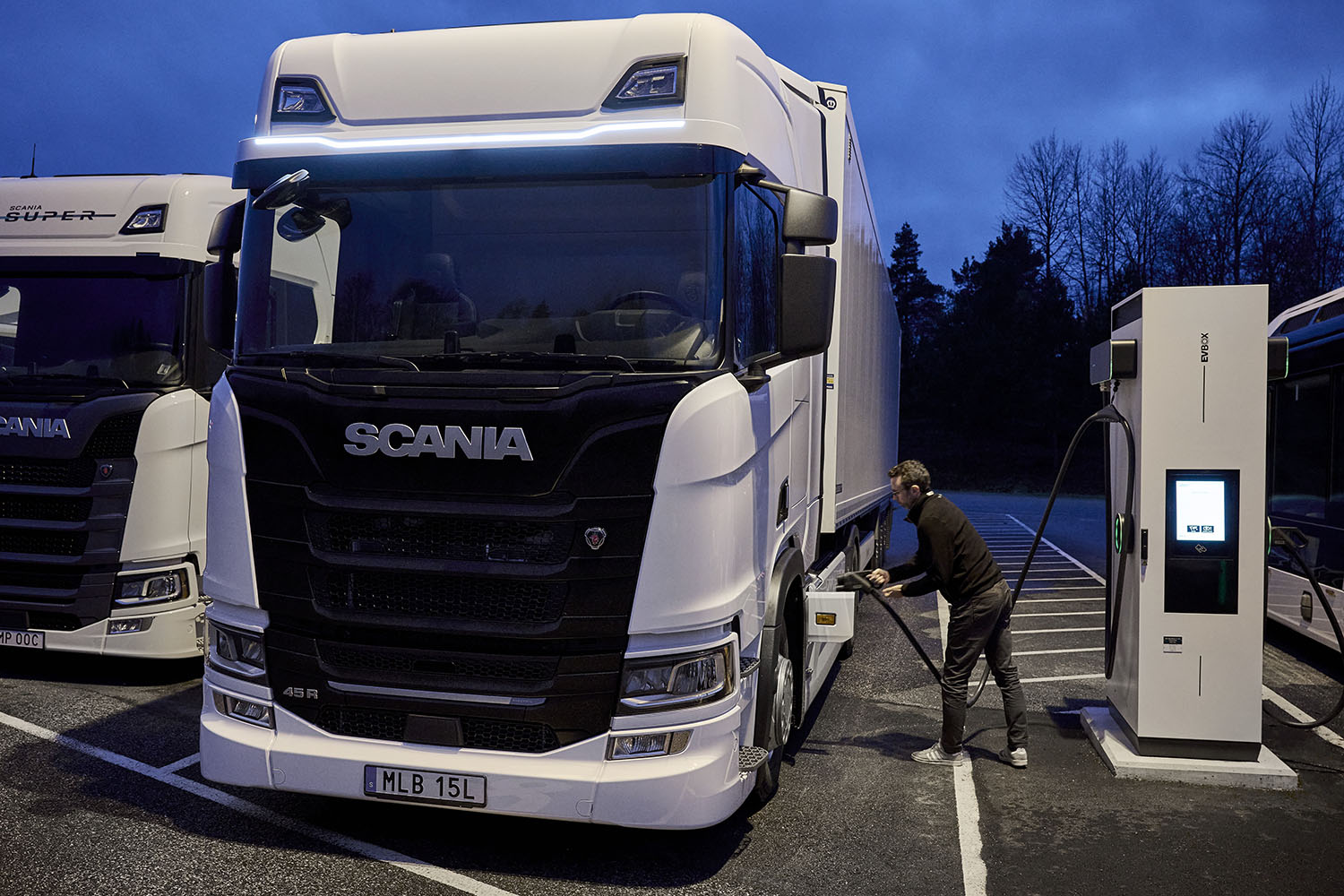
Battery payload loss is turning the business case for 44-tonne electric HGVs into a structural problem that no amount of clever routing can fix. The RHA’s March 2026 Payload Loss Survey Report — the first rigorous, operator-surveyed study of its kind — quantifies exactly how much battery weight is costing heavy freight operators, and why current UK weight regulations make the problem worse than the technology alone would suggest.
For 44-tonne operations — where the two-tonne battery derogation does not apply — the economics of electric HGVs are materially worse than diesel. The problem is not energy costs alone: operators must run more vehicles and more miles to move the same tonnage.
Until either regulations shift or batteries lose significantly more mass, this is a policy-created barrier as much as a technology one.
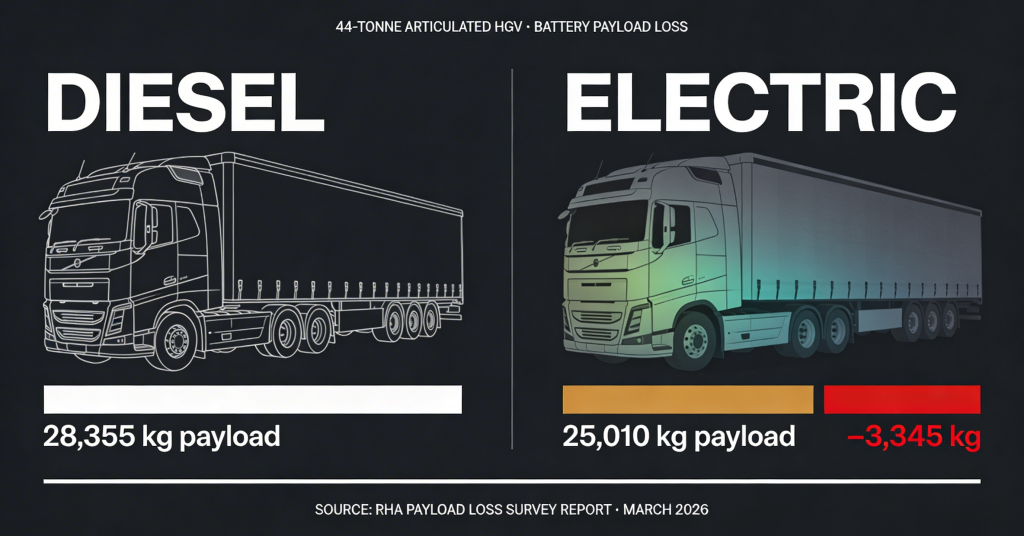
- A 44-tonne electric 6×2 tractor carries 3.3 tonnes less than its diesel equivalent — an 11.8% battery payload loss — because the electric powertrain weighs roughly 3,345 kg more.
- The existing 2-tonne derogation does not apply to the heaviest 44-tonne articulated combinations, which is exactly where the majority of UK trunking volume moves.
- Battery-electric tractors typically weigh 2–4 tonnes more than diesel; even where the derogation applies, the entire allowance is consumed by battery weight, leaving a net payload deficit.
- Running an electric 44-tonne 6×2 costs £28,282 per year more than diesel; factoring in extra miles to compensate for battery payload loss, total operating costs rise 18.7%.
- Batteries are projected to be only ~20% lighter by 2040 — insufficient to resolve the payload penalty within UK decarbonisation timelines.
How Battery Payload Loss Works in Practice
The battery payload loss problem in heavy electric freight is not principally a battery problem. It is a regulatory geometry problem — and the RHA survey is the first piece of industry evidence to make that case with hard operator data from 114 respondents.
The RHA modelled two real Volvo FH vehicles. The diesel 6×2 tractor has a kerb weight of 8,145 kg. The electric equivalent comes in at 11,490 kg. Both are plated at 44,000 kg gross. With a standard 7,500 kg unladen trailer, the diesel combination yields 28,355 kg of payload; the electric yields 25,010 kg. That 3,345 kg gap is not recoverable through better routing, smarter scheduling, or clever contracting. It is structural, baked into the vehicle.
11.8% Battery payload loss on a 44T electric 6×2 vs diesel£28,282 Extra annual fuel cost, electric 6×2 vs diesel equivalent18.7% Total operating cost increase once extra journeys are included57% Operators who cannot complete half their deliveries at 22T payload
| Configuration | Derogation? | Payload Loss | Extra Annual Cost | Total Cost Δ |
|---|---|---|---|---|
| Electric 6×2 (44T) | ✕ Not applicable | 11.8% (3,345 kg) | £28,282/yr | +18.7% |
| Electric 4×2 (40T) | ✓ Applies | 4% (1,035 kg) | £15,738/yr | +10.4% |
| Diesel 6×2 (44T) | n/a | None | Baseline | Baseline |
| Electric 6×2 (46T proposed) | ✓ Proposed fix | Near zero | £−1,855/yr saving* | −1.2%* |
*Projected saving assumes payload parity and depot electricity at £0.25/kWh. Source: RHA Payload Loss Survey Report, March 2026.
For the 4×2 configuration, where the 2-tonne derogation applies, battery payload loss shrinks from 11.8% to 4%, and the annual cost premium drops from £28,282 to £15,738. The derogation demonstrates that regulatory adjustment directly improves commercial viability. But it was not extended to six-axle 44-tonne artics, which dominate British long-haul trunking.
The cost arithmetic compounds relentlessly. Annual diesel fuel cost: £47,117. Annual electric charging cost adjusted upward by 11.8% for extra trips: £63,080. That £15,963 energy gap then multiplies through additional driver hours, tyre wear, and maintenance. In a 2% margin sector, an 18.7% cost increase is not a rounding error.
Why Battery Payload Loss Matters for UK Decarbonisation
The UK has over 534,100 HGVs on its roads. Fewer than 1,000 are electric. The RHA report lands at a moment when the government is consulting on a
new heavy vehicle CO₂ emissions framework that would mandate phase-out of new diesel HGV sales from 2040. If the economics of the transition are structurally broken for the heaviest vehicles — which carry the largest share of freight by volume — the phase-out timeline does not become greener. It becomes fiction.
If weight limits remain unchanged, operators wanting to move the same tonnage with electric trucks must run more vehicles. That means more drivers (the RHA forecasts 60,000 new HGV drivers needed per year for five years), more road movements, and more congestion. The “lighter” fleet option is not lighter on infrastructure at all.
This is also directly relevant to hydrogen. As I have argued in Hydrogen HGV Decarbonisation UK, battery payload loss is precisely where hydrogen drivetrains hold a structural advantage: hydrogen fuel cell tractors add approximately 1,000–1,200 kg to kerb weight versus 2,400–4,500 kg for battery systems at comparable range. At fleet level, that means 5–8% more vehicles needed versus 15–25% for battery-electric.
Three Regulatory Constraints Behind Battery Payload Loss
The RHA identifies three overlapping constraints, each of which needs to be addressed independently for 44-tonne electric operations to become commercially viable.
Gross Weight Cap
The 44-tonne limit is hard. The 2-tonne derogation does not extend to six-axle artics, so battery weight directly reduces payload with no regulatory relief.
RHA ask: raise to 46T
Axle Weight Limits
Drive axle limits remain at 10.5T, unchanged from the diesel era. Battery mass concentrates around specific axles, so operators hit the axle limit before the gross weight ceiling.
RHA ask: raise to 12.5T
Length & Turning Circle
Three-axle electric tractors need a longer wheelbase for batteries, but this breaches length regulations or turning-circle requirements, forcing operators toward underpowered 4×2 configs.
RHA ask: technical review
Operators are trapped between a vehicle that is too long for the rules and one that is too light for the job. This is not an engineering failure; it is a regulatory mismatch.
What the Industry Is Getting Wrong on Battery Payload Loss
Two things. First, the debate has been dominated by energy costs and range — both legitimate concerns, but neither is the binding constraint at the 44-tonne end of the market. Battery payload loss is. The survey shows 74% of deliveries could theoretically be completed within a 300-mile electric range if charging existed at the delivery point. Range is largely solvable with infrastructure. Battery payload loss is not solvable without either better batteries or different rules.
Second, the “wait for lighter batteries” argument is weaker than it sounds. The RHA cites University of L’Aquila research projecting approximately 20% mass reduction in battery technology by 2040. A 20% reduction in a 4,500 kg battery pack saves 900 kg — helpful, but not sufficient to close a 3,345 kg battery payload loss gap within UK decarbonisation timelines.
Implications of Battery Payload Loss by Stakeholder
For operators and fleet managers
The 18.7% total cost premium is a defensible, evidenced figure for contract renegotiations and investment cases. The Real-World Fleet TCO Calculator models battery payload loss, duty cycles, and fleet sizing — including the compounding effects of extra vehicles and driver costs that manufacturer tools omit. The
Commercial Fleet TCO Calculator lets you compare total cost of ownership across powertrain options directly.
For investors in zero-emission freight technology
The regulatory risk is real but directional. The EU is already moving toward a 4-tonne allowance for zero-emission lorries under a proposed revision to the Weights and Dimensions Directive. UK alignment would be commercially logical. Assets predicated on 44-tonne electric being viable under current rules are exposed. Those predicated on regulatory normalisation — whether in 18 or 36 months — are in a better position.
For policymakers
The RHA’s ask is precise: increase gross vehicle weight for affected electric HGVs to 46 tonnes, raise the drive axle limit to 12.5 tonnes, and convene a technical working group on length and turning-circle rules. The baseline comparison is not “46-tonne electric versus 44-tonne diesel” — it is “46-tonne electric versus 44-tonne diesel plus 15–25% more diesel journeys.” The road wear calculus changes significantly when framed correctly.
For hydrogen technology developers
The RHA’s payload data, combined with the Zero-Emission HGV TCO analysis published in November 2025, underlines the structural case for hydrogen in the heaviest use cases. Even without regulatory relief, hydrogen preserves near-diesel payload where battery payload loss remains material.
Batteries do not fail the economics of heavy freight on their own. Battery payload loss becomes a critical problem when outdated weight rules force operators to pay for battery mass with payload rather than with permissible gross weight. Fix the rules — or build the battery technology that makes the rules irrelevant — and the economics start to look like a solvable problem. Leave both unchanged, and the UK will attempt a mandatory transition to zero-emission HGVs while structurally incentivising operators to stay on diesel.
The RHA’s survey is not a complaint. It is a measurement. The question now is whether the response will be proportionate to what has been measured.