
This is not really a story about hydrogen prices.
It is a story about who ultimately receives the value created by decarbonisation policy.
For years Germany’s THG quota system generated compliance obligations and certificate trading activity that was largely invisible to end users. Now, for perhaps the first time, that value is appearing directly at the pump.
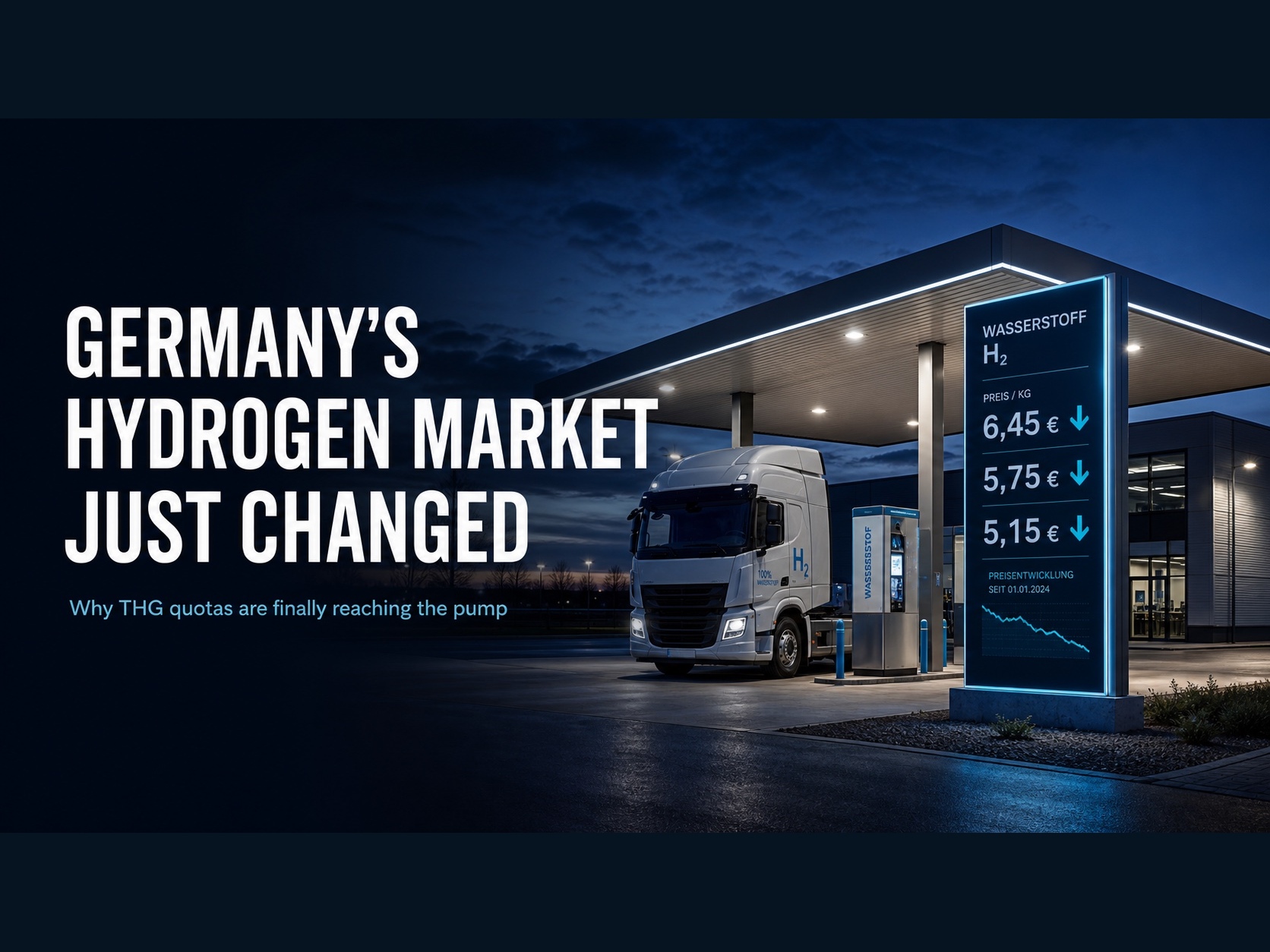
H2 MOBILITY Germany has announced a 10% reduction in the price of renewable hydrogen at five of its highest-volume stations from 1 June 2026. The reduction applies to both 350-bar and 700-bar refuelling at Berlin Tempelhofer Weg, Düsseldorf Höherweg, Frankfurt Hanauer Landstrasse, Mannheim and Munich Detmoldstrasse.
The immediate benefit is lower German hydrogen prices for the customers using those stations. The more important development is the commercial mechanism behind the cut. H2 MOBILITY says higher utilisation and the ability to market verified greenhouse-gas reductions under Germany’s reformed THG quota are allowing it to share economic value with customers.
That changes the economics of hydrogen. The fuel is no longer being sold only as a molecule. It is also being monetised as a verified compliance outcome.
Why This Matters
Hydrogen refuelling has been trapped in a familiar infrastructure problem. Stations need throughput to reduce unit costs, but fleets hesitate to adopt vehicles until fuel is available, reliable and competitively priced. Low demand produces high prices. High prices suppress demand.
The German hydrogen market is showing one way to weaken that loop. Instead of waiting for equipment costs to fall or utilisation to rise far enough on their own, policy creates a second source of value linked to verified emissions reductions.
This is significant because a hydrogen station has a difficult cost base. The operator must recover capital expenditure, maintenance, electricity, compression, storage, delivery, rent, staffing, payment systems and the cost of maintaining high uptime. At low throughput, those costs are divided across too few kilograms.
A compliance revenue stream does not remove those costs. It changes how much of them must be recovered from the pump price.
Infrastructure Changes When Revenue Streams Multiply
The most important infrastructure projects often become viable not when costs fall, but when additional revenue streams emerge. Germany’s hydrogen market increasingly rewards operators not just for dispensing fuel, but for delivering verified emissions reductions.
What H2 MOBILITY Actually Announced
H2 MOBILITY’s announcement is deliberately targeted. It is not a network-wide reduction and it is not evidence that every hydrogen station in Germany can immediately lower prices by 10%.
The company selected five high-volume locations. That matters because utilisation is already one part of the economic case. More kilograms dispensed allow fixed station costs to be spread across more transactions. H2 MOBILITY also says it is now able to market the greenhouse-gas reduction created by renewable hydrogen and share that value with customers.
The reduction therefore reflects two reinforcing effects:
- Better station utilisation, which improves conventional hydrogen fuel station economics.
- Compliance value, which creates revenue from the avoided emissions associated with eligible renewable hydrogen.
The distinction is important. The announcement should not be read as proof that certificates alone fund the entire price reduction. It should be read as evidence that operational scale and policy value can combine to move retail pricing.
H2 MOBILITY has also said that further price reductions may follow during 2026. If that happens, the market will be able to see whether this is a limited intervention at mature sites or the start of a broader restructuring of hydrogen retail economics.
Understanding Germany’s THG Quota System
Germany’s Treibhausgasminderungsquote, usually shortened to the THG quota, requires companies placing fossil fuels on the transport market to reduce the greenhouse-gas intensity of those fuels. Obligated suppliers can comply through qualifying lower-carbon fuels and energy, or by acquiring recognised emissions-reduction value generated elsewhere.
That creates a compliance market. Avoided emissions become measurable, certifiable and tradable.
The system is designed to make fossil fuel suppliers internalise part of the cost of transport decarbonisation. Instead of government paying every clean-fuel provider directly, obligated companies create demand for eligible emissions reductions.
Germany’s reforms strengthen this mechanism. The THG quota is intended to rise over time, while multipliers and sub-quotas increase the strategic value of certain fuels, including RFNBOs. Greater compliance demand should, all else being equal, increase the value attached to verified low-carbon outcomes.
This resembles early renewable electricity support mechanisms. A renewable generator did not only sell electricity. Depending on the market, it could also sell a renewable certificate, receive a feed-in tariff or benefit from an obligation placed on suppliers. Policy added a second economic layer to the same physical unit of energy.
Hydrogen is now moving in the same direction.
Why RFNBO Hydrogen Is Different
RFNBO means renewable fuel of non-biological origin. In practice, renewable hydrogen is the most commercially important example. The classification matters because not all electricity-based hydrogen automatically qualifies.
European rules require eligible RFNBO production to meet demanding standards around renewable electricity, additionality, timing and geography. The intention is to ensure that electrolysers contribute to genuine emissions reductions rather than simply diverting existing renewable electricity or drawing carbon-intensive grid power.
Those rules create cost and complexity. Producers need credible electricity sourcing, auditable production data and a chain of custody that survives scrutiny. Certification is not an administrative detail added after production. It is part of the product.
That makes RFNBO certification a commercial asset. A kilogram of certified RFNBO hydrogen can have a different market value from a physically similar kilogram that cannot demonstrate eligibility.
This is why discussion of hydrogen as an energy carrier is incomplete without discussion of documentation. In a compliance market, provenance can be as economically important as pressure, purity or delivery location.
How Hydrogen Is Now Being Sold Twice
The phrase “sold twice” does not mean double counting. The same environmental benefit cannot legitimately be claimed by multiple parties under a well-designed system.
It means that one operational activity creates two distinct forms of value:
- The customer buys hydrogen for its fuel value.
- The eligible emissions reduction creates compliance value that can be monetised through the THG quota system.
This is familiar across infrastructure markets. A waste-to-energy plant can earn gate fees and sell energy. A battery can earn from several grid services while using the same physical asset. A renewable generator can sell electricity and environmental attributes.
Hydrogen stations have often been modelled too narrowly. Revenue is assumed to equal kilograms dispensed multiplied by the pump price. That is still the core transaction, but it is no longer the whole business model.
When certificate income is retained entirely by intermediaries, customers see little change. When some of that income is used to reduce retail price, policy begins to influence adoption directly.
Hydrogen Is Becoming A Two-Sided Market
Hydrogen infrastructure operators increasingly sit between two paying markets.
On one side is the vehicle operator, industrial user or fleet buying the molecule. That customer values usable energy, refuelling speed, range, uptime and predictable cost.
On the other side is a compliance market paying for verified emissions reduction. That market values auditability, eligibility, carbon intensity, chain of custody and regulatory scarcity.
The hydrogen station connects the two. It is not merely a pump. It is a point where physical fuel, digital evidence and compliance demand meet.
Many hydrogen business cases underestimate infrastructure viability because they under-model certificate revenues. They model the costs of RFNBO compliance but fail to model the income that certification can unlock. The resulting analysis treats documentation as overhead rather than as a route to market.
The opposite error is also dangerous. Certificate revenue is variable, regulation-dependent and exposed to changing supply, demand and verification rules. It should not be treated as guaranteed annuity income. Investors need price scenarios, eligibility stress tests and a clear understanding of who owns the environmental attribute.
The emerging hydrogen station business model is a physical fuel business with a regulated environmental-attribute business attached.
The Economics Behind The 10% Price Reduction
A 10% reduction is commercially meaningful because fuel price is one of the most visible barriers to hydrogen mobility. It affects operating cost immediately and it influences whether fleets see the technology as capable of moving beyond subsidised trials.
The economics can be expressed simply:
Required pump revenue = delivered hydrogen cost + station operating cost + capital recovery + margin – net compliance revenue.
Each term matters. Lower production costs help. Higher throughput helps. Better logistics help. Grants and green hydrogen subsidies can reduce capital recovery. Compliance revenue reduces the amount that must be collected from customers.
The value of hydrogen compliance credits is not fixed. It depends on certificate market conditions, the carbon intensity of the hydrogen, the applicable multiplier, verification costs, contracting arrangements and the share retained by traders or other participants.
That means the commercial impact will vary by station and supply chain. A high-volume site dispensing well-documented RFNBO hydrogen is better placed to convert compliance value into a pump-price reduction than a low-volume site with uncertain supply provenance.
Volume and certification reinforce each other. More fuel creates more potential compliance value. Lower prices can attract more customers. More customers improve utilisation. That is the flywheel H2 MOBILITY is trying to start.
What Most Hydrogen Commentary Gets Wrong
Hydrogen commentary is still dominated by technology arguments: electrolyser efficiency, fuel-cell efficiency, storage losses and whether batteries are superior. These questions matter, but they do not determine infrastructure deployment on their own.
Markets deploy assets when revenues can cover costs at an acceptable risk-adjusted return. Regulation changes both revenues and risk.
A hydrogen station can remain technically unchanged while its economics improve because a quota becomes more demanding, an RFNBO multiplier changes, a certificate market becomes liquid or an obligated buyer signs a long-term contract.
The reverse is also true. A technically impressive station can become unfinanceable if policy support is withdrawn, certification fails, certificate ownership is disputed or demand remains too fragmented.
Infrastructure economics are therefore increasingly driven by policy design. Anyone assessing the Germany hydrogen market without modelling the THG quota is missing part of the revenue stack. Anyone assessing it using only the most optimistic certificate value is missing part of the risk.
Why This Matters For Infrastructure Investors
For investors, the H2 MOBILITY announcement is less important as a price promotion than as evidence of revenue-stack maturation.
Hydrogen infrastructure has typically depended on some combination of grants, shareholder support and expectations of future demand. A functioning compliance market adds revenue linked to actual decarbonisation performance. That is more useful than a one-off grant because it can reward ongoing throughput.
It also changes due diligence. Investors need to assess:
- Who owns the THG quota value under supply and customer contracts.
- Whether the hydrogen consistently meets RFNBO and verification requirements.
- How certificate prices behave under different quota and supply scenarios.
- Whether compliance income is additional to, or already embedded in, the fuel price.
- How much utilisation is required if certificate revenue falls.
- Whether the station serves anchor fleets capable of supporting reliable demand.
This is the same discipline required for hydrogen infrastructure deployment in the UK: identify the real source of cash flow, allocate policy risk and avoid confusing technical capacity with commercial demand.
Certificate income can improve viability. It does not rescue poor locations, weak operations or speculative demand.
Could Other Markets Replicate This Model?
Germany may be providing a template for other European markets, but replication requires more than copying the name of the quota.
A workable system needs an enforceable obligation, clear eligibility rules, credible verification, protection against double counting, sufficient market liquidity and confidence that the policy will survive long enough to support investment.
The UK could create a similar effect through transport fuel obligations, targeted mandates or other mechanisms that reward verified RFNBO use. But policy must be designed around infrastructure behaviour. If value is absorbed upstream and never reaches fuel users or station operators, it will do little to accelerate adoption.
There is also a wider energy-system opportunity. Hydrogen production can potentially connect flexible demand with periods of low-cost renewable generation. The economics are not as simple as “use free curtailed power”, because electrolysers still need adequate utilisation and grid access. However, the relationship between wind curtailment costs, hydrogen production and compliance value deserves serious market design work.
Good policy does not merely subsidise a preferred technology. It pays for a measurable system outcome and allows competing operators to discover how best to deliver it.
What It Means For The Future Of Hydrogen Retail
Hydrogen retail is likely to become more segmented.
Stations dispensing certified RFNBO hydrogen into high-value compliance markets may be able to offer lower customer prices than stations selling hydrogen without equivalent environmental attributes. High-throughput stations will have a further advantage because they can spread fixed costs and generate more certificate volume.
This will put pressure on operators to improve data, procurement and contracting. The winning station network may not be the one with the most dispensers. It may be the one that can reliably combine low delivered fuel cost, high utilisation and defensible compliance value.
Fleet customers should also become more sophisticated. The pump price matters, but so do contract duration, availability, provenance and the allocation of certificate value. A fleet may reasonably ask whether its demand is creating an environmental attribute, who is selling it and whether part of that value should reduce the contracted fuel price.
These questions belong inside fleet decarbonisation economics, not in a separate sustainability appendix.
Final Analysis
H2 MOBILITY’s 10% price reduction is a small intervention in a still-small market. It does not settle the argument over hydrogen mobility and it does not make every German hydrogen station commercially viable.
It does show that German hydrogen prices are no longer determined only by the cost of producing, moving and dispensing a molecule.
Hydrogen now has fuel value and compliance value. RFNBO certification has become a commercial asset. Station utilisation and hydrogen certificate trading can reinforce each other. Policy design is beginning to change what customers pay.
That is what makes the announcement significant. The Germany hydrogen market is starting to reveal where the value created by decarbonisation policy can go. H2 MOBILITY has chosen to let some of it reach the pump.
If the model scales, the most consequential change will not be a single 10% reduction. It will be a shift in how hydrogen infrastructure is financed, operated and priced across Europe.
Frequently Asked Questions
What is Germany’s THG quota?
Germany’s THG quota requires companies placing fossil transport fuels on the market to reduce their greenhouse-gas intensity. Eligible renewable fuels and verified emissions reductions can create compliance value that obligated suppliers use to meet the quota.
What is an RFNBO?
An RFNBO is a renewable fuel of non-biological origin. Renewable hydrogen is the main example. To qualify, production must meet European rules covering renewable electricity sourcing, additionality, timing, geography and greenhouse-gas performance.
Why can H2 MOBILITY reduce hydrogen prices?
H2 MOBILITY says higher utilisation at selected stations and the ability to market verified greenhouse-gas reductions under the reformed THG quota allow it to pass some value to customers through a 10% price reduction.
How valuable are hydrogen compliance credits?
The value varies with certificate prices, carbon intensity, eligibility, multipliers, verification costs and contracts. It can materially improve station economics, but it should be modelled as variable policy-linked revenue rather than guaranteed income.
Could the UK adopt a similar system?
Yes. The UK could strengthen mechanisms that reward verified renewable hydrogen in transport. To affect adoption, the design would need clear eligibility, robust verification and a route for compliance value to reach infrastructure operators and fuel users.
Are hydrogen stations becoming financially viable?
Some high-utilisation stations with reliable supply, anchor demand and compliance revenue may be moving closer to viability. Certificate income helps, but it does not remove the need for strong locations, efficient operations and bankable demand.
Sources
- H2 MOBILITY: Hydrogen prices reduced at selected stations, 1 June 2026
- German Federal Environment Ministry: Development of the greenhouse-gas reduction quota
- German Federal Ministry of Justice: 37th Federal Immission Control Ordinance
- European Commission Delegated Regulation (EU) 2023/1184: RFNBO renewable electricity rules
- European Commission Delegated Regulation (EU) 2023/1185: RFNBO greenhouse-gas methodology
Last reviewed: 9 June 2026. Reviewed for H2 MOBILITY pricing, Germany’s THG quota, RFNBO rules, hydrogen infrastructure economics and internal links.