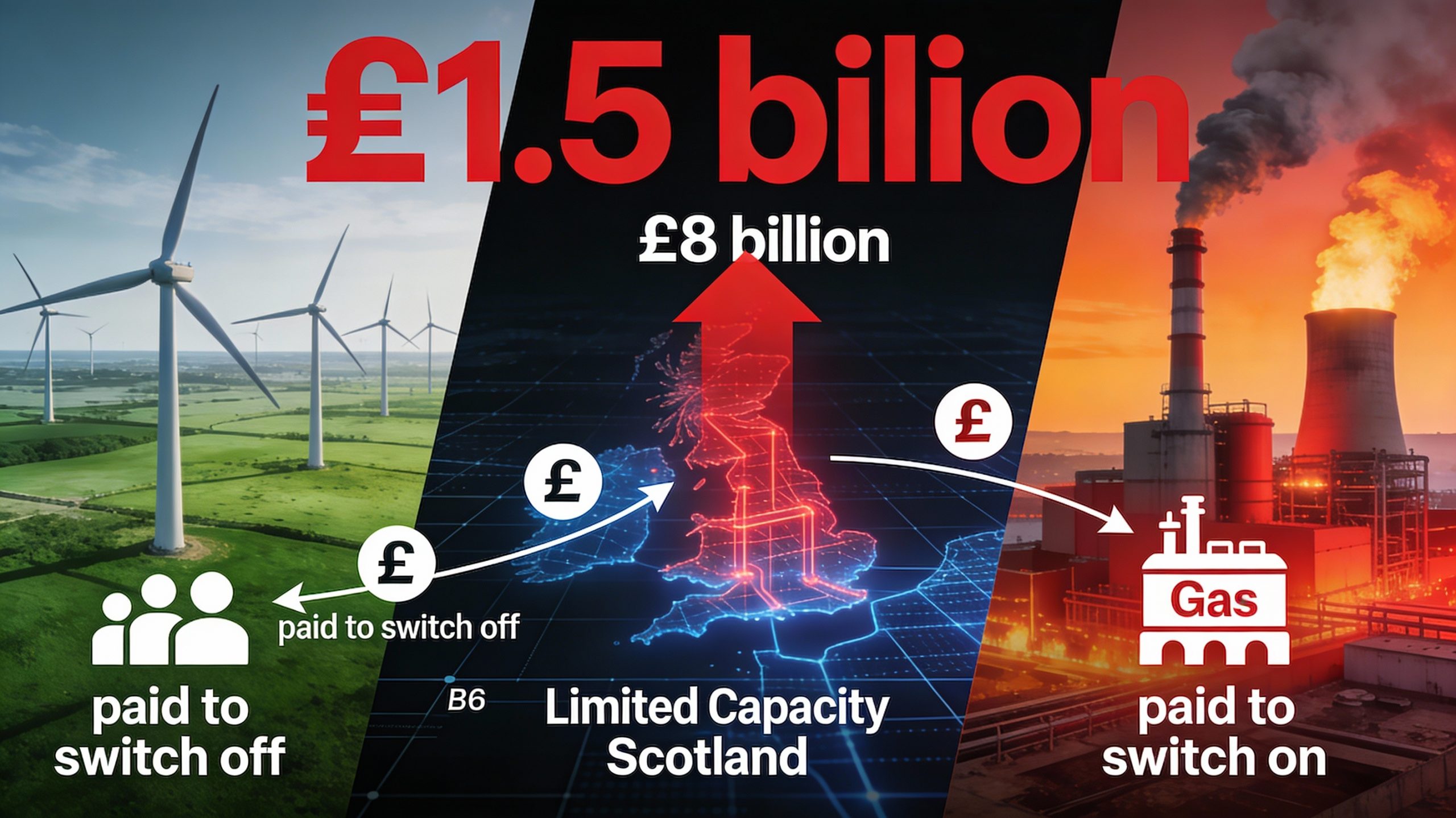
The UK spent £1.5 billion in 2025 paying wind farms to switch off and gas plants to switch on. Without urgent reform, that figure could reach £8 billion a year by 2030. This article explains why wind curtailment happens, what it really costs, and how batteries, hydrogen, demand response and grid upgrades can fix a system that pays to waste clean energy.
Who this is for?
Energy, infrastructure and industrial leaders facing grid constraints, hydrogen deployment or storage decisions. If you need to translate curtailment costs into board-level strategy or investment cases, I advise on energy infrastructure, hydrogen and industrial decarbonisation projects.
For operators, investors and policymakers: the economics of curtailment, storage and hydrogen directly affect infrastructure decisions. Use the fleet total cost of ownership model or explore the hydrogen economics and infrastructure hub for deeper analysis.
What Is Wind Curtailment – and Why Does It Matter?
Wind curtailment is what happens when grid operators pay wind farms to reduce output because the electricity network cannot safely move any more power from where it is generated to where it is needed. In the UK, that usually means Scottish wind being turned down when the transmission system into England hits its limits, even if turbines could keep spinning.
In 2025, according to figures reported by Emily Gosden in The Times and the Wasted Wind tracker run by Octopus Energy, Britain spent £1.46 billion dealing with this problem—up from £1.23 billion in 2024. About £380 million went to paying wind farm owners to switch off, down slightly from £395 million, but the cost of replacing that wasted wind with gas-fired power jumped from £835 million to £1.08 billion.
Octopus Energy summed it up bluntly: Britain paid over £1 billion in 2025 to switch off wind farms and burn expensive gas instead, and without urgent reform, these costs could soar to £8 billion a year by 2030. That is the “broken system” at the heart of this article.
If you are also wrestling with what to do when the system flips from scarcity to surplus, the companion analysis on the UK’s summer energy glut and “free electrons” problem looks at how these curtailment dynamics play through hydrogen, storage and industrial siting decisions.
How Much Does Wind Curtailment Cost the UK?
The £1.46 billion headline figure is only part of the picture. Over the last few years, wind curtailment and related constraint payments have grown from a nuisance cost into a structural problem that affects every UK electricity customer through their bills.
- 2020: Around £282 million and 3.8 TWh of curtailed wind
- 2023: About £780 million in constraint costs
- 2024: 8.3 TWh of wind energy curtailed, a 91% jump year-on-year
- 2025: £1.46 billion in total costs – £380m in “turn down” payments to wind and £1.08bn for replacement gas-fired generation
Most of this “wasted wind” comes from Scotland. Estimates suggest around 98% of curtailed wind generation is Scottish, with a handful of large offshore and onshore projects dominating constraint volumes. Seagreen, Scotland’s largest offshore wind farm at 1,075 MW, has seen curtailment rates reported above 70% in some periods, with tens of millions in annual constraint payments. Newer projects such as Viking on Shetland are seeing similar patterns from day one.
Households feel this in two ways. First, through Ofgem’s estimate that constraint costs added around £15 to a typical annual household bill in late 2025. Second, through the £60 per year that network upgrades will add by 2030, which the regulator argues is still cheaper than letting constraint costs rise unchecked. The hard truth is that bills are rising partly because we built renewables much faster than we upgraded the grid to move their power.
Why Are UK Wind Farms Switched Off? The B6 Boundary Bottleneck
The technical heart of the problem is a pinch point known as the B6 boundary—the transmission interface between Scotland and England. Think of it as a narrow bridge between two motorways. North of the bridge you have rapidly growing Scottish wind generation; south of it, most of the UK’s demand centres in England and Wales. When the “bridge” is full, you can’t push any more power across, regardless of how much wind is available.
The B6 boundary currently consists of two main AC lines plus one subsea HVDC link. That was fine when the grid was built around coal plants in the Trent Valley and gas plants on the English coast. It is not fine when you are trying to push tens of gigawatts of Scottish wind through the same limited corridors.
When the B6 boundary hits its safe operating limits, the National Energy System Operator (NESO) instructs Scottish wind farms to reduce output. At the same time, NESO dispatches gas plants and other generators south of the boundary to make up the shortfall. Consumers pay the wind farms for lost revenue (constraint payments) and pay the gas plants for the energy they produce. In 2025, that meant £380 million for turning Scottish wind off and £1.08 billion for turning English gas on.
Timing makes this worse. High-wind periods often coincide with low demand (for example, windy nights), which means prices are low, but constraints are high. Planned maintenance outages on key Scottish transmission lines and subsea cables also reduce available capacity at exactly the wrong times, driving curtailment costs higher.
How the Current Market Rewards Waste: Constraint Payments Explained
So why do wind farms get paid to switch off? The answer lies in how the UK’s electricity market and support schemes are structured.
- Contracts for Difference (CfD): Many wind farms earn a fixed “strike price” per MWh. If the wholesale price is lower than the strike price, they receive a top-up. If they are curtailed through no fault of their own, they are compensated so their revenue matches what they would have earned at the strike price.
- Constraint payments: When NESO asks a wind farm to reduce output to relieve a constraint, it must compensate them for lost income. These payments are made via the balancing mechanism and ultimately recovered from consumers.
- Replacement generation: At the same time, NESO must pay gas plants and other flexible generators south of the constraint to ramp up and replace the curtailed wind.
In some cases, companies own both assets: a constrained Scottish wind farm and a flexible gas plant in England. That creates the potential to be paid twice during the same constraint event. Octopus Energy’s Greg Jackson has described this as a “racket” that rewards incumbents for both not generating clean power and generating fossil power instead.
The key point is that under current rules, wind farms have little direct financial incentive to help reduce curtailment beyond their contractual obligations. They are made whole on revenue whether they generate or are curtailed. Gas plants are paid well for being flexible. Consumers carry the cost for both sides of the transaction.
The Great Grid Upgrade: Will Eastern Green Links Fix Curtailment?
The good news is that the UK is finally investing at the scale needed. Ofgem has approved plans for about £70 billion in high-voltage network upgrades over the next five years as part of the wider Great Grid Upgrade. The flagship projects here are the Eastern Green Links (EGL), a series of subsea HVDC “electricity superhighways” connecting Scottish wind to English demand.
- EGL1: Torness (Scotland) to Hawthorn Pit (England), 2 GW, target 2029 – already 16 months behind schedule
- EGL2: Peterhead to Drax, 2 GW, target 2029
- EGL3: Aberdeenshire to Norfolk, 2 GW, around 2033
- EGL4: Fife to Norfolk, 2 GW, around 2033
Together, these four links will add 8 GW of north-south transfer capability. Analysis suggests redesigning EGL3 and EGL4 alone will deliver £3–6 billion in net consumer benefits compared to earlier plans, mostly by avoiding constraint costs. Other onshore reinforcements and subsea links are being delivered in parallel.
The bad news: most of this new capacity does not arrive until 2029–2033. In the meantime, offshore wind is still targeting 50 GW by 2030, onshore wind aims for nearly 30 GW, and solar could reach 45–57 GW. The transmission cavalry is coming, but not soon enough to prevent curtailment costs from peaking later this decade.
Mitigation Strategy 1: Using Battery Storage Properly
Battery energy storage systems (BESS) are the fastest way to reduce curtailment without waiting for new transmission. Rather than turning wind farms off when the grid is full, batteries can absorb that surplus electricity and discharge it later when demand rises or constraints ease.
This is particularly relevant for operators evaluating infrastructure and fleet transitions, where storage and energy costs directly feed into total cost of ownership modelling.
As covered in more detail in full cost comparison of hydrogen vs battery-electric systems by 2030, utility-scale batteries have moved quickly down the cost curve and excel at short- to medium-duration storage. Their round-trip efficiency (often 80–90%) makes them ideal for daily cycling, frequency response, and intraday arbitrage.
Several studies put real numbers on the value of using batteries to tackle curtailment:
- Imperial College modelling suggests medium-duration storage (10–100 hours) could save £500m–£3.5bn per year, depending on scale and timing.
- Long-duration storage studies show that batteries positioned at key constraint boundaries (including B6) could reduce curtailment by double-digit percentages even at modest scales (500–2,000 MW).
- Industry analysis from Field Energy indicates BESS could cut curtailment costs by up to 80% if fully utilised during constraint events.
Why Aren’t Batteries Fixing Curtailment Already?
The short answer: the market and operational rules have not caught up with the technology.
- Constraint skips: Developers report that NESO often “skips” available batteries during constraint events, choosing more expensive options instead. In some cases, batteries are bypassed 90% of the time, even when they could provide cheaper flexibility.
- Balancing mechanism design: The rules for how assets bid and are dispatched in the balancing mechanism were not designed with large fleets of batteries in mind. This leads to under-utilisation and missed savings.
- Connection queues: There is over 60 GW of battery storage sitting in the connection queue, far more than the system’s 2030 target of 27 GW. Many viable projects cannot physically connect to the network before 2030.
Fixing battery under-utilisation is the fastest, cheapest lever available. It does not require new steel in the ground—just operational changes. NESO could prioritise battery dispatch during constraints when they are the least-cost option, publish constraint dispatch data to improve transparency, and adjust balancing rules in collaboration with industry. This alone could shave hundreds of millions off annual curtailment costs.
Mitigation Strategy 2: Hydrogen from Wasted Wind – When Does It Make Sense?
Hydrogen often shows up in this debate as the silver bullet: if we cannot export wind power south, why not use it to make green hydrogen in Scotland instead? The idea is compelling, especially in a country with global ambitions for hydrogen hubs and exports.
Policy Exchange and others have modelled the potential. Curtailed wind in 2022 could have produced around 118,000 tonnes of hydrogen; by 2029, curtailed volumes might support 455,000 tonnes per year. That is enough to replace most of the UK’s existing fossil-based hydrogen consumption, support green steel production, or supply a large share of sustainable aviation fuel feedstock. This links directly to the themes in the green hydrogen and SAF cost modelling and project economics work already covered here.
The Capacity Factor Problem
The challenge is that electrolyser economics are extremely sensitive to capacity factor. Electrolysers are capital-intensive. Running them only when curtailment occurs—often at unpredictable times—means very low utilisation. Several techno-economic studies show that electrolyser-only-on-curtailment models rarely achieve capacity factors above 20%, and often far lower. That pushes levelised hydrogen costs into uneconomic territory.
This is why most commercially viable hydrogen systems are analysed as part of integrated energy strategies rather than standalone curtailed-power solutions, as explored in the hydrogen economics and infrastructure hub.
Behind-the-meter configurations improve the picture by allowing electrolysers to run more of the time on wind that would otherwise have been exported. But they still face the same variability and are constrained by local grid connection, storage, and offtake infrastructure. As covered in Hydrogen | Tim Harper, capacity factor and power price are the two dominant green hydrogen cost drivers, and curtailed-only models fare badly on both.
Policy and Infrastructure Barriers
Even where the physics could work, policy gets in the way:
- The UK’s Low Carbon Hydrogen Standard (LCHS) does not currently recognise the system benefit of using curtailed power. Electrolysers that reduce curtailment can still be penalised on carbon intensity calculations.
- Transmission charges (TNUoS) treat electrolysers like any other large demand user, even when they are located behind the bottleneck and helping relieve constraints.
- Wind farms have no strong incentive to build or host electrolysers when they are already compensated for curtailment under CfDs.
- Hydrogen transport and storage infrastructure in Scotland is embryonic, making it hard to monetise hydrogen produced at scale.
The net result: hydrogen from curtailed wind remains largely theoretical today. A more realistic path is to pair electrolysers with new offshore wind under co-optimised configurations—running 40–50% of the time on contracted power, with curtailment reduction as an additional benefit rather than the primary business case. That aligns with the strategy for green hydrogen projects explored in Green Hydrogen Projects 2025.
Mitigation Strategy 3: Demand-Side Response and Flexibility
Demand-side response (DSR) turns consumers into part of the solution. Instead of adjusting supply to meet fixed demand, DSR shifts demand to better align with when renewable generation is abundant and cheap. In a constrained system like the UK’s, that means encouraging more consumption north of the B6 boundary when Scottish wind is high and export is limited.
This shift in load behaviour is already reshaping transport and infrastructure planning, particularly when analysed through fleet and infrastructure cost models.
The government’s Clean Flexibility Roadmap projects that flexibility capacity must grow from 24 GW in 2023 to 51–66 GW by 2030. Smart EV charging, vehicle-to-grid technology, heat-pump timing, smart appliances, and industrial load shifting will all be needed to hit those numbers.
Real-world trials show this is achievable and cost-effective. Octopus Energy’s “Saving Sessions” enrolled 1.4 million customers to reduce consumption during peak periods. Customers who opted in delivered 40% demand reductions during events, with invited customers reducing by around 10%. Welfare analysis indicates a £1.60–£2.60 benefit for every £1 spent—strong economics when compared to paying wind farms and gas plants for the same balancing service.
For more on how load shifting and flexibility change the economics of electrification and storage, see Operational Consequences of Electric HGV Adoption and the battery versus hydrogen storage discussion in Hydrogen vs Battery-Electric by 2030.
Mitigation Strategy 4: Microgrids and Local Energy Markets
Microgrids and local energy markets offer a more decentralised way to tackle constraints. Instead of relying entirely on long transmission lines to carry wind south, you create pockets where local generation and local demand are matched in real time.
In practice, this could mean:
- Industrial microgrids in Scotland where data centres, manufacturing, or hydrogen production are co-located with wind
- Community microgrids in remote areas with high renewable penetration and limited grid capacity
- Local constraint markets where consumers get paid to use more electricity when local generation would otherwise be curtailed
NESO’s Local Constraint Market trial in Scotland is an early example. Rather than paying wind farms to switch off, the system operator pays Scottish consumers to increase consumption at around 20p/kWh during constraint events. It is a simple idea: if you cannot move the power, move the demand.
Regulatory work like the P441 modification aims to make local energy markets easier to implement by allowing “behind the same substation” trading and simplifying settlement. But, as with hydrogen, microgrids are a complement, not a substitute, for bulk transmission upgrades. They are particularly powerful when combined with battery storage, flexible loads and local hydrogen production.
Why the UK Rejected Zonal Pricing – and Why It Matters for Curtailment
If you follow electricity market design, you will know that locational (zonal or nodal) pricing was the other big lever on the table. In 2025, after a long REMA (Review of Electricity Market Arrangements) process, the UK government decided not to move to zonal pricing, despite Ofgem’s own analysis suggesting £48–49 billion in consumer benefits between 2025 and 2060.
Under locational pricing, prices in Scotland would be lower when wind is abundant and constrained, while prices in southern England would be higher. That would send a powerful signal for new demand (like data centres, electrolysers, or industrial plants) to locate in Scotland and for new generation to favour unconstrained locations. It would also reduce curtailment costs by making it less profitable to build new wind into already-constrained zones.
The UK chose instead to stick with national pricing and rely on the Strategic Spatial Energy Plan to drive better siting decisions administratively. That protects investor certainty and avoids political arguments over regional price differences, but it also means the curtailment problem will be solved more slowly and more expensively than it could have been with sharper price signals.
A Six-Point Strategy to Cut Curtailment Costs and Maximise Clean Power
Putting this all together, what would an integrated strategy to minimise curtailment and maximise energy availability look like?
- 1. Stop underusing batteries. Reform NESO dispatch rules to eliminate constraint skips and give BESS priority during constraints when they are the cheapest option. Fast-track connections for strategically located storage.
- 2. Scale demand-side response. Treat flexibility as core infrastructure. Finish the smart meter rollout, make time-of-use tariffs the default, and support automated EV charging, heating and industrial load shifting.
- 3. Deploy hydrogen where it makes system sense. Focus on co-optimised wind–hydrogen projects with 40–50% electrolyser utilisation, not curtailed-only models. Reform the LCHS and TNUoS to recognise the value of constraint relief. Align this with the industrial and SAF-focused hydrogen work explored in Green Hydrogen & SAF and broader hydrogen strategy.
- 4. Deliver Eastern Green Links on time. Treat EGL1 and EGL2 as critical national infrastructure with visible ministerial oversight and delivery incentives. Every year of delay adds billions in avoidable curtailment costs.
- 5. Build long-duration storage. Invest in hydrogen storage (including Rough) and pumped hydro to handle multi-day and seasonal variability that batteries cannot economically cover, consistent with the grid storage role outlined in Hydrogen vs Battery-Electric.
- 6. Use local markets and microgrids where they add most value. Support local constraint markets and microgrids in the most constrained Scottish regions, turning wasted wind into local economic activity and resilience.
If implemented together, these measures could realistically save £7–10 billion in curtailment and balancing costs over the next five years, while unlocking more of the clean, homegrown power needed to deliver the UK’s 2030 targets. That is before counting the industrial and export opportunities from well-sited hydrogen projects and flexible data centre, transport, and industrial loads.
If curtailment risk is on your desk
For boards, investors and operators, this is not an abstract problem: it shows up as site selection, timing, stranded-asset risk and “energy glut” exposure in real projects. I work with teams to turn these grid and market signals into practical development and investment strategies.
Explore energy & infrastructure advisory work
Read the UK energy glut companion piece or get in touch to discuss a mandate.
FAQ: UK Wind Curtailment, Grid Constraints and Solutions
What is wind curtailment in the UK?
Wind curtailment happens when NESO instructs wind farms to reduce output because the transmission network cannot carry any more power safely, even though the turbines could physically keep generating. The UK then pays those wind farms for lost revenue and pays gas plants elsewhere to replace the curtailed power.
How much does wind curtailment cost UK consumers?
In 2025 the UK spent around £1.46 billion on wind curtailment and replacement generation, up from £1.23 billion in 2024. Ofgem estimates that constraint costs alone added about £15 to a typical household bill in late 2025, and network investment to fix constraints will add around £60 per year by 2030. Without reform, total costs could reach £8 billion annually by 2030.
Why are Scottish wind farms curtailed so often?
Scotland has some of the best wind resources in Europe and a high concentration of both onshore and offshore wind projects. But most UK demand is in England, and the transmission “bridge” between them—the B6 boundary—has limited capacity. When that boundary is full, Scottish wind cannot be exported and must be curtailed.
Can battery storage solve wind curtailment?
Battery storage cannot remove the need for more transmission, but it can significantly reduce curtailment costs, especially over the next five to ten years. Strategically located batteries can absorb surplus wind when the grid is constrained and discharge when demand is higher. The main barrier today is not technology or economics, but market and operational rules that underuse existing batteries.
Will hydrogen from curtailed wind be economic?
Hydrogen purely from curtailed wind is difficult to make economic because electrolyser utilisation is too low. More promising models combine contracted wind, grid power and some curtailment reduction to reach 40–50% utilisation, especially when hydrogen has high-value offtake in industry, transport or SAF. For a deeper dive into hydrogen economics and use cases, see the Hydrogen page and related long-form articles.
When will new transmission lines reduce curtailment?
The key Eastern Green Links projects (EGL1 and EGL2) are scheduled for around 2029, with EGL3 and EGL4 around 2033. Once complete, these will add 8 GW of north–south transfer capacity and should sharply reduce Scottish wind curtailment. However, delays have already occurred, and the next 4–6 years will still see high curtailment costs unless storage, demand response and local solutions are scaled quickly.
What’s the best way to stay updated on UK grid and hydrogen developments?
If you work in energy, transport or industrial decarbonisation and want context rather than hype, explore the Hydrogen hub, recent analysis on hydrogen vs battery-electric by 2030, and the latest field notes on AI data centres, grid constraints and energy system bottlenecks.