

Hydrogen Internal Combustion Engine (H2ICE): The Comprehensive 2026 Guide
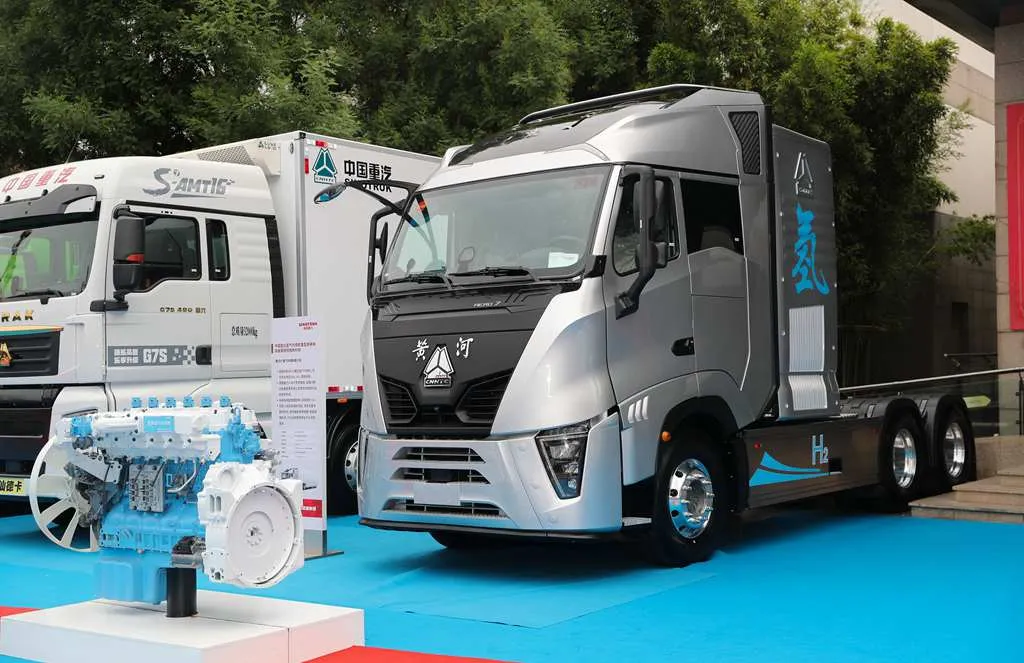
A hydrogen internal combustion engine (H2ICE) burns hydrogen in a reciprocating engine to produce mechanical power. It can remove nearly all fuel-derived carbon dioxide from the exhaust while retaining much of the manufacturing base, driveline and maintenance knowledge built around diesel engines. It does not, however, produce “only water”: high-temperature combustion in air can form nitrogen oxides, and its climate value depends on how the hydrogen is made and delivered.
Executive summary
H2ICE is moving beyond the prototype stage, but unevenly. JCB has full EU Stage V engine type-approval for non-road mobile machinery (NRMM) and says its 3CX Hydrogen backhoe loaders are in series production and available to order. Volvo began on-road testing of hydrogen high-pressure direct-injection trucks in April 2026. Tata Motors has vehicles in government-backed road trials in India. Toyota is still using endurance racing to develop liquid-hydrogen systems, while Cummins, MAN and HD Hyundai have not yet demonstrated the broad commercial volumes implied by some earlier announcements.
The technical case is strongest in severe-duty, high-utilisation and weight-sensitive applications where rapid mobile refuelling is valuable and battery charging is difficult. Battery-electric powertrains remain substantially more energy-efficient wherever a battery can perform the duty cycle. Fuel-cell electric vehicles (FCEVs) can use hydrogen more efficiently than a combustion engine, but they need an electrochemical stack, high-voltage system and electric driveline. H2ICE trades some efficiency for power density, familiar architecture and a potentially faster manufacturing route.
The language around emissions needs care. A pure-hydrogen engine has effectively zero fuel-derived tailpipe CO₂, but combustion heat can create nitrogen oxides (NOx) from the nitrogen and oxygen already present in air. Lean burn, exhaust-gas recirculation and selective catalytic reduction can reduce NOx sharply, yet H2ICE remains a regulated combustion technology rather than a literally emission-free one.
Key Takeaways
- H2ICE burns hydrogen rather than converting it electrochemically. It is a piston engine with a crankshaft, not a fuel cell, and can reuse parts of established engine, transmission and service ecosystems.
- “Zero tailpipe CO₂” is the accurate short description for a pure-hydrogen engine. H2ICE can still form nitrogen oxides (NOx) and may emit traces from lubricating oil or pilot fuel, so it is not literally exhaust-free.
- Peak brake thermal efficiency of about 40–45% is credible for advanced lean-burn engines. AVL has measured 50.1% on a specific HPDI research engine; this is a peak test-cell result, not a representative fleet average.
- Battery-electric remains the energy-efficiency benchmark. H2ICE is most credible where high utilisation, rapid refuelling, payload, severe duty, remote operation or a constrained grid have economic value.
- Hydrogen price dominates operating cost. At the MAN hTGX’s published 56kg/600km tank-and-range ratio, moving from £3/kg to £12/kg changes the indicative fuel bill by £100,800 a year at 120,000km.
- Commercial maturity is application-specific. JCB has certified, orderable off-road products; MAN has documented customer truck deployments; Volvo/Cespira and Tata are in road validation; several other programmes remain prototypes or demonstrations.
- Hydromax is important evidence of power density and combustion control. It does not by itself prove superior lifecycle emissions, efficiency, durability or total cost of ownership.
What changed in 2026
- JCB Hydromax set a hydrogen land-speed benchmark. On 11 August, Andy Green drove the twin-engine streamliner to a two-run average of 406.320mph (653.909km/h) at Bonneville, according to the FIA-supervised result reported by the Associated Press.
- JCB moved from approval towards product. The company now describes its hydrogen backhoe loaders as series-production machines available to order, rather than evaluation prototypes.
- Volvo and Cespira moved hydrogen HPDI onto public roads. Volvo began on-road testing in April 2026 and still places commercial introduction before 2030.
- Several schedules slipped. HD Hyundai’s HX12 target moved from early 2026 to the end of 2026, with a hydrogen truck targeted for 2027. Cummins’ longstanding public timetable points to full X15H production in 2027, not 2025–26.
- The EU added temporary compliance flexibility without weakening its long-term heavy-duty targets. The March 2026 amendment changes how manufacturers can accumulate credits during 2025–29; the wider standards review remains due in 2027.
1. What is a hydrogen internal combustion engine?
1.1 Operating Principles: How H2ICE Works
A hydrogen internal combustion engine uses pistons, connecting rods and a crankshaft in much the same way as a petrol or diesel engine. Hydrogen and air enter the cylinder, the mixture is ignited, the expanding gases drive the piston and the crankshaft turns that linear movement into useful rotary power. The engine may ignite the mixture with a spark plug, or use a small pilot injection of liquid fuel to initiate compression ignition.
This is fundamentally different from a fuel-cell electric vehicle. A fuel cell combines hydrogen and oxygen electrochemically to make electricity, which then powers an electric motor. H2ICE converts chemical energy to heat and pressure inside a cylinder before delivering shaft power mechanically. Both carry hydrogen; only one burns it.
The appeal is continuity. An engine maker may be able to retain a familiar block, cranktrain, gearbox, axles, machining equipment and dealer network. The hydrogen-specific work is nevertheless substantial: fuel tanks, pressure regulation, injectors, turbocharging, ignition, ventilation, seals, combustion control and NOx aftertreatment all have to be designed or recalibrated for hydrogen.
1.2 Key Distinctions: H2ICE, Fuel Cells and Batteries
| Factor | H2ICE | Fuel-cell electric vehicle | Battery-electric vehicle |
|---|---|---|---|
| Energy conversion | Hydrogen combustion to shaft power | Hydrogen to electricity to motor | Grid electricity to battery to motor |
| Typical advantage | Power density, rapid refuelling, familiar engine architecture | Higher hydrogen-to-wheel efficiency and quiet electric drive | Highest tank-to-wheel and electricity-to-wheel efficiency |
| Main penalty | Lower efficiency than electric drive; NOx control required | Fuel-cell cost, hydrogen purity and balance-of-plant complexity | Battery mass, charge time and grid connection for demanding duties |
| Best fit | Severe-duty, remote, high-utilisation or captive-fuel operations | Hydrogen duties where range and fuel efficiency justify the stack | Routes and machines that can charge without unacceptable payload or uptime loss |
1.3 Hydrogen Fuel Properties Relevant to Engine Design
Hydrogen contains about 120 megajoules per kilogram on a lower-heating-value basis, almost three times diesel by mass. The difficulty is volume. At ordinary pressure its energy content is only about 10.8 megajoules per cubic metre, roughly three orders of magnitude less than a cubic metre of diesel. Vehicle systems therefore compress gaseous hydrogen—commonly around 350 bar for heavy-duty applications and 700 bar for many light-duty systems—or cool it to approximately −253°C so that it becomes a liquid. The tank, insulation or composite cylinders reduce the apparent mass advantage of the fuel itself.
Hydrogen also has a wide flammability range, fast flame speed and very low ignition energy. Those properties make ultra-lean combustion possible, but they also create risks of pre-ignition, knock and backfire if hot surfaces, residual gases or the injection event are not carefully controlled. Direct injection after the intake valves close can protect volumetric efficiency and reduce backfire risk, but it demands fast, durable high-pressure injectors.
2. How efficient is H2ICE compared with diesel, fuel cells and batteries?
2.1 Brake thermal efficiency needs a precise definition
Brake thermal efficiency (BTE) is the share of the fuel’s chemical energy that appears as useful power at the engine crankshaft. It is a peak engine-test measure, not a complete vehicle-efficiency or lifecycle measure. A 45% BTE engine converts 45% of the incoming fuel energy to shaft power at the stated test point; the rest is lost mainly as exhaust heat, cooling heat and friction.
Modern lean-burn hydrogen engines can reach diesel-like peak efficiency. A 2025 peer-reviewed study of low-NOx off-road hydrogen engines reported around 45% peak BTE. A broader 2025 review placed optimised modern H2ICE designs mainly in the 40–45% range. Those are credible high-load results; they should not be rewritten as a guarantee that every production hydrogen engine will deliver 45% across a real duty cycle.
The 50% claim is narrower. AVL, TUPY, Westport and Graz University of Technology measured 50.1% BTE on a 13-litre hydrogen high-pressure direct-injection demonstrator. The first hydrogen configuration measured 49.1%; gas-exchange optimisation raised it to 50.1%. A further 51.7% figure came from one-dimensional simulation using a 23.1:1 compression ratio and a high-efficiency turbocharger. It is therefore accurate to call 50.1% a demonstrated peak for a specific research engine and 51.7% a modelled optimisation, not commercial-fleet performance.
Battery-electric drivetrains remain much more efficient at turning stored electrical energy into motion because they avoid electrolysis, hydrogen compression or liquefaction, and combustion losses. Fuel cells normally convert hydrogen to wheel power more efficiently than an H2ICE, especially at moderate load, although their output and efficiency can fall with ageing, temperature and demanding transient operation. H2ICE competes through application fit rather than universal energy superiority.
For heavy vehicles the practical comparison also includes payload and charging. Improvements in battery energy density do not eliminate the mass of a long-range pack, and that can affect payload and fleet economics. Where a battery can meet the route without operational penalty, its efficiency is difficult to beat. Where it cannot, hydrogen combustion and fuel cells deserve comparison against the actual duty cycle rather than against an abstract average truck.
2.2 Manufacturing reuse reduces transition risk, not engineering effort
- Potentially reusable: block architecture, crankshaft, bearings, transmission, axles, machining assets and parts of the service network.
- Normally redesigned or recalibrated: cylinder head, injectors, ignition, turbocharger, piston crown, valves, fuel rail, lubrication strategy, controls, tanks and safety systems.
- New commercial dependencies: composite hydrogen cylinders, pressure regulators, certified refuelling equipment, low-leak fittings and dependable hydrogen supply.
The UK Advanced Propulsion Centre’s H2ICE review identified manufacturing continuity as an important advantage for non-road machinery. The benefit is strongest for an established engine maker with an existing platform and customer base. It is weaker for a vehicle maker that would have to build an entire hydrogen supply chain from scratch.
2.3 Where hydrogen combustion makes commercial sense
H2ICE becomes credible where several constraints coincide: high utilisation, large continuous power demand, weight-sensitive operation, rapid refuelling, remote or severe-duty work, difficult grid connection, an existing combustion-engine production base and a captive hydrogen supply. Construction machinery, mining equipment, agricultural machines, generators, some heavy trucks and specialised emergency or airport vehicles are the most plausible early markets.
The same logic explains where it does not fit. A delivery vehicle returning to a depot with adequate charging time will normally use electricity more efficiently and may have lower maintenance and energy costs as a battery-electric vehicle. An urban bus that already has hydrogen infrastructure may gain more range per kilogram from a fuel cell and avoid combustion noise and NOx. The useful question is not whether H2ICE can replace diesel in principle, but whether it removes a real operational constraint at a total system cost the operator can sustain. See the related analysis of hydrogen versus electric trucks and the fleet TCO model.
Construction equipment and non-road mobile machinery
Construction is the clearest early application because the operating problem resembles diesel distribution more than public-road fuelling. Excavators, loaders and generators may work long shifts at sites with no permanent high-power grid connection. A mobile hydrogen bowser can refuel several machines in minutes, while a sufficiently large battery fleet may require chargers, transformers, cabling and spare machines to cover charging periods. The internal-combustion architecture also preserves mechanical power take-offs, familiar hydraulic integration and field-service practices.
Those advantages are conditional. A grid-connected urban site with predictable breaks may electrify economically, particularly where noise and local air quality are priorities. Hydrogen machinery needs enough shared demand to keep a bowser or on-site store utilised; otherwise fuel logistics dominate TCO. JCB’s programme is commercially significant because it combines an approved engine, machines and mobile refuelling rather than treating the engine as an isolated component.
Heavy trucks and high-utilisation freight
Long-haul and specialist trucks bring payload, range and driver-time economics into the comparison. A battery truck can be compelling when depot charging and statutory rest breaks cover the energy requirement; a 2026 Faraday Institution review notes that a large share of British truck energy could be supplied by depot or slow overnight charging. Hydrogen becomes more relevant where a vehicle runs multiple shifts, cannot return to a charger, carries a mass-sensitive load or needs certified configurations that are not yet available as battery vehicles.
MAN positions hTGX for construction, tank, timber and heavy transport rather than as a universal replacement for its battery-electric range. Its documented Vervaeke deployment is revealing: the customer required AT and FL approvals for dangerous-goods transport and valued the truck’s lower unladen mass relative to a comparable electric tractor. Fuel availability and contracted price remain decisive, and a fuel-cell truck will usually travel farther per kilogram because it converts hydrogen more efficiently.
Agriculture and mining
Tractors, harvesters and mine equipment often combine high continuous load, seasonal or multi-shift operation and distance from strong grids. They already receive fuel through controlled logistics, which makes a captive hydrogen supply more plausible than a national public-station network. Mines may also aggregate demand from haulage, generators and processing equipment. Against that, both industries demand exceptional durability, simple repair and predictable fuel cost; hydrogen tanks consume packaging space, and specialist components must be stocked far from conventional service centres.
Stationary power and marine applications
Hydrogen generators can provide dispatchable power where a site already stores hydrogen or where temporary high power is worth more than round-trip efficiency. They are less persuasive when renewable electricity can be used directly or stored in a battery, because converting electricity into hydrogen and back through an engine loses much more energy. Combined heat and power can improve total fuel utilisation if there is a genuine, simultaneous use for the heat.
Marine engines benefit from long-established reciprocating-engine supply chains and can use large tanks more easily than road vehicles, but gaseous hydrogen’s low volumetric density constrains range. Liquid hydrogen improves packaging at the cost of cryogenic complexity and boil-off. Coastal, inland-waterway and workboat routes with fixed bunkering points are more plausible than unrestricted ocean shipping. For deep-sea vessels, hydrogen-derived ammonia or methanol may package more conveniently, although each introduces its own efficiency, toxicity or carbon-accounting issues.
Motorsport and high-performance development
Motorsport gives engineers repeated high-load operation, rapid development cycles and a public demonstration platform. Toyota uses endurance racing to test liquid-hydrogen storage, pumps and injection; JCB used land-speed competition to test extreme power density. These programmes can accelerate components and controls, but their economics, maintenance intervals and packaging are not representative of fleet vehicles. The dedicated Hydromax section below separates the transferable engineering evidence from the record-car spectacle.
3. Combustion strategies: lean burn, direct injection and HPDI
3.1 Spark-ignition lean burn
Lean burn means admitting more air than is chemically required to burn the hydrogen. The excess air reduces peak flame temperature and throttling losses, which can improve efficiency while suppressing thermal NOx. If the mixture becomes too lean, however, ignition becomes unstable and the engine can misfire. Engineers therefore balance air ratio, boost pressure, spark timing, compression ratio and exhaust-gas recirculation across the speed-and-load map.
Port fuel injection introduces hydrogen upstream of the inlet valve and is comparatively simple, but the gaseous fuel displaces intake air and can limit power density. Direct injection puts hydrogen into the cylinder after the intake valve closes, preserving more air charge and reducing the opportunity for an intake backfire. The injector must deliver a large gas volume in a very short time against rising cylinder pressure.
3.2 High-pressure direct injection with pilot ignition
High-pressure direct injection (HPDI) introduces hydrogen late in the compression stroke. A small liquid-fuel pilot auto-ignites and lights the hydrogen, allowing a diesel-like compression-ignition cycle with high torque and efficiency. In the AVL demonstrator, hydrogen supplied 97.5% of the fuel energy at full load; the remaining pilot fuel means direct CO₂ was very low rather than literally zero.
HPDI’s disadvantages are a more complex dual-fuel system, high-pressure injectors and the need to manage pilot-fuel emissions. Cespira—the joint venture between Volvo Group and Westport—has moved this architecture from test cells to on-road Volvo truck testing in 2026. Commercial launch is still planned before 2030, so the system remains in vehicle validation rather than customer production.
3.3 Turbocharging and cooling determine usable power density
Because gaseous hydrogen occupies intake volume, a naturally aspirated engine can lose power relative to diesel. Turbocharging compresses more air into the cylinder so more hydrogen can be burned without moving into a hot, NOx-producing mixture. The turbocharger, intercooler, exhaust valves, pistons and lubrication circuit must survive the resulting cylinder pressure and heat. The Hydromax programme makes that challenge unusually visible.
4. What emissions does a hydrogen combustion engine actually produce?
4.1 Zero fuel-derived tailpipe CO₂ is not the same as zero emissions
Hydrogen contains no carbon, so a pure-hydrogen engine does not create carbon dioxide from the fuel reaction. Water vapour is the principal product of burning hydrogen with oxygen. Small carbon-containing emissions can still arise from lubricating oil, crankcase gases or a liquid ignition pilot, and none of this says how much greenhouse gas was emitted to produce, compress, liquefy or transport the hydrogen.
Lifecycle performance therefore depends on the supply chain. Renewable electricity used in an efficient electrolyser can produce low-carbon hydrogen, but a constrained grid, fossil-derived electricity or hydrogen made from natural gas without effective carbon capture can erase much of the climate advantage. Liquefaction is especially energy-intensive. For that reason, a vehicle’s 0g tailpipe CO₂ classification should never be presented as proof of a near-zero lifecycle footprint.
4.2 Why H2ICE creates NOx
Nitrogen oxides (NOx) are formed when nitrogen and oxygen in the intake air react at high combustion temperatures. The nitrogen does not have to come from the fuel. A hydrogen flame can therefore create NOx even though the hydrogen molecule contains no carbon or nitrogen. NOx contributes to ground-level ozone and respiratory harm, which is why hydrogen combustion remains subject to air-pollutant limits.
- Lean burn lowers peak flame temperature by diluting the mixture with excess air.
- Exhaust-gas recirculation (EGR) returns a controlled amount of inert exhaust to the cylinder, absorbing heat and reducing oxygen concentration.
- Water injection can suppress combustion temperature and abnormal combustion, although it adds a fluid system and cold-weather issues.
- Selective catalytic reduction (SCR) injects urea solution, commonly sold as AdBlue, into the exhaust so a catalyst can convert NOx mainly into nitrogen and water.
The earlier version of this article described 0.020g/kWh as JCB’s certified NRTC result. The source behind that number was a Ricardo air-quality scenario that assumed 0.02g/kWh for hydrogen NRMM; it was not JCB’s EU type-approval certificate. JCB’s approval confirms compliance with the EU Stage V limit under Regulation (EU) 2016/1628. A 2025 peer-reviewed engine study showed very low NOx is technically achievable, but emissions vary strongly with load, mixture and aftertreatment temperature. The defensible conclusion is that H2ICE NOx can be tightly controlled—not that every certified engine emits the same near-zero number.
4.3 Particles, unburned hydrogen and other exhaust species
Pure hydrogen has no carbon from which to form conventional soot. That gives spark-ignition H2ICE an important particulate advantage over diesel. Trace particles and hydrocarbons can still come from lubricating oil, and HPDI engines can form additional carbon-containing emissions from their pilot fuel. Depending on combustion and aftertreatment chemistry, regulators also monitor ammonia and nitrous oxide. Brake and tyre particles remain regardless of powertrain.
5. What the JCB Hydromax record says about H2ICE maturity
On 11 August 2026 at the Bonneville Salt Flats in Utah, Andy Green drove the JCB Hydromax to an average of 406.320mph (653.909km/h) over the required runs. The Associated Press reported the result from the FIA-supervised attempt, describing two hydrogen internal combustion engines with a combined output of about 1,600bhp. The speed exceeded the roughly 185.5mph hydrogen-combustion benchmark associated with BMW’s H2R and the 302.877mph hydrogen fuel-cell benchmark set by the Buckeye Bullet 2.
FIA status at publication. The FIA officiated the attempt and its rules require two runs in opposite directions within 60 minutes, with the record calculated from their average. As of 14 August 2026, however, the FIA’s public list of homologated world speed records had not yet been updated with Hydromax. This article therefore describes 406.320mph as the FIA-supervised record result, pending formal homologation rather than as a finally ratified entry.
5.1 The engineering connection to JCB’s production engine
Hydromax is a purpose-built 9.75-metre streamliner, not a production digger with a streamlined body, but its engines are derived from JCB’s commercial hydrogen architecture. JCB says the crankshaft is the same component used in its 448 hydrogen and diesel engines. Ricardo helped uprate each engine from roughly 74hp to about 800hp, nearly double its rated speed and remove around 100kg of mass. Two engine-and-gearbox units drive the front and rear axles.
Component commonality matters commercially because a production crankshaft has known materials, machining processes, suppliers and durability history. Keeping it in an 800hp derivative does not mean a standard engine could deliver that power in a backhoe loader; it shows that the underlying cranktrain had considerable structural margin and that extreme development did not require abandoning the commercial architecture entirely.
The surrounding systems reveal how difficult the power increase was. JCB says the piston-cooling jets circulate one litre of oil per second, as much as the rest of each engine combined. Special exhaust-valve technology manages the heat, while titanium turbocharger compressors run above 150,000rpm at close to 300°C. JCB estimated that a full record run would consume just over two kilograms of hydrogen and produce about 18 litres of water. The high boost, cooling flow and specialised valves explain how a recognisable reciprocating engine can sustain extraordinary power without implying that all of those measures belong in a 55kW production machine.
5.2 What the record proves—and what it does not
The record demonstrates very high power density, repeatable combustion control and sustained high-load operation from twin hydrogen piston engines. It also shows that JCB, Ricardo, Prodrive and Xtrac could integrate fuelling, cooling, turbocharging, transmission and controls into a vehicle capable of completing the FIA run sequence. That is meaningful evidence of engineering maturity.
A land-speed car is optimised for maximum power over a short, controlled event. It does not establish engine life over thousands of machine hours, cold-start reliability on a building site, fuel-station uptime, fleet maintenance cost or hydrogen price. Nor does speed prove lower lifecycle emissions, higher efficiency or a better total cost of ownership than a battery or fuel-cell powertrain. Hydromax is best read as an extreme validation of combustion and mechanical capability that sits alongside, rather than substitutes for, JCB’s production certification and customer deployment.
6. Which manufacturers are actually commercialising H2ICE?
| Manufacturer | Technology and application | Verified August 2026 status | Commercial interpretation |
|---|---|---|---|
| JCB | 448 spark-ignition engine for construction equipment and generators | Full EU Stage V type-approval; 3CX Hydrogen and G60RS H launched; series production claimed | Certified, orderable early production; installed-fleet scale still emerging |
| MAN | H45 direct-injection engine in hTGX specialist heavy truck | Documented customer deployment, including six trucks with Jos Scholman and an ADR truck with Vervaeke | Limited production and deployment; the originally announced 200-unit total is not publicly reconciled |
| Cummins | X15H/X10 platform for heavy trucks and industrial applications | Development and customer integration; published full-production expectation remains 2027 | Pre-production rather than meaningful volume |
| Volvo Group/Cespira | Hydrogen HPDI heavy trucks | On-road testing began April 2026; launch planned before 2030 | Vehicle validation |
| Toyota | Liquid-hydrogen spark-ignition race engine | 2026 endurance development with superconducting pump | Advanced demonstration, not a customer H2ICE product |
| HD Hyundai Infracore | HX12 11-litre engine for trucks, generators and excavators | End-2026 mass-production target; truck target 2027 | Demonstration and pre-production; earlier timetable slipped |
| Tata Motors | Spark-ignition H2ICE and FCEV heavy trucks | 16-vehicle, 24-month Indian corridor trial programme | Customer-like deployment trial, not serial sales |
| Kawasaki | Supercharged motorcycle H2ICE and CORLEO engine-generator | Running prototype and concept programmes | Research and demonstration |
| ULEMCo | Hydrogen-diesel conversions, specialist vehicles and mobile refuelling | Airport, construction and retrofit deployments | Niche commercial integration rather than high-volume OEM production |
| AVL | Research engineering and complete H2ICE development | 50.1% HPDI research engine with partners | Demonstrated test-cell performance and engineering services |
| Westport/Cespira | Hydrogen HPDI fuel systems | On-road Volvo validation | Enabling technology moving from demonstrator to vehicle test |
JCB: certification, production and the strongest off-road case
JCB secured the first full EU type-approval for a hydrogen engine used in non-road mobile machinery in May 2025. The certificate applies across all 27 EU member states and other territories recognising EU approval, replacing the earlier patchwork of national “new technology” permissions. JCB had built more than 130 evaluation engines by then.
By mid-2026 the company was advertising the 55kW 3CX Hydrogen backhoe loader and a 58kVA hydrogen generator as orderable products, while stating that hydrogen diggers were rolling off production lines. JCB has invested more than £100 million in the programme. This is limited early production rather than evidence of a large installed fleet, but it is further along the commercialisation ladder than a motor-show prototype.
MAN and Cummins: announced products, limited delivery evidence
MAN announced an initial 200-unit hTGX series for customers in Germany, the Netherlands, Norway, Iceland and selected non-European markets, with a roughly 600km range and refuelling in under 15 minutes. Customer deployment is now verifiable: MAN reports that Dutch contractor Jos Scholman received six hTGX trucks, supported by its own hydrogen station and electrolyser, and that Vervaeke received an ADR-configured 6×2 truck. The latter carries 56kg at 700 bar, has a stated range of about 600km and is claimed to be about 2,300kg lighter than a comparable electric tractor. These deliveries move MAN into limited customer deployment, but the company has not publicly reconciled them with the originally announced total of around 200 units.
Cummins has developed hydrogen versions of its fuel-agnostic engine platform, including the 15-litre X15H. The company’s own published timetable has long said full production is expected in 2027. Earlier wording in this article about small-series production in 2025–26 was ahead of the available evidence.
Volvo, Westport and AVL: high-efficiency hydrogen reaches the road
Volvo began on-road testing of hydrogen-combustion heavy trucks in April 2026 using Cespira’s HPDI system. The company expects commercial introduction in Europe before 2030 and explicitly notes that regulatory classification varies by region. AVL’s test-cell efficiency result and Volvo’s road programme connect the research claim to a credible industrial validation path, but customer launch remains several years away.
Toyota, HD Hyundai and Tata Motors: endurance development and fleet trials
Toyota’s GR Corolla remains a motorsport development vehicle. In June 2026 it became the first race car to compete with a superconducting liquid-hydrogen pump. Moving the motor into the −253°C tank freed space to increase capacity from 220 to as much as 300 litres and lowered the centre of gravity. Endurance racing validates pumps, injectors, refuelling and thermal management under stress, but Toyota has not announced a production H2ICE passenger car.
HD Hyundai’s roadmap has slipped. After previously targeting truck-engine production in early 2026, the company said in December 2025 that the 11-litre HX12 now aims for mass production by the end of 2026, with hydrogen trucks in 2027, generators in 2029 and excavators in 2030. That is progress through testing—including more than 1,500 generator hours—but not yet confirmed customer production.
Tata Motors began a 24-month Indian programme in March 2025 involving 16 hydrogen trucks across major freight corridors, including both H2ICE and FCEV vehicles. The H2ICE models include the Prima H.55S and H.28, with published ranges of roughly 300–500km. These are real road trials supported by the National Green Hydrogen Mission, but their purpose is to establish commercial viability rather than demonstrate it has already been achieved.
Kawasaki and ULEMCo: specialist development
Kawasaki’s hydrogen work includes a supercharged motorcycle-engine demonstrator and the CORLEO concept, whose 150cc hydrogen engine generates electricity for four electric legs. These programmes show breadth, not commercial deployment. ULEMCo is further into niche fleet use through hydrogen-diesel dual-fuel conversions, airport vehicles, excavators and the HyTANKa mobile refueller. Its 2025–26 partnerships with hydrogen and cylinder suppliers are intended to scale deployment, but the company remains a specialist integrator rather than a volume truck manufacturer.
7. How EU and UK regulation treats hydrogen combustion
7.1 EU heavy-duty CO₂ standards and the 2026 flexibility change
EU heavy-duty CO₂ regulation measures direct vehicle CO₂, not all exhaust pollutants or lifecycle greenhouse gases. That allows a hydrogen combustion truck to qualify as a zero-emission heavy-duty vehicle for CO₂ compliance if its certified direct CO₂ remains within the regulatory threshold. A pure-hydrogen spark-ignition engine can satisfy that principle; an HPDI engine must also account for its carbon-containing pilot fuel.
On 30 March 2026 the Council adopted a targeted flexibility amendment. From 2025 to 2029, manufacturers can accumulate credits when they beat their own annual CO₂ targets rather than the stricter linear reduction trajectory. The change applies to heavy lorries above 16 tonnes and certain buses above 7.5 tonnes, but not urban buses. It does not change the long-term fleet targets: the Council describes reductions of 15% from 2025, 43% from 2030 and 90% in 2040. A broader review of the heavy-duty standards is due in 2027.
7.2 Euro 7 regulates NOx even when tailpipe CO₂ is zero
Euro 7 is the EU type-approval regime for pollutant emissions and durability. For heavy-duty internal-combustion vehicles it sets limits for NOx, particulate mass and number, carbon monoxide, non-methane organic gases, ammonia, methane and nitrous oxide. The heavy-duty NOx limits are 200mg/kWh on the specified laboratory cycles and 260mg/kWh under real-driving conditions. Hydrogen does not exempt an engine from these requirements.
The distinction is central: “zero-emission vehicle” in a CO₂ regulation can mean zero or near-zero direct carbon dioxide for compliance purposes, while Euro 7 still treats the same vehicle as an internal-combustion engine with regulated exhaust pollutants. Policy labels are definitions within particular legal instruments, not complete scientific descriptions.
7.3 UK type approval and zero-emission policy remain fragmented
JCB has full Great Britain and EU engine type-approval for its Stage V non-road engine. The position for road-going H2ICE trucks is less settled. The UK government’s 2026 consultation on a new HGV CO₂ framework closed in March and specifically asked how hydrogen combustion and dual-fuel vehicles should be treated; a final framework had not been published by this article’s cut-off.
Different UK rules already use different definitions. Some weight and MOT provisions define zero emission by 0g/km of tailpipe CO₂, potentially broad enough for a pure-hydrogen engine. The HGV levy guidance explicitly says hydrogen-combustion HGVs do not receive the zero-emission treatment. Fleet operators should therefore check the exact approval, tax, road-charging and grant regime rather than assuming one “zero-emission” label carries across them all.
8. Cost and total cost of ownership
Total cost of ownership (TCO) is the lifetime cost of putting a vehicle or machine to work, not simply its purchase price. A useful comparison includes acquisition, finance, depreciation and residual value; fuel or electricity; infrastructure; maintenance; downtime; payload; driver or operator time; tax, tolls, grants and carbon costs; annual mileage or operating hours; and the years the asset will remain in service.
The previous edition’s five-year table usefully put hydrogen price and efficiency at the centre of the analysis, but its precise purchase prices and some operating assumptions were not traceable to observed transactions. The 2026 update therefore retains the table-based TCO analysis while separating verifiable inputs from operator-specific estimates. The hydrogen sensitivity below is arithmetic based on MAN’s published tank capacity and range; it is not a forecast of every truck’s real fuel consumption.
8.1 Capital Expenditure (CapEx) Comparison
Diesel still benefits from mature high-volume production, established resale markets and widely available finance. H2ICE can reuse an engine platform, transmission and parts of a cab or machine, which may make its incremental powertrain cost lower than a fuel-cell system or a very large battery. That does not mean a low-volume hydrogen truck is currently cheap: composite tanks, injectors, pressure regulators, sensors, certification and manufacturer risk all carry early-series premiums.
A battery vehicle shifts cost into the battery and charging connection but has a mechanically simpler drivetrain. A fuel-cell vehicle adds a stack, air and thermal systems, high-voltage battery and electric drive. Financing magnifies the acquisition gap, while residual-value uncertainty affects all emerging powertrains. Published list prices rarely capture grants, fleet discounts, charger or station assets, and manufacturer service packages, so a defensible TCO should use the operator’s quoted transaction and finance terms.
8.2 Hydrogen Price Sensitivity
Hydrogen price has an unusually direct effect on H2ICE economics because the engine uses more kilograms per kilometre than a fuel-cell truck. For an auditable illustration, MAN states that the hTGX stores 56kg at 700 bar and offers a range of about 600km. Dividing full tank capacity by stated range gives 9.33kg/100km. This range-derived planning ratio assumes the whole stated capacity and range are available; road, load, weather, auxiliary demand and reserve strategy will change actual consumption.
| Delivered hydrogen price | Fuel cost per 100km at 9.33kg/100km | Annual fuel cost at 120,000km | Five-year fuel cost |
|---|---|---|---|
| £3/kg | £28 | £33,600 | £168,000 |
| £5/kg | £46.67 | £56,000 | £280,000 |
| £7/kg | £65.33 | £78,400 | £392,000 |
| £10/kg | £93.33 | £112,000 | £560,000 |
| £12/kg | £112 | £134,400 | £672,000 |
Assumptions: 56kg divided by MAN’s stated 600km range; 120,000km a year; five identical operating years; fuel only. Excludes VAT treatment, station capital and operating cost, vehicle finance, maintenance, AdBlue, labour, tolls, incentives, payload revenue and residual value. Values are rounded and are scenarios, not quoted retail prices.
The table exposes the commercial threshold more usefully than a single “hydrogen truck TCO” number. Every £1/kg change moves annual fuel cost by £11,200 under these assumptions. The spread between £3/kg and £12/kg is therefore £100,800 per truck per year. A 2026 open-access freight study modelled hydrogen at €5/kg, while a Finnish heavy-transport study tested €2–12/kg and found results changed sharply with truck weight, mileage and electricity price. These are scenario studies rather than proof that fleets can buy low-carbon hydrogen at those prices.
A quick operator break-even calculation is: allowable hydrogen price per kilogram = competing vehicle’s energy cost per 100km ÷ H2ICE kilograms per 100km. The result is only an energy-cost threshold; a complete decision must then add the capital, infrastructure, maintenance, payload and uptime differences. If measured consumption replaces the 9.33kg range-derived ratio, the calculation becomes specific to the route.
8.3 Total Cost of Ownership (TCO) Scenario
| Factor | Diesel ICE | H2ICE | Hydrogen fuel cell | Battery electric |
|---|---|---|---|---|
| Vehicle or equipment cost | Lowest and most certain in mature segments | Low-volume premium; potential platform reuse | High stack, tank and electric-driveline cost | Battery premium, falling with scale |
| Energy efficiency | Advanced peak BTE roughly comparable with best H2ICE | About 40–45% peak for advanced lean-burn; 50.1% demonstrated on one HPDI research engine | Generally higher hydrogen-to-wheel efficiency than H2ICE | Highest tank-to-wheel and electricity-to-wheel efficiency |
| Energy cost | Liquid-fuel price, duty and tax dependent | Highly sensitive to delivered £/kg and consumption | Same hydrogen price exposure but fewer kg for equivalent work | Often lowest with depot electricity; public rapid charging can cost more |
| Refuelling or charging | Minutes; ubiquitous network | Minutes if a working dispenser is available | Minutes if pressure, cooling and station throughput permit | Best during existing idle time; rapid charging needs high power |
| Infrastructure | Mature and highly utilised | Captive bowser or station can work; public network sparse | Similar hydrogen supply plus purity requirements | Depot connection, charger and sometimes grid reinforcement |
| Payload impact | Reference case | Tanks add volume; can be lighter than a long-range battery system | Tanks plus stack and battery | Large packs add mass, partly offset by regulatory allowances |
| Maintenance | Known engine and aftertreatment burden | Familiar engine service plus hydrogen components and SCR | Fewer engine parts, but stack and balance-of-plant uncertainty | Simplest powertrain; battery and thermal-system risk remains |
| High-utilisation suitability | Excellent operationally, high carbon exposure | Potentially strong where rapid fuelling prevents lost shifts | Strong where hydrogen efficiency offsets higher capital cost | Strong if charging fits breaks; weaker if charging creates idle assets |
| Remote operation | Excellent fuel logistics | Credible with mobile or captive hydrogen supply | Credible with suitable hydrogen quality and support | Credible for planned duties if generation or grid capacity is available |
| Tailpipe CO₂ | High | Essentially zero from pure hydrogen; traces possible from oil or pilot fuel | Zero in operation | Zero in operation |
| NOx | Requires stringent control | Can form thermally; requires combustion control and often SCR | None from the electrochemical process | None from the drivetrain |
| Lifecycle emissions dependency | Oil extraction, refining and fuel | Hydrogen production, conditioning, delivery and any pilot fuel | Hydrogen pathway, stack and vehicle manufacture | Electricity mix, battery manufacture and utilisation |
| Technology maturity | Full global series production | Certified products and limited deployments in selected segments | Commercial models and fleets, still low volume in heavy duty | Commercial series products and rapidly growing heavy-duty deployment |
This framework explains why purchase price alone is a poor decision rule. Financing converts an acquisition premium into an annual cash cost; weak residual values increase depreciation; a lost tonne of payload can require additional trips; and charging or refuelling time can consume driver hours or require spare assets. Taxes, tolls, grants and carbon prices can change the ranking again, particularly where a regulation gives a zero-CO₂ vehicle preferential treatment.
8.4 Utilisation, Downtime and Captive Hydrogen
Utilisation determines whether an expensive powertrain earns or destroys value. If rapid hydrogen refuelling lets a machine complete a second shift, avoids a spare vehicle or preserves revenue payload, the resulting benefit can outweigh higher energy use. Construction, airport, port and mine equipment can also share one fuel asset, improving infrastructure utilisation. Conversely, a depot truck parked for ten hours every night has no economic need to pay for fast refuelling if it can charge cheaply during that existing idle period.
Captive hydrogen can have a radically different delivered cost from low-volume public retail fuel. A site with an electrolyser, industrial by-product hydrogen or a long-term bulk-delivery contract can spread compression, storage and dispensing costs across predictable demand. A public station must recover capital and maintenance while serving uncertain throughput, and may also pay for transported hydrogen and high-pressure storage. Captive supply does not automatically mean low-carbon or cheap hydrogen, but it gives the operator greater control over volume, source and asset utilisation.
The practical workflow is to model representative days, not annual averages: kilometres or hours, load, gradients, ambient conditions, auxiliary power, breaks, depot dwell, station capacity and failure contingencies. Then run sensitivities for hydrogen, electricity, diesel, finance and residual value. The fleet total cost of ownership model and the deeper analysis of battery weight, payload and HGV economics provide the wider commercial framework.
9. The remaining obstacles to H2ICE adoption
- Low-carbon hydrogen supply: Fuel must be available at a dependable delivered price and with auditable carbon intensity.
- Storage volume: Composite tanks or cryogenic vessels consume packaging space and add mass, even though hydrogen itself is light.
- Refuelling reliability: Compression, cooling, dispensing and on-site storage must support the fleet’s peak demand, not merely an average daily volume.
- NOx across the duty cycle: Ultra-lean operation lowers NOx, but full load, cold start and low aftertreatment temperature remain calibration challenges.
- Durability and lubrication: High boost, abnormal combustion, hydrogen interaction with materials and oil-derived deposits require long in-use validation.
- Regulatory inconsistency: CO₂, pollutant, tax, toll and procurement rules do not all use the same definition of zero emission.
- Scale: Low vehicle volumes keep tanks, injectors and stations expensive, while a sparse fuel network suppresses vehicle demand.
This is a coordination problem as much as an engine problem. Vehicle orders, hydrogen production, transport, station throughput, technician training and regulation must arrive in the same place and roughly the same year. The system-level context is explored in hydrogen and energy systems and the analysis of grid constraints and hydrogen production opportunity.
10. Hydrogen refuelling infrastructure
Public station counts have proved volatile because closures and low utilisation matter as much as openings. The stronger 2026 statement is regulatory: the EU Alternative Fuels Infrastructure Regulation requires publicly accessible hydrogen stations at no more than 200km intervals on the TEN-T core and comprehensive networks and at least one in every urban node by the end of 2030. The European Commission describes this as a minimum network, not proof that commercial demand will support every station.
For early H2ICE, captive infrastructure may be more important than the public network. A construction contractor, mine, port, generator fleet or return-to-base truck operator can aggregate demand at one location and refuel from a mobile or fixed store. ULEMCo’s HyTANKa and JCB’s mobile refueller mimic the diesel-bowser operating model. Captive supply reduces route risk but transfers responsibility for hydrogen logistics and station utilisation to the operator.
11. Commercial outlook: a niche can be substantial without becoming universal
The earlier article’s global unit forecasts for 2025–35 were unsourced and have been removed. The observable evidence supports a more modest conclusion. By August 2026, H2ICE spans certified non-road products, limited-series truck programmes, government fleet trials and advanced prototypes. Battery-electric heavy vehicles are available in far more models and larger volumes, while hydrogen fuel-cell vehicles retain an efficiency advantage where hydrogen is already chosen.
H2ICE can still become commercially important without taking a large share of all road vehicles. Construction equipment, mining, distributed power, specialist transport and high-load captive fleets are valuable markets. The route to scale is likely to be application by application: prove duty-cycle performance, secure fuel, establish after-sales support and then expand to adjacent machines using the same engine and tanks.
| Commercial stage | Evidence required | Examples visible by August 2026 |
|---|---|---|
| Research | Engine simulation or controlled test-cell result | AVL/TUPY/Westport 50.1% BTE programme |
| Prototype | Running engine or vehicle not yet operated in a representative service | Kawasaki motorcycle; CORLEO concept |
| Demonstration | Public or endurance operation intended to validate systems | Toyota liquid-hydrogen GR Corolla; JCB Hydromax |
| Certification | Type-approval against the applicable engine or vehicle rules | JCB 448 EU Stage V and Great Britain approval |
| Limited production | Orderable product and repeatable build process, still at low volume | JCB construction products; MAN hTGX small series |
| Customer deployment | Vehicles or machines working outside the developer’s own test fleet | MAN with Jos Scholman and Vervaeke; specialist ULEMCo projects |
| Series production at scale | Sustained deliveries, broad support and meaningful installed fleet | No H2ICE programme yet provides diesel- or battery-comparable volume evidence |
This evidence table replaces the previous edition’s unsourced global-unit forecast. Published predictions that assigned precise H2ICE volumes to 2025–35 could not be reconciled with confirmed deliveries, and retaining them would conflict with the article’s sourcing standard. The replacement preserves the original market-adoption analysis while giving readers a test they can apply to future announcements.
12. Hydrogen Storage: 350 Bar, 700 Bar and Liquid Hydrogen
Hydrogen’s excellent gravimetric energy density is often quoted without its poor volumetric density. One kilogram contains about 120MJ on a lower-heating-value basis, but an uncompressed kilogram occupies roughly 11 cubic metres near ambient conditions. A vehicle therefore carries a pressure vessel or a cryogenic tank whose mass, volume and cost are part of the powertrain. Comparing the bare fuel kilogram with a battery pack or diesel tank is misleading because the storage systems perform very different jobs.
12.1 Compressed Gaseous Hydrogen
Heavy-duty prototypes and products use both 350-bar and 700-bar systems. Lower pressure can reduce compression energy and tank cost but requires more cylinder volume for the same mass of fuel. Higher pressure improves onboard packaging at the cost of stronger composite vessels, more demanding station compression and heat management during fast filling. MAN’s hTGX uses 700 bar; construction machinery can accept different packaging and refuelling choices because it is not constrained by a road tractor’s cab and trailer envelope.
Composite cylinders use a gas-tight liner wrapped with carbon-fibre reinforcement and are protected by valves that isolate flow during a fault. Tank mass does not disappear as pressure rises, and cylindrical vessels leave unused space around them. Designers must also provide impact protection, pressure relief, leak detection and safe vent routing. A stated “tank capacity” should be checked for usable rather than nominal fuel and for the reserve assumed in the published range.
12.2 Liquid Hydrogen
Cooling hydrogen to around −253°C creates a much denser liquid, improving range and packaging. Toyota’s racing programme demonstrates why this interests high-performance and long-duration applications. The trade-offs are the substantial energy required for liquefaction, insulated tanks, cryogenic pumps and boil-off as heat leaks into the vessel. A vehicle that operates continuously may consume vapour as it forms; an intermittently used asset needs a safe pressure-management strategy.
Liquid hydrogen can therefore solve an onboard-volume problem while worsening supply-chain efficiency and complexity. Its lifecycle case must include the electricity used for liquefaction and any losses in storage and transfer, rather than treating the hydrogen at the nozzle as the boundary of analysis.
13. Hydrogen Engine Safety, Leakage and Refuelling
Hydrogen can be handled safely, but its hazards are different from diesel and must be engineered accordingly. The US Department of Energy’s hydrogen-safety guidance notes its wide flammable range and low ignition energy. Its small molecule can leak through gaps that would retain a liquid fuel, and some metals can lose ductility after hydrogen exposure. Unlike a diesel spill, gaseous hydrogen is highly buoyant and disperses rapidly in an open space; in a roofed, enclosed or poorly ventilated area it can collect at high points.
13.1 Engineering Controls
- Tank integrity and crash protection: certified pressure vessels are mounted away from likely impact and fitted with shut-off and thermally activated pressure-relief devices.
- Ventilation and vent routing: compartments avoid trapped high points, and deliberate releases are directed away from occupants, hot surfaces and enclosed spaces.
- Leak detection: sensors monitor tanks, valves, fuel lines and enclosed machinery spaces, triggering isolation and shutdown.
- Materials compatibility: pipes, seals, injectors and vessels are selected and tested for hydrogen permeation, pressure cycling and embrittlement risk.
- Ignition control: electrical equipment, hot surfaces and static discharge are managed around areas where a flammable mixture could form.
- Procedural safety: operators and emergency responders need training for connection, purging, maintenance, collision damage and cryogenic exposure where liquid hydrogen is used.
Pressure itself is not evidence that a system is unsafe; composite tanks are tested well beyond normal service pressure and regulated through vehicle, machinery and gas-equipment standards. Nor does buoyancy make hydrogen inherently safer than petrol or diesel. Risk depends on the release, enclosure, ignition sources and protection system. The appropriate conclusion is that mature engineering can control the hazards, while inspection, ventilation and correct refuelling remain essential throughout the asset’s life.
14. H2ICE in the 2035 decarbonisation portfolio
By the mid-2030s, batteries are likely to dominate duties that can accommodate charging and battery mass. Fuel cells may serve hydrogen routes where tank-to-wheel efficiency and quiet operation justify their greater powertrain complexity. H2ICE is most likely to persist where combustion architecture, mechanical power delivery, rapid fuelling and rugged service provide a measurable operational advantage.
Its future therefore depends less on proving that hydrogen can burn—an established fact—than on proving complete systems at acceptable cost. JCB’s production move, Volvo’s on-road HPDI test and Tata’s corridor trials are more commercially revealing than another isolated engine dyno result. Hydromax adds confidence in the technology’s extreme power and high-load capability, while leaving the economic and lifecycle questions exactly where they belong: with the machine, fuel supply and duty cycle.
15. Hydrogen combustion is credible where the application earns its inefficiency
The hydrogen internal combustion engine is no longer a laboratory curiosity, but neither is it a universal zero-emission replacement for diesel. Its strongest evidence now comes from three different levels of maturity: JCB’s certified and orderable off-road products, Volvo and Tata’s real-road validation, and Toyota and Hydromax’s high-load development programmes.
The decisive analytical framework is application fit. Battery-electric power should normally win where it can deliver the required work because it uses energy more efficiently. Fuel cells deserve attention where hydrogen is necessary and fuel economy per kilogram matters. H2ICE becomes attractive when high utilisation, power density, payload, rapid mobile refuelling, remote operation and manufacturing continuity together outweigh the efficiency penalty.
That balanced position also resolves the terminology. H2ICE can be a zero-tailpipe-CO₂ technology and may be classified as zero emission within a CO₂ regulation. It remains a combustion engine with regulated exhaust pollutants, and its lifecycle climate performance is only as strong as its hydrogen supply.
- Hydrogen versus electric trucks
- Fleet total cost of ownership
- Battery energy density
- Battery weight, payload and zero-emission HGV economics
- Hydrogen and energy systems
- Technology commercialisation and deployment readiness
- European hydrogen truck manufacturers
- Hydrogen heavy-goods transport
- EV and hydrogen market slowdowns
- How energy infrastructure projects get financed and delivered
Advisory support for fleets, hydrogen and transport infrastructure
If you are assessing where hydrogen combustion, fuel cells or battery-electric systems fit, the issue is rarely just the technology. It is whether the economics, infrastructure, utilisation and operating model work together under real conditions.
I advise boards, investors, operators and project developers on fleet decarbonisation, hydrogen infrastructure, powertrain comparison, commercial modelling and project bankability.
Sources and further reading
- FIA: Hydromax test and record procedure
- JCB: Hydromax production-derived engine details
- Ricardo: Hydromax engine development
- MAN: six hTGX customer vehicles with Jos Scholman
- EU Regulation 2024/1257: Euro 7
- Council of the EU: 2026 heavy-duty CO₂ flexibility
- Environmental Science: Processes & Impacts: low-NOx off-road hydrogen engines
- AVL: 50.1% BTE hydrogen HPDI demonstrator
- International Journal of Hydrogen Energy: 2026 zero-carbon freight TCO analysis
- Journal of Energy Storage: heavy-truck powertrain TCO sensitivity
- US Department of Energy: safe use of hydrogen
- Infineum: H2ICE lubrication
- H2.LIVE: European station status
- H2Accelerate: Hydrogen ICE paper, October 2025
Document version: 2026 update | Last updated: 14 August 2026 | Author: Tim Harper



Pingback: Hydrogen Heavy Goods Transport: Fuel Cell, Hydrogen Combustion, and Dual-Fuel Pathways for 2025 %pagHydrogen Heavy Goods Transport in 2025 | Fuel Cell, H2ICE & Dual-Fuel Options
Pingback: Top European Hydrogen Truck Manufacturers 2025 | Ultimate FCEV & H2ICE Guide
Pingback: Hydrogen or Double the Trucks | Hydrogen HGV Decarbonisation UK