
Originally published 14 October 2025. Substantially updated in 2026 to reflect current commercial battery performance, emerging technologies and revised industry timelines.
Battery energy density still matters. It determines how much energy can be carried for a given mass or volume, and therefore affects vehicle range, payload, flight endurance and the size of everything from a smartphone to a humanoid robot. But in 2026 the headline number is increasingly misleading without context.
A laboratory coin cell is not an automotive cell. An automotive cell is not a complete battery pack. A prototype that reaches 400 watt-hours per kilogram under carefully controlled conditions is not equivalent to a qualified product leaving a factory at automotive yield. Cooling plates, busbars, casing, electronics, impact protection and reserve capacity all sit between a cell specification and usable energy on the road.
The battery market is also fragmenting. The useful question is no longer simply which chemistry has the highest energy density. It is which combination of energy, power, cost, life, safety, charging speed, temperature performance and manufacturability best fits the job.
What Has Changed Since the Original Article?
Three changes matter most. First, LFP has continued to expand despite its lower cell-level energy density. BYD’s Blade architecture and CATL’s cell-to-pack systems showed that removing modules and reducing inactive material can recover part of the chemistry disadvantage at pack level. CATL now claims 205 Wh/kg at system level for Shenxing Plus. That is a manufacturer figure for a particular pack architecture, not a general LFP benchmark, but it demonstrates how far pack engineering has moved.
Second, sodium-ion has moved beyond small demonstrations. CATL announced a 175 Wh/kg Naxtra cell, gained Chinese vehicle-safety certification and, in 2026, showed a production passenger-car programme with Changan. It is also moving sodium-ion into stationary storage. This is commercial progress, although production volume, pack-level performance and real-world fleet data remain much thinner than they are for LFP.
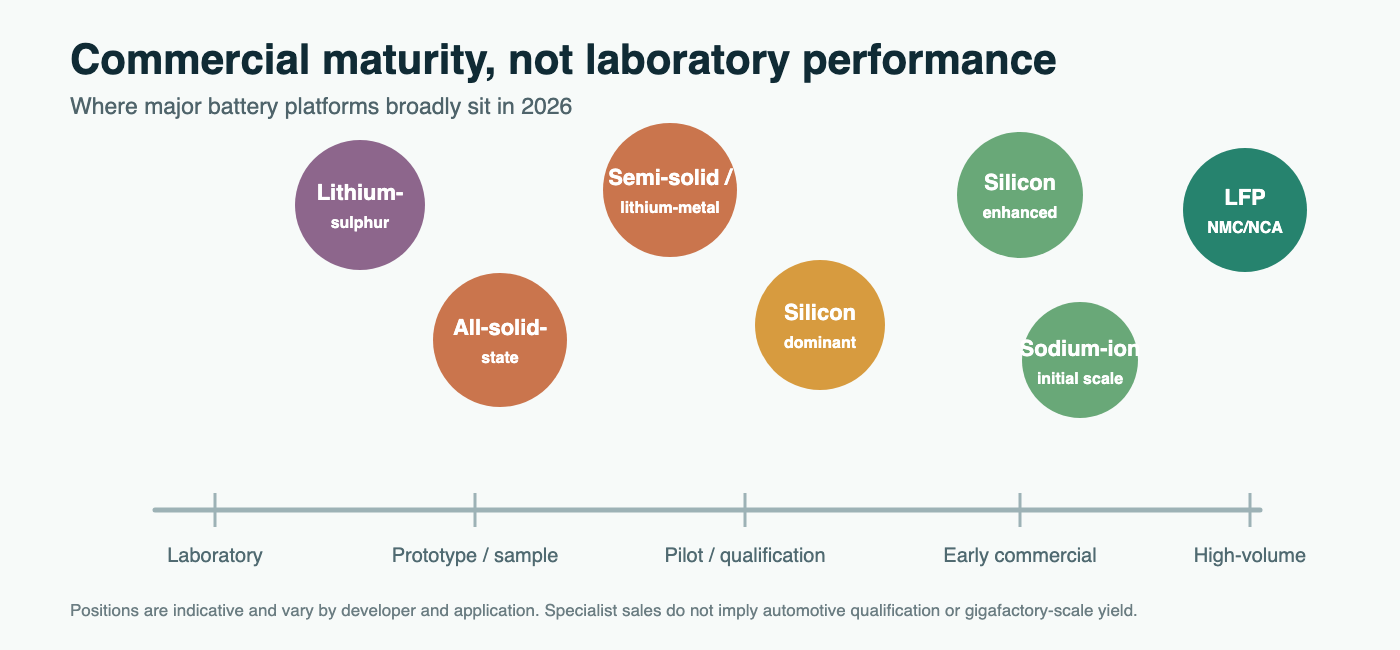
Third, advanced anodes and solid electrolytes have produced better prototypes without removing the scale-up problem. QuantumScape shipped B1 samples of its QSE-5 lithium-metal cell. Factorial put 375 Wh/kg semi-solid cells into road-test vehicles with Mercedes-Benz and Stellantis. Honda, Samsung SDI and SK On operate demonstration or pilot lines; Toyota and Idemitsu continue to target initial solid-state applications around 2027-28. These are meaningful milestones. They are not evidence that solid-state batteries have become a high-volume automotive product.
The industrial backdrop has become harder, too. Northvolt’s March 2025 bankruptcy showed that battery manufacturing is not secured by good chemistry, political support or large order books alone. Yield, process stability, customer qualification, working capital and disciplined factory ramp-up matter as much as a promising cell design. The assets may find new owners, but the lesson for Europe is uncomfortable: scaling battery production is a manufacturing problem before it is a branding exercise.
What Does Battery Energy Density Actually Mean?
Gravimetric energy density, normally expressed in watt-hours per kilogram (Wh/kg), describes stored electrical energy relative to mass. It matters when weight limits payload or movement: aircraft, drones, trucks and mobile robots are obvious examples.
Volumetric energy density, expressed in watt-hours per litre (Wh/L), describes energy relative to volume. It is often the tighter constraint in phones, laptops and vehicle platforms where the available battery space is fixed.
A cell-level figure includes the active materials, separator, electrolyte, current collectors and cell casing. A pack-level figure includes hundreds or thousands of cells plus interconnects, cooling, enclosure, battery-management electronics, fuses, contactors and crash protection. Pack integration varies widely, so converting a cell figure to a pack figure with a universal percentage is unsafe.
Nominal capacity is not always usable capacity. Battery-management software holds back energy at the top and bottom of the state-of-charge window to protect safety and life. Cold weather, high discharge power and ageing can reduce what is available further. Any comparison should therefore ask four questions: is the number gravimetric or volumetric, cell or pack, nominal or usable, and measured in what test?
The Commercial State of the Art in 2026
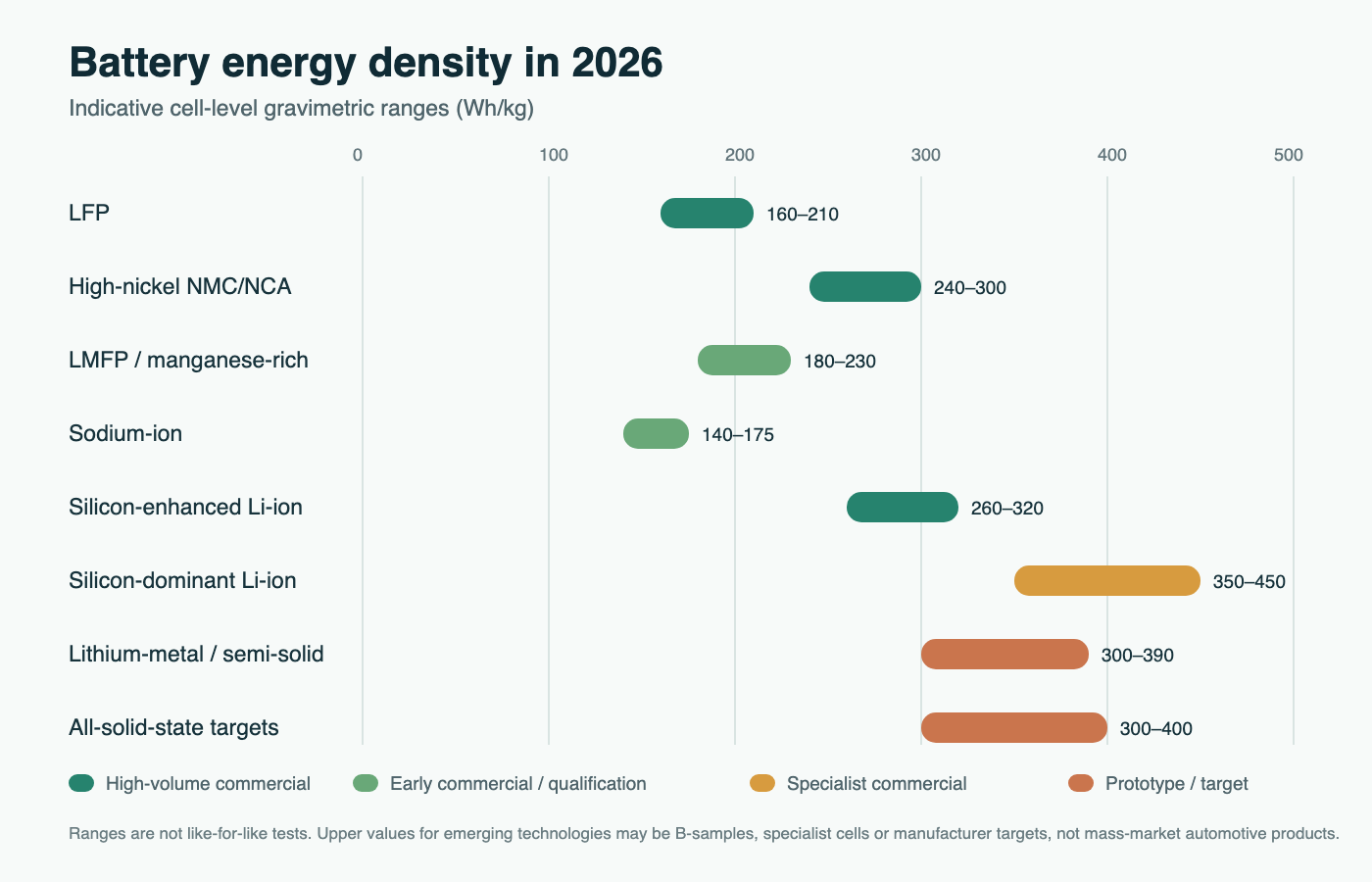
The ranges below are deliberately broad. Products overlap, published data are not always measured on the same basis, and manufacturers disclose more at cell level than at pack level. A dash means that no defensible general pack range is available, not that a pack cannot be built.
| Chemistry or architecture | Approximate cell-level energy density | Approximate pack-level energy density | Commercial maturity in 2026 | Likely first major applications | Principal limitation |
|---|---|---|---|---|---|
| LFP | 160-210 Wh/kg | 125-180 Wh/kg typical; selected manufacturer systems claim about 205 Wh/kg | High-volume commercial | Mass-market EVs, buses, commercial vehicles, grid storage | Lower specific energy, especially in cold range-sensitive duty |
| High-nickel NMC/NCA | 240-300 Wh/kg | 160-220 Wh/kg | High-volume commercial | Premium and long-range EVs, weight-sensitive mobility | Cost, thermal management, nickel and cobalt exposure |
| LMFP and manganese-rich lithium-ion | 180-230 Wh/kg, depending on formulation | 140-180 Wh/kg, limited public data | Early commercial to qualification | Mid-market EVs and commercial vehicles | Conductivity, voltage management and industrial consistency |
| Sodium-ion | 140-175 Wh/kg for announced commercial products | Roughly 100-140 Wh/kg; disclosure remains limited | Early commercial and initial vehicle deployment | Stationary storage, low-cost mobility, cold climates | Lower energy density and an immature supply chain |
| Silicon-enhanced lithium-ion | 260-320 Wh/kg in automotive-type cells | 170-230 Wh/kg | Commercial, with modest silicon content increasingly common | Premium EVs, electronics and performance products | Expansion, first-cycle loss and cost at higher silicon loading |
| Silicon-dominant lithium-ion | 350-450 Wh/kg in specialist commercial or pre-commercial cells | 250-350 Wh/kg where disclosed | Commercial in small high-value markets; automotive qualification | Drones, defence, aviation and premium electronics | Cycle life, swelling, manufacturing control and price |
| Lithium-metal / semi-solid | 300-390 Wh/kg in B-samples and automotive prototypes | Test-vehicle results, not a settled commercial range | Prototype and pilot | Premium vehicles and specialist mobility | Dendrites, interface stability, pressure and yield |
| All-solid-state | Common programme targets are 300-400 Wh/kg and 800-1,000 Wh/L | Not established commercially | Pilot lines, samples and qualification | Premium, low-volume and performance-sensitive vehicles | Interfaces, pressure, moisture control, yield and cost |
| Lithium-sulphur | About 300-450 Wh/kg in specialist cells and pilots | Not established across commercial systems | Early specialist commercialisation | Drones, satellites, defence and potentially aviation | Cycle life, polysulphide shuttle and low volumetric density |
LFP, LMFP and the Value of “Good Enough”
LFP has expanded because a battery is bought as a system, not as a cathode datasheet. It avoids nickel and cobalt, offers strong thermal stability, tolerates repeated cycling and is generally cheaper to manufacture. In city cars, buses, depot-based vans and stationary storage, those attributes frequently outweigh the mass needed to carry each kilowatt-hour.
Pack design has narrowed the practical gap. Cell-to-pack architectures remove modules and reduce frames, fasteners and duplicated casing. BYD’s long Blade cells and CATL’s module-free systems use geometry as an energy-density tool. The chemistry has not suddenly acquired the specific energy of high-nickel NMC; more of the pack has simply become cell.
LMFP adds manganese to raise voltage and energy density while retaining much of LFP’s material logic. It could become a useful middle tier, particularly when blended with LFP or deployed in vehicles that need more range without moving fully to high nickel. It does not remove every compromise. Conductivity, electrolyte stability at higher voltage and repeatable high-volume manufacture still determine whether a laboratory formulation becomes a dependable pack.
High-Nickel Batteries Are Not Disappearing
High-nickel NMC and NCA retain a strong case wherever mass and volume carry a high economic penalty. Premium long-range cars, performance vehicles, aircraft prototypes and some commercial vehicles can justify the additional material cost and thermal-management burden.
The market is becoming less binary. LG Energy Solution is broadening its portfolio across LFP, high-voltage mid-nickel and lithium-manganese-rich cells while continuing high-nickel products. GM and LG plan LMR prismatic cells for large electric trucks and SUVs. The objective is not the maximum possible nickel content; it is enough energy at a lower cost and with a more resilient material bill.
Panasonic Energy remains important in high-energy cylindrical cells, including the 4680 format, and is working with Sila on higher-silicon anodes. Tesla’s 4680 programme is equally instructive for manufacturing. A larger cell and a dry-electrode process may reduce inactive material, factory energy and cost, but industrialising a new coating process while maintaining uniformity and yield is a separate challenge from demonstrating it. Dry electrodes could matter more initially to factory economics than to the Wh/kg printed in a vehicle brochure, a distinction also examined in the site’s reality check on faster batteries.
Silicon Anodes: Incremental Change Before Revolution
Silicon stores far more lithium per gram than graphite, but it also expands dramatically during charging. That movement can crack particles, disrupt electrical contact and continuously expose fresh surface to the electrolyte. The result is lost lithium, swelling and shortened life.
Mainstream lithium-ion cells already use small amounts of silicon oxide or silicon-carbon material. Increasing that fraction gradually is the low-risk route: modest improvements in energy density without replacing every established process at once. Sila and Group14 are scaling engineered silicon-carbon materials intended to manage expansion within a porous structure. Group14’s South Korean plant has moved into production at a stated 10 GWh-equivalent material capacity; Sila’s Titan Silicon is already used in consumer devices and is being qualified for automotive supply.
Silicon-dominant cells are further ahead in small, expensive products than in mass-market cars. Amprius sells high-specific-energy cells into aviation and defence markets and reports commercial products around 450 Wh/kg, with higher figures attached to newer platforms. Those are real products in specialist volumes, not proof that a 450 Wh/kg family-car pack is ready. Automotive buyers require long cycle life, low swelling, predictable fast charging, abuse tolerance and millions of cells produced with narrow variation.
Solid-State Batteries: Progress, but Not Yet a Universal Replacement
“Solid-state” covers several different technologies. Sulphide electrolytes can offer high ionic conductivity and can be pressed into intimate contact with electrodes, but they are moisture-sensitive and can release hydrogen sulphide if mishandled. Oxide ceramics are chemically robust but brittle and difficult to join across large areas. Polymers are easier to process and can maintain contact, yet often conduct ions best at elevated temperature. Semi-solid systems retain some liquid and should not be presented as all-solid-state.
The attraction is not the solid electrolyte alone. It is the possibility of using lithium metal or an anode-free design, higher-voltage cathodes and less inactive material. The problems sit at the interfaces. Lithium must plate and strip evenly; cracks or voids concentrate current; dendrites can still propagate through defects; and some cells need continuous stack pressure that becomes awkward at pack scale.
There has been genuine progress. QuantumScape began shipping B1 QSE-5 samples in October 2025, with a stated volumetric energy density above 800 Wh/L and fast-charge capability. Factorial’s 375 Wh/kg FEST cells have been installed in Mercedes-Benz and Stellantis development vehicles. Solid Power supplies sulphide electrolyte and has licensed cell technology to BMW and SK On. Samsung SDI has a pilot line and continues to target a 900 Wh/L all-solid-state product; SK On targets 2029 commercialisation. ProLogium reports 380 Wh/kg and 900 Wh/L for its latest ceramic platform and has started construction of a French factory.
Each statement needs its status attached. A B-sample is for design validation, not a retail cell. A road-test car proves integration, not production yield. A pilot line proves that a process can be repeated at useful scale, not that it can compete on cost with a mature gigafactory. Toyota’s 2027-28 programme may produce a premium, low-volume application first. That would still be a commercial achievement, but it would not mean conventional lithium-ion had been replaced.
Sodium-Ion Finds Its Market
Sodium-ion should not be dismissed because it stores less energy per kilogram. Sodium is abundant, the chemistry can avoid lithium, nickel and cobalt, and hard-carbon anodes can perform well at low temperature. Aluminium can replace copper on the anode current collector in some designs, helping cost and supply-chain resilience.
CATL’s Naxtra announcement matters because it attaches a 175 Wh/kg cell to certification and vehicle programmes rather than to a laboratory paper. Its stationary-storage plans are arguably more important. Grid containers do not need to fly, and an extra tonne of cell mass may be irrelevant if the system is cheaper, safe, durable and easier to source.
That same logic suits short-range vehicles, two- and three-wheelers, starter batteries and cold-weather fleets. Sodium-ion will compete with relentlessly improving LFP, not with a static benchmark. Its success therefore depends on manufacturing yield, hard-carbon supply, calendar life and delivered system cost. Energy density is one line in that calculation, not the verdict.
Lithium-Sulphur and Other High-Energy Approaches
Lithium-sulphur has attractive raw materials and high theoretical specific energy, but practical cells lose performance through sulphur’s low conductivity, electrode expansion and the polysulphide shuttle. Volumetric energy density is less impressive than the gravimetric headline, which matters when space is constrained.
Lyten is pursuing commercial qualification for drones, satellites, defence and aviation while building manufacturing capacity. Those markets are credible entry points because low mass can justify higher cost and shorter service life. They are not a shortcut to mainstream automotive qualification. The same applies to lithium-metal cells: specialist products can create a market while high-volume vehicle programmes continue the slower work of safety validation and yield improvement.
Why Pack Engineering Matters as Much as Chemistry
Pack energy density can improve even when cell chemistry changes only modestly. Cell-to-pack removes modules. Cell-to-body and structural designs ask the enclosure to carry vehicle loads. Better cooling can reduce plates and channels. Higher-voltage architectures can reduce conductor mass. More accurate battery management can make a larger share of nominal capacity usable without compromising life.
None of this is free. A tightly integrated structural pack may be harder to inspect, repair or recycle. Removing barriers between cells can complicate thermal propagation. A design optimised for mass may increase insurance or service cost after a minor impact. The best pack is therefore another application-specific compromise between energy density, safety, manufacturing, reparability and end-of-life recovery.
What Higher Energy Density Actually Enables
Aviation
Aviation is unusually sensitive to gravimetric energy density because the aircraft must lift its energy store. Small training aircraft and short-hop eVTOLs can work with present cells when range, reserve and payload are tightly constrained. Regional aircraft require better cells and exceptionally efficient airframes. Long-haul battery-electric flight remains remote.
Jet fuel contains roughly 12,000 Wh/kg before engine efficiency is considered, compared with a few hundred Wh/kg for a complete battery system. Electric motors are much more efficient than turbines, but that does not erase the mass gap, and a battery does not become lighter during flight. Higher-energy cells can enlarge the useful niches; they do not put a wide-body airliner within one product cycle. This is why alternatives such as sustainable aviation fuel and liquid-hydrogen aviation infrastructure remain part of the discussion.
Heavy Transport
In trucks and buses, higher pack-level energy density means more range, less payload loss or a smaller battery for the same route. It does not remove charging time, grid connections, duty-cycle variation or finance. Battery-electric trucks are well suited to predictable routes with depot charging; the hardest long-haul and weight-sensitive work remains more contested.
The operational consequences are examined in the site’s work on electric HGV payload loss, the economics of heavy-truck battery swapping, Chinese zero-emission commercial vehicles and the real-world fleet TCO model. A lighter pack improves each case, but it does not decide it in isolation.
Robotics
Humanoid and mobile robots need enough energy to work for a shift without carrying their battery like ballast. They also need high power for actuators, fast charging or safe swapping, good cycle life and a pack that does not destabilise the machine’s weight distribution. Samsung SDI’s 2025-26 work with Hyundai, Kia and other partners on robotic batteries reflects this distinct design space.
As with vehicles, customers will buy uptime rather than Wh/kg. The wider commercial context is covered in the 2026 humanoid robotics market analysis and the site’s robotics and physical AI hub.
Consumer Electronics and Drones
Smaller, high-value products are often the first market for new battery materials. They require fewer cells, tolerate a price premium and move through qualification faster than a car platform. Silicon-rich cells can turn extra energy into a thinner device, longer drone endurance or more onboard computing. The trade-off may be acceptable even if cycle life is below the level expected from a fleet vehicle.
Grid Storage
Stationary storage reverses the priorities. Land and container mass may matter, but cost per delivered megawatt-hour, cycle life, fire behaviour, warranty, material availability and financing usually matter more. LFP is entrenched because it offers a strong system balance. Sodium-ion can win business without matching NMC energy density if it provides lower supply risk or better cold-weather performance. The auto industry’s move into battery storage shows how manufacturing strategy is also fragmenting by application.
The Road to 2030
The most likely 2030 battery is not a chemistry that has displaced everything else. It is a more efficiently packaged lithium-ion cell with incremental improvements to cathode, electrolyte, anode and manufacturing.
- LFP should remain strong in cost-sensitive vehicles and stationary storage, with better pack integration and faster charging.
- High-nickel and mid-nickel lithium-ion should remain important where range, performance and weight justify the cost.
- Silicon content should rise broadly, while genuinely silicon-dominant cells expand first in electronics, drones, defence and aviation.
- Sodium-ion should scale in storage and selected mobility markets, particularly where cold performance or material diversification has value.
- Solid-state batteries may appear in premium or low-volume vehicles, but broad cost parity and gigafactory-scale yield are unlikely to be automatic by 2030.
- Lithium-metal and lithium-sulphur should develop credible specialist markets before they become plausible mass-market automotive competitors.
The forecast should remain conditional. A cell can miss its launch because an interface degrades, but also because a coating line yields too few saleable electrodes, a supplier cannot meet purity requirements or an automaker changes platform strategy. Northvolt’s collapse is a reminder that industrial execution can dominate electrochemistry.
Conclusion
There will probably be no single battery winner. LFP, high-nickel lithium-ion, sodium-ion, silicon-rich cells and several forms of solid or semi-solid battery can all grow because they solve different problems.
The next phase of battery development will be less about one record number and more about matching chemistry, cell design, pack architecture and manufacturing process to an application. The important question is not merely, “How high is the energy density?” It is: high enough for what, at what cost, and for how many cycles?
Frequently Asked Questions
What is the highest energy density available in a commercial battery in 2026?
Specialist silicon-anode cells are sold at around 400-450 Wh/kg for aviation, drones and defence. They are produced in far smaller volumes and under different life and cost requirements from automotive cells. High-volume EV cells are more commonly about 160-210 Wh/kg for LFP and 240-300 Wh/kg for high-nickel lithium-ion at cell level.
What is the difference between cell and pack energy density?
Cell energy density measures the electrochemical cell. Pack energy density includes cooling, casing, wiring, controls and crash protection, so it is lower. The reduction varies with cell format, vehicle architecture, safety requirements and usable-capacity policy.
What is a realistic EV battery energy density in 2026?
Most commercially produced EV cells fall broadly between 160 and 300 Wh/kg, while complete packs are commonly around 125-220 Wh/kg. Exceptional manufacturer claims can sit outside those ranges, but the cell or pack boundary and test basis must be checked.
Are solid-state batteries commercially available?
Small solid-state batteries exist, and automotive developers are producing samples and test-vehicle packs. In 2026, all-solid-state batteries are not yet a high-volume automotive product. The first vehicle applications are more likely to be premium or low-volume programmes later in the decade.
Why use sodium-ion if its energy density is lower?
Sodium-ion can reduce dependence on lithium, nickel and cobalt and may offer good safety and cold-weather performance. In stationary storage or short-range mobility, cost, durability and material availability can be more valuable than carrying the maximum energy per kilogram.
Will one battery chemistry dominate by 2030?
Probably not. LFP is well suited to cost-sensitive vehicles and storage; high-nickel cells to range- and weight-sensitive vehicles; sodium-ion to selected storage and mobility markets; and silicon-rich or solid-state cells to higher-value applications. Manufacturing scale and application fit will matter as much as laboratory performance.
Selected Technical Sources
- International Energy Agency, Global EV Outlook 2026: electric vehicle batteries
- CATL 2026 multi-chemistry technology update and 2025 Naxtra product disclosure
- CATL Naxtra safety certification
- Toyota and Idemitsu solid-state production programme
- Honda all-solid-state demonstration line
- QuantumScape QSE-5 B1 sample shipment
- Factorial and Stellantis development-vehicle testing
- Solid Power 2025 Form 10-K
- Samsung SDI solid-state pilot programme
- SK On solid-state research update
- ProLogium 2026 cell and module programme
- Panasonic Energy and Sila silicon-anode agreement
- Group14 SCC55 cycle-life disclosure
- Amprius 2024 annual filing, published 2025
- LG Energy Solution and GM lithium-manganese-rich programme
- Northvolt bankruptcy statement, March 2025
- Lyten lithium-sulphur technology and qualification status
Pingback: 韓国POSTECH、航続距離2倍のアノードフリー電池を開発──1,270Wh/Lを達成 - digitopia