
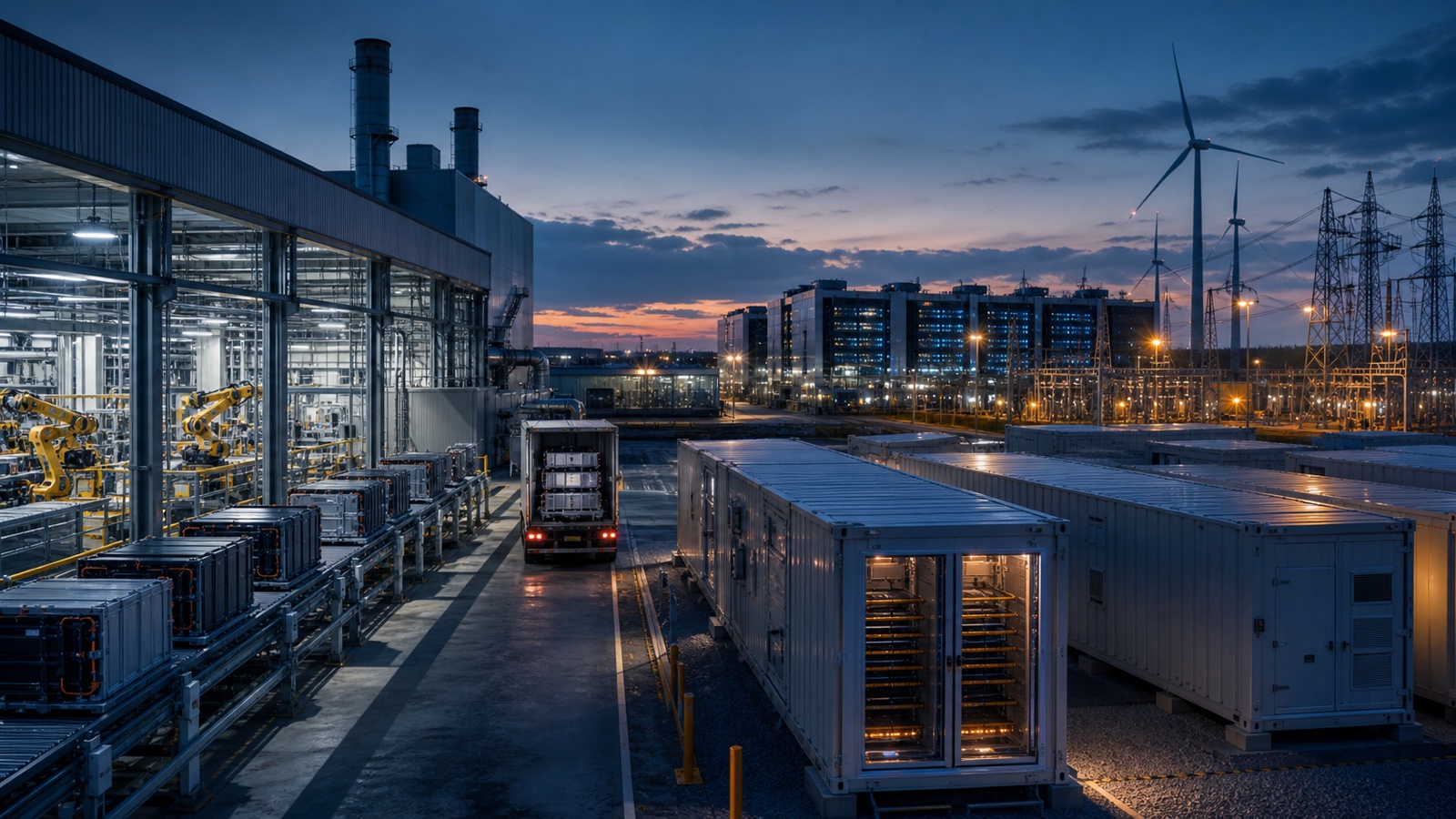
General Motors’ sodium-ion partnership with Peak Energy looks, at first glance, like another battery announcement from an automaker trying to sound technologically relevant.
It is more consequential than that.
GM is developing sodium-ion cells for stationary storage while converting part of its Ultium Cells operation in Spring Hill, Tennessee, towards lithium iron phosphate production for the storage market. Ford has launched Ford Energy and is repurposing Kentucky battery capacity for grid-scale systems. Volkswagen is operating its first large-scale Elli PowerCenter in Salzgitter. Stellantis is deploying storage across its own industrial estate while its battery ventures adapt to a weaker EV outlook.
Legacy automakers are discovering that their most valuable asset may not be the car, but the ability to manufacture electrochemical storage at scale.
This is not simple diversification. It is an EV battery capacity pivot driven by three uncomfortable realities: electric-vehicle demand has grown more slowly than the capacity built to serve it; AI data centres are creating a new class of power customer; and Chinese battery manufacturers have made standard battery competition structurally difficult for Western incumbents.
GM’s Sodium-Ion Bet Is Not Just Another Battery Announcement
GM’s agreement with Peak Energy matters because it separates the requirements of a stationary battery from those of a vehicle battery.
An EV battery must carry its own weight. Energy density, volume and acceleration performance matter. A grid battery sits on a concrete pad. Its customer cares more about installed cost, cycle life, safety, temperature tolerance, warranty terms and the revenue it can earn over decades.
That distinction creates room for sodium-ion. GM and Peak Energy plan to develop sodium-ion cells for stationary applications, with trial production expected at GM’s Battery Cell Development Center in Michigan by 2028. Peak Energy has already deployed a 3.5 MWh sodium-ion system at SolarTAC in Colorado and has announced supply agreements that give the chemistry a route beyond laboratory validation.
Sodium-ion has lower energy density than the best lithium-ion chemistries. That is a serious disadvantage inside a car and a much smaller problem in a stationary enclosure. Sodium is abundant, the chemistry can reduce exposure to lithium and graphite supply chains, and Peak Energy argues that its passive-cooling architecture can reduce the auxiliary equipment required by conventional systems.
The strategic point is not that sodium-ion has already beaten LFP. It has not. The point is that GM is trying to enter a battery segment where manufacturing learning, domestic supply-chain development and differentiated intellectual property may still matter.
GM is not betting that sodium-ion will replace lithium-ion everywhere. It is betting that stationary storage should not be forced to inherit every compromise designed for a moving vehicle.
GM’s second move is more immediate. Its Ultium Cells joint venture with LG Energy Solution is retooling part of the Spring Hill plant to make LFP cells for stationary storage, with commercial production expected in late 2027. LFP is already well established in BESS because it offers a useful balance of cost, cycle life and thermal stability.
These two tracks reveal the strategy. LFP provides a credible route into today’s market. Sodium-ion is the attempt to avoid becoming an undifferentiated LFP assembler tomorrow.
GM is also working with Redwood Materials on second-life EV batteries, including a 12 MW/63 MWh microgrid supporting a Crusoe data-centre development in Nevada. New cells, alternative chemistry and second-life packs are different products, but all monetise capabilities originally built around vehicles.
Automaker Storage Pivot Comparison
| Automaker | Storage move | Chemistry/technology | Timing | Strategic rationale |
|---|---|---|---|---|
| General Motors | Peak Energy partnership; Spring Hill conversion; Redwood second-life systems | Sodium-ion, LFP and second-life lithium-ion | Spring Hill production targeted for late 2027; sodium-ion trials targeted for 2028 | Redeploy battery manufacturing, build a differentiated US storage supply chain and serve data-centre/grid demand |
| Ford | Ford Energy and Kentucky BESS manufacturing pivot | Primarily LFP-based stationary storage | First customer deliveries targeted for 2027 | Monetise underused battery capacity and sell directly to utilities, data centres and industrial users |
| Volkswagen | Elli PowerCenter in Salzgitter with energy trading | Large-scale lithium-ion storage integrated with digital trading | Operational in 2026 | Extend from vehicles and cells into power-market participation |
| Stellantis | On-site BESS across European plants; battery ventures adapting to demand | Industrial BESS and lithium-ion manufacturing base | Deployment programme through 2026 and beyond | Reduce plant energy costs, increase self-consumption and preserve optionality around battery assets |
Ford Energy: The First Serious Detroit Pivot into Grid Storage
Ford moved earlier and more explicitly than GM. Its late-2025 reset combined a large write-down of EV investment with the creation of Ford Energy, a wholly owned business focused on battery energy storage systems.
The company plans to repurpose battery manufacturing capacity in Kentucky for stationary storage, targeting around 20 GWh of annual output when fully ramped. Ford’s stated customer base includes utilities, data centres and large industrial users.
This is a more serious move than putting a familiar badge on a bought-in battery container. Ford can bring manufacturing scale, procurement capability, quality systems, balance-sheet support and an established industrial workforce. It can also use its own sites as proving grounds.
But the move exposes a major commercial difference between cars and storage. A vehicle is a branded consumer product. A BESS project is an infrastructure asset bought through technical diligence, project finance, warranties, software integration, grid connection and long-term service agreements. The battery cells matter, but the customer also needs controls, power electronics, system integration, safety evidence and a bankable performance guarantee.
Ford Energy therefore has to become more than a battery manufacturer. It must become an infrastructure supplier.
The Factory Is Only Half the Product
Automakers know how to manufacture at scale. Grid-storage customers buy availability, dispatch performance, warranty confidence and revenue certainty. Winning BESS requires software, project delivery and long-term asset support as well as cells.
Volkswagen’s Elli PowerCenter and the European Energy Play
Volkswagen’s strategy is different from Detroit’s. It is less about announcing a factory rescue and more about extending the group into energy markets.
The Elli PowerCenter in Salzgitter is a 20 MW/40 MWh large-scale storage system located close to Volkswagen’s battery activity. Elli is using the asset not only to store electricity but also to trade energy and provide flexibility to the power system.
That matters because the margin in storage does not necessarily sit in the cell. It can sit in deciding when to charge, when to discharge, which market to bid into and how to stack revenues without damaging the asset.
Volkswagen has spent years trying to connect EVs, charging, home energy and grid services. Elli gives it an operational asset through which to learn how batteries earn money outside a vehicle. In a European market facing grid congestion, renewable volatility and rising electricity demand, that learning may be more valuable than the initial 40 MWh project.
The PowerCenter also sits inside a wider industrial logic. Europe is paying substantial sums to constrain renewable generation while also struggling to connect new loads. The commercial question behind wind curtailment is not whether storage is useful. It is whether storage is located, contracted and dispatched in a way that captures enough of the value.
Stellantis and the Quieter Industrial Storage Strategy
Stellantis has not presented a Ford-style storage subsidiary or a GM-style sodium-ion technology bet. Its approach is quieter and, in some respects, more conservative.
The group has been deploying roughly 200 MWh of battery storage across about 20 European industrial sites as part of a wider effort to increase on-site energy self-consumption. This turns factories into early storage customers and gives Stellantis direct operational experience with BESS economics.
Its StarPlus Energy venture with Samsung SDI remains primarily associated with vehicle batteries. Reports that battery ventures are adapting their product priorities should be treated carefully until specific conversion plans are confirmed. The strategically defensible claim is narrower: Stellantis has battery-manufacturing exposure, has reduced earlier EV commitments, and is using stationary storage within its own industrial system.
That is still important. Automakers operate large, power-intensive estates. They can deploy storage behind the meter, reduce peak demand, increase renewable self-consumption, improve resilience and build evidence before selling more broadly. Internal demand can be a bridge between unused battery capacity and an external storage business.
Why This Is Happening Now
The automaker move into storage is being described as a response to a booming market. That is true, but incomplete. It is also a response to poor capital allocation.
Western automakers invested heavily in battery plants on the assumption that EV demand would rise quickly enough to absorb output. Demand has continued to grow in many markets, but not at the rate or with the product mix that those investment plans assumed. Capacity that looked strategically scarce became financially burdensome.
A battery plant has high fixed costs. Underutilisation is expensive. Converting some production toward stationary storage can improve asset utilisation, preserve jobs and create a second customer base without abandoning EVs entirely.
The distinction matters. This is not evidence that battery-electric vehicles have failed. It is evidence that a factory built for one demand curve can become stranded when the curve arrives later, shifts geography or is captured by lower-cost competitors.
There is also a wider industrial-policy dimension. US and European policymakers increasingly want domestic battery capacity for resilience as well as decarbonisation. Grid storage, defence installations, industrial microgrids and data centres broaden the strategic case for keeping battery manufacturing alive.
AI Data Centres Have Changed the Battery Storage Customer
AI data centres change battery demand because they combine enormous electricity consumption with a very low tolerance for power interruption.
The International Energy Agency expects global data-centre electricity demand to more than double by 2030, with AI as the most important driver of growth. The challenge is not only annual energy consumption. Large AI campuses can arrive faster than transmission networks, generators and grid connections can be built.
That creates several roles for batteries:
- Power quality and ride-through: batteries respond quickly to disturbances and bridge short interruptions.
- Backup architecture: BESS can reduce reliance on diesel generation for some resilience functions, although it does not automatically replace long-duration backup.
- Grid-connection management: storage can reduce peaks, manage constrained connections and support phased site growth.
- Microgrids: batteries can coordinate on-site generation, grid supply and critical loads.
- Power-market participation: a data-centre battery may earn revenue or reduce cost when it is not needed for resilience.
This is why the emerging customer is attractive to automakers. Data-centre developers and major technology companies are creditworthy, technically sophisticated and willing to sign long-term agreements when power availability is the constraint on growth.
It is also why the opportunity can be overstated. Batteries move electricity through time. They do not create energy, solve every grid bottleneck or provide indefinite backup. The commercial case depends on duration, cycling, interconnection, degradation, controls and the value of the service being provided. My analysis of AI data-centre grid capacity and data-centre microgrids makes the same point: infrastructure demand is real, but the solution must be matched to the constraint.
EV Batteries vs Stationary Storage Batteries
| Factor | EV battery priority | Grid/data-centre storage priority | Why it matters |
|---|---|---|---|
| Energy density | High: mass and volume directly affect range and payload | Moderate: footprint matters, but systems remain stationary | Lower-density chemistries can be commercially viable in BESS |
| Cycle life | Important, balanced against range and performance | Critical, especially for frequently dispatched assets | Replacement cost and lifetime throughput drive returns |
| Thermal management | Must work across mobile duty cycles and crash constraints | Must minimise fire risk and auxiliary power at site scale | Cooling architecture changes operating cost and permitting |
| Installed cost | Measured against vehicle price and customer performance | Measured against revenue stack and cost per delivered MWh | The cheapest cell is not always the lowest-cost system |
| Weight | Directly reduces efficiency or payload | Usually secondary once foundations and transport are managed | Stationary storage opens the door to sodium-ion and second-life packs |
| Supply-chain exposure | Important for vehicle margin and production continuity | Important for project bankability, policy eligibility and scale | Domestic chemistry and manufacturing can carry strategic value |
| Software and controls | Integrated with vehicle performance and charging | Integrated with grid dispatch, markets and site resilience | BESS value depends heavily on orchestration, not cells alone |
Why Sodium-Ion Matters for Stationary Storage
Sodium-ion matters because stationary storage rewards a different optimisation.
LFP has become the default chemistry for many grid-storage projects. It is relatively low cost, has good cycle life and avoids nickel and cobalt. It also benefits from an enormous established supply chain. Those strengths make it hard to displace.
Sodium-ion’s near-term opportunity is therefore not based on superior energy density. It is based on the potential to offer competitive lifetime cost, strong temperature performance, reduced dependence on lithium and graphite, and a supply chain that Western manufacturers may be able to shape earlier.
For EVs, lower energy density means more mass and volume for the same usable energy. That is difficult in passenger cars and even more consequential in payload-sensitive commercial vehicles. The trade-off is clear in the site’s analysis of battery payload and lifecycle economics and the wider battery energy-density roadmap.
For stationary storage, a larger enclosure can be acceptable if it lowers cost or complexity. Sodium-ion could be attractive in hot or cold climates, in markets concerned about lithium supply, or where safety and cooling requirements materially affect project economics.
But this remains an emerging commercial proposition. Bankability depends on real-world degradation, warranty support, insurance acceptance, manufacturing yield and system-level cost. Announced partnerships are not the same as proven fleets of assets.
Battery Chemistry Fit: EVs vs Stationary Storage
This chart-ready comparison shows where each technology is strongest. Ratings are directional and depend on cell design and system integration.
LFP
- Energy density: Medium
- Cost: Low
- Supply-chain exposure: High exposure to Chinese scale and IP
- Thermal management: Relatively favourable
- Grid fit: Excellent and already bankable
Sodium-Ion
- Energy density: Low to medium
- Cost: Potentially low at scale
- Supply-chain exposure: Lower lithium dependence; supply chain still immature
- Thermal management: Potential advantage
- Grid fit: Promising, not yet broadly bankable
NMC/NMCA
- Energy density: High
- Cost: Higher
- Supply-chain exposure: Nickel, cobalt and processing risk
- Thermal management: More demanding
- Grid fit: Capable, but often unnecessarily premium
Second-Life EV Batteries
- Energy density: Variable
- Cost: Potentially attractive
- Supply-chain exposure: Depends on available retired packs
- Thermal management: Pack-specific integration challenge
- Grid fit: Strong for selected projects with robust diagnostics
The China Problem Legacy Automakers Cannot Ignore
China is not merely a source of cheaper battery cells. It is the centre of gravity of the battery industry.
CATL and BYD have used domestic EV scale, vertical integration, manufacturing learning and sustained investment to build formidable positions in batteries. China also dominates LFP production and much of the upstream and processing capacity required across lithium-ion supply chains.
This creates a structural problem for legacy automakers moving into storage. If Ford or GM buys standard cells, packages them into a standard container and competes mainly on price, it enters a market where CATL, BYD and LG Energy Solution already have scale, customer references and established products.
The automaker advantage is real but narrower than it appears. They have manufacturing sites, engineering talent, procurement systems, access to capital and political relevance. Chinese battery groups have lower costs, faster iteration, broader chemistry portfolios and deeper supply-chain integration.
GM’s sodium-ion partnership is partly a response to that imbalance. It is an attempt to compete where the industrial structure is less settled. The same strategic logic appears elsewhere in Western industrial policy: find a technical or regulatory segment where Chinese scale is not yet decisive, then build a domestic ecosystem before it becomes decisive.
This does not make sodium-ion automatically Western. CATL and other Chinese manufacturers are also developing and commercialising sodium-ion. The window for differentiation may be brief.
The Strategic Risk: BESS Is Already Competitive
Stationary storage is growing quickly, but growth does not guarantee attractive margins.
BESS is already exposed to falling cell prices, intense competition, standardised container formats and aggressive bids. Large buyers can procure systems globally. Project developers care about warranties and bankability, but they also apply relentless price pressure.
That creates the risk that automakers repeat the EV battery problem in a different market. They may redeploy factories into storage only to discover that storage cells and containers have become commodities too.
The defensible positions are likely to sit around one or more of the following:
- Differentiated chemistry with proven lifetime economics.
- Software capable of dispatching assets across complex revenue stacks.
- Bankable warranties and long-term service.
- Domestic-content eligibility and trusted supply chains.
- Integrated delivery for data centres, industrial sites and microgrids.
- Access to second-life packs with reliable diagnostics and predictable supply.
A factory is a valuable starting point. It is not a moat.
Legacy Automaker Battery Storage Pivot Timeline
Ford: announces Ford Energy and a major reset of EV investment, with Kentucky capacity redirected towards stationary storage.
GM/Redwood: expands work on second-life batteries for large microgrid and data-centre applications.
Volkswagen: Elli PowerCenter begins operation in Salzgitter, combining storage with energy trading.
Stellantis: continues on-site BESS deployment across European plants.
GM: announces Peak Energy sodium-ion partnership and advances the Spring Hill LFP storage pivot.
Ford: targets first Ford Energy customer deliveries.
GM/LG Energy Solution: targets commercial LFP storage-cell production from Spring Hill.
GM/Peak Energy: targets sodium-ion trial-cell production at GM’s Michigan development centre.
Implications for Startups, Investors and Policymakers
For Startups
The opportunity is not to imitate an automaker’s manufacturing footprint. It is to provide what that footprint lacks.
Peak Energy is a clear example: a specialist chemistry and system architecture paired with an incumbent capable of scaling production. Similar openings exist in battery-management software, asset optimisation, diagnostics for second-life packs, fire-safety systems, interconnection, thermal management and data-centre microgrid controls.
Startups should be careful about becoming replaceable technology suppliers to much larger manufacturers. The strongest position is ownership of validated performance data, software, intellectual property or customer access that remains valuable after manufacturing scales.
For Infrastructure Investors
Investors should separate manufacturing headlines from asset economics. A domestically produced battery may receive policy support and reduce supply-chain risk, but a BESS project still requires a credible connection, revenue model, degradation case, warranty and route to market.
Data centres can provide bankable demand, but the storage requirement must be defined precisely. Is the battery providing seconds of ride-through, several hours of peak management, grid services, backup, or all of them? Each use changes cycling, sizing and revenue.
Second-life batteries deserve attention where the integrator can prove state of health, standardise packs and stand behind performance. Cheap retired batteries are not automatically cheap infrastructure.
For Policymakers
Battery policy can no longer be designed only around EV sales. Stationary storage supports grids, industrial resilience, renewable integration and data-centre development. The same cell plant can serve several strategic markets.
Policy should reward outcomes rather than merely announce capacity. Domestic-content incentives can help establish manufacturing, but competitiveness depends on productivity, chemistry, software, permitting, interconnection and demand. Protecting an expensive factory indefinitely is not an industrial strategy.
The more useful question is whether domestic manufacturers can deliver storage systems that infrastructure customers choose after support begins to fall away.
For Legacy Automakers
The storage pivot buys time and improves the odds of using assets that might otherwise remain underutilised. It also creates a route into power markets that will become increasingly connected to transport, charging and industrial energy.
But storage cannot become an excuse to avoid the harder vehicle-market problem. Chinese manufacturers are not winning only because they make batteries cheaply. They combine batteries, power electronics, software, manufacturing speed and product iteration.
Legacy automakers need to decide whether they want to be cell manufacturers, system integrators, energy traders, infrastructure providers or all four. Each requires different capabilities. Trying to do all four without clear ownership and commercial discipline will turn diversification into another expensive narrative.
The battery-storage pivot will succeed only if automakers build a commercial deployment model around the repurposed factories. Supply chain maturity is a relevant barrier, but it extends beyond cell availability to integration, warranties, software, service and bankable performance data. Automotive scale can lower manufacturing cost, yet infrastructure customers will still compare complete systems on lifetime economics and reliability. The strongest entrants will convert manufacturing assets into repeatable customer outcomes rather than treating stationary storage as a destination for excess cells.
Conclusion: The Car Is No Longer the Whole Battery Business
The auto industry’s move into stationary storage is not a side business created by enthusiasm for the grid. It is a structural reset forced by underused battery capacity, new electricity demand and a battery market increasingly shaped by Chinese scale.
GM’s sodium-ion bet is the most technologically ambitious part of that reset. Ford Energy is the clearest industrial pivot. Volkswagen’s Elli PowerCenter shows how storage can lead into trading and grid services. Stellantis demonstrates the value of becoming an internal customer before building an external proposition.
The opportunity is substantial. So is the competitive risk.
Legacy automakers can redeploy factories, workforces and supply chains towards battery energy storage systems. They cannot assume that manufacturing capacity alone will produce attractive returns. CATL, BYD and LG Energy Solution already understand this market. Data-centre customers will demand bankable performance, not automotive heritage.
The companies that win will treat batteries as infrastructure assets with chemistry, software, controls, warranties and revenue models designed around the customer they actually serve.
The car is no longer the whole battery business. It may not even be the most strategically valuable part.
Frequently Asked Questions
Why are automakers moving into battery energy storage?
Automakers are moving into battery energy storage to use underutilised EV battery manufacturing capacity, serve fast-growing grid and data-centre demand, and create additional markets for their battery expertise. The pivot can improve factory utilisation, but it also places automakers in an already competitive infrastructure market.
Why is GM investing in sodium-ion batteries?
GM is working with Peak Energy on sodium-ion cells for stationary storage because the chemistry may offer lower supply-chain exposure, favourable temperature performance and competitive lifetime cost without needing the high energy density required by vehicles. It also gives GM a possible point of differentiation from standard LFP systems.
Are sodium-ion batteries suitable for electric vehicles?
Sodium-ion batteries can be used in some electric vehicles, but their lower energy density makes them less attractive for many near-term passenger-car and payload-sensitive commercial-vehicle applications. Stationary storage is a stronger early market because weight and volume are less important.
What is Ford Energy?
Ford Energy is Ford’s battery energy storage business. It is intended to supply grid-scale storage to utilities, data centres and industrial users while repurposing part of Ford’s battery manufacturing base, including capacity in Kentucky.
How do AI data centres affect battery storage demand?
AI data centres require large amounts of reliable power and can face long waits for grid capacity. Batteries can provide ride-through, power-quality support, peak management, microgrid control and selected backup functions. They help manage power constraints, although they do not create energy or replace every form of long-duration backup.
Sources and Further Reading
- Financial Times: GM joins race to build batteries for AI data centres and the grid, 9 June 2026
- CNBC: GM eyes new battery type to grow data-centre and energy-storage business, 9 June 2026
- TechCrunch: GM bets big on energy storage for data centres and the grid, 9 June 2026
- ESS News: LG and GM pivot Ultium Cells JV to LFP battery production for US storage
- Energy-Storage.news: Ford’s strategic pivot into the competitive BESS market
- Renewable Energy Industry: Volkswagen commissions first large-scale battery storage system and launches energy trading
- International Energy Agency: Energy and AI
- International Energy Agency: Batteries and Secure Energy Transitions
- Reuters: How China’s EV battery makers stack up in energy storage
- ESS News: Peak Energy operates large-scale sodium-ion battery in the US
Last reviewed: 10 June 2026. Reviewed for automaker storage announcements, battery chemistry claims, AI data-centre demand, internal links, mobile table behaviour and source attribution.