Hydrogen Investment Opportunity 2026: Why Deal Collapse Signals Real Value
A critical analysis of the hydrogen sector’s 2024–2025 sector clear out and the emerging three-tier market structure.

Hydrogen investment opportunity 2026: a temporary crash followed by a structurally stronger market.
Key Points
- The clear out was real.
The hydrogen sector experienced genuine capital reallocation from September 2024–January 2026: bankruptcies, project cancellations, and valuations compressed 50%+. - Deal collapse reflects repricing, not death.
Venture capital allocation shifted from mega-rounds ($80–100M) to survival-stage financing ($12–18M)—rational repricing of risk, not capital flight. - Three tiers emerged.
Bankable projects (government-backed, contracted demand) are now better positioned than 2021. Growth-stage companies with customers can access capital at high cost. Tier 3 (pre-revenue) is essentially extinct. - The timing window opens 2026–2028.
First production data from HAR1 projects validates cost curves. Government NDC reviews force capital reallocation toward shovel-ready infrastructure. - Now is the key hydrogen investment opportunity.
Depressed valuations and capital scarcity create the best entry point in a decade—if you can distinguish terminal cases from genuine opportunities.
What Actually Happened (2024–2025)
An investment banker deep in the cleantech/hydrogen space provided a straightforward thesis: Over the last four months, the hydrogen sector experienced a genuine sector clear out. Companies failed. Projects were cancelled. Billions in announced investment vaporized.
Yet his conclusion? Now is genuinely a time to buy.
This hydrogen investment opportunity exists not because hydrogen already works everywhere, but because the market finally priced in when hydrogen actually works. The question isn’t whether hydrogen is dead. It’s whether you can distinguish between terminal cases and actual opportunities.
The Casualties
The Danish electrolyser manufacturer filed for bankruptcy in March 2025, after a \”restructuring\” that fooled no one. The company’s high-pressure alkaline technology was picked up for €10–15 million by thyssenkrupp Nucera. For context: GHS had raised over $100 million in venture capital. The purchase price was less than acquisition fees.
The German hydrogen developer entered self-administration in November 2024 after majority shareholder Foresight Group declined to approve additional funding. The company had raised €59 million in shareholder loans. Invested equity is gone completely. HydrogenOne Capital Growth (HGEN) wrote down the position from £11m to zero. The board’s assessment: \”No recovery anticipated.\”
Hyvia (Renault–Plug Power JV): Liquidated.
BP’s HyGreen Teesside (500MW planned): Cancelled entirely.
Ørsted’s H2RES: Dead.
SSE’s GHB2: Abandoned.
LCP Delta’s 2025 European hydrogen market update documents 33 projects cancelled or halted in 2024 alone, representing 3.6GW of planned capacity.
Deal Volume and Deal Size
Deal volume in hydrogen is at the same level as 2020/21. But here’s the critical detail: deal size is approximately 80% smaller.
Series B/C hydrogen companies raising $50–100M at $300–500M+ valuations.
Same companies raising $10–20M at $50–100M valuations (with equity dilution of 30–50%).
Venture capital allocation to hydrogen: $960 million globally across 50 deals (2024) versus $1.11 billion across 18 deals (2023). The math: 55% fewer deals, but 14% less capital = deal size collapsed.
This is the sound of capital reallocating from hype to reality.
Why Nobody Talks About the Net Zero Problem
Governments aren’t going to hit their net zero targets. Not even close.
The Net Zero Stocktake 2025 documents this with surgical precision:
- 137 of 198 governments have net zero targets (69% of them).
- Only 67% have these targets enshrined in law.
- Global GDP coverage of net zero commitments dropped from 93% (2023) to 77% (2025) after the Trump administration rescinded federal hydrogen tax credits.
- One-third of Fortune 2000 companies with net zero targets have no implementation plan whatsoever.
The Political Mechanism
The EU is scrambling. The UK is accelerating. The US federal government abandoned $6–8 billion in available tax credits in December 2024 via executive order—credits that made hydrogen projects bankable.
Spain’s government threatened a permanent windfall tax on renewable hydrogen in early 2024, forcing project sponsors to consider cancellation (they backed down, but the signal was sent: rules can change at political whim).
Here’s the mechanism: Governments now face a credibility crisis on climate commitments. They’ve made promises they can’t keep voluntarily. The NDC (Nationally Determined Contribution) reviews happen in 2025–2027. The political window for governments to announce \”progress\” is 24–36 months.
That creates a predictable cycle:
- Miss targets (2024–2025).
- Face political/credibility heat (2026–2027).
- Scramble for \”shovel-ready\” decarbonization assets to announce (2027–2028).
- Re-allocate available capital toward projects that can move fast.
The capital isn’t disappearing. It’s just waiting for assets that can execute.
Three Tiers. That’s All You Need to Know.
The clear out didn’t affect the sector uniformly. It created a three-tier market:
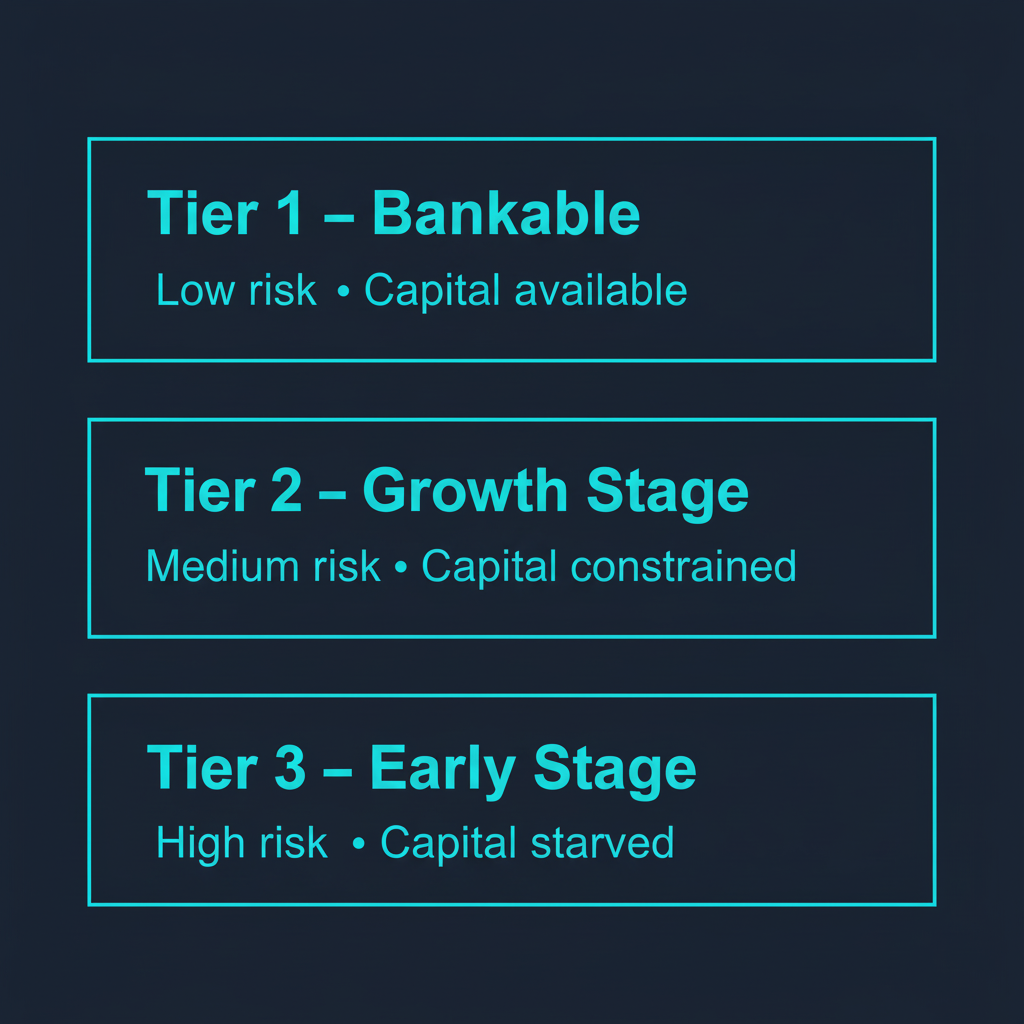
Three-tier hydrogen market: bankable, growth-stage and early-stage segments with very different risk and capital profiles.
Tier 1: Bankable (Low Risk / Capital Available)
Government-backed hydrogen projects with long-term revenue contracts. In the UK, this is the Hydrogen Allocation Round (HAR) model: 15-year contracts for difference, protecting producers against price volatility.
HAR1 Status (November 2024): 11 projects signed contracts. By July 2025, 10 projects had unlocked £400 million in private capital investment alongside government support, as analysed in UK Hydrogen Policy 2025: Comprehensive Sector Review.
HAR2 Status (April 2025): 27 projects shortlisted, targeting 765MW of capacity, with final selections expected in 2025. The implications for investors are covered in 2025 Review: 2026 UK Energy Priorities.
EU Equivalent: European Hydrogen Bank (EHB) with €1 billion committed. Projects are reaching Final Investment Decision (FID) with 15–20 year government-backed revenue contracts.
Capital availability: High, at reasonable cost.
Expected returns: 4–8% IRR (patient capital, but de-risked).
Tier 2: Growth Stage (Medium Risk / Capital Constrained)
Companies with actual revenue or locked-in offtake agreements. These are the survivors—the venture-backed companies that didn’t go bankrupt because they have customers.
- Post-revenue operations (not pre-revenue vaporware).
- 10+ year contracts with identified offtakers (steelmakers, refineries, energy companies), especially those exposed to green steel and CBAM.
- Technology differentiation (cost, efficiency, durability advantages).
- Pathway to $2.50–4.00/kg production costs by 2030.
Capital availability: Constrained. Available at high cost (30–40% equity dilution, 12%+ debt costs).
Valuations: Typically 30–40% discount to replacement cost—a genuine opportunity for disciplined capital.
Expected returns: 12–18% IRR (meaningful risk premium, but concrete fundamentals).
Tier 3: Early Stage (High Risk / Capital Starved)
Pre-revenue technology companies. Unfunded project developers. Small equipment manufacturers competing against large multinational players.
Capital availability: Essentially zero, unless founders inject personal capital or strategic players acquire them.
Survival odds: <20%. Most Tier 3 companies won’t exist in 2028.
Bankruptcies clustered here: GHS (pre-revenue on own production), HH2E (no offtake agreement), Hyvia (no demand), BP’s HyGreen (couldn’t find customers).
The Numbers Tell a Clear Story
1. Valuation Compression Is Real
HydrogenOne Capital Growth (HGEN), the primary listed vehicle tracking hydrogen company valuations, published its half-year report in November 2024.
2. Deal Size Compression Is Structural, Not Temporary
The shift from mega-rounds ($100M+) to survival rounds ($10–20M) reflects a fundamental repricing of risk given actual project timelines and technology maturity.
3. The IEA Baseline: Builders Are Still Building
The Global Hydrogen Review 2025 makes a useful distinction:
- Operational green hydrogen capacity (2024): 1.4GW globally.
- Expected operational capacity (2025): 5GW projected.
- Green hydrogen at Final Investment Decision (FID): 20GW globally.
20GW is real. It means engineering is complete, financing is secured, contracts are in place, and construction can begin immediately.
4. The Cost Curve Is Converging to Viability
Progress underway: The cost trajectory described here is explored in more detail in UK Green Hydrogen Costs: Why the UK Lags Europe, but the core drivers are:
- Electrolyser capital costs: Down from $1,200/kW (2015) → $400–600/kW (2024), target <$200/kW (2028–2030).
- Renewable electricity: Down 70% over a decade, further 30–40% reductions possible by 2030.
- Scaling effects: Industrial production volumes increasing 10–15x by 2030.
The Timing Question
2027–2028 will be characterized by:
- First HAR1 projects reaching operational phase (actual hydrogen, actual revenue, actual cost data).
- EU hydrogen projects hitting FID in waves (regulatory pathway now clear).
- Governments re-announcing commitments as part of NDC reviews (political cover).
- Cost curves trending toward viability (documented technology roadmaps delivering).
- Capital fleeing other green energy (renewables valuations compressing).
When that happens: Cost of capital will increase, available entry prices will be gone, and portfolio companies will be fully diluted/refinanced at higher valuations.
Right now: Prices are depressed, cost of capital is high (but available), portfolio companies are desperate enough to accept reasonable terms, and strategic players can negotiate board seats and return expectations.
Where the Hydrogen Investment Opportunity Actually Lies
This hydrogen investment opportunity works specifically for:
- Post-revenue or revenue-near companies (demonstrated customers, not hypothetical).
- Technology with clear cost pathways (not moonshots; documented, funded R&D).
- Strategic players with balance sheets (not venture funds waiting for exits).
- Government-backed or contractually secured demand (not merchant basis speculation).
- Management teams that survived the hype (founder-led or institutional investor-led).
What it explicitly excludes:
- Pre-revenue electrolyser or fuel cell developers.
- Project developers without offtake agreements.
- Technology plays in crowded spaces.
- Merchant hydrogen production (no long-term price hedges).
For a broader context on use cases, policy and competing pathways, see the hydrogen field notes hub at timharper.net/hydrogen and the cost comparison in Hydrogen vs Battery Electric: Cost Analysis and Market Outlook 2030.
The 18-Month Outlook
Q1–Q2 2026 (Now–June): HAR1 projects moving toward first hydrogen production. HAR2 final selections announced. EU hydrogen projects hitting FID. Cost curve data from first production facilities becoming available.
Q3–Q4 2026: First production data from HAR1 projects. Government announcements of hydrogen production targets. Further bankruptcies likely (Tier 3 companies running out of runway).
2027–2028: Regulatory pathway crystallizes. Second wave of FID projects in Europe. Capital reallocation from renewables toward industrial decarbonization. Valuation multiple re-rating as first projects demonstrate commercial viability.
So What’s the Bet?
The thesis boils down to: Do you believe government targets are politically locked in enough to force action in 24–36 months?
If yes: Now is objectively the best entry point in a decade for hydrogen infrastructure and production assets.
If no: Hydrogen remains speculative, and you should wait.
The political lock-in is real. Governments won’t hit targets voluntarily. They will scramble to announce progress. Projects with revenue certainty, technology that works, and execution credibility will see re-rating.
The companies that die won’t be the ones with customers. They’ll be the ones betting on customers eventually materializing.
If You’re Building or Investing
- Don’t build vaporware. The hype cycle for pre-revenue hydrogen projects is over. Get to revenue, secure contracts, lock in supply agreements.
- Don’t bet on merchant hydrogen. The only bankable hydrogen is hydrogen someone contractually agreed to buy 10+ years ago at a fixed price.
- Recruit relentlessly for cost. The only competitive advantage that survives is the ability to produce hydrogen at $2.50–4.00/kg by 2030.
- Build for policy windows. Understand the political calendar (NDC reviews, COP conferences, election cycles). Capital flows toward projects that align with government announcements.
- Accept outside capital discipline. Professional investors with board seats, governance rights, and return expectations are here. That’s not a loss—it’s a feature. It forces real accountability.
Boards and investors who want a deeper read on hydrogen deal screening, project risk and capital structure can reach out via timharper.net to explore advisory or non-executive support.