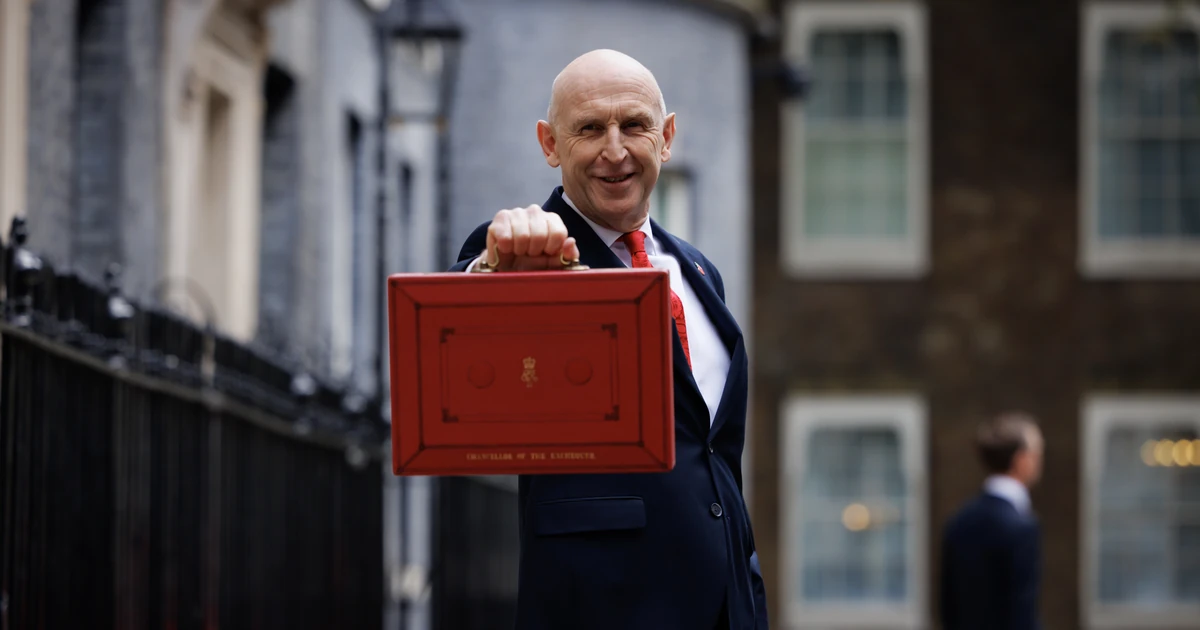
The UK Budget 2026 hydrogen measures cut planned capital grants and change the funding route for production support. It does so while Britain’s hydrogen programme is already behind its contracting timetable. The commercial consequences reach producers, infrastructure investors, equipment makers and customers across the economy.
Summary
The UK Budget 2026 hydrogen measures combine a £500 million capital-grant saving, public funding for existing production contracts, conditional future investment and relief for competing energy sources. Separately, DESNZ’s £900 million accounting underspend exposes expected HAR2 contracts that were not signed in 2025–26. The figures cannot be added together. The central question is whether Britain can deliver its hydrogen ambitions when funding certainty and contracting timetables are both under pressure. Deployment ultimately depends on the cost and reliability of useful services: industrial output, completed construction work and freight delivered, rather than energy prices alone.
In this analysis
Britain has spent years designing mechanisms to subsidise low-carbon hydrogen production. Its commercial challenge increasingly lies in connecting those mechanisms to customers who can afford the fuel and equipment, with contracts strong enough to finance the entire chain.
John Healey’s Budget of 28 October changes several links in that chain. Capital grants become more constrained; existing production agreements retain support through a different funding route; future projects face further spending decisions. Diesel duty relief and industrial electricity support also influence the alternatives against which hydrogen must compete.
The sequence matters: production cost → distribution cost → delivered hydrogen price → equipment cost → customer economics → bankable demand. Making fuel cheaper at the plant does not necessarily make a truck, furnace or excavator viable. Conversely, a project with competitive supply and a strong operational case may remain deployable without a production grant. The hydrogen research hub explores those connections; the Budget changes the conditions under which companies must assemble them.
UK Budget 2026 hydrogen funding: what changes?
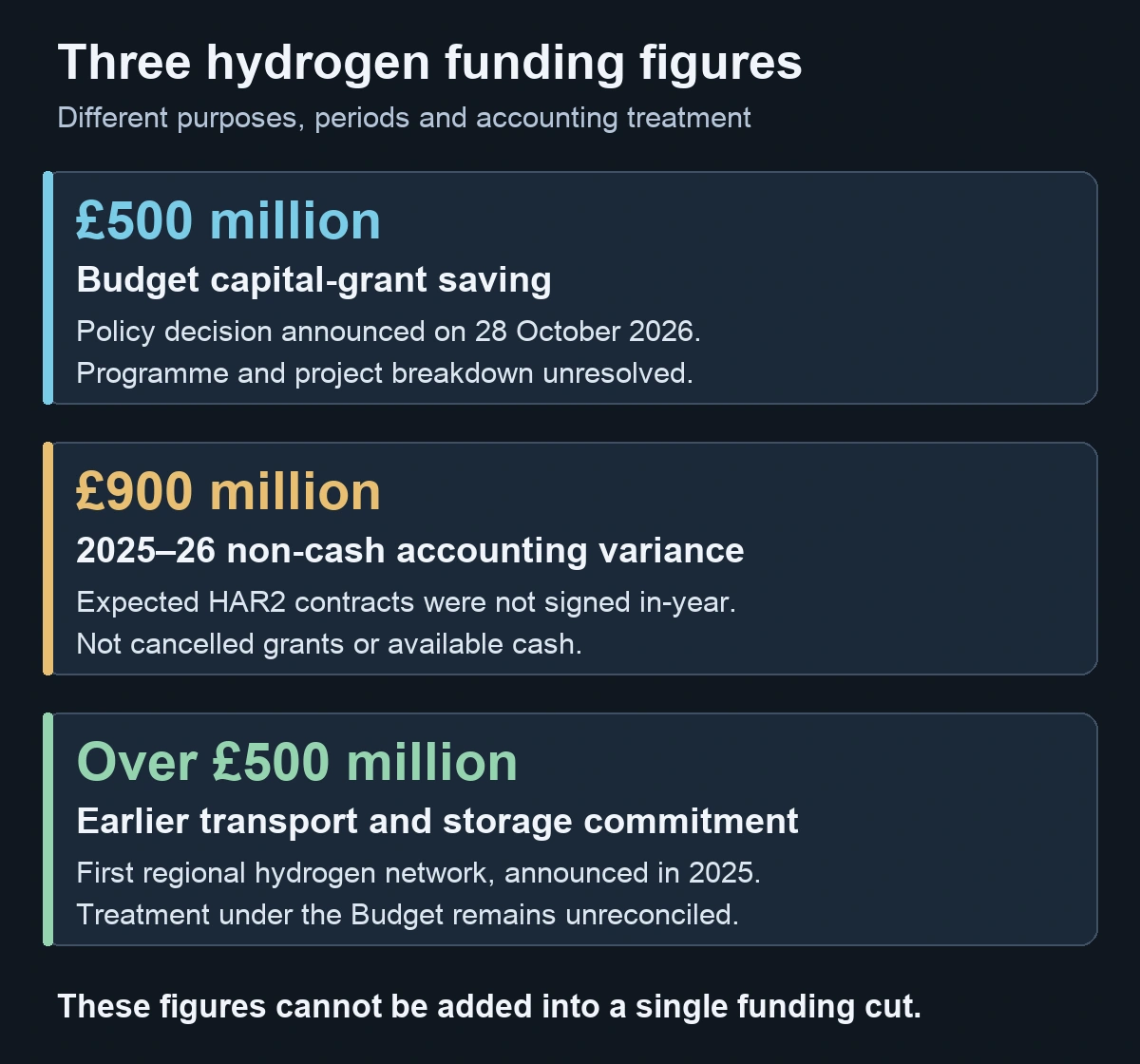
The Treasury’s Budget document announces a £500 million saving in hydrogen capital grants as DESNZ reprioritises spending towards defence. That is a policy decision to reduce planned grant expenditure. The published passage does not identify its programme components, annual profile or whether the amounts had been legally contracted, allocated to unawarded programmes or earmarked internally. Those distinctions determine which projects must replace capital and which future opportunities disappear.
A funding change for a programme already behind schedule
A separate figure reveals a delivery problem. DESNZ’s 2025–26 annual accounts report a £900 million Green Hydrogen underspend because anticipated Hydrogen Allocation Round 2 contracts were not signed during that year. It is a non-cash Resource AME variance: an accounting budget for recognising long-term obligations, rather than £900 million of cancelled capital grants or available cash.
The distinction does not diminish its commercial significance. Under the LCHA accounting treatment, expected future subsidy payments are recognised when agreements are entered into, before production-linked cash payments begin. Missing signatures therefore affect the accounts and expose a missed contracting milestone. The £900 million cannot be added to the Budget’s £500 million as a £1.4 billion withdrawal of hydrogen funding.
The original HAR2 application guidance envisaged shortlisting in autumn 2024 and awards from early 2025. The shortlist arrived in April 2025; the July 2025 market update subsequently aimed for successful projects in early 2026. Yet the October Budget still promised progression to Invite to Offer, with funding considered at the next spending review. It supplies no replacement firm award date.
This is corroborated by NISTA’s project reporting. HAR2 was rated red, with business-case approval delays holding up negotiations. The original operational eligibility window was March 2026–March 2029, but contract award, financial close, construction and first hydrogen are separate milestones. Published project schedules do not provide a reliable national total of operational capacity delayed specifically by HAR2. Neither the £900 million nor the round’s conditional capacity ambition can supply that number.
The economic mechanism is nevertheless clear. A developer without an executed support agreement has less certainty for financing. Equipment suppliers cannot equate selection with a firm order; infrastructure investors cannot count on the associated throughput; customers cannot confidently schedule conversion against an uncertain fuel-delivery date. Planning and engineering may continue at risk, but that does not make the financed deployment timetable secure. The Budget therefore arrives after documented contracting delays, adding funding uncertainty to an existing coordination problem.
The remaining funding decisions have different effects
| Policy | Position after the Budget | Commercial significance |
|---|---|---|
| Strategic hydrogen investment | Up to £300 million may be available, subject to affordability and value for money | Potential loan or equity finance requires approval and an investable project |
| Hydrogen Allocation Round 1 | Existing production contracts publicly funded instead of the planned gas levy | Preserves the existing contractual revenue mechanism |
| Hydrogen Allocation Round 2 | Negotiations to progress; funding considered at the next spending review | Progress through selection is not a funded award |
| Main diesel duty | Existing 5p/litre cut extended to 1 July 2027; inflation increase deferred | Avoids a scheduled increase for incumbent vehicles |
| Industrial electricity | Financing confirmed for eligible manufacturers under BICS | Lowers qualifying bills; electrolyser and depot eligibility require checking |
Conditional loan or equity investment cannot simply be netted against the £500 million grant saving. A grant does not require repayment; a loan needs servicing, and equity expects a return. Their commercial value depends on the terms and risks being financed.
Infrastructure has its own unresolved question. The July 2025 market update committed over £500 million towards a first regional hydrogen transport and storage network, with operation aimed from 2031. The Budget does not reconcile that commitment with its capital saving. Similar headline amounts cannot establish that the entire network allocation has been removed. Nor does a programme commitment prove every proposed project had a signed grant.
A pipeline, underground store, tube-trailer operation and road refuelling station serve different users and recover costs differently. The wider energy and infrastructure analysis explains why funding one asset does not automatically create a complete system. Until DESNZ publishes the programme breakdown, assigning the saving wholly to production, networks or vehicle refuelling would overstate the evidence.
Production support already has a demand purpose
The production-versus-demand distinction needs care. Britain’s production support was designed partly to make hydrogen affordable to users, rather than simply to reward output.
Under the Hydrogen Production Business Model, a producer can receive revenue support through a Low Carbon Hydrogen Agreement. Broadly, a variable payment helps bridge the difference between an agreed production-related price and a reference price linked to hydrogen sales, subject to contractual rules. That can allow a producer to sell below its unsupported production cost.
The official contract summary describes volume protection, with support per kilogram potentially increasing at lower sales, while a month with no sales receives no subsidy. Limited transport and storage costs may be included where agreed; contractual eligibility matters.
This is indirect demand support through the producer. Its value to customers depends on the contracted delivered price after distribution, dispensing and equipment costs, including how those charges change over time.
Replacing the planned Gas Shipper Obligation with public funding changes who finances producer support. Existing HAR1 contracts retain their revenue mechanism; future agreements depend on government commitment and value for money. Developers gain no automatic entitlement to future rounds from the change. Investors must distinguish the protection of executed contracts from exposure to public spending decisions before award. The £27 million resource-budget uplift for 2027–28 is an annual provision, not the lifetime value of hydrogen support or a vehicle-purchase fund.
For industrial purchasers, the immediate benefit of production support depends on the negotiated sales contract and whether the plant reaches operation. A supported strike price is not a universal delivered-price offer. Delays may extend reliance on incumbent hydrogen or fossil fuels and make conversion dates harder to underwrite. The distinction between support awarded, supply commissioned and fuel contracted is crucial.
Electricity can outweigh a production grant
The capital-grant saving and industrial electricity measures affect different parts of electrolytic hydrogen’s cost. Electricity procurement can outweigh a modest grant change. An electrolyser uses electricity to split water; its commercial cost depends on the complete electricity bill and the hours over which it can recover its investment.
Consider an illustrative plant consuming 52 kWh per kilogram. Electricity at £50/MWh contributes £2.60/kg; £100/MWh contributes £5.20/kg; £150/MWh contributes £7.80/kg. The assumption is an editorial scenario, informed by US Department of Energy system benchmarks, rather than a claim about the performance of every operating plant.
Assume installed capital cost of £1,000/kW, 6,000 equivalent full-load hours each year, a 20-year life, an 8% capital cost and annual fixed operating costs of 2% of gross investment. Annualising that investment gives the following simplified plant costs.
| Electricity price | Without a capital grant | With a hypothetical 30% capital grant |
|---|---|---|
| £50/MWh | £3.66/kg | £3.39/kg |
| £100/MWh | £6.26/kg | £5.99/kg |
| £150/MWh | £8.86/kg | £8.59/kg |
These are partial levelised costs, excluding water, stack replacement, connection-specific costs, land and downstream delivery. The grant rate is hypothetical, not a Budget entitlement. The example shows a mechanism: losing that grant adds about 26p/kg, whereas increasing electricity from £50 to £100/MWh adds £2.60/kg.
That does not make grants unimportant. A project can struggle to finance an extra upfront equity requirement even if its eventual unit-cost increase looks small. Fewer operating hours also spread capital over fewer kilograms. Cheap power available briefly is commercially different from an affordable supply supporting sustained output.
Blue hydrogen, produced from fossil gas with carbon capture, has a different exposure: gas procurement, capture performance, carbon transport and storage, and the cost of remaining emissions. Prioritising mature clusters may assist specified blue-hydrogen schemes, but they remain dependent on carbon-capture infrastructure, emissions performance and customers. Capital restraint and conditional public revenue support can affect both green and blue projects; cheaper industrial electricity mainly changes the electrolytic side. The Budget does not establish a universal cost winner between them. Distributed electrolysis, renewable-linked plants and nuclear-powered proposals similarly need their own power, connection and customer contracts.
Capital restraint increases infrastructure exposure
Until DESNZ identifies the capital programmes affected, infrastructure exposure must be assessed conditionally. Any reduction in support would fall on assets needed to deliver hydrogen at the required purity, pressure and reliability. Compression, storage, delivery, dispensing, losses and contingency all have a cost. For dispersed users, the cost per kilogram is particularly sensitive to throughput.
Suppose a refuelling station costs £2 million, has a 15-year economic life and an 8% capital cost, and incurs £100,000 a year in fixed operating expenditure. At one tonne per day design throughput, its annualised capital and fixed operating costs alone work out as follows.
| Average utilisation | Fixed station cost per kilogram |
|---|---|
| 10% | £9.14 |
| 40% | £2.29 |
| 80% | £1.14 |
Purchased hydrogen, haulage, compression electricity, variable maintenance, losses and supplier margin must still be added. These are scenario assumptions, not a station supplier’s quotation. They illustrate why even substantial production support can fail to create an affordable pump price when utilisation is low.
An anchor fleet can improve the position by providing predictable daily purchases. A smaller installation serving contracted customers may therefore have a stronger early case than a larger speculative network. However, the station must accommodate actual vehicles, filling pressures, delivery schedules and maintenance arrangements. Capacity on a planning drawing is not saleable throughput.
On-site production transfers power and operating risks to the site. Liquid hydrogen introduces liquefaction and handling costs. Their competitiveness depends on volumes, distances and procurement terms.
Capital restraint and uncertain production dates make these choices more consequential. A refuelling developer risks building too early for available fuel or too late for an anchor fleet. Investors will seek aligned commissioning dates, minimum volumes and credible contingency supply. The established UK hydrogen pricing analysis distinguishes these delivered costs from the producer’s headline cost.
Diesel’s tax advantage is being continued
The Budget extends the existing 5p-per-litre duty reduction for six months, from January to July 2027, while deferring the planned inflation increase. It avoids a scheduled rise rather than cutting today’s duty again. The distinction is explicit in the Treasury costings, page 13.
| Annual diesel consumption | Annualised value of 5p/litre | Value over six extra months, assuming even consumption |
|---|---|---|
| 40,000 litres | £2,000 | £1,000 |
| 60,000 litres | £3,000 | £1,500 |
| 80,000 litres | £4,000 | £2,000 |
| 100,000 litres | £5,000 | £2,500 |
These figures exclude the separately deferred inflation increase and recoverable VAT, and assume the duty difference reaches the purchaser. A full-year saving should not be attributed to a six-month extension.
For hydrogen, the effect is a less expensive incumbent than the previously scheduled tax baseline. That makes some switching cases harder, although wholesale diesel movements may be much larger than the duty difference. The OBR forecast also highlights the repeated postponement of fuel-duty increases. Investment cases should test future policy rather than assume the scheduled rise will certainly occur.
The existing temporary HGV vehicle-excise-duty concession is another part of the baseline. It should not be presented as a new hydrogen-specific benefit, or confused with the separate HGV Levy. My earlier analysis of diesel prices and haulage costs explains how fuel exposure reaches freight customers.
HGVs, vans and buses need funded procurement
The Budget preserves producer revenue support but does not establish a new universal hydrogen vehicle-purchase programme. Existing demand support remains relevant to fleet procurement. Current truck grants depend on approved models, vehicle weight and applicant conditions. Van grants have different caps for small and large vehicles. The existing zero-emission HGV demonstration programme includes hydrogen projects. These mechanisms should not be overlooked simply because production funding receives more attention.
However, a grant for eligible vehicles does not establish that a particular hydrogen model qualifies, is available in right-hand drive or has a UK service network. Manufacturers must supply a commercial proposition covering approval, delivery, warranty, maintenance, finance and residual value. A prototype announcement provides much less certainty.
For fleet operators, the investment question is whether vehicle finance, an eligible grant, a service contract and dependable refuelling can be secured together. Manufacturers face demand risk when customers cannot assemble that package. The £500 million saving cannot be assigned to vehicle grants without programme evidence.
Buses and coaches can concentrate demand at depots, helping station utilisation. But local-authority procurement still needs an affordable whole-life contract and reliable fuel. Fare support is not automatically a vehicle replacement budget, and the reviewed Budget does not establish a new universal hydrogen fleet-purchase programme. Funded procurement can create bankable demand. Detailed vehicle cost comparisons and HGV payload considerations belong in the site’s specialist analyses rather than the Budget assessment.
Construction can reward a strong operating case
Construction deserves a more specific assessment because temporary sites combine power constraints with changing demand and short infrastructure lives.
An excavator, crane or generator working beyond available grid capacity may have few convenient alternatives. Yet the commercial comparison still needs to include equipment hire, fuel deliveries, on-site storage, downtime, operator training and mobilisation between sites. Batteries, hybrids and grid upgrades also belong in the comparison where feasible. Hydrogen combustion equipment requires its own consumption and emissions assessment, rather than borrowing fuel-cell assumptions.
There is now a concrete equipment example. JCB’s May 2026 announcement formally launched its production 3CX Hydrogen backhoe loader and described a three-year operating lease and service offer. That is a stronger availability signal than an engine prototype. It still does not establish the delivered hydrogen price or the economics of every construction task, and a backhoe loader should not stand in for an entire excavator market.
Temporary generators need the same whole-life comparison: useful electricity delivered, equipment hire, conversion efficiency, fuel logistics and standby provision. Avoiding a documented grid-related delay can create value, but that value must outweigh the fuel and equipment premium. Production support alone does not establish the result.
HS2, Sizewell C and the Lower Thames Crossing provide settings in which to test that logic; naming them establishes no hydrogen order. Any shared station needs committed daily volumes and a plan for demand after construction ends.
The Budget’s relevance to construction is the financing and timing of usable supply. Temporary grid connections, storage and hydrogen deliveries must align with the works programme. If affected projects lose capital support or production contracts arrive late, contractors may face fewer viable suppliers or need interim power arrangements. The saving’s programme breakdown is needed before assigning that exposure to a particular site or equipment class.
Construction also needs the correct diesel-tax baseline. HMRC’s earlier reform removed red-diesel entitlement from most sectors from April 2022. The Budget’s extension of red-diesel relief should not be applied indiscriminately to construction machinery that is required to use fully duty-paid fuel.
Industrial customers buy process outcomes
For industrial consumers, the Budget’s production support can affect fuel availability while capital restraint and electricity relief influence conversion decisions. Existing hydrogen feedstock users and plants replacing another energy carrier face different investment requirements.
A refinery, chemical plant or fertiliser producer replacing existing hydrogen demand has an established process requirement. A glass furnace, ceramics plant or food processor switching from gas needs to justify conversion and ongoing operation. Steel reduction involves another process-specific decision, rather than a simple comparison of burner fuel prices. Cement also has process emissions that a fuel change alone cannot remove.
The Budget’s competitive effect must be judged against existing fuel costs. An illustrative heat comparison shows why production support and conversion finance perform different jobs. At £50/MWh gas, 90% useful-heat efficiency and full marginal exposure to a £60/tCO₂ carbon price, using an assumed 0.203 tonnes of combustion emissions per MWh on a lower-heating-value basis gives roughly £69/MWh of useful heat. Hydrogen at £6/kg and the same useful-heat efficiency costs approximately £200/MWh before conversion capital. These are scenario prices and assumptions, not a forecast of gas or carbon markets.
Actual UK Emissions Trading Scheme exposure, free allocation, hydrogen production emissions and equipment efficiency must be checked for each installation. Existing feedstock demand needs a comparison with incumbent hydrogen supply; direct-reduction steel needs a comparison of complete production routes. The relevant metric is the cost of a saleable product or useful process output.
The demand-side capital position is also older than this Budget. The Industrial Energy Transformation Fund closed to further extension in July 2025, while successful existing projects retained funding. Its official collection says no successor is planned. That is a pre-existing conversion-support gap, not a closure announced today, and Scotland’s arrangements need separate treatment.
An affordable low-carbon hydrogen contract may therefore be necessary without being sufficient. Industrial customers also need conversion finance, reliable supply and a way to recover any remaining premium in competitive product markets. Import competition can prevent a manufacturer passing through costs that look modest in a national decarbonisation model.
Rail, shipping and aviation have different buyers
The same customer test applies beyond road vehicles, but the product being purchased changes. A hydrogen train needs dependable route or depot supply and a whole-life operating case against electrification, batteries or other feasible traction. The Budget itself includes battery-train procurement for the TransPennine route upgrade. Rail investment therefore cannot be counted as hydrogen demand without checking the actual technology and contract. The Budget policy decisions identify that procurement.
Ports and airports may aggregate demand from ground vehicles, handling equipment and temporary power. That can help shared infrastructure, provided those customers choose hydrogen after comparing available electric alternatives. The volume must come from operational plans and purchase commitments, rather than multiplying every vehicle on the estate by an assumed future fuel demand. The hydrogen aviation infrastructure analysis examines why fuel handling and delivery remain distinct investment requirements.
Shipping and aviation can create another market through hydrogen-derived fuels. Hydrogen used to manufacture ammonia, methanol or synthetic aviation fuel is an intermediate input; the ship operator or airline may buy the finished fuel rather than hydrogen itself. Conversion plants, other feedstocks, certification and delivery add costs between supported hydrogen production and the final customer’s bill.
The Budget’s conditional support for future hydrogen contracts therefore cannot be counted as demand from ships or aircraft. Producers and fuel-conversion investors still need funded customers; public hydrogen support does not by itself finance the whole supply chain.
Cheaper electricity changes both sides of the comparison
The British Industrial Competitiveness Scheme, BICS, can improve the economics of eligible manufacturing. However, the applicant guidance applies sector, product, site and grid-consumption tests. It schedules Renewables Obligation and Feed-in Tariff exemptions from April 2027 and Capacity Market relief from October. A headline reduction of up to 25% is not an entitlement for every electrolyser, hydrogen station or truck depot.
If an eligible hydrogen production site receives a lower effective electricity price, electrolysis can benefit. But cheaper electricity can also strengthen battery trucks, direct industrial electric heating and other alternatives. Their advantage depends on how much electricity they need to deliver the same useful service and whether the required infrastructure is available. The batteries and electrification hub provides the wider context for those competing investments.
The Budget’s electricity Climate Change Levy freeze and the previously announced removal of Carbon Price Support from April 2028 should also be kept distinct. Carbon Price Support is a charge associated with fossil-fuel electricity generation; removing it does not abolish the UK ETS. The effect on a plant’s purchased electricity depends on market prices and its contract.
For electricity-system storage, conditional investment in strategic hydrogen projects still requires a revenue case for dependable power. Storage duration and dispatchability must recover conversion losses and infrastructure costs. Public producer support does not itself establish a contract for the resulting electricity.
Finance and manufacturing follow contracted customers
The Budget prioritises mature hydrogen and carbon-capture projects in Teesside, Merseyside and North Wales, while maintaining Viking cluster grant funding and exploring financial investment in future projects, including Acorn. That favours identified mature schemes over a presumption that every proposed region receives the same support.
Industrial clusters can share infrastructure and aggregate demand. Users in South Wales, the Midlands, wider Yorkshire or remote Scottish locations still need their own delivered-supply cases. An ambition on a regional map cannot replace a commercially workable route from producer to customer. UK expenditure should also be distinguished from devolved funding.
For lenders, bankable demand means more than a signed expression of interest. The buyer must have sufficient credit quality, and the contract must provide credible volumes, duration, pricing, supply conditions and remedies. A long commitment from a customer unable to afford the fuel is weak security. Minimum-volume obligations may protect the producer while transferring an intolerable risk to the fleet.
Loan or equity investment may be well suited to a project with strong customers and a temporary financing gap. It is less effective where customers cannot generate enough revenue to repay the capital. Replacing grants with repayable finance increases the need to distinguish these situations.
Equipment makers face the consequences through orders. Electrolyser, fuel-cell, compressor, storage-vessel, sensor and engineering suppliers need projects that reach funded procurement. Eligible manufacturing electricity relief may help factory costs, but the more immediate exposure is the timing and certainty of customer procurement. Delayed orders can leave capacity underused, spread development costs across fewer units and weaken smaller suppliers’ cash flow. UK content and manufacturing capability will not be secured merely by announcing a domestic production ambition.
Integrated projects must allocate late commissioning, equipment failure and demand risks. The coordination problem examined in why hydrogen deployment is slower in the UK remains central after the Budget.
International competition is about the customer proposition
The Budget’s grant restraint and uncertain future awards also affect Britain’s position in competing for internationally mobile project and manufacturing investment. The relevant comparison includes support for customers as well as producers. The IEA’s 2026 review finds that only one-fifth of new low-emissions hydrogen offtake agreements signed in 2025 were firm. Announced demand and financeable purchases remain different quantities well beyond Britain.
The EU combines production auctions with renewable-fuel obligations and infrastructure requirements. Its planned IF26 hydrogen auction has a proposed €500 million budget and a December opening. That is future production support, not proof of cheap fuel available today. Germany, France, the Netherlands and Spain operate within that broader framework, but their power costs, customers and implementation differ. The site’s analysis of European hydrogen auctions and project locations provides context for Spain’s position; auction support should still be distinguished from operational capacity and affordable end-user supply.
The US clean-hydrogen production credit is another production-side mechanism, with emissions, labour and verification conditions. It should not be treated as a universal customer discount. Japan’s price-gap contracts and China’s end-use-price objectives give more explicit attention to purchasers. The IEA policy chapter shows why headline subsidy totals cannot substitute for comparing scope, customer support and certainty.
The commercial test after the Budget
The Budget changes the funding environment for a hydrogen programme already experiencing contracting delays. Its capital-grant saving narrows planned grant support, although the affected allocations and contractual status remain undisclosed. Public funding sustains existing HAR1 agreements while future awards face further decisions. Conditional loan or equity investment offers a possible financing route, rather than a replacement grant entitlement.
For producers, that means securing both an executable support agreement and customers. For infrastructure investors, it means matching assets to credible commissioning dates and throughput. Equipment manufacturers need financeable orders. Customers need dependable supply at a price that allows their own businesses to compete. Diesel duty relief and qualifying electricity support alter those comparisons in different directions; the reviewed measures establish no universal new hydrogen demand subsidy that closes every gap.
Projects with competitive supply and committed buyers may still progress. Others face both a funding gap and an uncertain timetable. DESNZ should therefore reconcile the capital saving with earlier network commitments and publish credible award and delivery schedules. Those answers matter more to deployment than adding unlike accounting figures into a single headline.
Industrial customers buy useful process output; construction companies buy completed work; freight operators sell transport capacity; electricity generators sell dependable power. Hydrogen producers sell fuel, but their customers must earn a return from using it. The test of the Budget is whether its implemented measures make those end uses commercially viable, with production, infrastructure and demand arriving together.
Questions readers are asking
Has the Budget cancelled hydrogen production support?
No. It announces hydrogen capital-grant savings while publicly funding existing HAR1 contracts and making future commitments conditional. The detailed exposure of individual capital programmes remains unresolved.
Is the £500 million saving definitely the regional pipeline and storage fund?
The reviewed Budget passage does not establish that. The earlier network commitment and the new saving need a programme-level reconciliation; matching amounts are insufficient evidence.
Does the £900 million underspend mean £900 million of grants were cancelled?
No. DESNZ attributes this non-cash resource variance to expected HAR2 contracts not being signed during 2025–26. It establishes a contracting shortfall against financial assumptions, not that amount of cancelled capital grants or available cash.
Are these calculations forecasts?
No. They are transparent sensitivities with stated assumptions, excluding recoverable VAT. Real decisions require supplier quotations, measured duty cycles, finance terms, applicable grants and credible contracts.
Sources and calculation notes
Official sources are linked beside the claims they support. The accounting reconciliation and project-timetable audit distinguish contract recognition, cash payments, capital grants and conditional programme ambitions. The underlying accounts do not establish a measurable national capacity delay attributable specifically to HAR2.
Numerical examples are editorial sensitivities, excluding recoverable VAT. Capital is annualised with the stated discount rate and zero residual value unless otherwise specified. Industrial hydrogen uses 33.33kWh/kg on a lower-heating-value basis. Real investment decisions need supplier quotations, measured duty cycles, finance terms, infrastructure costs and appropriate tax treatment. Evidence checked through 28 October 2026, with final verification on 29 October.
Featured photograph: John Healey with the Budget box, 28 October 2026. Alecsandra Dragoi / Treasury, CC BY-NC-ND 4.0. Resized and cropped.