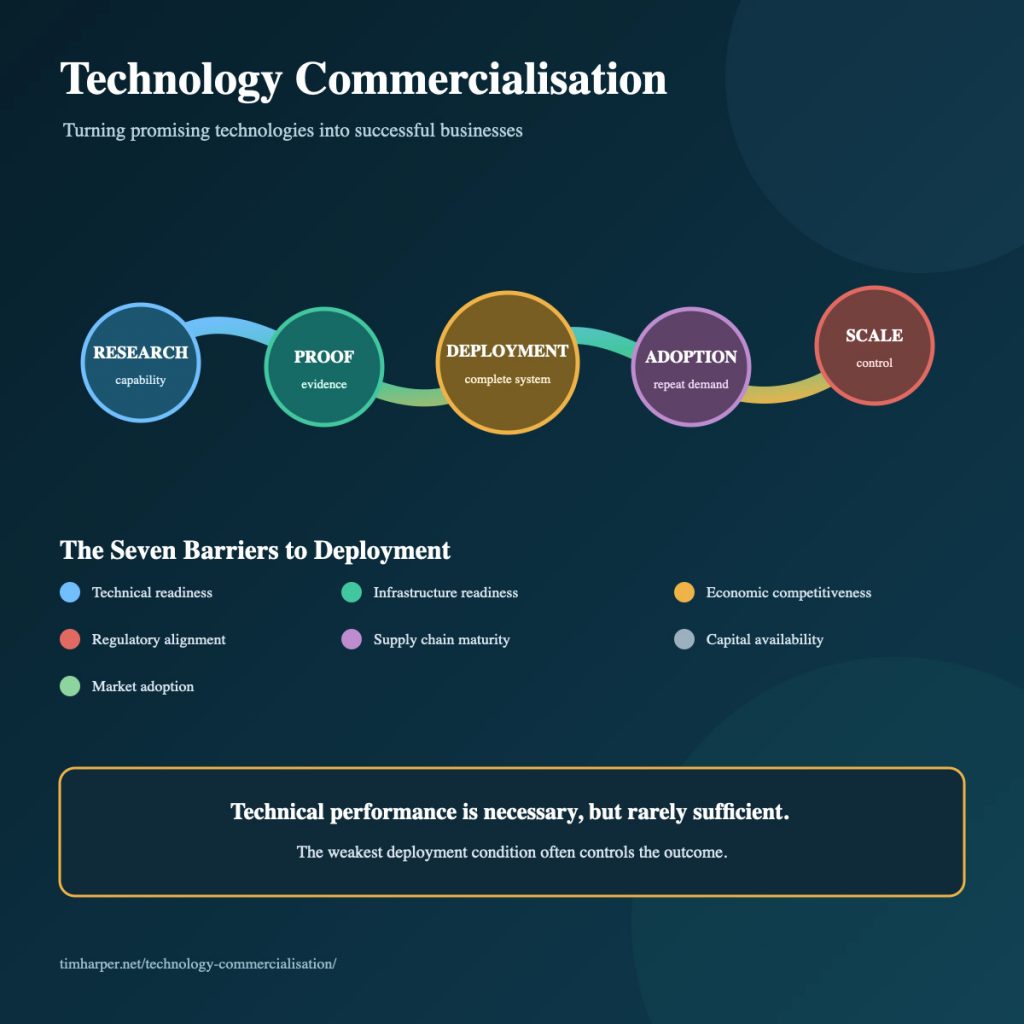
Technology commercialisation is the work of turning a scientific or engineering capability into a repeatable, financeable and valuable business. It connects research, infrastructure, economics, regulation, supply chains, capital and customer adoption. The central lesson is simple: technical performance is necessary, but it is rarely sufficient.
Hydrogen, batteries, advanced materials, robotics, sensors and artificial intelligence look like different sectors. Commercially, they repeatedly encounter the same problem. A technology can perform well in a laboratory, impress in a demonstration and still fail when it meets the cost, timing, infrastructure and risk requirements of a real market.
This page sets out a practical framework for founders, investors, corporate innovation teams, policymakers, journalists and board members who need to understand that gap. It draws on lessons from energy systems, advanced materials and robotics to explain why deployment is a system problem rather than a single technical milestone.
Technology Commercialisation: The Core Argument
A successful emerging technology is not simply one that works. It is one that can be manufactured, delivered, financed, regulated, operated, maintained and adopted at a cost and risk level the market will accept.
- Invention creates a capability. Commercialisation assembles the system that makes the capability useful and repeatable.
- Pilots prove selected assumptions. They do not automatically prove demand, margins, bankability or scale.
- The weakest deployment condition often controls the outcome. Strong technology cannot compensate indefinitely for absent infrastructure, poor economics or unclear demand.
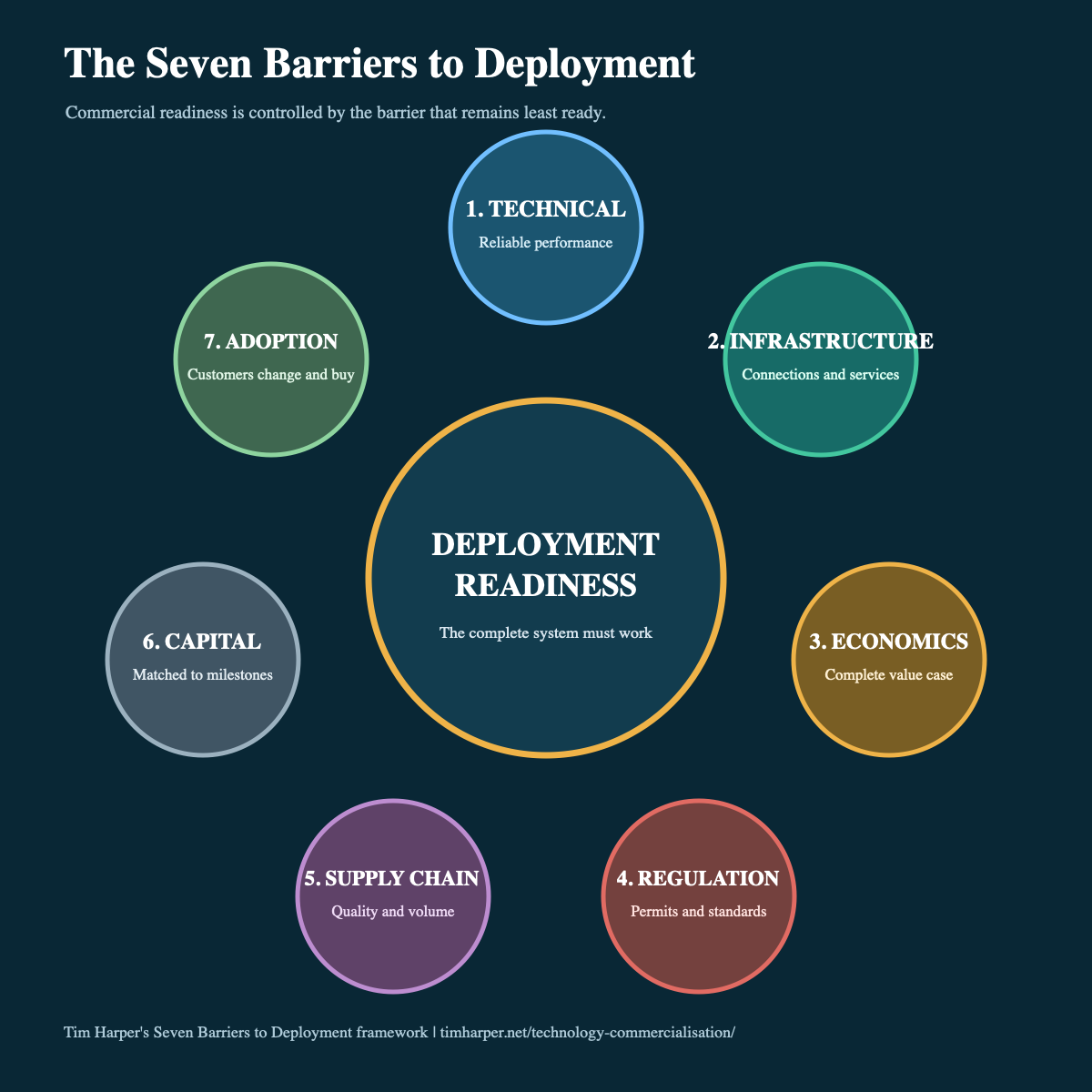
- Commercial readiness is multi-dimensional. Technical readiness is only one of seven barriers that must be cleared.
- Deployment creates the evidence that markets trust. Reliable operation, repeat customers and known costs matter more than announcements.
What Is Technology Commercialisation?
Technology commercialisation is the process of converting knowledge, intellectual property, engineering capability or scientific discovery into a product, service or operating system that creates sustained value. That value may take the form of revenue, productivity, lower cost, reduced risk, resilience or a public benefit. The important word is sustained. A one-off demonstration can prove possibility. Commercialisation proves that the result can be delivered repeatedly under real conditions.
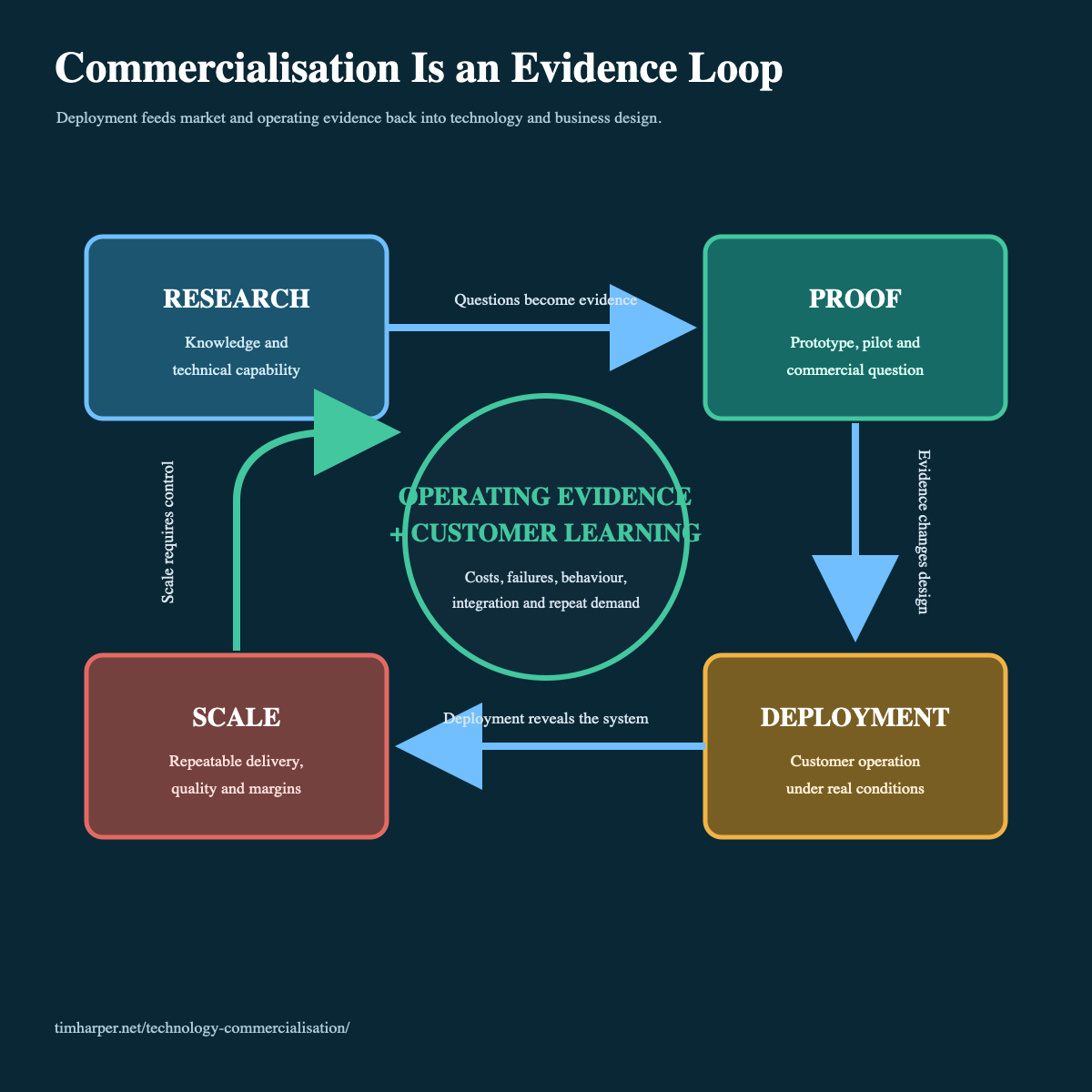
The process is often described as a straight line from research to product. In practice it is iterative. Customer needs reshape the technical specification. Manufacturing choices alter performance and cost. Regulation changes the route to market. Infrastructure limits which customers can adopt first. Capital availability determines how quickly the venture can learn. Commercialisation is therefore not the final stage after technical development; it is a discipline that should influence development from the beginning.
| Stage | Primary question | Typical evidence | Common mistake | Commercial milestone |
|---|---|---|---|---|
| Research | Can this phenomenon or method work? | Experimental results, models, publications and reproducibility | Assuming scientific importance creates a market | A credible capability with protectable or transferable value |
| Innovation | Can the capability solve a useful problem? | Prototype, performance data and early user feedback | Optimising the technology before defining the buyer | A clear problem-solution fit |
| Commercialisation | Can it be bought, delivered and supported? | Paid pilots, unit economics, contracts and operational evidence | Treating a pilot as proof of a scalable business | The first repeatable sale at known cost |
| Scale-up | Can the business grow without losing control? | Repeat orders, manufacturing yield, service data and predictable margins | Scaling overhead and capacity before demand is reliable | Repeatable delivery with improving economics |
Commercialisation is distinct from invention because it starts with a different standard of proof. Invention asks whether something is possible. Commercialisation asks whether enough of the surrounding system can be made to work at the same time. That includes who pays, who carries risk, what infrastructure is required, what regulations apply, how the product is produced, and why a customer should change from the incumbent solution.
The commercial question is not “does the technology work?” It is “does the complete system work well enough for a customer, investor and operator to commit?”
Technology Readiness Is Not Commercial Readiness
Technology readiness levels are useful for describing technical maturity, but they can create false confidence when used as a proxy for deployment readiness. A technically mature electrolyser can still sit inside an uneconomic hydrogen project. A high-performance battery can still impose an unacceptable payload penalty. A reliable robot can still lack a task that produces a return. A new material can still fail because customers will not redesign their manufacturing process around it.
Commercial readiness is broader. It requires evidence that the technology fits into a value chain and can survive contact with procurement, financing, operations, regulation and competition. This is why deep-tech commercialisation and scale-up governance matter alongside scientific progress. For an investment decision, an independent assessment of technical and commercial readiness tests the evidence behind those assumptions.
Why Great Technologies Fail
Emerging technologies rarely fail for one reason. More often, several individually manageable problems combine into an unfinanceable or unattractive proposition. The prototype works, but the installation takes too long. The product performs, but a customer’s existing process must be redesigned. The operating cost looks competitive, but only at a utilisation rate the market cannot yet provide. The first project succeeds, but it depends on bespoke engineering that cannot be repeated profitably.
These failures are often misdiagnosed as evidence that the underlying technology is bad. Sometimes that is correct. Frequently, however, the failure is one of system design, market timing or commercial structure.
| Technology | What technical success can prove | What still blocks commercial success | Commercialisation lesson |
|---|---|---|---|
| Fuel cells and hydrogen | Efficient electrochemical conversion and viable vehicle operation | Fuel price, station utilisation, distribution, anchor demand and policy certainty | The vehicle and the refuelling network must scale together |
| Advanced batteries | Higher energy density, faster charging or longer cycle life | Manufacturing yield, safety, raw materials, warranty risk, infrastructure and total cost | Cell performance is only one part of the operating economics |
| Carbon capture | CO2 can be separated from a process stream | Transport, storage liability, energy penalty, carbon price and long-term contracts | A capture plant without a complete CO2 chain is not a deployable system |
| Autonomous vehicles | A vehicle can navigate selected conditions | Edge cases, liability, regulation, public trust, mapping and operating design domain | A strong demonstration is not the same as safe general deployment |
| Synthetic fuels | Hydrocarbons can be produced from hydrogen and captured carbon | Electricity cost, feedstock, conversion losses, offtake and competing uses | Technical feasibility can coexist with difficult economics |
| Robotics | A machine can complete a task in a demonstration | Uptime, integration, dexterity, safety, support, workflow design and customer ROI | The useful unit is a completed shift, not an impressive movement |
| Advanced materials | A material has exceptional laboratory properties | Consistency, processing, qualification, substitution cost and manufacturing adoption | Customers buy improved products and processes, not properties in isolation |
The Pilot Trap
Pilots are essential, but they are frequently designed to demonstrate the strongest part of the technology rather than test the weakest part of the business. A pilot may prove that a robot can complete a task, while avoiding the messy shift changes, maintenance routines and production interruptions that determine customer value. A hydrogen station may dispense fuel, while operating at a utilisation rate far below the level needed for economic viability. A novel material may improve performance, while requiring a qualification process the customer cannot justify.
A useful pilot answers a defined commercial question. It might test whether installation can be completed within a customer’s shutdown window, whether an operator can maintain the system, whether throughput remains stable over thousands of cycles, or whether the buyer will sign a repeat order at the proposed price. The pilot should expose uncertainty, not protect the project from it.
A Better Test for Pilots
Before approving a pilot, ask: Which commercial decision will become easier when this pilot is complete? If the answer is unclear, the pilot may create publicity and technical data without materially reducing deployment risk.
Timing Can Defeat Good Technology
A technology can be early, late or aimed at a market whose conditions change before scale is reached. Infrastructure may arrive more slowly than expected. A competing technology may improve faster. Interest rates may increase the cost of capital. Regulation may be delayed. Customers may postpone replacement cycles. A supply chain built around one forecast can become stranded when demand shifts.
The lesson is not to wait for perfect certainty. It is to identify which assumptions depend on time and who bears the cost if they are wrong. The analysis of automakers redirecting battery capacity into stationary storage is an example: manufacturing capability remained valuable, but the original demand curve and product mix changed.
The Seven Barriers to Deployment
The Seven Barriers to Deployment is a practical commercialisation framework developed to compare emerging technologies on the same basis. It treats deployment as a constrained system. Progress is governed less by the strongest dimension than by the barrier that remains least ready.
How to Use the Seven Barriers
The framework is not a scoring exercise designed to produce a reassuring average. A project with six strong scores and one fatal barrier is still blocked. The purpose is to reveal dependencies, sequence work and decide where the next unit of capital or management attention creates the greatest reduction in risk.
- Define the deployment unit. Be precise about the customer, application, location, duty cycle and commercial offer being assessed.
- Score evidence, not confidence. Distinguish measured performance, signed contracts and permitted sites from forecasts, expressions of interest and assumptions.
- Identify the controlling barrier. Ask which condition can stop the project even if every other workstream succeeds.
- Map dependencies. Infrastructure, supply chains, regulation and customer adoption often need to develop in a particular order.
- Design the next proof point. Fund the experiment, pilot, contract or partnership that reduces the most important uncertainty.
- Review the full system after every major change. Improvements in one barrier can create pressure elsewhere.
| Barrier | Key diligence question | Strong evidence | Weak signal often mistaken for proof |
|---|---|---|---|
| Technical readiness | Will it perform through the real duty cycle? | Independent, sustained operating data | A controlled demonstration |
| Infrastructure readiness | Can all required connections and services be delivered on time? | Permits, capacity agreements and delivery plan | A technically possible connection |
| Economic competitiveness | Who receives value and who pays? | Auditable total-cost model and paid repeat demand | A low projected unit cost at future scale |
| Regulatory alignment | Can the system be approved and insured? | Clear pathway, standards and accountable parties | General policy support |
| Supply chain maturity | Can quality and volume rise together? | Qualified suppliers, yield data and alternatives | Available prototype components |
| Capital availability | Can funding survive delays and scale-up needs? | Capital plan matched to milestones and downside cases | A headline fundraising target |
| Market adoption | Will the buyer change and buy again? | Repeat orders, integration commitment and reference customers | Non-binding interest |
Commercialisation Is a Board-Level Discipline
The framework is also a governance tool. Boards and investors need a shared view of what the company is trying to prove and what remains uncertain. Technical teams may naturally focus on performance. Sales teams may focus on pipeline. Investors may focus on the next financing event. Operations may focus on delivery. Without a common commercialisation model, each group can report progress while the controlling barrier remains unresolved.
A board should be able to explain the current deployment unit, the controlling barrier, the evidence required to clear it, the capital needed, and the consequences if the assumption is wrong. That is more useful than a long list of activities. It also creates a disciplined basis for deciding when to stop, narrow the market or redesign the offer.
Lessons From Energy Systems
Energy systems make commercialisation barriers visible because infrastructure, regulation, capital and adoption are impossible to separate from the technology. A fuel, generator, battery or vehicle becomes useful only as part of a wider system. The economics depend on when and where energy is available, how it is moved, how assets are used and which party carries risk.
Hydrogen: A System, Not a Molecule
Hydrogen is often debated as if technical efficiency determines the outcome. In practice, commercial deployment depends on production cost, transport, storage, refuelling or distribution infrastructure, anchor demand, utilisation, policy and the alternatives available to the customer. The site’s hydrogen and energy systems hub brings those dependencies together, while the hydrogen economics page focuses on how project viability changes under real conditions.
A hydrogen refuelling station can be technically complete and commercially weak. Low early utilisation raises the cost per kilogram, which reduces customer demand, which keeps utilisation low. Breaking that loop usually requires coordinated fleets, anchor customers, phased capacity, policy support or a supply arrangement that shares early risk. This is why UK hydrogen infrastructure deployment and the commercial structure of hydrogen infrastructure matter as much as vehicle performance.
The collapse of a project does not necessarily prove that hydrogen cannot work. It may show that demand was not assembled, counterparties were weak, infrastructure was late, or funding assumed a market would emerge automatically. The same diagnosis applies to many capital-intensive technologies.
Fleet Decarbonisation: The Duty Cycle Decides
Battery-electric and hydrogen vehicles cannot be compared meaningfully without the operating system around them. Mileage, payload, route variability, charging or refuelling time, depot access, grid capacity, driver hours and asset utilisation all affect the answer. The best technology for one route may be unsuitable for another.
This is why fleet decarbonisation economics must start with operational evidence. The commercial fleet TCO calculator, battery weight and payload calculator and zero-emission break-even analysis test how deployment choices change when assumptions change.
The lesson extends beyond transport: customers adopt systems that fit their operating constraints. Asking a customer to absorb hidden downtime, process disruption or infrastructure risk weakens adoption even when the headline technology appears superior.
Grid Constraints and Renewable Integration
Renewable generation can be technically available and economically wasted when transmission, storage and demand are not aligned. The analysis of UK wind curtailment costs shows how a successful generation technology can be constrained by the surrounding system. The wind curtailment cost calculator makes those trade-offs testable.
Grid constraints also affect batteries, hydrogen, industrial electrification and AI data centres. A project with a strong technology and customer can still fail because the required connection will not arrive in time. Infrastructure readiness is therefore not a background assumption. It is a commercial variable that should be tested before capital is committed.
The same system logic appears across adjacent markets. Improvements in battery energy density create value only when manufacturing cost, safety and application fit align. The semiconductor supply chain shows how qualified inputs and industrial capacity can constrain technically mature products, while AI data-centre power demand demonstrates that access to grid capacity can determine whether rapidly financed digital infrastructure is deployable. Together these cases reinforce a central point: commercialisation outcomes are shaped by the surrounding system as much as by the core technology.
Energy-System Lesson
Deployment succeeds when supply, infrastructure, demand and finance are assembled as one system. Optimising one asset while assuming the rest will appear is a common cause of project failure.
Lessons From Advanced Materials
Advanced materials provide one of the clearest demonstrations of the gap between laboratory performance and market adoption. A material may be stronger, lighter, more conductive or more selective than an incumbent. That does not mean a customer can use it economically.
The commercial value of a material exists inside an application and manufacturing process. Customers need consistent batches, reliable specifications, suitable formats, quality assurance, integration methods, regulatory acceptance and evidence that the performance improvement justifies redesign. The cost of adopting the material may be larger than the cost of buying it.
Graphene and Nanotechnology: Properties Are Not Products
Graphene and nanotechnology generated enormous expectations because their scientific properties were exceptional. Commercial progress proved slower and more application-specific. The challenge was not simply producing a material with desirable characteristics. It was producing the right grade, at consistent quality, in a form a customer could integrate, for an application where the benefit exceeded qualification and switching costs.
The nanotechnology archive documents an earlier cycle of emerging-technology enthusiasm, investment and market formation. Its continuing relevance is that the same pattern appears in new sectors: broad platform claims attract attention, while commercial value eventually concentrates in narrower applications where the system economics work.
Technology Transfer Must Transfer More Than IP
Technology transfer is often treated as the movement of intellectual property from a university or laboratory into a company. That is necessary, but incomplete. Commercialisation also requires tacit knowledge, process discipline, application insight, customer relationships and a management team able to make trade-offs between scientific opportunity and market focus.
A licence cannot by itself create manufacturing capability, demand or a viable business model. Nor can a startup pursue every possible application of a platform technology. Early focus is essential because each application can require different testing, partners, regulation and sales channels. Choosing where not to deploy is part of commercialisation.
| Laboratory claim | Customer question | Commercial evidence required |
|---|---|---|
| The material is stronger or lighter | Does it improve my product enough to justify redesign? | Application-level performance and total cost |
| The process works at bench scale | Can it run consistently at production throughput? | Yield, quality, uptime and scale-up data |
| The material has many applications | Which application will buy first and why? | Focused value proposition and committed customer |
| The IP is defensible | Can competitors or incumbents deliver an adequate alternative? | Freedom to operate, know-how and route-to-market advantage |
| The unit cost will fall at scale | Who funds the capacity before demand is proven? | Phased capital plan and credible offtake |
Lessons From Robotics
Robotics is the next major commercialisation challenge because progress in AI, compute, sensors and hardware has made machines more capable while raising expectations faster than deployment evidence. A robot can now produce an extraordinary demonstration. Customers still need to know whether it can complete useful work safely and repeatedly at an acceptable cost.
Humanoid Robotics and the Demonstration Gap
Humanoid robots attract attention because their form suggests general-purpose capability. Commercial deployment will initially be much narrower. Factories, warehouses and selected institutional environments offer controlled tasks and measurable returns. Homes and highly variable settings create harder problems in safety, dexterity, support and liability.
The analysis of the humanoid robotics market in 2026 argues that the sector has moved from pure demonstration towards early deployment, but shipments and valuations are not the same as customer economics. The commercially meaningful metrics are completed shifts, uptime, intervention rate, task throughput, support cost and repeat orders.
Dexterity, Tactile Sensing and Physical AI
AI can help a robot identify objects and plan actions. Physical work also requires force control, touch, error recovery and an understanding of how the environment changes during contact. The analysis of why touch gives robots dexterity and why tactile sensing is a missing commercial layer illustrates a broader lesson: the most visible capability is not always the controlling barrier.
For robotics companies, commercialisation means choosing a task where the complete system can win. That may require changing the workflow, adding fixtures, constraining the environment or combining autonomy with human supervision. A solution does not need to be fully general to be valuable. It does need to be honest about where its economics and reliability hold.
Robotics Deployment Is Organisational Change
Robots do not enter an empty factory. They enter an operating organisation with safety procedures, labour relationships, production targets, maintenance teams, IT systems and existing equipment. Adoption therefore depends on integration and change management as much as machine capability.
A strong robotics pilot tests the complete deployment: installation, training, exception handling, maintenance, data governance, worker interaction and return on investment. The goal is not merely to show that the robot can perform the task. It is to determine whether the customer can operate a reliable system around it.
Robotics Lesson
The commercially relevant unit is not the robot. It is the reliable completion of useful work inside a customer’s operating system.
The Future of Technology Commercialisation
The next decade will produce more technically capable systems, but capability alone will not make commercialisation easier. AI accelerates research, design and software development. Robotics brings intelligence into the physical world. Energy systems face growing demand and infrastructure constraints. Industrial automation changes the economics of production. Deep-tech companies can address larger problems, but they also depend on more complex networks of capital, regulation and supply.
AI Will Compress Some Development Cycles and Expose Other Bottlenecks
AI can reduce the cost of coding, modelling, discovery, analysis and customer support. It can help small teams build faster and improve the performance of sensors, robots and industrial systems. As technical development accelerates, the scarce resources may shift towards deployment data, customer access, infrastructure, trusted supply chains and regulatory approval.
This means commercial advantage may move away from owning a promising model or prototype and towards controlling the conditions in which it learns and creates value. In physical AI, access to real tasks and operational data can be more defensible than a demonstration. In energy, access to land, power, connections and offtake can matter more than the equipment. In materials, application know-how and qualification can matter more than the original formulation.
Deployment Will Become the Main Source of Differentiation
As technologies mature, competitors can often reach similar headline performance. The harder advantages are operational: lower installation time, stronger service, better financing, trusted certification, reliable supply, easier integration and evidence from real customers. These are not secondary features. They determine adoption.
Companies that learn fastest from deployment can create a reinforcing loop. Deployment generates data and customer understanding. That evidence improves the product, lowers risk and attracts capital. Better economics support more deployment. The loop can also run in reverse when projects are delayed, costs rise and customers lose confidence.
Industrial Strategy and Commercialisation Will Converge
Governments increasingly treat semiconductors, batteries, robotics, energy systems and advanced materials as strategic capabilities. Public policy can create markets, fund infrastructure and reduce early risk. It can also support capacity without creating a competitive business. Effective industrial strategy must connect research funding to customers, supply chains, skills, procurement and scale-up capital.
The question is not simply whether a country produces excellent research. It is whether companies can turn that research into repeatable industrial capability. The site’s analysis of the UK’s science commercialisation gap, applied research funding and semiconductor clusters shows why policy must be judged by deployment outcomes rather than announcements.
The Companies That Win Will Be System Builders
Many emerging-technology businesses describe themselves as product companies. The strongest will often behave as system builders. They will understand the customer’s operation, assemble partners, secure infrastructure, manage regulation, structure finance and define a deployment sequence. They may sell equipment, software, services or outcomes, but their real capability will be making the complete commercial system hold together.
This does not mean every startup should become vertically integrated. It means leadership must know which parts of the system the company controls, which require partners, and which can stop deployment. Commercial focus is the discipline of building enough of the system without trying to own all of it.
What This Means for Decision-Makers
Founders
Define the first repeatable deployment, not the largest imaginable market. Use pilots to test commercial risk, and raise capital against evidence that changes a customer’s decision.
Investors
Separate technical readiness from commercial readiness. Test the controlling barrier, capital path, customer switching cost and evidence behind projected scale economics.
Corporate Innovation Teams
Design deployments around operational value and integration. Avoid pilots that demonstrate novelty but leave procurement, ownership and scale decisions unresolved.
Policymakers
Connect research support to infrastructure, procurement, skills, supply chains and scale-up finance. Judge programmes by repeatable deployment and productive capacity.
Journalists
Distinguish funding, valuation, technical demonstrations, shipments and profitable deployments. They are different forms of evidence and should not be reported as equivalents.
Board Members
Make the controlling commercialisation barrier explicit. Align technical, commercial, operational and financing milestones around the evidence needed to clear it.
Technology Commercialisation: Frequently Asked Questions
What is technology commercialisation?
Technology commercialisation is the process of turning scientific knowledge, intellectual property or engineering capability into a repeatable product, service or operating system that creates sustained value. It includes customer definition, economics, delivery, infrastructure, regulation, supply chains, capital and adoption.
How is commercialisation different from innovation?
Innovation applies knowledge in a new or improved way. Commercialisation proves that the innovation can be bought, delivered, supported and repeated under real market conditions. An innovation can be valuable without yet having a viable commercial model.
Why do promising technologies fail?
Promising technologies commonly fail because the surrounding system is not ready. Typical causes include weak economics, unavailable infrastructure, unclear regulation, immature supply chains, unsuitable capital, poor market timing and customer resistance. Technical weakness is only one possible cause.
What are the Seven Barriers to Deployment?
The Seven Barriers to Deployment are technical readiness, infrastructure readiness, economic competitiveness, regulatory alignment, supply chain maturity, capital availability and market adoption. The framework is used to identify the constraint most likely to stop or delay commercial deployment.
What is the difference between a pilot and commercial proof?
A pilot tests selected assumptions in a limited setting. Commercial proof shows that a customer will buy again and that the offer can be delivered reliably at known cost. A technically successful pilot may still leave the business model, integration, support and scale economics unresolved.
What is the most important commercialisation milestone?
The first repeatable sale is usually more important than the first sale. It shows that the offer can be bought and delivered again without rebuilding the product, process or commercial structure from the beginning.
How should investors assess emerging technologies?
Investors should assess the complete deployment system, not only technical performance or market size. The key questions are which barrier controls adoption, what evidence clears it, how much capital is required, who bears deployment risk and whether customer economics improve at credible scale.
Does commercialisation always require venture capital?
No. The appropriate capital depends on the technology, development time, risk and business model. Commercialisation may use customer funding, strategic partners, grants, project finance, licensing, corporate investment, venture capital or a combination. The capital structure must match the evidence and time required.
Why is infrastructure so important to emerging technology?
Infrastructure determines whether a technology can be used where and when customers need it. Grid connections, refuelling networks, logistics, data, installation capacity and maintenance services can all control deployment even when the core technology is mature.
How does technology commercialisation apply to hydrogen, batteries and robotics?
Each sector has different technologies, but the commercial challenge is similar. Hydrogen needs coordinated production, distribution and demand. Batteries must fit manufacturing, infrastructure and duty-cycle economics. Robotics must deliver reliable useful work inside a customer’s operating system. In every case, technical capability creates value only when the wider deployment conditions align.
Working on a Technology That Needs to Scale?
Commercialisation problems become easier to solve once the controlling barrier is explicit. If a promising technology, project or venture needs a clearer deployment model, commercial structure or board-level decision framework, start a conversation with Tim Harper or review the deep-tech commercialisation advisory work.
Last reviewed: 12 June 2026.